The Jewels of Aptor
by Samuel R. Delany
On This Page
Description
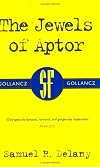
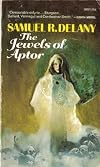
When Argo, the White Goddess, orders it, Geo, the itinerant poet, and his three disparate companions journey to the island of Aptor to seize a jewel from the dark god, Hama, and return it to Argo so that she may defeat the malign forces ranged against her and the land of Leptar. But, as the four press deep into the enigmatic heart of Aptor and the easy distinctions between good and evil blur, their mission no longer seems so straightforward. For Argo already controls two of the precious show more stones, and possession of the third would make her power absolute. And the four friends have learned that power corrupts and absolute power corrupts absolutely... show lessTags
Recommendations






























Member Reviews
(Caveat: I couldn't finish this book. I made it to page 87 of an Ace edition in what appears to be a 70s reprint).
I picked this up from a second-hand shop thinking I've never read a Delany novel I didn't like. Well now I've found one. The first twenty pages or so are quite promising and built up some expectations, but it has taken me over two weeks to plod through nearly 90 pages. I know it's his first novel and I was willing to cut him some slack. But, honestly, it's just awful.
The book seems more in the vein of the "sword and sorcery" genre than what one usually expects from Delany. It's not a surprise that he didn't stick with this style for very long because in my opinion (again, based solely on 87 pages of this first novel) he was show more not very good at it. However, I am not familiar with any other work spanning 1962-65: the earliest I've gone is Babel-17, which is fantastic. What a difference three years made. It has some of the same flavor of a grand adventure story but with a lot more going on to keep you interested. This novel has made me think that perhaps certain kinds of "adventure stories" are better when you are younger. But I'm not so sure. I had similar - but much less pronounced - reactions to reading Fritz Lieber's "Fafnir and the Grey Mouser" books at age 39, but I made it through three of those and enjoyed myself for a least a good portion of that time. "Aptor" has made me think about the kind of function that pulp sci-fi and fantasy books performed for readers in the 60s and 70s, and how that same function is now being filled by other kinds of storytelling like role-playing games. Much of the "adventure and hi-jinx" in The Jewels of Aptor, with its horrible dialogue and impoverished descriptions, is on a level with the worst of any random Forgotten Realms contract writer, and I feel like I'm reading some random Dungeon Master's narrative hand-scribbled on notebook paper and not an actual novel by someone I consider a luminary of science fiction. My eyes start to gloss over, I realize I haven't really been conscious for most of the last page or two that I've read, and I begin to wonder why I am reading an awful novel when there are so many good ones out there I have yet to discover. Including a solid handful of titles by Delany that I'm still looking forward to reading. Perhaps I'll pick one of those next to wash the taste of this from my palette.
I am putting this down right around the part where he seems to have decided to rewrite the script from The Blob. Perhaps I will pick it up at some future date, but I'll have to get a copy from the library because I am putting this in my "to donate to charity" pile. Maybe when someone makes Jewels of Aptor into a tabletop campaign setting or a CRPG, I'll play it, but as a novel this just seems to tank on so many levels. show less
I picked this up from a second-hand shop thinking I've never read a Delany novel I didn't like. Well now I've found one. The first twenty pages or so are quite promising and built up some expectations, but it has taken me over two weeks to plod through nearly 90 pages. I know it's his first novel and I was willing to cut him some slack. But, honestly, it's just awful.
The book seems more in the vein of the "sword and sorcery" genre than what one usually expects from Delany. It's not a surprise that he didn't stick with this style for very long because in my opinion (again, based solely on 87 pages of this first novel) he was show more not very good at it. However, I am not familiar with any other work spanning 1962-65: the earliest I've gone is Babel-17, which is fantastic. What a difference three years made. It has some of the same flavor of a grand adventure story but with a lot more going on to keep you interested. This novel has made me think that perhaps certain kinds of "adventure stories" are better when you are younger. But I'm not so sure. I had similar - but much less pronounced - reactions to reading Fritz Lieber's "Fafnir and the Grey Mouser" books at age 39, but I made it through three of those and enjoyed myself for a least a good portion of that time. "Aptor" has made me think about the kind of function that pulp sci-fi and fantasy books performed for readers in the 60s and 70s, and how that same function is now being filled by other kinds of storytelling like role-playing games. Much of the "adventure and hi-jinx" in The Jewels of Aptor, with its horrible dialogue and impoverished descriptions, is on a level with the worst of any random Forgotten Realms contract writer, and I feel like I'm reading some random Dungeon Master's narrative hand-scribbled on notebook paper and not an actual novel by someone I consider a luminary of science fiction. My eyes start to gloss over, I realize I haven't really been conscious for most of the last page or two that I've read, and I begin to wonder why I am reading an awful novel when there are so many good ones out there I have yet to discover. Including a solid handful of titles by Delany that I'm still looking forward to reading. Perhaps I'll pick one of those next to wash the taste of this from my palette.
I am putting this down right around the part where he seems to have decided to rewrite the script from The Blob. Perhaps I will pick it up at some future date, but I'll have to get a copy from the library because I am putting this in my "to donate to charity" pile. Maybe when someone makes Jewels of Aptor into a tabletop campaign setting or a CRPG, I'll play it, but as a novel this just seems to tank on so many levels. show less
There's a weird style to a lot of 60s science fiction & fantasy, and this one's got it; maybe it even started it for all I know. It's a blend of psychedelia and philosophy and whimsy that seems really dated to me. I also feel this in Confederacy of Dunces, which was written in 1963, so I guess it was just the way things were then.
Delany's first published novel is short, fun, and highly imaginative. The Jewels of Aptor is a much less challenging read than some of his later novels, (Dhalgren, The Einstein Intersection, etc), but it does contain portents of stylistic things to come. The plot is a bit on the naive side as our heroes blindly blunder along being guided by larger forces - most of which are gratingly benign - but it's still a rollicking good adventure yarn featuring some truly unique ideas and characters.
I know I’ve read this before – I’ve certainly had the Sphere paperback edition pictured for several decades – so it was probably back in the late 1970s or early 1980s. And having now reread The Jewels of Aptor, nothing pinged any memories. Oh well. A poet and a sailor sign aboard an expedition to rescue the Goddess Argo’s sister from Aptor, a distant continent of horrors and monsters. They are joined by a four-armed boy who is telepathic. Once Geo and Orson and Snake have explored some of Aptor, it’s clear the continent was once technological and suffered an unspecified “atomic” disaster. Quite how this exists alongside a mediaeval style civilisation on Leptor, which is where Geo, Orson and the Goddess Argo are from, is show more never explained. Perversely, if the book has a flaw, it’s that it has too many explanations. Whenever something happens, Geo and Orson speculate on what it might mean, or what is being planned. Most of the time they’re wrong; most of the time, it reads more like the author is trying to figure out the plot. But for a work by a nineteen-year-old, this is a better novel than by some current authors twice Delany’s age when he wrote it. Yes, it’s an early work, and the plotting is a bit hit and miss, but the beginnings of the language are there, as is the singular approach to the genre. When I think about what Delany has written over the years… He was a genre stalwart and award winner but has since moved out to the edges of genre, and yet has continued to be one of the real innovators in science fiction, both as a writer and a critic, and more people in genre should pay attention to him. show less
Samuel Delany is in my top 5 favorite SF writers - & there's much more to him than that. He might've been around 19 when he wrote this so it's pretty damned precocious but his later writing's so much 'better' that I have to acknowledge this as somewhat 'immature'. Brilliant, but obviously written by someone who has a long way to go. Delany's one of those people who sets just about anybody's stereotypes on their heads by being such a free thinking, strong minded individualist.
I remember reading something by him where he discussed liking a Robert Heinlein novel b/c the protaganist isn't revealed as 'black' until very late in the bk - in a casual mention so casual that it establishes this particular fictional future as having gotten past show more the endless racism that our own time period is so sickeningly mired in. This, as I recall, stimulated his interest in writing SF. & Delany's bks address political issues of race & class & sexuality w/in fictional contexts in ways that few other people have ever had the inspiration to do. Or, at least, didn't until more recently than Delany did. More about that later. I'll probably read everything by him someday & I even recommend reading this one just for thoroughness's sake. Delany's worth it even at his 'worst' - b/c his 'worst' is far more intensely thoughftul than many, many writers' 'best'. show less
I remember reading something by him where he discussed liking a Robert Heinlein novel b/c the protaganist isn't revealed as 'black' until very late in the bk - in a casual mention so casual that it establishes this particular fictional future as having gotten past show more the endless racism that our own time period is so sickeningly mired in. This, as I recall, stimulated his interest in writing SF. & Delany's bks address political issues of race & class & sexuality w/in fictional contexts in ways that few other people have ever had the inspiration to do. Or, at least, didn't until more recently than Delany did. More about that later. I'll probably read everything by him someday & I even recommend reading this one just for thoroughness's sake. Delany's worth it even at his 'worst' - b/c his 'worst' is far more intensely thoughftul than many, many writers' 'best'. show less
As his debut, this novel is not as polished or philosophical as Delany's later material. However, as a fairly straightforward quest fantasy, it's great. Even his debut shows off Delany's fantastic narrative voice, and the plot is great, albeit a tad predictable. It's definitely not a book I would recommend as someone's first Delany, but if you've enjoyed other books by him, it's worth the read!
First line: "Afterwards, she was taken down to the sea."
I decided to actually start reading some of my collection of pulp novels (which I mostly collect for the covers).
I didn't realize this was his first novel, but it makes sense--he certainly came a long way in the 22 years between this one (1962) and [b:Stars in My Pocket Like Grains of Sand|85861|Stars in My Pocket Like Grains of Sand|Samuel R. Delany|http://photo.goodreads.com/books/1171062756s/85861.jpg|945568] (1984).
The tone of the story is kind of a combination of [a:H. Rider Haggard|13399|H. Rider Haggard|http://photo.goodreads.com/authors/1183145651p2/13399.jpg] and [b:Motel of the Mysteries|108831|Motel of the Mysteries|David show more Macaulay|http://photo.goodreads.com/books/1171591770s/108831.jpg|737733]: part gruesome adventure story and part archaeology of the present in the far future. It seems to be meant as a cautionary tale about nuclear war as well as organized religion.
It has a lot of the usual "Golden Age of SF" problems--the As You Know Bob exposition, characters that are mainly placeholders, rather awkward writing, etc. But you can still see the awesome Delaney of the future here, mainly in the totally cracked-out weirdness, and also in the surprisingly cool female characters, especially for being written in 1962.
Unfortunately, it ends up being fairly boring. I wouldn't really recommend it--it's more interesting as an artifact than as an actual book. show less
I decided to actually start reading some of my collection of pulp novels (which I mostly collect for the covers).
I didn't realize this was his first novel, but it makes sense--he certainly came a long way in the 22 years between this one (1962) and [b:Stars in My Pocket Like Grains of Sand|85861|Stars in My Pocket Like Grains of Sand|Samuel R. Delany|http://photo.goodreads.com/books/1171062756s/85861.jpg|945568] (1984).
The tone of the story is kind of a combination of [a:H. Rider Haggard|13399|H. Rider Haggard|http://photo.goodreads.com/authors/1183145651p2/13399.jpg] and [b:Motel of the Mysteries|108831|Motel of the Mysteries|David show more Macaulay|http://photo.goodreads.com/books/1171591770s/108831.jpg|737733]: part gruesome adventure story and part archaeology of the present in the far future. It seems to be meant as a cautionary tale about nuclear war as well as organized religion.
It has a lot of the usual "Golden Age of SF" problems--the As You Know Bob exposition, characters that are mainly placeholders, rather awkward writing, etc. But you can still see the awesome Delaney of the future here, mainly in the totally cracked-out weirdness, and also in the surprisingly cool female characters, especially for being written in 1962.
Unfortunately, it ends up being fairly boring. I wouldn't really recommend it--it's more interesting as an artifact than as an actual book. show less
Members
- Recently Added By
Lists

First Novels
373 works; 17 members

Pre-1969 LGBTQ Literature
182 works; 69 members
Author Information

196+ Works 28,812 Members
Samuel R. Delany Jr. was born in Harlem, New York on April 1, 1942. He is a science fiction and short story writer. His first novel, The Jewels of Aptor, was published in 1962. He has written more than 20 novels and collections of short stories, memoirs, and critical essays. He has received numerous awards including the Nebula Award for best novel show more for Babel-17 in 1966 and The Einstein Intersection in 1967, the Nebula Award for best short story for Aye, and Gomorrah and Time Considered as a Helix of Semi-Precious Stones, the Hugo Award for best short story for Time Considered as a Helix of Semi-Precious Stones in 1970 and for his non-fiction book, The Motion of Light in Water, and the Bill Whitehead Award for Lifetime Achievement in Gay Literature in 1993. He is as a professor in the department of English at the University at Buffalo, Buffalo, New York. (Bowker Author Biography) Samuel R. Delany is a professor of English & Creative Writing at Temple University in Philadelphia. (Publisher Provided) show less
Some Editions
Series
Belongs to Publisher Series
Work Relationships
Is contained in
Common Knowledge
- Original publication date
- 1962
- People/Characters
- Geo
- First words
- Waves flung themselves at the evening.
- Last words
- (Click to show. Warning: May contain spoilers.)She stepped back, fists proudly on her hips. "Just look at that thing go!"
Classifications
Statistics
- Members
- 746
- Popularity
- 37,498
- Reviews
- 14
- Rating
- (3.05)
- Languages
- 5 — English, Hebrew, Italian, Japanese, Spanish
- Media
- Paper, Audiobook, Ebook
- ISBNs
- 23
- UPCs
- 1
- ASINs
- 38