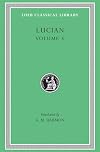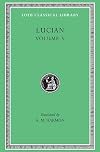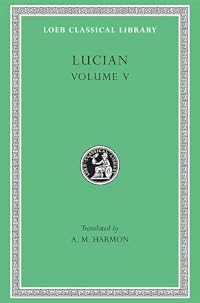
Lucian: Volume V (Loeb Classical Library 302)
by Lucian
On This Page
Description
Lucian (ca. 120-190 CE), the satirist from Samosata on the Euphrates, started as an apprentice sculptor, turned to rhetoric and visited Italy and Gaul as a successful travelling lecturer, before settling in Athens and developing his original brand of satire. Late in life he fell on hard times and accepted an official post in Egypt. Although notable for the Attic purity and elegance of his Greek and his literary versatility, Lucian is chiefly famed for the lively, cynical wit of the humorous show more dialogues in which he satirises human folly, superstition and hypocrisy. His aim was to amuse rather than to instruct. Among his best works are A True Story (the tallest of tall stories about a voyage to the moon), Dialogues of the Gods (a 'reductio ad absurdum' of traditional mythology), Dialogues of the Dead (on the vanity of human wishes), Philosophies for Sale (great philosophers of the past are auctioned off as slaves), The Fisherman (the degeneracy of modern philosophers), The Carousal or Symposium (philosophers misbehave at a party), Timon (the problems of being rich), Twice Accused (Lucian's defence of his literary career) and (if by Lucian) The Ass (the amusing adventures of a man who is turned into an ass). The Loeb Classical Library edition of Lucian is in eight volumes. show lessTags
Recommendations

Member Reviews
Lucian of Samosata (Ancient Greek: Λουκιανὸς ὁ Σαμοσατεύς, Latin: Lucianus Samosatensis; c. AD 125 – after AD 180) was a rhetorician[1] and satirist who wrote in the Greek language. He is noted for his witty and scoffing nature. Although he wrote solely in Greek, he was ethnically Assyrian.[2][3][4]
Lucian also wrote a satire called The Passing of Peregrinus,[12] in which the lead character, Peregrinus Proteus, takes advantage of the generosity and gullibility of Christians. This is one of the earliest surviving pagan perceptions of Christianity. His Philopseudes (Φιλοψευδὴς ἤ Ἀπιστῶν, "Lover of Lies or Cheater") is a frame story which includes the original version of The Sorcerer's show more Apprentice.
Cf. http://en.wikipedia.org/wiki/Lucian show less
Lucian also wrote a satire called The Passing of Peregrinus,[12] in which the lead character, Peregrinus Proteus, takes advantage of the generosity and gullibility of Christians. This is one of the earliest surviving pagan perceptions of Christianity. His Philopseudes (Φιλοψευδὴς ἤ Ἀπιστῶν, "Lover of Lies or Cheater") is a frame story which includes the original version of The Sorcerer's show more Apprentice.
Cf. http://en.wikipedia.org/wiki/Lucian show less
Members
- Recently Added By
Author Information

502+ Works 3,875 Members
Lucian, the wit and satirist, was a brilliant Greek writer in the time of the Roman Empire. He was born in Samosata, Syria. He traveled and lectured in Italy, Asia Minor, and Gaul; and in later life, held a government position in Egypt. Of nearly 80 works, the most important and characteristic are his essays written in dialogue form. "Dialogues of show more the Gods," which satirizes mythology; "Dialogues of the Dead," which are expositions of human vanity; and "The Sale of Lives," which satirizes various schools of philosophy. He is a good critical source for ancient art and for information about his literary contemporaries. "The True History," a nonsense fantasy and parody of adventure stories, influenced Rabelais, Swift 1), and Voltaire. (Bowker Author Biography) show less
All Editions
Series
Belongs to Publisher Series
Loeb Classical Library (302)
Common Knowledge
- Canonical title
- Lucian: Volume V (Loeb Classical Library 302) (Loeb Classical Library 302)
Classifications
Statistics
- Members
- 67
- Popularity
- 463,963
- Reviews
- 1
- Rating
- (4.00)
- Languages
- English, Greek (Ancient)
- Media
- Paper, Ebook
- ISBNs
- 5
- ASINs
- 3