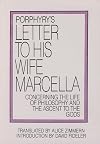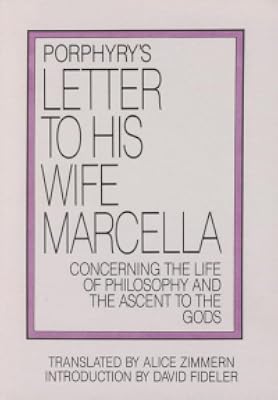
Porphyry's Letter to His Wife: Concerning the Life of Philosophy and the Ascent to the Gods
by Porfirio
On This Page
Description
With an introduction to the life of Porphyry and an overview of Neoplatonic thought by David Fideler.Tags
Recommendations








Member Reviews
I didn't find this work all that interesting. Firstly, Thomas Taylor, in his Select Works of Porphyry, noted several cases of Porphyry simply quoting from the Sentences of Sextus and the Sentences of Demophilus in this supposedly personal letter. Secondly, and on top of that, this polemicist towards Christianity didn't mind shamefully and unabashedly stealing ideas and terms from the religion he was a noted opponent of. You can search in vain in Plato's writings for terms like faith, hope and love, and you won't find them. Plato did talk about love as the Greek "eros", but it is very different than Christian notions of love (i.e. as phileo and agape) and he never tied eros to faith (pistis) and hope (elpis). You will also search in vain show more for that trinity of terms in Hellenistic pagan literature. Porphyry could have only got it from one source. He also speaks of "evil spirits" in here; such an idea cannot be supported in Neo-Platonist theology; indeed, it's inadequate approach to evil is one of my criticisms of Neo-Platonism.
I wouldn't care that Porphyry plagiarized in a period when that was acceptable, but given his reputation as a pioneer of textual criticism, I can only consider him to be a bit of a hypocrite. He criticized Origen for borrowing from Plato whilst being a Christian, but I guess he thought the same rule shouldn't be applied to him with regards to Christianity.
Porphyry was considered to be an important Neo-Platonist. If it was to be gauged on this work solely, I could only find that appraisal puzzling. Of course, most of his works are no longer extant, so it would be unfair to reach any absolute conclusions as to his philosophical merits based only on what remains, but I have no problem judging what's left to judge. He has to be given credit for collecting and publishing Plotinus' writings at least, but his own merits are so far indeterminate. show less
I wouldn't care that Porphyry plagiarized in a period when that was acceptable, but given his reputation as a pioneer of textual criticism, I can only consider him to be a bit of a hypocrite. He criticized Origen for borrowing from Plato whilst being a Christian, but I guess he thought the same rule shouldn't be applied to him with regards to Christianity.
Porphyry was considered to be an important Neo-Platonist. If it was to be gauged on this work solely, I could only find that appraisal puzzling. Of course, most of his works are no longer extant, so it would be unfair to reach any absolute conclusions as to his philosophical merits based only on what remains, but I have no problem judging what's left to judge. He has to be given credit for collecting and publishing Plotinus' writings at least, but his own merits are so far indeterminate. show less
Ratings
Members
- Recently Added By
Author Information

77+ Works 557 Members
Common Knowledge
- Original publication date
- 1816; 1896
Classifications
Statistics
- Members
- 40
- Popularity
- 732,811
- Reviews
- 1
- Rating
- (2.00)
- Languages
- English, French
- Media
- Paper
- ISBNs
- 5
- ASINs
- 1