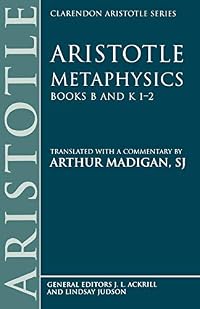
Metaphysics: Books B and K 1-2 (Clarendon Aristotle Series)
by Aristotle (Author), Aristotle (Author)
22 Members (5.00)
On This Page
Description
Arthur Madigan presents a clear, accurate new translation of the third book (Beta) of Aristotle's Metaphysics, together with two related chapters from the eleventh book (Kappa). Madigan's accompanying introduction and commentary give detailed guidance to these texts, in which Aristotle setsout what he takes to be the main problems of metaphysics or 'first philosophy' and assesses possible solutions to them; he takes his starting-point from the work of earlier philosophers, especially Plato show more and some of the Presocratics. These texts serve as a useful introduction both to Aristotle's ownwork on metaphysics and to classical metaphysics in general; they are also a good example of Aristotle's dialectical method, which reasons not from known truths but from reputable opinions. show lessTags
Recommendations

























Member Reviews
Members
- Recently Added By
Author Information
Aristotle, 384 B.C. - 322 B. C. Aristotle was born at Stagira, in Macedonia, in 384 B.C. At the age of 17, he went to Athens to study at Plato's Academy, where he remained for about 20 years, as a student and then as a teacher. When Plato died in 347 B.C., Aristotle moved to Assos, a city in Asia Minor, where a friend of his, Hermias, was ruler. show more After Hermias was captured and executed by the Persians in 345 B.C., Aristotle went to Pella, the Macedonian capital, where he became the tutor of the king's young son Alexander, later known as Alexander the Great. In 335, when Alexander became king, Aristotle returned to Athens and established his own school, the Lyceum Aristotle's works were lost in the West after the decline of Rome, but during the 9th Century A.D., Arab scholars introduced Aristotle, in Arabic translation, to the Islamic world. In the 13th Century, the Latin West renewed its interest in Aristotle's work, and Saint Thomas Aquinas found in it a philosophical foundation for Christian thought. The influence of Aristotle's philosophy has been pervasive; it has even helped to shape modern language and common sense. Aristotle died in 322 B.C. (Bowker Author Biography) show less

Series
Belongs to Publisher Series
Common Knowledge
- Disambiguation notice
- This is a translation and commentary in the Clarendon Aristotle Series. Please do not combine with any other edition of this work.
Classifications
Statistics
- Members
- 22
- Popularity
- 1,184,824
- Rating
- (5.00)
- Languages
- English
- Media
- Paper
- ISBNs
- 2