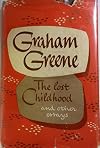
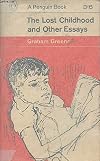
The Lost Childhood and Other Essays
by Graham Greene 
150 Members (3.86)
On This Page
Description
From Dickens to Wilde-literary criticism and personal reflections by a master "unmatched... in his uncanny psychological insights" ( The New York Times ). Graham Greene shares his love affair with reading in this collection of essays, memories, and critical considerations, both affectionate and tart, "[that] could have come from no other source than the author of Brighton Rock and The Power and the Glory " ( The Scotsman ). Whether following the obsessions of Henry James, marveling at the show more "indispensible" Beatrix Potter, or exploring the Manichean world of Oliver Twist, Graham Greene revisits the books and authors of his lifetime. Here is Greene on Fielding, Doyle, Kipling, and Conrad; on The Prisoner of Zenda and the "revolutionary... colossal egoism" of Laurence Stern's epic comic novel, Tristram Shandy; on the adventures of both Allan Quatermain and Moll Flanders; and more. Greene strolls among the musty oddities and folios sold on the cheap at an outdoor book mart, tells of a bizarre literary hoax perpetrated on a hapless printseller in eighteenth-century Pall Mall, and in the titular essay, reveals the book that unlocked his imagination so thoroughly that he decided to write forever. For Greene, "all the other possible futures slid away." In this prismatic gallery of profound influences and guiltless pleasures, Greene proves himself "so intensely alive that the reader cannot but respond to the dazzling combination of intelligence and strong feeling" (Edward Sackville West). show lessTags
Recommendations
















Member Reviews
Members
- Recently Added By
Published Reviews
In almost all of the twenty-three brief studies in "The Lost Childhood," whether it is criticism of a specific novel, such as "The Woman Who Was Poor" of Leon Bloy, or a character sketch such as the one on the sculptor Eric Gill, Greene is primarily concerned, in his role of critic, with discovering what he calls the "obsession" of his author -- the one theme -- and with illuminating the show more entire work by an analysis of the obsession. He sees every creative writer who has made any real achievement, as a victim, as a man victimized by an obsession. This is a difficult formula for a critic to follow but which, in the case of Graham Greene, is particularly rewarding. show less
added by John_Vaughan
The Lost Childhood and Other Essays is a collection of 46 essays, a few of which I had read elsewhere - such as The Lost Childhood with its account of Graham Greene's suddenly awakened interest in writing at the age of 14, an interest induced by reading Marjorie Bowen's The Viper of Milan. And The Revolver in the Corner Cupboard, with its confusingly (mis)stated odds of survival, in which he show more tells a terrible tale of his efforts to escape boredom during his late teens by playing at Russian roulette with his brother's revolver. Continued show less
added by apenguinaweek
Author Information

356+ Works 87,436 Members
Born in 1904, Graham Greene was the son of a headmaster and the fourth of six children. Preferring to stay home and read rather than endure the teasing at school that was a by-product of his father's occupation, Greene attempted suicide several times and eventually dropped out of school at the age of 15. His parents sent him to an analyst in show more London who recommended he try writing as therapy. He completed his first novel by the time he graduated from college in 1925. Greene wrote both entertainments and serious novels. Catholicism was a recurring theme in his work, notable examples being The Power and the Glory (1940) and The End of the Affair (1951). Popular suspense novels include: The Heart of the Matter, Our Man in Havana and The Quiet American. Greene was also a world traveler and he used his experiences as the basis for many books. One popular example, Journey Without Maps (1936), was based on a trip through the jungles of Liberia. Greene also wrote and adapted screenplays, including that of the 1949 film, The Third Man, which starred Orson Welles. He died in Vevey, Switzerland in 1991. (Bowker Author Biography) show less
Graham Greene has a Legacy Library. Legacy libraries are the personal libraries of famous readers, entered by LibraryThing members from the Legacy Libraries group.
Common Knowledge
- Canonical title*
- The Lost Childhoods and Other Essays
- Original publication date
- 1951
*Some information comes from Common Knowledge in other languages. Click "Edit" for more information.
Classifications
Statistics
- Members
- 150
- Popularity
- 218,247
- Rating
- (3.86)
- Languages
- Dutch, English, Spanish
- Media
- Paper, Ebook
- ISBNs
- 5
- ASINs
- 14