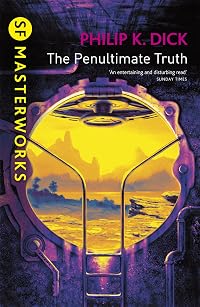
The Penultimate Truth
by Philip K. Dick
On This Page
Description
In a future in which the earth has been ravaged and cities are burnt-out wastelands too dangerous for human life, Americans have all been shipped underground, where they toil in crowded industrial ant hills and receive a steady diet of inspiring speeches from a President who never seems to age. Nick St. James, like the rest of the masses, believed in the words of his leaders, but that all changes when he travels to the surface. What what he finds there is more shocking than anything he could show more possibly imagine. show lessTags
Recommendations









Member Reviews
Holy Mother Lug Nuts, how did this one escape my notice for so long? And I such a Dickhead that I've even enjoyed Clans of the Alphane Moon? But so it goes: of the handful of Philip K. Dick novels that are/were still on the eternal to-be-read pile, The Penultimate Truth was one for a long, long time. I guess this was partly because I'd assumed I'd read all of his A material and most of his B and all that was left was, well, not either of these.
Shows what I know. Thank goodness for my pal EssJay (who else?), who broadcast her great love for this all-but-forgotten work earlier this year. In her opinion, it should have been a bestseller.
And speaking of EssJay and Philip K. Dick, if you happen to be someone who hasn't read any of my show more all-time hero's work and are wondering where to start, she went so far as to make a PKD newbie decision tree. And really, even if you're not a newbie, you should go admire. You might even find it useful in helping a friend figure out if PKD is right for them!
Of course, I'm one of those fantatics who thinks PKD is right for everybody, so, well, caveat lector for the rest of this blog post. Because it's not just going to be about this book. No.
Several years ago, I had a dream, a dream so marvelous that I actually cried on waking up and realizing it had all been a dream (even though my dream self had spent a lot of the dream questioning how it could possibly be real). In it, I had found in my father's garage of all places, a big wooden crate brimful of those trade paperback editions of PKD's novels that Del Rey was releasing in the 90s. Among all the beloved familiar titles were some I'd never heard of before. As in they didn't exist. At least not in our world. I'm talking dozens of new-to-me, new-to-everyone, full-on PKD novels. I couldn't decide what to read first. I couldn't carry them all. I couldn't figure out how they'd gotten there, because my dad doesn't do science fiction, nor did my grandfather (most of whose crap is what posthumously clutters that garage). And there was no one with which to share my discovery, my joy, and obviously it was meant to be that way.
Then I woke up. To sadness. So much sadness.
Anyway, I bring this up because I realized, as I was raving to EssJay about it, that The Penultimate Truth feels like one of those books from my dream. How is this book not more famous? It's kind of the bridge book between his conventional* science fiction and his batshit looney tunes theo-philosophical druggie cuckoo stuff. Read closely. You can almost watch the artistically refined madness taking hold of him, in, for instance, the plot the Yancemen (think of them as the 1%, who managed to provoke World War III and then duped the entire surviving population of both sides into evacuating into vast underground "ant tanks" to live and work at an ever-accelerating pace building more weaponry because the Yancemen have also duped everyone else into believing that the War Never Ended) cook up against one of their number, to get him out of the way forever, according to their law: said plot involving fabricating ancient artifacts and alien skulls, salting a building site with them, and letting him get busted for not reporting a discovery that would put a halt to his building project. Dude. The Yancemen are pretty close to all-powerful. They could pretty much just disappear this Runcible guy. But no.
Awesome.
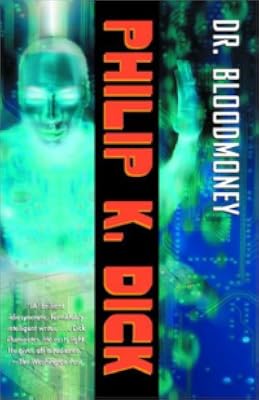
And yet agonizing, too. The Penultimate Truth is also one of the most conscience-burdened of PKD's novels, if not the most, more so even than Dr. Bloodmoney, for Bloodmoney is just concerned with the agenbite of one man's inwit. This one features a whole society of Yancemen whose sole and circular pursuit in life is keeping 99%** of humanity from discovering their hoax -- and working at an ever more frenzied pace to build the robotic "leadies" the tankers believe are going to the war effort but are really going to fill the entourages and private armies of the Yancemen. And most of these Yancemen are at least a little uneqsy about their part in this monstrous deception, although none of them seem to have the courage to do anything to address the wrongs from which they benefit. Pangs of conscience never overcome complacency -- or fear, with fear being perhaps the stronger obstacle/opponent, fear of reprisals from betrayed fellow Yancemen and fear of "another war" if the 99% ever emerge from the ant tanks and learn the terrible truth -- in PKD.
Or almost never. Because someone is acting in sneaky ways for the benefit of the 99%, adding delicious mystery, and another layer of paranoia, to the plot.
"Not much of a way... of inheriting the Earth. Maybe we haven't been meek enough." That one little line of dialogue neatly sums up the whole book. It could be spoken among either the Yancemen or the tankers. You'll have to read the book to find out who says it. And you'll remember that I quoted it here, and you'll feel what EssJay calls the "Dick Click" -- that frisson of understanding you get when all the weird crap PKD has been throwing at you finally starts to make a kind of sense, though I think the real Dick Click in this novel is a few chapters after this exchange.
At any rate, for this PKD fan who is also a big fan of hoaxes and hoaxers, this book was pretty much a pipeful of crack. As my bit about my PKD book dream I mentioned a few paragraphs ago might indicate, I'm kind of trying to ration what new-to-me PKD remains. After this, though, my resolve is kind of crumbling.
*Well, conventional for him, anyway.
**Dick never uses these figures, but the dystopia he has created for The Penultimate Truth so perfectly fits our current situation and rhetoric that it's impossible not to use them, just as its impossible not to think of the robotic "leadies" the tankers keep building as our modern drone weaponry, at least in part. PKD was a freaking precog, yo. show less
Shows what I know. Thank goodness for my pal EssJay (who else?), who broadcast her great love for this all-but-forgotten work earlier this year. In her opinion, it should have been a bestseller.
And speaking of EssJay and Philip K. Dick, if you happen to be someone who hasn't read any of my show more all-time hero's work and are wondering where to start, she went so far as to make a PKD newbie decision tree. And really, even if you're not a newbie, you should go admire. You might even find it useful in helping a friend figure out if PKD is right for them!
Of course, I'm one of those fantatics who thinks PKD is right for everybody, so, well, caveat lector for the rest of this blog post. Because it's not just going to be about this book. No.
Several years ago, I had a dream, a dream so marvelous that I actually cried on waking up and realizing it had all been a dream (even though my dream self had spent a lot of the dream questioning how it could possibly be real). In it, I had found in my father's garage of all places, a big wooden crate brimful of those trade paperback editions of PKD's novels that Del Rey was releasing in the 90s. Among all the beloved familiar titles were some I'd never heard of before. As in they didn't exist. At least not in our world. I'm talking dozens of new-to-me, new-to-everyone, full-on PKD novels. I couldn't decide what to read first. I couldn't carry them all. I couldn't figure out how they'd gotten there, because my dad doesn't do science fiction, nor did my grandfather (most of whose crap is what posthumously clutters that garage). And there was no one with which to share my discovery, my joy, and obviously it was meant to be that way.
Then I woke up. To sadness. So much sadness.
Anyway, I bring this up because I realized, as I was raving to EssJay about it, that The Penultimate Truth feels like one of those books from my dream. How is this book not more famous? It's kind of the bridge book between his conventional* science fiction and his batshit looney tunes theo-philosophical druggie cuckoo stuff. Read closely. You can almost watch the artistically refined madness taking hold of him, in, for instance, the plot the Yancemen (think of them as the 1%, who managed to provoke World War III and then duped the entire surviving population of both sides into evacuating into vast underground "ant tanks" to live and work at an ever-accelerating pace building more weaponry because the Yancemen have also duped everyone else into believing that the War Never Ended) cook up against one of their number, to get him out of the way forever, according to their law: said plot involving fabricating ancient artifacts and alien skulls, salting a building site with them, and letting him get busted for not reporting a discovery that would put a halt to his building project. Dude. The Yancemen are pretty close to all-powerful. They could pretty much just disappear this Runcible guy. But no.
Awesome.
And yet agonizing, too. The Penultimate Truth is also one of the most conscience-burdened of PKD's novels, if not the most, more so even than Dr. Bloodmoney, for Bloodmoney is just concerned with the agenbite of one man's inwit. This one features a whole society of Yancemen whose sole and circular pursuit in life is keeping 99%** of humanity from discovering their hoax -- and working at an ever more frenzied pace to build the robotic "leadies" the tankers believe are going to the war effort but are really going to fill the entourages and private armies of the Yancemen. And most of these Yancemen are at least a little uneqsy about their part in this monstrous deception, although none of them seem to have the courage to do anything to address the wrongs from which they benefit. Pangs of conscience never overcome complacency -- or fear, with fear being perhaps the stronger obstacle/opponent, fear of reprisals from betrayed fellow Yancemen and fear of "another war" if the 99% ever emerge from the ant tanks and learn the terrible truth -- in PKD.
Or almost never. Because someone is acting in sneaky ways for the benefit of the 99%, adding delicious mystery, and another layer of paranoia, to the plot.
"Not much of a way... of inheriting the Earth. Maybe we haven't been meek enough." That one little line of dialogue neatly sums up the whole book. It could be spoken among either the Yancemen or the tankers. You'll have to read the book to find out who says it. And you'll remember that I quoted it here, and you'll feel what EssJay calls the "Dick Click" -- that frisson of understanding you get when all the weird crap PKD has been throwing at you finally starts to make a kind of sense, though I think the real Dick Click in this novel is a few chapters after this exchange.
At any rate, for this PKD fan who is also a big fan of hoaxes and hoaxers, this book was pretty much a pipeful of crack. As my bit about my PKD book dream I mentioned a few paragraphs ago might indicate, I'm kind of trying to ration what new-to-me PKD remains. After this, though, my resolve is kind of crumbling.
*Well, conventional for him, anyway.
**Dick never uses these figures, but the dystopia he has created for The Penultimate Truth so perfectly fits our current situation and rhetoric that it's impossible not to use them, just as its impossible not to think of the robotic "leadies" the tankers keep building as our modern drone weaponry, at least in part. PKD was a freaking precog, yo. show less
Originally published in 1964 and now part of the S.F. Masterwork series. Typical of Philip K Dick's conception of plot and format the reader is immediately plunged headlong into the story. Terms and acronyms are used which are explained later and I felt deliriously all at sea for the early part
of this novel, but the fog gradually cleared and I settled down to an interesting and imaginative read.
The story opens with Joseph Adams sat in front of his rhetoriezor (some sort of high powered computer) and he trying to write a speech for the ruler of planet earth. He lives in a vast mansion and is served by a host of leadies (robots). His friend Colleen has flapped over from her villa and they joke about words he can use. There has been a show more third world war. The story then switches to the tankmen who live below the surface of the earth in an industrial community called Tom Mix and they are in crisis. They are tasked with making the leadies and are unable to fulfil their quota because their chief mechanic is terminally ill and is on life support. Nicholas St James is forced to burrow up to the surface in order to buy an essential replacement organ for the mechanic on the black market. His chances of success are thin because radiation levels have devastated life on the surface and killer robots patrol the land.
Joseph Adams is one of the elite surface dwellers: survivors of the war who are looking to expand their considerable holdings. Radiation levels are now survivable in many areas and vegetation is making a comeback. The tankmen are fed a diet of propaganda to keep them ignorant of life on the surface. What will happen if the tankmen learn the truth?
A theme that now seems baked into our culture of an elite group who dominate and exploit those less fortunate has been a popular trope of science fiction writing. This early example of a situation that is entirely possible on our planet is dealt with in under 200 pages and although world building takes second place to the story it functions well enough. A good example of 1960's science fiction and so 4 stars. show less
of this novel, but the fog gradually cleared and I settled down to an interesting and imaginative read.
The story opens with Joseph Adams sat in front of his rhetoriezor (some sort of high powered computer) and he trying to write a speech for the ruler of planet earth. He lives in a vast mansion and is served by a host of leadies (robots). His friend Colleen has flapped over from her villa and they joke about words he can use. There has been a show more third world war. The story then switches to the tankmen who live below the surface of the earth in an industrial community called Tom Mix and they are in crisis. They are tasked with making the leadies and are unable to fulfil their quota because their chief mechanic is terminally ill and is on life support. Nicholas St James is forced to burrow up to the surface in order to buy an essential replacement organ for the mechanic on the black market. His chances of success are thin because radiation levels have devastated life on the surface and killer robots patrol the land.
Joseph Adams is one of the elite surface dwellers: survivors of the war who are looking to expand their considerable holdings. Radiation levels are now survivable in many areas and vegetation is making a comeback. The tankmen are fed a diet of propaganda to keep them ignorant of life on the surface. What will happen if the tankmen learn the truth?
A theme that now seems baked into our culture of an elite group who dominate and exploit those less fortunate has been a popular trope of science fiction writing. This early example of a situation that is entirely possible on our planet is dealt with in under 200 pages and although world building takes second place to the story it functions well enough. A good example of 1960's science fiction and so 4 stars. show less
Philip K. Dick is one of my favorite authors. And yet, so often, after reading one of his books, I'm really not sure where I've been and where I wound up. This novel has some of that about it, but, like so much of Dick's work, is full of ideas that cause you to pause in wonder. And the final extinguishment of the plot is nowhere near as important as the road traveled to get there.
It is after the war, and most people are being kept underground for their own protection. Well, not really. Actually, the world didn't get destroyed and a lot of people are living a very nice life above ground. Even those who find out the truth lead lives that, while not that great, are better than the ones they had. As so often happens with Dick, nothing is as show more it seems (even the benevolent overlord is a robot).
Two ensuing struggles result. The first as a below ground dweller learns the truth and struggles to get back to let everyone know (and to revive an individual who was an integral part of the society.) The second is the battle between those who are slowly taking over radiated lands to build their own private palaces. Of course they intertwine. And, of course, because this is a Dick novel, the results are not what we expect.
One of the more interesting constructs in the novel is the way a faked documentary works as an important turning point in the progress of the plot. On one level, we learn how this faked documentary – a piece of film that is almost sacrosanct to most people – helped drive people's belief about the war. On another level, the flaws within it are so obvious that one group of protagonists use the flaws to help drive the plot of the novel even deeper.
Two things really drive Dick's fiction – ideas and paranoia. This has both in the appropriate measure. And, as such, it stands well against much of his other work show less
It is after the war, and most people are being kept underground for their own protection. Well, not really. Actually, the world didn't get destroyed and a lot of people are living a very nice life above ground. Even those who find out the truth lead lives that, while not that great, are better than the ones they had. As so often happens with Dick, nothing is as show more it seems (even the benevolent overlord is a robot).
Two ensuing struggles result. The first as a below ground dweller learns the truth and struggles to get back to let everyone know (and to revive an individual who was an integral part of the society.) The second is the battle between those who are slowly taking over radiated lands to build their own private palaces. Of course they intertwine. And, of course, because this is a Dick novel, the results are not what we expect.
One of the more interesting constructs in the novel is the way a faked documentary works as an important turning point in the progress of the plot. On one level, we learn how this faked documentary – a piece of film that is almost sacrosanct to most people – helped drive people's belief about the war. On another level, the flaws within it are so obvious that one group of protagonists use the flaws to help drive the plot of the novel even deeper.
Two things really drive Dick's fiction – ideas and paranoia. This has both in the appropriate measure. And, as such, it stands well against much of his other work show less
Written at the height of the Cold War, not long after the Cuban missile crisis, The Penultimate Truth is, in part, a reflection of general anxieties (in the West, at least) about the likelihood of nuclear war and whether human life would survive the devastating aftermath. The majority of the world's population live underground, in fear of the continuing armageddon they are told is still raging above-ground and of the threat of radiation for anyone who emerges on the Earth's surface. A Big Brother figure, Talbot Yancy, exhorts the multitudes to build more specialist robots to continue the fight above ground, though these are in truth designed to end up furnishing the requirements of an oligarchy which maintains the myth of a continuing show more war.
Many of Philip K Dick's thematic obsessions emerge in this novel (itself an enlargement of short stories written several years previously). These themes include the notion that authenticity may be an illusion, that what we perceive of as true is merely a simulacrum hiding something other. The key figure in the novel is a surviving Native American called Lantano. As with many of Dick's choices of character names the etymology and, thus, meaning is significant. The Ancient Greek lanthano means "to escape notice, to lie hidden", and in the novel Lantano's real identity and abilities indeed lie hidden for some time. In addition, the soft malleable metal lanthanum, which also derives from the same Greek root, not also provides chemical compounds which act as catalysts (exactly Dave Lantano's function) but also changes its structure according to temperature, and this change in appearance and properties is also matched by the mechanism that Dick describes which efficiently assassinates another key character. Nothing is as it at first seems.
The same applies to Talbot Yancy. This seems to be a compound of the name of British writer Talbot Mundy, an early 20th century writer whose stories combined mystical ideas with adventure yarns and reportedly influenced a generation of sf writers, and the surname Yancy, supposedly from an Amerindian word meaning Englishman which gave rise to the name Yankee. These several layers of allusion add even more to the mix from which the reader has to extract the quintessential meanings of The Penultimate Truth.
Typically, this Dick novel is difficult to engage with at first--he delights in puns and specially-created neologisms, literary references, a cast of assorted flawed characters and deliberate disorientations. The sci-fi machines that he envisaged in 1964 for his near-future scenarios (a key date in the story is 1982, ironically the year of Dick's death) are implausible in the extreme (robots with AI, time-travel machines, personal flying machines that operate with no obvious fuel-limitations) but are merely hooks on which to hang his philosophical musings. If resolution is often far from sure by the end of his novels, the fact that our preconceptions have been challenged is reward enough; if characterisation is often minimal and unconvincing it matters more that individuals function as Everyman figures in a morality play and make the reader contemplate real moral dilemmas. The penultimate truth? That's for the reader to ponder; this reader is still pondering it.
http://calmgrove.wordpress.com/2012/06/17/truth/ show less
Many of Philip K Dick's thematic obsessions emerge in this novel (itself an enlargement of short stories written several years previously). These themes include the notion that authenticity may be an illusion, that what we perceive of as true is merely a simulacrum hiding something other. The key figure in the novel is a surviving Native American called Lantano. As with many of Dick's choices of character names the etymology and, thus, meaning is significant. The Ancient Greek lanthano means "to escape notice, to lie hidden", and in the novel Lantano's real identity and abilities indeed lie hidden for some time. In addition, the soft malleable metal lanthanum, which also derives from the same Greek root, not also provides chemical compounds which act as catalysts (exactly Dave Lantano's function) but also changes its structure according to temperature, and this change in appearance and properties is also matched by the mechanism that Dick describes which efficiently assassinates another key character. Nothing is as it at first seems.
The same applies to Talbot Yancy. This seems to be a compound of the name of British writer Talbot Mundy, an early 20th century writer whose stories combined mystical ideas with adventure yarns and reportedly influenced a generation of sf writers, and the surname Yancy, supposedly from an Amerindian word meaning Englishman which gave rise to the name Yankee. These several layers of allusion add even more to the mix from which the reader has to extract the quintessential meanings of The Penultimate Truth.
Typically, this Dick novel is difficult to engage with at first--he delights in puns and specially-created neologisms, literary references, a cast of assorted flawed characters and deliberate disorientations. The sci-fi machines that he envisaged in 1964 for his near-future scenarios (a key date in the story is 1982, ironically the year of Dick's death) are implausible in the extreme (robots with AI, time-travel machines, personal flying machines that operate with no obvious fuel-limitations) but are merely hooks on which to hang his philosophical musings. If resolution is often far from sure by the end of his novels, the fact that our preconceptions have been challenged is reward enough; if characterisation is often minimal and unconvincing it matters more that individuals function as Everyman figures in a morality play and make the reader contemplate real moral dilemmas. The penultimate truth? That's for the reader to ponder; this reader is still pondering it.
http://calmgrove.wordpress.com/2012/06/17/truth/ show less
I love PKD novels, but this one makes a good argument for "less is more" -- it was on track to be great foreshadowing of current reality, but by getting slightly too specific on certain aspects of the plot, rather than leaving ambiguity, it was pigeonholed in one specific case. Still great, but not one of his best books. The end does help recover things, but it easily could have been great.
Essentially the world has a world nuclear war and many people are stuck living in underground cities in horrible conditions providing labor to continue the world, fed information by only a narrow media channel. Things progress from there...
Essentially the world has a world nuclear war and many people are stuck living in underground cities in horrible conditions providing labor to continue the world, fed information by only a narrow media channel. Things progress from there...
This is another dystopian, post-atomic war world Dick writes about and he does so pretty well and in a fairly (and surprisingly) linear fashion. During the war, most of humanity was forced underground to live in "ant tanks," self contained living units with their own presidents, etc. The year is 2025 and everyone has been living underground for 15 years, nightly watching news bulletins about the horrible war taking place on the surface of the earth. They spend their time creating robots called "leadies" to send up to the surface to wage war. What they don't know is, the war has been over for at least 13 years and they're being duped by "Yance men" who are living large with their own mansions and private leadie armies. We're first show more introduced to Nicholas St. James, the president of one of these ant tanks, who tunnels to the surface of the earth, risking his life (he thinks), to find an artificial pancreas for one of his key tank members. Meanwhile, Joseph Adams is a speechwriter for the Agency, responsible for the nightly fake newscasts, and he's working for the 82-year-old world despot, Stanton Brose, who he detests. Brose runs everything. And he's the only one with access to the futuristic weapons cache left over from the war. When St. James comes to the surface, he is shocked to find actual trees and is immediately greeted by two leadies who want to kill him, before they themselves are killed by a mysterious stranger. This stranger turns out to be another speech writer, a fantastic one, with dreams of taking over the world through the aid of time travel. So murders occur, suspicions are raised, plots are hatched, and we have a PKD novel in full swing. This isn't Dick's best novel, but it's not his worst and it is entertaining and a fast read, so I have no problem recommending this book to both Dick fans and regular fans of sci fi and dystopian settings. show less
My first PKD Book, and it was a good one. In some ways, dated, in other ways, very relevant in today's digital world where most information is dispensed through digital means.
In this book we find the president of an ANT Farm (Those tubes that people crammed into at the beginning of WW3)being pushed to fing an artificial pancreas for their mechanic. The story also follows Joseph Adams, a public relations Yance-Man whose job it is to write Speeches for President Yancy. This is all fine and good, except World War III ended 10 years before, and nobody told the people in the ANT farms.
At the front, it seems the story is quite simple. We have a man with an ethical issue. It seems straight out a small man, Big Government sort of story. But, show more its much more than that, with a nod at environmentalism, the will of the masses, and the role of media in how the world is perceived. show less
In this book we find the president of an ANT Farm (Those tubes that people crammed into at the beginning of WW3)being pushed to fing an artificial pancreas for their mechanic. The story also follows Joseph Adams, a public relations Yance-Man whose job it is to write Speeches for President Yancy. This is all fine and good, except World War III ended 10 years before, and nobody told the people in the ANT farms.
At the front, it seems the story is quite simple. We have a man with an ethical issue. It seems straight out a small man, Big Government sort of story. But, show more its much more than that, with a nod at environmentalism, the will of the masses, and the role of media in how the world is perceived. show less
Members
- Recently Added By
Lists

Best Science Fiction Novels
816 works; 430 members

S.F. Masterworks (Complete)
229 works; 15 members

SF Masterworks
193 works; 8 members

Books Read in 2002
197 works; 8 members

Novels Set Underground
28 works; 7 members

Forced Exposure
83 works; 1 member

Books Read in 2020
4,379 works; 124 members

Books Read in 2011
684 works; 19 members

Books Read in 2023
5,547 works; 145 members
Author Information

671+ Works 146,998 Members
Phillip Kindred Dick was an American science fiction writer best known for his psychological portrayals of characters trapped in illusory environments. Born in Chicago, Illinois, on December 16, 1928, Dick worked in radio and studied briefly at the University of California at Berkeley before embarking on his writing career. His first novel, Solar show more Lottery, was published in 1955. In 1963, Dick won the Hugo Award for his novel, The Man in the High Castle. He also wrote a series of futuristic tales about artificial creatures on the loose; notable of these was Do Androids Dream of Electric Sheep?, which was later adapted into film as Blade Runner. Dick also published several collections of short stories. He died of a stroke in Santa Ana, California, in 1982. (Bowker Author Biography) show less
Some Editions
Series
Belongs to Publisher Series
Bastei Science Fiction-Action (21177)
PKD composition order (1964)
Goldmann Science Fiction (0112)
SF Masterworks (58)
Work Relationships
Is contained in
Common Knowledge
- Canonical title
- The Penultimate Truth
- Original title
- The Penultimate Truth
- Original publication date
- 1964-05-12
- People/Characters
- Nicholas St. James; Joseph Adams; Webster Foote; David Lantano; Stanton Brose; Jack Blair (show all 21); Verne Lindblom; Dr. Carol Tigh; Jeremy Cencio; Colleen Hackett; Rita St. James; Commissioner Dale Nunes; Louis Runcible; Isabella Lantano; Maury Souza; Talbot Yancy; Ernest Eisenbludt; Adolf Hitler; Winston Churchill; Franklin Delano Roosevelt; Joseph Stalin
- Important places
- San Francisco Bay Area, California, USA; Cheyenne, Wyoming, USA; Utah, USA; London, England, UK; New York, New York, USA; Tom Mix Tank, Wes-Dem (show all 7); Estes Park, Colorado, USA
- Important events
- World War III; Post-apocalypse; World War II; Yalta Conference
- First words
- A fog can drift in from outside and get you; it can invade.
- Last words
- (Click to show. Warning: May contain spoilers.)Because we will not allow you.
- Original language
- English
- Canonical DDC/MDS
- 813.0876220; 813087621
Classifications
- Genres
- Science Fiction, Fiction and Literature
- DDC/MDS
- 813.0876220 — Literature & rhetoric American literature in English American fiction in English By type Genre fiction Adventure fiction Speculative fiction Science fiction Post-apocalypse Nuclear apocalypse
- LCC
- PS3554 .I3 .P4 — Language and Literature American literature American literature Individual authors 1961-
- BISAC
Statistics
- Members
- 2,160
- Popularity
- 9,430
- Reviews
- 36
- Rating
- (3.57)
- Languages
- 14 — Chinese, Czech, Dutch, English, French, German, Greek, Hungarian, Italian, Japanese, Polish, Portuguese, Spanish, Swedish
- Media
- Paper, Audiobook, Ebook
- ISBNs
- 50
- ASINs
- 27