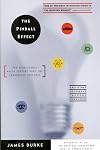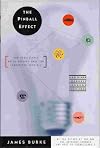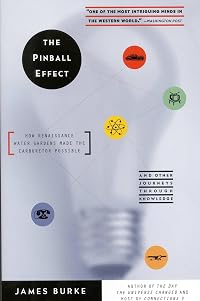
The Pinball Effect: How Renaissance Water Gardens Made the Carburetor Possible - and Other Journeys
by James Burke
On This Page
Description
Using 100s of fascinating examples, James Burke shows how old established ideas in science and technology often lead to serendipitous and amazing modern discoveries and innovations.Tags
Recommendations









Member Reviews
The pinball metaphor of the title is very apt, as James Burke sends readers of this book bouncing through history -- mostly the history of science and technology -- in truly a dizzying fashion, connecting events and ideas together through links that range from obvious to tenuous. The first chapter, for example, starts out with the invention of the permanent wave hair treatment, takes a surprisingly small step from there to borax mining, moves on through the California gold rush to Yankee clipper ships, the Irish potato famine, British trade restrictions, the invention of the postage stamp, French economic reforms, the building of canals and aqueducts, trench warfare, the American revolution, the rise of steamships and the advent of the show more luxury liner. All in the course 22 pages. And that's probably one of the simpler chapters; there's a lot less science in it than most.
Burke's stated goal is to make readers appreciate the intricate, interconnected web of history, and I do think he manages that fairly well. He also does a good job of presenting scientific and technological discovery as the messy, gradual, often partly accidental process that it is. And many of the historical and scientific tidbits he discusses here are important, or interesting, or both. Unfortunately, though, this kind of rapid careening from subject to subject can get more than a little disorienting and doesn't lead to a truly satisfying understanding of anything. It's pretty much the print equivalent of browsing around Wikipedia and following a new link every few minutes. Considering that this book was published in 1996, maybe Burke deserves some credit for creating the experience of random-walking through Wikipedia well before Wikipedia existed. In fact, he even includes notes at many points in each chapter indicating which bits of other chapters they can be linked into, and invites the reader to flip back and forth and skip around. I'd be very surprised if anybody did, though. This sort of thing pretty much requires hypertext to work properly. I guess maybe Burke was just a bit ahead of his time. show less
Burke's stated goal is to make readers appreciate the intricate, interconnected web of history, and I do think he manages that fairly well. He also does a good job of presenting scientific and technological discovery as the messy, gradual, often partly accidental process that it is. And many of the historical and scientific tidbits he discusses here are important, or interesting, or both. Unfortunately, though, this kind of rapid careening from subject to subject can get more than a little disorienting and doesn't lead to a truly satisfying understanding of anything. It's pretty much the print equivalent of browsing around Wikipedia and following a new link every few minutes. Considering that this book was published in 1996, maybe Burke deserves some credit for creating the experience of random-walking through Wikipedia well before Wikipedia existed. In fact, he even includes notes at many points in each chapter indicating which bits of other chapters they can be linked into, and invites the reader to flip back and forth and skip around. I'd be very surprised if anybody did, though. This sort of thing pretty much requires hypertext to work properly. I guess maybe Burke was just a bit ahead of his time. show less
A fascinating premise and a thankfully unscholarly look at scientific and cultural advances and how they relate and inter-relate. Hand in hand with chaos theory, showing the randomness of human achievement.
Ratings
Members
- Recently Added By
Author Information

35+ Works 4,879 Members
James Burke's contributes a monthly column to Scientific American and serves as director, writer and host of the television series Connections 3, which airs on the Learning Channel.
Awards and Honors
Distinctions
Common Knowledge
- Original publication date
- 1996
- Dedication
- To Madeline
Classifications
Statistics
- Members
- 753
- Popularity
- 37,553
- Reviews
- 2
- Rating
- (3.69)
- Languages
- English, German, Hungarian, Spanish
- Media
- Paper, Audiobook
- ISBNs
- 9
- ASINs
- 3