On This Page
Description
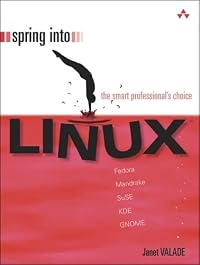
Janet Valade has 20 years experience in the computing field. Her background includes experience as a technical writer for several companies, as a Web designer/programmer for an engineering firm, and as a systems analyst in a university environment where, for over 10 years, she supervised the installation and operation of computing resources, designed and developed a state-wide data archive, provided technical support to faculty and staff, wrote numerous technical papers and documentation, show more and designed and presented seminars and workshops on a variety of technology topics. Janet currently has two published books--PHP & MySQL for Dummies, Second Edition, and PHP 5 for Dummies. In addition, she has authored chapters for several Linux and Web development books. Barry Rosenberg wrote the cult classic, KornShell Programming Tutorial (AddisonWesley, 1991), which pioneered many of the chunk-oriented techniques found in the Spring Into... Series. He is the author of more than sixty corporate technical manuals, primarily on programming. An experienced instructor, Barry has taught everything from high-school physics to weeklong corporate seminars on data structures. Most recently, Barry spent four semesters at MIT where he taught advanced technical writing. Barry is also a professional juggler who has performed more than 1,200 shows, including a three-week run in Japan. Juggling serves as the backdrop for his novel, Cascade (not yet published). Barry currently works as the documentation manager at 170 Systems. Book Content - 1. Understanding Open Source Software 2. Choosing a Linux Distribution 3. Getting Ready to Install Linux 4. Installation 5. Interacting with Linux 6. Using Your Desktop 7. Using the Command Line 8. Linux Accounts 9. File Management 10. Applications and Programs 11. Word Processing 12. Spreadsheets 13. Graphics 14. Printing 15. The Internet 16. Multimedia 17. Email, Messaging, and News 18. Editing Text Files 19. Shell Scripts APPENDIX A: Regular Expressions APPENDIX B: Command Reference. show lessTags
Recommendations



Member Reviews
Here is my review of my latest book.
I will break the review into two major sections: what I liked about the book, and what I wish the
author would revise before the next edition.
This book was a comprehensive overview of three Linux distros. I never thought I could learn and
review so much about an operating system from such a small book. This book covers everything from
installing Linux to using OpenOffice to writing your own shell scripts. I would highly recommend
this book to any experienced Windows or Macintosh user who is comtemplating on migrating to Linux.
Even though I was passingly familiar with Linux, I learned a lot from reading this book. I learned
how to import templates into OpenOffice. I learned how to use styles as formatting show more shortcuts in
OpenOffice. I learned how to allow and forbid certain actions on files just by manipulating group
and owner permissions.
-------------------------------------------------------------------
Spring Into Linux is an excellent book but there were some quirks I wish would be addressed before
the next edition. The author gives a great description of how email works and how email clients
work. I wish the author would have taken it a step further. I wish the author would have discussed
"email relaying" and how email administrators try to stop it. Those security practices affect
people who travel with their computers to hotels or to bookstore hotspots or to public computer
labs. I work in such a place and I often tell people that they need to use web mail (or VPN) if
they want to send messages while there on the road. It's only a matter of time before Linux
becomes just as popular on laptops as other operating systems. lol...
I thought I also noticed some minor grammar and shell scripting mistakes, but I kept on reading.
The author put so much work into the various subjects that I was merely thankful for the
information.
I also wish that that in the next edition the author would cover Fedora Core 3 and 4. I also wish
that the author would have explained up2date a little more and explained that Red Hat has a list
of "Fedora prepared" packages on their web site. I tend to think that is where Fedora users should
first look for their extra packages.
---------------------------------------------------------
Book Review - "Spring Into Linux" by Janet Valade, Addison Wesley
Background
I'm not a techie. I wanted a beginner's guide to Linux to learn some of the basics. I'm running Fedora, version 5. I read the first half of the book, the chapters on Installation through File Management, stopping where the book began to cover applications and programs.
Review
I thought that the book was a useful introduction, particularly for someone used to a Windows environment, which appears to be the book's targeted audience. One of its strength lies in the way the chapters are consistently laid out: a short 1-2 page intro to the topic at hand, a more detailed section covering the highlights on the topic at hand, and then a wrap-up of what was covered. I didn't feel I needed to read the later chapters on applications figuring that I would learn what I needed about individual applications by working with them directly.
The book is an easy read. However, I think most readers will want to quickly move on to something more robust. show less
I will break the review into two major sections: what I liked about the book, and what I wish the
author would revise before the next edition.
This book was a comprehensive overview of three Linux distros. I never thought I could learn and
review so much about an operating system from such a small book. This book covers everything from
installing Linux to using OpenOffice to writing your own shell scripts. I would highly recommend
this book to any experienced Windows or Macintosh user who is comtemplating on migrating to Linux.
Even though I was passingly familiar with Linux, I learned a lot from reading this book. I learned
how to import templates into OpenOffice. I learned how to use styles as formatting show more shortcuts in
OpenOffice. I learned how to allow and forbid certain actions on files just by manipulating group
and owner permissions.
-------------------------------------------------------------------
Spring Into Linux is an excellent book but there were some quirks I wish would be addressed before
the next edition. The author gives a great description of how email works and how email clients
work. I wish the author would have taken it a step further. I wish the author would have discussed
"email relaying" and how email administrators try to stop it. Those security practices affect
people who travel with their computers to hotels or to bookstore hotspots or to public computer
labs. I work in such a place and I often tell people that they need to use web mail (or VPN) if
they want to send messages while there on the road. It's only a matter of time before Linux
becomes just as popular on laptops as other operating systems. lol...
I thought I also noticed some minor grammar and shell scripting mistakes, but I kept on reading.
The author put so much work into the various subjects that I was merely thankful for the
information.
I also wish that that in the next edition the author would cover Fedora Core 3 and 4. I also wish
that the author would have explained up2date a little more and explained that Red Hat has a list
of "Fedora prepared" packages on their web site. I tend to think that is where Fedora users should
first look for their extra packages.
---------------------------------------------------------
Book Review - "Spring Into Linux" by Janet Valade, Addison Wesley
Background
I'm not a techie. I wanted a beginner's guide to Linux to learn some of the basics. I'm running Fedora, version 5. I read the first half of the book, the chapters on Installation through File Management, stopping where the book began to cover applications and programs.
Review
I thought that the book was a useful introduction, particularly for someone used to a Windows environment, which appears to be the book's targeted audience. One of its strength lies in the way the chapters are consistently laid out: a short 1-2 page intro to the topic at hand, a more detailed section covering the highlights on the topic at hand, and then a wrap-up of what was covered. I didn't feel I needed to read the later chapters on applications figuring that I would learn what I needed about individual applications by working with them directly.
The book is an easy read. However, I think most readers will want to quickly move on to something more robust. show less
Members
- Recently Added By
Author Information

7 Works 576 Members
Janet Valade has 17 years of experience as a Web designer, programmer, and systems analyst.
Series

Common Knowledge
- Canonical title
- Spring Into Linux
Classifications
- Genres
- Technology, Nonfiction
- DDC/MDS
- 005.432 — Computer science, information & general works Computer science, knowledge & systems Artificial Intelligence/Virtual Reality Systems programming and programs Systems programs Specific operating systems
- LCC
- QA76.76 .O63 .V34 — Science Mathematics Mathematics Instruments and machines Calculating machines Electronic computers. Computer science Computer software
- BISAC
Statistics
- Members
- 24
- Popularity
- 1,106,680
- Reviews
- 1
- Rating
- (3.00)
- Languages
- Czech, English
- Media
- Paper, Ebook
- ISBNs
- 3
- UPCs
- 1