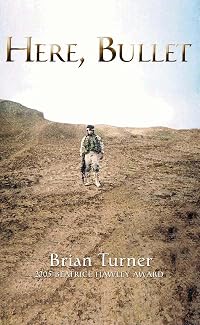
Here, Bullet
by Brian Turner
On This Page
Description
A first-person account of the Iraq War by a solider-poet, winner of the 2005 Beatrice Hawley Award.
Tags
Recommendations



























Member Reviews
http://www.newsreview.com/sacramento/Content?oid=oid%3A48127
My review of HERE, BULLET:
'Dulce et decorum est'
There’s something about being asked to surrender one’s life for the sake of national honor--the ultimate lie, “The old Lie” described in Wilfred Owen’s famed poem of the first World War, “Dulce et decorum est”--that leads the warrior poet, from Owen and his compatriot Siegfried Sassoon to the Vietnam War’s Yusef Komunyakaa and Bruce Weigl, and now to Iraq’s poet-veteran Brian Turner to tell the truth.
Turner, of Fresno, spent a year in Iraq with the 3rd Stryker Brigade Combat Team, 2nd Infantry Division, starting in November 2003. His other military experience includes a seven-year stint on active duty in the show more U.S. Army, with a deployment with the 10th Mountain Division in Bosnia-Herzegovina; his academic credentials include a Master of Fine Arts degree from the University of Oregon. But all it takes is to read a few lines from any of the poems in his new book, Here, Bullet, to know that Turner is the real deal.
Winner of the 2005 Beatrice Hawley Award, Here, Bullet chronicles Turner’s time in Iraq, though it is not strictly made up of poems about combat. Instead, Turner looks at the land, its people and its history, but always with his soldier’s eye. He disproves the myth of the ignorant brute armed with automatic weapons--as if any of us truly believed that true of our troops--in poems such as “Gilgamesh, in Fossil Relief.” Beginning with an account of a seventh-century poet carving his own version of the great epic into stone, Turner reminds us:
It is an old story now. It was an old
story then,
full of gods and beasts and the inevitable
point of no return each age must learn.
Then he turns to now, and the lessons of our age, as we attempt, however futilely, to remake the world:
History is a cloudy mirror made of dirt
and bone and ruin. And love? Loss?
These are the questions we must answer
by war and famine and pestilence, and again by touch and kiss, because each age must
learn
This is the path of the sun’s journey by
night.
Turner’s poems are, as this small excerpt indicates, thoughtful, steeped in both the dry facts and the still-reeking guts of history, and as current as the nightly news. Critics have commented on the immediacy of the poems, in particular the way that so many of them sound as if they were scribbled in moments stolen from the day’s patrols.
At the center of the book, the poem “2000 lbs.” is, in its 100 lines, the horrific center of the Iraq war. It gives, in 360-degree vision and full detail, the scene of an IED bombing, from the bomber’s “fist, white-knuckled / and tight, glossy with sweat” to the daydreaming of an Iraqi taxi driver. Then, the explosion: the National Guard sergeant, who sees the carnage in complete silence because his eardrums have ruptured; the destroyed bridal shop; the grandmother keening over the body of her dead grandson; the lieutenant holding up his arms, sans hands; and the vaporized bomber himself, “who may have invoked the Prophet’s name, / or not--he is obliterated at the epicenter, / he is everywhere, he is of all things.”
Brian Turner has given us the first real look at what the war means, for that is the business of poetry. It is respectful, beautiful and honest--all that we can ask of poetry and all that we will never get from war. show less
My review of HERE, BULLET:
'Dulce et decorum est'
There’s something about being asked to surrender one’s life for the sake of national honor--the ultimate lie, “The old Lie” described in Wilfred Owen’s famed poem of the first World War, “Dulce et decorum est”--that leads the warrior poet, from Owen and his compatriot Siegfried Sassoon to the Vietnam War’s Yusef Komunyakaa and Bruce Weigl, and now to Iraq’s poet-veteran Brian Turner to tell the truth.
Turner, of Fresno, spent a year in Iraq with the 3rd Stryker Brigade Combat Team, 2nd Infantry Division, starting in November 2003. His other military experience includes a seven-year stint on active duty in the show more U.S. Army, with a deployment with the 10th Mountain Division in Bosnia-Herzegovina; his academic credentials include a Master of Fine Arts degree from the University of Oregon. But all it takes is to read a few lines from any of the poems in his new book, Here, Bullet, to know that Turner is the real deal.
Winner of the 2005 Beatrice Hawley Award, Here, Bullet chronicles Turner’s time in Iraq, though it is not strictly made up of poems about combat. Instead, Turner looks at the land, its people and its history, but always with his soldier’s eye. He disproves the myth of the ignorant brute armed with automatic weapons--as if any of us truly believed that true of our troops--in poems such as “Gilgamesh, in Fossil Relief.” Beginning with an account of a seventh-century poet carving his own version of the great epic into stone, Turner reminds us:
It is an old story now. It was an old
story then,
full of gods and beasts and the inevitable
point of no return each age must learn.
Then he turns to now, and the lessons of our age, as we attempt, however futilely, to remake the world:
History is a cloudy mirror made of dirt
and bone and ruin. And love? Loss?
These are the questions we must answer
by war and famine and pestilence, and again by touch and kiss, because each age must
learn
This is the path of the sun’s journey by
night.
Turner’s poems are, as this small excerpt indicates, thoughtful, steeped in both the dry facts and the still-reeking guts of history, and as current as the nightly news. Critics have commented on the immediacy of the poems, in particular the way that so many of them sound as if they were scribbled in moments stolen from the day’s patrols.
At the center of the book, the poem “2000 lbs.” is, in its 100 lines, the horrific center of the Iraq war. It gives, in 360-degree vision and full detail, the scene of an IED bombing, from the bomber’s “fist, white-knuckled / and tight, glossy with sweat” to the daydreaming of an Iraqi taxi driver. Then, the explosion: the National Guard sergeant, who sees the carnage in complete silence because his eardrums have ruptured; the destroyed bridal shop; the grandmother keening over the body of her dead grandson; the lieutenant holding up his arms, sans hands; and the vaporized bomber himself, “who may have invoked the Prophet’s name, / or not--he is obliterated at the epicenter, / he is everywhere, he is of all things.”
Brian Turner has given us the first real look at what the war means, for that is the business of poetry. It is respectful, beautiful and honest--all that we can ask of poetry and all that we will never get from war. show less
This is a remarkable book of poems takes the reader to the U.S. war in Iraq, where the author served in the U.S. Army as an infantry leader in 2003-2004. The situation was hellish, but what is remarkable about these poems is their precision and delicacy with which it is communicated. That is not to say that they are not graphic; in some places they are, painfully so -- some of the images will be hard to forget. But the author doesn't shout and scream, he speaks clearly and unemotionally, showing us what happened rather than telling us. He does this through images, some as gross as a 2000 pound bomb, some as ethereal as a flight of birds. He also shows us how the war affects various people, some American but many Iraqi, and most show more ambiguous. The author himself is notably absent. All in all, a moving and beautiful work. I look forward to reading more of Mr. Turner's poetry. show less
To be honest I'd expected a book that drew praise because it came from the warfront and not from the perceived old boy network of academics. This book is much better than that, many of the pages transport the reader into Balad, Mosul and many of the forward bases in Iraq. I think the best compliment you can give to poetry about a real event is that it held up a mirror to the experience and let the reader taste the events in Iraq. Here, Bullet did that and not just about facing danger, but the care providers, the families and girlfriends, loneliness and the suicide epidemic.
Much of this brought back memories.
From Ashbah, 'The ghosts of American soldiers
wander the streets of Balad by night
. . .
the desert wind blowing trash
down the show more narrow alleys as a voice
sounds from the minaret'
Whether Turner is speaking of the dead exhaustion of multiple missions or that the ghosts of the departed still linger, both realities are true and Turner allows the both a presence without interpreting for the reader.
In R&R he paints a convincing picture of the Soldier as much more than the robotic symbol of foreign policy, one who has the life of a lover, of family, of mission all fighting for space in the same mind.
'I have a lover with hair that falls
like autumn leaves on my skin.
Water that rolls in smooth and cool
as anesthesia. Birds that carry
all my bullets into the barrel of the sun.'
If there is a complaint, and it's not much of one, each poem is buried in the psyche of one Soldier. The poems are deeply confessional. There's another side of the words from loved ones, the commo between Soldiers that is hinted at but it makes me feel that something personal to the poet is held at arm's length. Again, it's minor because most writers cannot get the feeling of one set of emotions as deeply as this one does in '2000 pounds' showing how a bomb blast alters everyone.
One of the best poems at showing these lingering effects comes toward the end in 'Night in Blue.'
'I have only the shadows under the leaves
to take with me, the quiet of the desert,
the low fog of Balad, orange groves
. . . .
I have a woman crying in my car
late at night when the stars go dim,
moonlight and sand as a resonance
of the dust of bones, and nothing more.'
Worth every penny and the time it takes to read it over and over. show less
Much of this brought back memories.
From Ashbah, 'The ghosts of American soldiers
wander the streets of Balad by night
. . .
the desert wind blowing trash
down the show more narrow alleys as a voice
sounds from the minaret'
Whether Turner is speaking of the dead exhaustion of multiple missions or that the ghosts of the departed still linger, both realities are true and Turner allows the both a presence without interpreting for the reader.
In R&R he paints a convincing picture of the Soldier as much more than the robotic symbol of foreign policy, one who has the life of a lover, of family, of mission all fighting for space in the same mind.
'I have a lover with hair that falls
like autumn leaves on my skin.
Water that rolls in smooth and cool
as anesthesia. Birds that carry
all my bullets into the barrel of the sun.'
If there is a complaint, and it's not much of one, each poem is buried in the psyche of one Soldier. The poems are deeply confessional. There's another side of the words from loved ones, the commo between Soldiers that is hinted at but it makes me feel that something personal to the poet is held at arm's length. Again, it's minor because most writers cannot get the feeling of one set of emotions as deeply as this one does in '2000 pounds' showing how a bomb blast alters everyone.
One of the best poems at showing these lingering effects comes toward the end in 'Night in Blue.'
'I have only the shadows under the leaves
to take with me, the quiet of the desert,
the low fog of Balad, orange groves
. . . .
I have a woman crying in my car
late at night when the stars go dim,
moonlight and sand as a resonance
of the dust of bones, and nothing more.'
Worth every penny and the time it takes to read it over and over. show less
Here, Bullet by Brian Turner, who served in the U.S. army for seven years after receiving his MFA and was a team leader for one year in Iraq with the 3rd Stryker Brigade Combat Team, won the 2005 Beatrice Hawley Award and was printed by Alice James Books — a nonprofit cooperative poetry press. (The title poem, “Here, Bullet,” was recently profiled in the Virtual Poetry Circle.) The collection is broken down into four sections, and each section is preceded by a quote relevant to it, with some even quoting the Qur’an. Turner is adept at illustrating the violence of war, but also the humanity that accompanies it. From the startling nature of rockets going off over head to the silence of bullets as they enter the body, he provides a show more keen eye into how those instruments of war impact both sides of the battle equally psychologically, physically, and spiritually.
Soldiers who craft wartime poetry have generally either fallen into the category of using graphic violence to shock and awe the reader or using quieter imagery to bring about reader understanding about psychological impacts of battle. There also are those that have political poems that are heavy on criticism or propaganda, but those would fall less into the wartime poetry category. Turner combines both violence and peace in his imagery, but in a unique way that has violence silently creeping into the lines and shocking readers. For instance, in “Eulogy” (page 20), readers may hardly notice the suicide of Private Miller because he takes “brass and fire into his mouth,” but once the birds fly up off the water by the sound, it is clear the brass and fire are from a gun. While outright, violent images can be eye-opening for readers, the quiet power in some of Turner’s lines are that much more lasting.
Read the full review: http://savvyverseandwit.com/2011/08/here-bullet-by-brian-turner.html show less
Soldiers who craft wartime poetry have generally either fallen into the category of using graphic violence to shock and awe the reader or using quieter imagery to bring about reader understanding about psychological impacts of battle. There also are those that have political poems that are heavy on criticism or propaganda, but those would fall less into the wartime poetry category. Turner combines both violence and peace in his imagery, but in a unique way that has violence silently creeping into the lines and shocking readers. For instance, in “Eulogy” (page 20), readers may hardly notice the suicide of Private Miller because he takes “brass and fire into his mouth,” but once the birds fly up off the water by the sound, it is clear the brass and fire are from a gun. While outright, violent images can be eye-opening for readers, the quiet power in some of Turner’s lines are that much more lasting.
Read the full review: http://savvyverseandwit.com/2011/08/here-bullet-by-brian-turner.html show less
http://american-poetry.suite101.com/article.cfm/brian_turner_here_bullet_soldier...
I got the book after I heard Lieutenant Colonel John Nagl talk about it on NPR. Nagl helped author the US Army's Counterinsurgency Field Manual and also wrote a gripping review of Brian Turner's poetry collection. He says he is deeply moved by it. The poems bring back the memories of the comrades and friends lost in the war.
I got the book after I heard Lieutenant Colonel John Nagl talk about it on NPR. Nagl helped author the US Army's Counterinsurgency Field Manual and also wrote a gripping review of Brian Turner's poetry collection. He says he is deeply moved by it. The poems bring back the memories of the comrades and friends lost in the war.
http://www.nytimes.com/2010/02/08/us/08military.html?th=&emc=th&pagewant...
http://www.nytimes.com/2005/11/27/books/review/27clover.html?_r=1
From "Hwy 1"
Cranes roost atop power lines in enormous
bowl-shaped nests of sticks and twigs,
and when a sergeant shoots one from the highway
it pauses, as if amazed that death has found it
here, at 7 A.M. on such a beautiful morning,
before pitching over the side and falling
in a slow unraveling of feathers and wings.
From "The Hurt Locker"
Nothing but hurt left here.
...
Open the hurt locker and learn
how rough men come hunting for souls.
"AB Negative (The Surgeon's Poem)"
From "Ashbah"
The ghosts of American soldiers
wander the streets of Balad by night,
unsure of their way home, exhausted...
...a voice
sounds show more from the minaret, a soulful call
reminding them how alone they are,
how lost.
From "Where the Telemetries End"
We share a long night
of breathing.
From "Najaf, 1820"
It is November,
the clouds made of gunpowder and rain,
the earth pregnant with the dead...
...with room enough yet for what the years will bring...
From "For Vultures: A Dystopia"
For their hunger, for their patience,
for each circle traced in shadow
and sunk down in the earth...
Let them witness every plume
of smoke, every fallen soldier,
every woman's last kiss
for the ones they love...
From "Dreams from the Malaria Pills (Barefoot)"
He's questioning why blood is needed, and so much,
why he's wheeled through his hometown streets
on a gurney draped in camouflaged sheets.
...
You carry the pearls of war within you, bombs
swallowed whole and saved for later.
From "How Bright It Is"
It will take many nails from the coffinmakers
to shut out this light... show less
http://www.nytimes.com/2005/11/27/books/review/27clover.html?_r=1
From "Hwy 1"
Cranes roost atop power lines in enormous
bowl-shaped nests of sticks and twigs,
and when a sergeant shoots one from the highway
it pauses, as if amazed that death has found it
here, at 7 A.M. on such a beautiful morning,
before pitching over the side and falling
in a slow unraveling of feathers and wings.
From "The Hurt Locker"
Nothing but hurt left here.
...
Open the hurt locker and learn
how rough men come hunting for souls.
"AB Negative (The Surgeon's Poem)"
From "Ashbah"
The ghosts of American soldiers
wander the streets of Balad by night,
unsure of their way home, exhausted...
...a voice
sounds show more from the minaret, a soulful call
reminding them how alone they are,
how lost.
From "Where the Telemetries End"
We share a long night
of breathing.
From "Najaf, 1820"
It is November,
the clouds made of gunpowder and rain,
the earth pregnant with the dead...
...with room enough yet for what the years will bring...
From "For Vultures: A Dystopia"
For their hunger, for their patience,
for each circle traced in shadow
and sunk down in the earth...
Let them witness every plume
of smoke, every fallen soldier,
every woman's last kiss
for the ones they love...
From "Dreams from the Malaria Pills (Barefoot)"
He's questioning why blood is needed, and so much,
why he's wheeled through his hometown streets
on a gurney draped in camouflaged sheets.
...
You carry the pearls of war within you, bombs
swallowed whole and saved for later.
From "How Bright It Is"
It will take many nails from the coffinmakers
to shut out this light... show less
Members
- Recently Added By
Lists

Recommendations for Ezra
12 works; 1 member

Books Read in 2010
631 works; 11 members
Author Information

9+ Works 503 Members
Brian Turner was born in Visalia, California on February 12, 1967. He received an MFA from the University of Oregon before serving for seven years in the U.S. Army. He was deployed to Bosnia-Herzegovina in 1999-2000, then in November 2003, he was an infantry team leader for a year in Iraq. His first book, Here, Bullet, chronicles his time in Iraq. show more His other books include Phantom Noise and My Life as a Foreign Country. (Bowker Author Biography) show less
Awards and Honors
Awards
Classifications
Statistics
- Members
- 282
- Popularity
- 114,253
- Reviews
- 7
- Rating
- (4.06)
- Languages
- English
- Media
- Paper, Ebook
- ISBNs
- 4
- ASINs
- 1