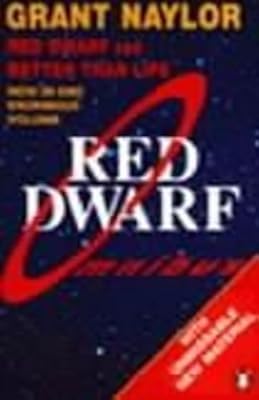
Red Dwarf Omnibus
by Grant Naylor
Red Dwarf Books (Collections and Selections — omnibus: 1-2 and other material)
On This Page
Description
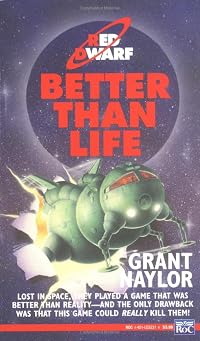
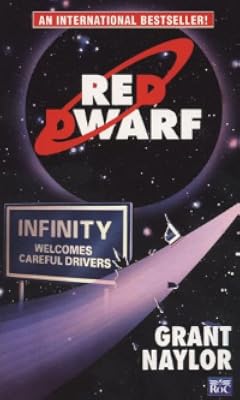
Here are the first two novels of the cult series Red Dwarfin one volume - Red Dwarfand Better Than Life- plus the first draft of the original TV pilot script. It all when Dave Lister is celebrating his twenty-fourth birthday on a Monopoly board pub crawl round London, and somehow ends up three million years from Earth, marooned in the wrong dimension of the wrong reality, and down to his last two cigarettes. Together with a dead man, a senile computer, a deranged sanitation mechanoid with an show more overactive guilt chip and the best-dressed entity in all six known universes, the last remaining member of the human race begins his epic journey home. show lessTags
Recommendations





Member Reviews
Mixed response to this one - sometimes I'd think the humor was pretty juvenile, but then I'd come across a gem like this one:
“The GAS (Genetic Alternative Sports) … Sports fans were no longer interested in seeing a conventional boxing match, when they could witness two genetically engineered pugilists — who were created with their brains in their shorts, and all their other major organs crammed into their legs and feet, leaving their heads solid blocks of unthinking muscle — knock hell out of one another for hours on end in a way that normal boxers could only manage for minutes.” Red Dwarf Omnibus (Better than Life) p490
“The GAS (Genetic Alternative Sports) … Sports fans were no longer interested in seeing a conventional boxing match, when they could witness two genetically engineered pugilists — who were created with their brains in their shorts, and all their other major organs crammed into their legs and feet, leaving their heads solid blocks of unthinking muscle — knock hell out of one another for hours on end in a way that normal boxers could only manage for minutes.” Red Dwarf Omnibus (Better than Life) p490
This is a collection containing the first two Red Dwarf novels with a couple of scripts at the end of some early versions of the show. It was published in 1992, though the original novels were first published in 89 and 90.
This is the first book for adults that I ever read. In junior school, I was a massive fan of the TV show because my family watched it, though half the jokes sailed over my head. By senior school, I was reading the novels and hugely influenced by them at the time. Many many years later I have come back to this very dogeared book.
My main reaction is that the first novel is a lot better than the second. The first novel has a clear 3-act structure while the second just feels like a list of stuff happening. I don't think a show more novel has to have a clear structure to be good, but it certainly makes a difference here. I've always just read them as one big story, but now I kind of wish I had them as separate books so I could more easily enjoy and digest them on their own.
Stuck on a mining space ship in deep deep space, our main characters are Lister (probably the last human alive) and Rimmer (a hologram of his dead roommate). Rimmer seems to get a lot more character development than Lister, and in fact I find it hard to really define Lister as a character at all, which is not great after reading two novels about him. The ship's computer Holly gets some definition before almost totally dropping out of the story. The Cat (a man evolved from cats) and Kryten (a mechanoid they pick up) are not much of characters at all, and the second book introduces Talkie Toaster who if anything has more of a presence than the other two. Both Lister and Rimmer are the architects of their own downfalls, but since they both clearly suffer from mental health issues, they are very sympathetic without having to be likeable. That's interesting. I think it is a shame that there is not much character development in the second novel, and what there is kind of happens 'off screen'. For a story about two characters who hate each other but are stuck together, they sure don't actually spend much time together and never really develop in front of us. It is suggested that they do, but we don't get to experience it.Also, not super keen on the 'woman as a reward' trope that we end on.
Book 1 - Red Dwarf: Infinity Welcomes Careful Drivers is hugely inventive and descriptive and shows great skill at setting up a science fiction world. It's so much more in depth and spectacular than the TV sitcom that inspired it and I'm kind of sad that the novels dwindled to nothing when the writing team of Grant and Naylor broke up. Part One is everything before the accident that wipes out the crew. Part Two is after the accident and does borrow heavily from the scripts, and weirdly feels like the weakest section because of it. A lot of quips here and a lot less description. Part Three is... well I guess that's too spoilery, but each of the three parts are very distinct and different from each other. (Episodes that share ideas with this novel are: The End, Future Echoes, Me2, Kryten, Better Than Life.)
Book 2 - Better Than Life starts off by dealing with how the first book ended. But the following parts don't feel like separate parts at all and are rather a series of events that each directly lead on to each other in a way that is so mixed up that it all just feels like a run-on sentence. It also either borrows more heavily from the TV show or has stuff that they later worked into the show , so it's a bit less interesting to read. (Episodes that share ideas with this novel are: Better Than Life, Backwards, Marooned, Polymorph, White Hole).
Where the first novel feels like its own entity that happens to share similarities to the sitcom, the second feels more like episodes sewn together. Weirdly the first book has much more depth than the sitcom but the sitcom seems to have more depth than the second book.Probably doesn't help that book 2 basically has the entire episode of Polymorph as the climax, so not exactly a surprise if you know the show, which if you're reading these novels you probably do. Essentially I think 1 is more character-driven and two is more action-driven and the change is very noticeable.
The most annoying thing is that both books refer to events in the future that never happen. Perhaps they were supposed to happen in the next books in the series, but that never happened due to the writing split, or perhaps it was supposed to be a joke, or it was just a hint at what would happen to the characters one day and the audience doesn't have to be there for it, but I find that a very unsatisfying thing to do to your reader.
At the end of this book is a radio skit which was an early idea for Red Dwarf and the original script for the TV pilot which is awfully similar to the actual script for the first episode. Mildly interesting for fans.
Anyway, although I would be interested to read these books in isolation at some point, I think Red Dwarf: Infinity Welcomes Careful Drivers is a cracking read, Better Than Life is fairly entertaining, and I have no interest in reading the other books that came later which I recall being much worse in quality. An enjoyable blast from the past. show less
This is the first book for adults that I ever read. In junior school, I was a massive fan of the TV show because my family watched it, though half the jokes sailed over my head. By senior school, I was reading the novels and hugely influenced by them at the time. Many many years later I have come back to this very dogeared book.
My main reaction is that the first novel is a lot better than the second. The first novel has a clear 3-act structure while the second just feels like a list of stuff happening. I don't think a show more novel has to have a clear structure to be good, but it certainly makes a difference here. I've always just read them as one big story, but now I kind of wish I had them as separate books so I could more easily enjoy and digest them on their own.
Stuck on a mining space ship in deep deep space, our main characters are Lister (probably the last human alive) and Rimmer (a hologram of his dead roommate). Rimmer seems to get a lot more character development than Lister, and in fact I find it hard to really define Lister as a character at all, which is not great after reading two novels about him. The ship's computer Holly gets some definition before almost totally dropping out of the story. The Cat (a man evolved from cats) and Kryten (a mechanoid they pick up) are not much of characters at all, and the second book introduces Talkie Toaster who if anything has more of a presence than the other two. Both Lister and Rimmer are the architects of their own downfalls, but since they both clearly suffer from mental health issues, they are very sympathetic without having to be likeable. That's interesting. I think it is a shame that there is not much character development in the second novel, and what there is kind of happens 'off screen'. For a story about two characters who hate each other but are stuck together, they sure don't actually spend much time together and never really develop in front of us. It is suggested that they do, but we don't get to experience it.
Book 1 - Red Dwarf: Infinity Welcomes Careful Drivers is hugely inventive and descriptive and shows great skill at setting up a science fiction world. It's so much more in depth and spectacular than the TV sitcom that inspired it and I'm kind of sad that the novels dwindled to nothing when the writing team of Grant and Naylor broke up. Part One is everything before the accident that wipes out the crew. Part Two is after the accident and does borrow heavily from the scripts, and weirdly feels like the weakest section because of it. A lot of quips here and a lot less description. Part Three is... well I guess that's too spoilery, but each of the three parts are very distinct and different from each other. (Episodes that share ideas with this novel are: The End, Future Echoes, Me2, Kryten, Better Than Life.)
Book 2 - Better Than Life starts off by dealing with how the first book ended. But the following parts don't feel like separate parts at all and are rather a series of events that each directly lead on to each other in a way that is so mixed up that it all just feels like a run-on sentence. It also either borrows more heavily from the TV show or has stuff that they later worked into the show , so it's a bit less interesting to read. (Episodes that share ideas with this novel are: Better Than Life, Backwards, Marooned, Polymorph, White Hole).
Where the first novel feels like its own entity that happens to share similarities to the sitcom, the second feels more like episodes sewn together. Weirdly the first book has much more depth than the sitcom but the sitcom seems to have more depth than the second book.
The most annoying thing is that both books refer to events in the future that never happen. Perhaps they were supposed to happen in the next books in the series, but that never happened due to the writing split, or perhaps it was supposed to be a joke, or it was just a hint at what would happen to the characters one day and the audience doesn't have to be there for it, but I find that a very unsatisfying thing to do to your reader.
At the end of this book is a radio skit which was an early idea for Red Dwarf and the original script for the TV pilot which is awfully similar to the actual script for the first episode. Mildly interesting for fans.
Anyway, although I would be interested to read these books in isolation at some point, I think Red Dwarf: Infinity Welcomes Careful Drivers is a cracking read, Better Than Life is fairly entertaining, and I have no interest in reading the other books that came later which I recall being much worse in quality. An enjoyable blast from the past. show less
It grieves me to see my absolute favorite book of all time with such a small readership. It pains me to see that even among these, none of them have taken the time to review it. Given, I had never heard of this book, nor seen it anwhere previous to my good friend digging it out of his closet, at the bottem of a box of hand-me-down, second hand books, I can understand and even forgive the general public of being unaware of this apparently hidden, or overlooked marvel. Yet for none of you faithfull Red Dwarf fans to even recommend or try to promote it fills me full of sorrow. Now I know why people think me crazy when I speak of this wonder, that is Red Dwarf.
Set in your basic futuristic Sci-Fi world it is easy enough to get comfortable to show more the idea of intergalactic travel, and mammoth sized ships, aswell as all that is space gizmo and gadgetry. It is here that we find our unlikely hero Dave Lister set for a very unexpexted journey with a most unlikely crew. This tale exemplifies classic british humor and delivers it in excess. As with any comedy, it is not just the jokes themselves, but the deliverance that counts and Doug Naylor and Rob Grant can hit every beat right on time. The duo have crafted a story rich with characters you just love to hate but feel compelled to laugh instead. Unlike many books with a tendacy to skirk a good story, or sometime even a plot, to produce a few cheap laughs, Red Dwarf provides.
It is really one of those novels you will be sad to finish because you know there is nothing after that, and nothing will compare. Fortunatley, indipendantly, Dog and Rob did create sequels, both that were kind of eachothers version of what took place after the events of Red Dwarf, and Better Then Life. If I had to recommend one book, there is not a one I would be more proud to represent then Red Dwarf. show less
Set in your basic futuristic Sci-Fi world it is easy enough to get comfortable to show more the idea of intergalactic travel, and mammoth sized ships, aswell as all that is space gizmo and gadgetry. It is here that we find our unlikely hero Dave Lister set for a very unexpexted journey with a most unlikely crew. This tale exemplifies classic british humor and delivers it in excess. As with any comedy, it is not just the jokes themselves, but the deliverance that counts and Doug Naylor and Rob Grant can hit every beat right on time. The duo have crafted a story rich with characters you just love to hate but feel compelled to laugh instead. Unlike many books with a tendacy to skirk a good story, or sometime even a plot, to produce a few cheap laughs, Red Dwarf provides.
It is really one of those novels you will be sad to finish because you know there is nothing after that, and nothing will compare. Fortunatley, indipendantly, Dog and Rob did create sequels, both that were kind of eachothers version of what took place after the events of Red Dwarf, and Better Then Life. If I had to recommend one book, there is not a one I would be more proud to represent then Red Dwarf. show less
I have not seen the TV series, so I can't say I am a fan of the TV series like most other reviewers. But certainly, I loved the books. I think most people who like The Hitchhiker's Guide, for example, will enjoy these books as well. The humor is less subtle than Douglas Adams, but the story is more action packed (it has a more 21st century feel, not surprisingly.)
The main characters are brilliantly done. The lazy guy who loves curry, the loser technician who blames everyone else for his failures, the guilt-ridden cleaning android, the highly-evolved Cat, and of course, the irritating toaster that won't shut up. Let's not forget Holly, the super genius computer. I think I had greater expectations from Holly, though. I think I probably show more expected something more like Marvin, the paranoid android, something with more of a character, but the "character" from others makes up for this lack, for sure.
The story is an action-packed, silly adventure through space and time. Hilarious and horrible things happen to them from beginning to end and the characters, so beautifully crippled by their own flaws, try to survive it all.
All in all, a blast to read. show less
The main characters are brilliantly done. The lazy guy who loves curry, the loser technician who blames everyone else for his failures, the guilt-ridden cleaning android, the highly-evolved Cat, and of course, the irritating toaster that won't shut up. Let's not forget Holly, the super genius computer. I think I had greater expectations from Holly, though. I think I probably show more expected something more like Marvin, the paranoid android, something with more of a character, but the "character" from others makes up for this lack, for sure.
The story is an action-packed, silly adventure through space and time. Hilarious and horrible things happen to them from beginning to end and the characters, so beautifully crippled by their own flaws, try to survive it all.
All in all, a blast to read. show less
This was an audiobook 'read' and I have read both Infinity Welcomes Careful Drivers and Better Than Life before as stand alone books. This audiobook mashes both those books together and also some other parts from the TV show into one big story covering the Red Dwarf world. It is narrated by Chris Barrie who is frankly superb and I listened to this over the course of 2 nights while at work. I love everything about this, the story is great, the characters strong, the performance superb, and to top it all off it's really funny as well. I would highly recommend this to any Red Dwarf fan.
Relives the television series, but there isn't too much added value. The only exception is Rimmer, whose neuroses are made much more obvious with a narrator's insight.
I listened to the audiobook (abridged version) narrated by Chris Barrie. He did a brilliant job and I would definitely like to purchase the full version at some point.
Members
- Recently Added By
Author Information

7 Works 4,706 Members
Series

Work Relationships
Common Knowledge
- Canonical title
- Red Dwarf Omnibus
- Original publication date
- 1992-11
- People/Characters
- Dave Lister; Arnold Judas Rimmer; The Cat; Holly; Kristine Kochanski; Kryten 2X4B-523P
- Important places
- Mimas; Red Dwarf
- Dedication
- To Kath and Linda
Special thanks to Paul Jackon for everything, to Ed Bye for everything else and to Chris Barrie, Craig Charles, Danny John-Jules, Norman Lovett, Peter Risdale-Scott, Roger Bolton, Peter Wragg and all ... (show all)the Red Dwarf backstage crew. - First words
- 'DESCRIBE, USING DIAGRAMS WHERE APPROPRIATE, THE EXACT CIRCUMSTANCES LEADING TO YOUR DEATH.'
- Last words
- (Click to show. Warning: May contain spoilers.)Film. The ship in space
Hawaiian music. Titles.
'The Beginning.' - Original language
- English
- Canonical DDC/MDS
- 823.914
- Disambiguation notice
- Contains the first two Red Dwarf books plus a 'Backword' of 46 pages of new material including a sketch from the radio show "Son of Cliché" and the first draft of the TV pilot. Do not combine with the compilation of only th... (show all)e first two novels.
Classifications
Statistics
- Members
- 641
- Popularity
- 45,279
- Reviews
- 7
- Rating
- (4.09)
- Languages
- English
- Media
- Paper
- ISBNs
- 1
- ASINs
- 1