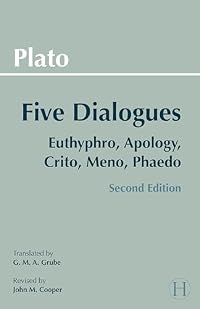
Euthyphro / Apology / Crito / Meno / Phaedo
by Plato
On This Page
Description
Explore the foundational ideas of Western philosophy through Plato's "Five Dialogues." This collection, translated by Benjamin Jowett, presents a series of engaging conversations that delve into ethics, justice, virtue, and the nature of the soul. From Socrates' compelling defense in the "Apology" to the profound discussions of "Phaedo" on the immortality of the soul, these dialogues offer timeless insights into human thought and the pursuit of truth. Ideal for both students of philosophy show more and readers seeking to understand the pillars of classical thought. show lessTags
Recommendations





Member Reviews
This was recommended to me by the single most coolest stranger I have ever spent a few hours trapped on a plane with. It is by Plato (boo) but purports to be accounts of philosophical conversations Socrates had. I really enjoyed the first two (Euthyphro and Apologia) which dealt with issues of justice, the second of which is theoretically the speech Socrates gave in his defense while he was on trial. The last three were philosophical and scientific train wrecks.
These last three, based on my limited exposure in college, feel very Plato to me. They range in topic from the nature of learning to the human soul and a truly Seussical argument that the quality of the thing comes not from its quantifiable attributes, but from it's relationship show more with Plato's beloved ideals or, as he called them, "Forms". These Forms are not anything we can see, or even really describe. They are simply the most pure form of a given ideal or attribute. Plato was really hung up on the ideal that the world as we see it is just a shitty copy of the ideals. I can't imagine he was much fun to hang out with. He also seems from this book to have desperately needed a lay as he was far too zealous in his claims that celibacy was absolutely necessary for the soul to prosper after death. I think it's a pretty simple case of sour grapes myself, but I digress.
As I said, the topics in these last three are rangy, but they do share a commonality. They are all patent balderdash. Seriously. I don't think Plato (or Socrates if you're willing to accept that) even knew what a logical fallacy was. I wrote many irreverent notes in my margins (some about Plato's mother) as my irritation grew. So what was the problem? Honestly, it's roughly the same one I had with Lee's Strobel's [Case for Christ]. It starts with a premise for which there is no evidence but that the author dearly wants to be true, almost certainly for the comfort it provides him. In this case it is that the soul is immortal and that once it is freed from the body it is granted clear sight and infinite knowledge. And like Lee Strobel the rest of Plato/Socrates' claims are dependent their audience accepting this first unsupportable claim. The similarity doesn't end there.
Each dialogue is presented as if it is a serious philosophical debate, but by the last three hardly any of the participants speak at all except to periodically tell Socrates how great he is and how right whatever nonsense he's just said is. You could rename this section of the book "Socrates and the Sycophants". It's very similar to the investigation that isn't really an investigation undertaken by Strobel, though Plato/Socrates is probably guiltier of far more self-satisfied moronic brain-wanking than Strobel ever could be.
All in all I enjoyed the book. The first two dialogues I genuinely enjoyed and the last three I enjoyed bitching about. This I found worthy as I do love to hate Plato and had felt ill prepared to do so before and wasn't about to read [The Republic]. Oh, and at the end Socrates drinks hemlock and dies. It isn't as dramatic as it sounds though.
Excerpt from Phaedo:
...if someone tells me a thing is beautiful because it has a bright colour or shape or any such thing, I ignore these other reasons--for all these confuse me--but I simply, naively and perhaps foolishly cling to this, that nothing else makes it beautiful other than the presence of, or the sharing in, or however you may describe its relationship to that Beautiful we mentioned, for I will not insist on the precise nature of the relationship, but that all beautiful things are beautiful by the Beautiful. That, I think, is the safe answer for me or anyone else to give, namely, that it is through the Beauty that beautiful things are made beautiful... show less
These last three, based on my limited exposure in college, feel very Plato to me. They range in topic from the nature of learning to the human soul and a truly Seussical argument that the quality of the thing comes not from its quantifiable attributes, but from it's relationship show more with Plato's beloved ideals or, as he called them, "Forms". These Forms are not anything we can see, or even really describe. They are simply the most pure form of a given ideal or attribute. Plato was really hung up on the ideal that the world as we see it is just a shitty copy of the ideals. I can't imagine he was much fun to hang out with. He also seems from this book to have desperately needed a lay as he was far too zealous in his claims that celibacy was absolutely necessary for the soul to prosper after death. I think it's a pretty simple case of sour grapes myself, but I digress.
As I said, the topics in these last three are rangy, but they do share a commonality. They are all patent balderdash. Seriously. I don't think Plato (or Socrates if you're willing to accept that) even knew what a logical fallacy was. I wrote many irreverent notes in my margins (some about Plato's mother) as my irritation grew. So what was the problem? Honestly, it's roughly the same one I had with Lee's Strobel's [Case for Christ]. It starts with a premise for which there is no evidence but that the author dearly wants to be true, almost certainly for the comfort it provides him. In this case it is that the soul is immortal and that once it is freed from the body it is granted clear sight and infinite knowledge. And like Lee Strobel the rest of Plato/Socrates' claims are dependent their audience accepting this first unsupportable claim. The similarity doesn't end there.
Each dialogue is presented as if it is a serious philosophical debate, but by the last three hardly any of the participants speak at all except to periodically tell Socrates how great he is and how right whatever nonsense he's just said is. You could rename this section of the book "Socrates and the Sycophants". It's very similar to the investigation that isn't really an investigation undertaken by Strobel, though Plato/Socrates is probably guiltier of far more self-satisfied moronic brain-wanking than Strobel ever could be.
All in all I enjoyed the book. The first two dialogues I genuinely enjoyed and the last three I enjoyed bitching about. This I found worthy as I do love to hate Plato and had felt ill prepared to do so before and wasn't about to read [The Republic]. Oh, and at the end Socrates drinks hemlock and dies. It isn't as dramatic as it sounds though.
Excerpt from Phaedo:
...if someone tells me a thing is beautiful because it has a bright colour or shape or any such thing, I ignore these other reasons--for all these confuse me--but I simply, naively and perhaps foolishly cling to this, that nothing else makes it beautiful other than the presence of, or the sharing in, or however you may describe its relationship to that Beautiful we mentioned, for I will not insist on the precise nature of the relationship, but that all beautiful things are beautiful by the Beautiful. That, I think, is the safe answer for me or anyone else to give, namely, that it is through the Beauty that beautiful things are made beautiful... show less
the socrates of meno and phaedo is clearly the voice of plato. when socrates goes from questioning everything (the real socrates) to "concluding" things he previously had--or would have--questioned (plato) he becomes a rather uninteresting and mundane character. still, when the true socrates shines he really does shine.
A great showcase of well structured arguments. This is a philosophical classic that gets a bit complex at the end. My only problem with this book is that the end gets a bit boring to read in comparison to the first two sections. Overall this book made me reflect on several facets of my life that I have largely overlooked.
Five Dialogues: Euthyphro, Apology, Crito, Meno, Phaedo. Plato, translated by G.M.A. Gruber. 1981. This was the first reading selection for the new book club. I hadn’t read Plato since Dr. Lott’s class in world literature at Montevallo, so reading it was tough, although the more I read the easier it became. After the discussion I want to go back and re-read it! What struck me was the similarities of the ethical concerns in these with Judo-Christian thought.
Dialogues taken from around the time of Socrates' death. I picked up this book wanting to understand more about the thinking of Socrates and the progressions of logical thought. My only previous introduction to "the Socratic Method" was from pop culture references and its abysmal application in public education.Apology, Crito and Phaedo all center upon Socrates' trial, personal philosophy and final conversation (respectively) and, while interesting from an academic point of view, I did not find them very helpful with regard to understanding the manner in which Socrates' plied his trade.Euthyphro and Meno, on the other hand, were remarkable for my understanding.In Euthyphro, Socrates attacks the question of the meaning of virtue when a show more young man decides to sue his father for the (supposedly) wrongful death of one slave that had killed another. In Meno, Socrates again tries to grasp an underlying meaning to the word, this time with a focus as to the nature of virtue, and whether or not it is a kind of knowledge that can be taught or it is ingrained in the "soul" of a man. While, in Meno, the conversation detours into a discussion of the soul and Socrates' personal belief that knowledge is eternal and "recollected" by the individual rather than learned or discovered, the characterization of knowledge, education and definition were extremely interesting.G. M. A. Grube's translations are at once simple and elegant prose which made for both enjoyable reading and clear understanding of the text. While the particular dialogues were not necessarily the best ones to cut my teeth on for my particular learning project, I would definitely recommend this collection for any one wanting more of the Man behind the Method. show less
Good collection of dialogues. "Meno" has a special place in my heart.
Every educated person should read these brief dialogs because they are the closest thing to an underpinning of Western philosophy.
Members
- Recently Added By
Lists

Will Durant's 100 Books: An Update
46 works; 4 members

Philosophy, Politics and Economics
61 works; 1 member

sotiris' favourites circa january 2023
43 works; 2 members

el
1,139 works; 1 member
Author Information

2,709+ Works 100,246 Members
Plato was born c. 427 B.C. in Athens, Greece, to an aristocratic family very much involved in political government. Pericles, famous ruler of Athens during its golden age, was Plato's stepfather. Plato was well educated and studied under Socrates, with whom he developed a close friendship. When Socrates was publically executed in 399 B.C., Plato show more finally distanced himself from a career in Athenian politics, instead becoming one of the greatest philosophers of Western civilization. Plato extended Socrates's inquiries to his students, one of the most famous being Aristotle. Plato's The Republic is an enduring work, discussing justice, the importance of education, and the qualities needed for rulers to succeed. Plato felt governors must be philosophers so they may govern wisely and effectively. Plato founded the Academy, an educational institution dedicated to pursuing philosophic truth. The Academy lasted well into the 6th century A.D., and is the model for all western universities. Its formation is along the lines Plato laid out in The Republic. Many of Plato's essays and writings survive to this day. Plato died in 347 B.C. at the age of 80. (Bowker Author Biography) show less
Some Editions
Work Relationships
Common Knowledge
- Canonical title
- Euthyphro / Apology / Crito / Meno / Phaedo
- People/Characters
- Socrates (c. 470–399 BC); Meno
- First words
- "EUTHYPHRO: 'What's new, Socrates, to make you leave your usual haunts in the Lyceum and spend your time here by the king-archon's court?'"
- Last words
- (Click to show. Warning: May contain spoilers.)[From Phaedo] "Such was the end of our comrade, Echecrates, a man who, we would say, was of all those we have known the best, and also the wisest and the most upright."
- Disambiguation notice
- Please separate and combine only LT works having substantially the same content. For example, this LT work includes five of Plato's dialogues: Euthyphro, The Apology (a.k.a. The Defense of Socrates... (show all)), Crito, Meno, and Phaedo. Thank you.
Classifications
Statistics
- Members
- 3,263
- Popularity
- 5,206
- Reviews
- 17
- Rating
- (3.93)
- Languages
- English, Finnish, German, Greek (Ancient)
- Media
- Paper, Audiobook, Ebook
- ISBNs
- 25
- ASINs
- 10