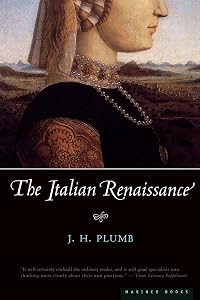
The Italian Renaissance
by J. H. Plumb
On This Page
Description
Spanning an age that witnessed great achievements in the arts and sciences, this definitive overview of the Italian Renaissance will both captivate ordinary readers and challenge specialists. J. H. Plumb's impressive and provocative narrative is accompanied by contributions from leading historians, including Morris Bishop, Jacob Bronowski, Maria Bellonci, and many more, who have further illuminated the lives of some of the era's most unforgettable personalities, from Petrarch to Pope Pius show more II, Michelangelo to Isabella d'Este, Machiavelli to Leonardo. A highly readable and engaging volume, The Italian Renaissance is a perfect introduction to the movement that shaped the Western world. show lessTags
Recommendations

















Member Recommendations

Member Reviews
It was slow in starting, but once it got rolling, this book was terrific! The first several chapters sounded like the "hype" you hear in television commercials for upcoming action flicks, and the style got old after only a few pages. Once the book really began, however, it was excellent through to the end. Plumb and his fellow authors do not shy away from the most terrible and disgusting aspects of the Renaissance, such as the revival of pederasty and the rampant adultery committed by middle class men, nor do they fail to give praise where praise is due. You get a real feel for the Renaissance and the great personalities, achievements, and events of the period. The last few chapters, which cover several of the greatest individuals of show more the Renaissance, are particularly good. They lead the reader to a real appreciation for the people of the Renaissance, a real understanding of what makes them tick, and an empathy for each of them as a person. This book taught me to love the Renaissance. show less
A book divided, augmented: first half by Plumb, second half, chapter biographies by Origo on Pius II, Kenneth Clark on Michelangelo, Bronowski on Leonardo. Origo writes like a Renaissance humanist, “Success comes most swiftly and completely not to the greatest or perhaps even the ablest men, but to those whose gifts are most completely in harmony with the taste of their time”(241). Plumb's chapter on Renaissance Florence notes it was dominated by "the sword and the florin": banking, and to build that, military defenses against neighbors. Earlier, by the 13C, the guilds grew central: the lanuoli (wool), sete (silk-weavers), notaio (notaries, still overpayed in modern IT), and bankers (including money-changers, with a balance). For show more fascinating maps of where each guild tended to live, see online Burr Litchfield's "Florence Ducal Capital 1530-1630." For example, the shoemakers tended to live all over the city, all men, whereas the hosiers concentrated toward the center city, most on the Via di Calzaiuoli between Piazza Signoria and the Duomo. Probably the stockings were made by women all over the city, at home.
Plumb's chapter on the Image of Man covers from Alberti's sense of grandeur to Aretino's bisexual amorality. Still, Aretino was such a good writer that he was summoned to Rome by the man he had supported for the papacy, the second Medici pope, Clement VII. He entertained the Papal court until he got into a terrible fight with the husband of a wife he had seduced, and the Pope sent him away. Of course, Aretino filled his house in Venice with women and boys--evidently he had asked the Duke of Mantua to send him a boy he fancied (120). Even if we disapprove his life, we must approve Aretino's death: "in his sixties he roared too vehemently at a bawdy joke, had apoplexy, and died"(121).
Clark's Michelangelo is rich. Turns out M was the only Renaissance artist from aristocratic roots, his father claiming lineage from the Duke of Canossa, and strongly objecting to his son's becoming an artisan/ artist. Even when his son had obtained great fame (and always sent him money), the father considered his work with "bewildered incredulity" (194). Having grown up in Florence, making sculptures like the Greek, he was noticed by Lorenzo Medici; and, he grew up knowing Leo X, Lorenzo's son. But he also knew his predecessor Julius II, for whom he made a famous tomb featuring Moses with horns, a Vulgate mistranslation from the Hebrew for beams of light. When the sculptor returned to Florence, the city magistrates ordered something to stand outside the Palazzo Vecchio to do justice to the city. The David resulted.
What do American cities order to exhibit their pride? Where I taught for 35 years had a fireworks display every August 15, Feast of the Assumption, but since it couldn't be called that, it was named for the city. Boston may consider the Marathon its true face. Maybe Kansas City Missouri, so filled with public sculptures, ordered a sculpture. Urra if they did.
Plumb’s own essay on Florence recaps my year of post-doc study under Tony Molho, an economic historian of Italy; his seminar produced an international scholar in criminal history at John Jay and Padova, a college president, a prominent art historian at Notre Dame, a couple other scholars in the south, and me. Plumb notes that wealth alone allowed Florentine survival, so the bankers, the Medici and Acciaioli with their international branches, anchored the Republic which became a Dukedom, with banker-dukes, because of the money loaned by the bankers. (Beware indebtedness, Oh Republic!) One of Tony’s guest speakers, Brown colleague Burr Litchfield (now my neighbor), is a specialist on Renaissance Florentine neighborhoods, where the various guilds and primates lived—the lanuoli, the sete, the notai, the Signorie. The heads of government, the Priors of the Signorie, only ruled for two months, which both diminished and augmented the battles to achieve that eminence, and thereby control the only manipulation in a mostly-free market capitalism.
Pietro Aretino wrote unbridled satires on anyone who would pay to suppress them, from business giants to Cardinals; he developed the tamer pasquinades posted on a statue near Piazza Navona—near Giordano Bruno’s raised three centuries later. Aretino satirized Cardinal Medici competitors for the Papacy after thee death of Leo X. He himself had varied sexual tastes, asked the Duke of Mantova to send him a boy who struck his fancy. The humanists, after all, knew Plato and Jove’s love of Ganymede.(120). Aretino grew rich from “extracting money from the entrails of the rich,” lived on Venice’s Grand Canal; Titian did several portraits, and the satirist wrote explicit poems illustrating a series of 16 obscene drawings by Giulio Romano (the only painter mentioned by Shakespeare). Most delightfully, Aretino literally died laughing, roaring at a bawdy joke. This is a cautionary tale since I am a laugher myself--my laugh scares infants.
Here’s one of his verses I translated for a colleague’s retirement, his "Dubbi Amorosi 14":
Lawyer Pataffio, to lower his taxes, and raise
His son’s reputation, married him to Denise.
But after feasting, the boy didn’t have enough vigor
To plunge his arrow into her virgin quiver;
Whence, to keep from shame and dishonor,
The old gentleman jumped back upon her
And showed the customary sheets: The question:
Can he claim a deduction for his full contribution?
The Decision
You must recall all kinds of distinctions
Between exemptions, exclusions and extinctions.
In this case, since the old man passed sixty-five,
He deserves an exemption for being alive.
Yet to Portia, he can’t claim a contribution
Unless she’s a non-profit institution:
But, he can claim the total depreciation
For the cost of the sheets, plus inflation. show less
Plumb's chapter on the Image of Man covers from Alberti's sense of grandeur to Aretino's bisexual amorality. Still, Aretino was such a good writer that he was summoned to Rome by the man he had supported for the papacy, the second Medici pope, Clement VII. He entertained the Papal court until he got into a terrible fight with the husband of a wife he had seduced, and the Pope sent him away. Of course, Aretino filled his house in Venice with women and boys--evidently he had asked the Duke of Mantua to send him a boy he fancied (120). Even if we disapprove his life, we must approve Aretino's death: "in his sixties he roared too vehemently at a bawdy joke, had apoplexy, and died"(121).
Clark's Michelangelo is rich. Turns out M was the only Renaissance artist from aristocratic roots, his father claiming lineage from the Duke of Canossa, and strongly objecting to his son's becoming an artisan/ artist. Even when his son had obtained great fame (and always sent him money), the father considered his work with "bewildered incredulity" (194). Having grown up in Florence, making sculptures like the Greek, he was noticed by Lorenzo Medici; and, he grew up knowing Leo X, Lorenzo's son. But he also knew his predecessor Julius II, for whom he made a famous tomb featuring Moses with horns, a Vulgate mistranslation from the Hebrew for beams of light. When the sculptor returned to Florence, the city magistrates ordered something to stand outside the Palazzo Vecchio to do justice to the city. The David resulted.
What do American cities order to exhibit their pride? Where I taught for 35 years had a fireworks display every August 15, Feast of the Assumption, but since it couldn't be called that, it was named for the city. Boston may consider the Marathon its true face. Maybe Kansas City Missouri, so filled with public sculptures, ordered a sculpture. Urra if they did.
Plumb’s own essay on Florence recaps my year of post-doc study under Tony Molho, an economic historian of Italy; his seminar produced an international scholar in criminal history at John Jay and Padova, a college president, a prominent art historian at Notre Dame, a couple other scholars in the south, and me. Plumb notes that wealth alone allowed Florentine survival, so the bankers, the Medici and Acciaioli with their international branches, anchored the Republic which became a Dukedom, with banker-dukes, because of the money loaned by the bankers. (Beware indebtedness, Oh Republic!) One of Tony’s guest speakers, Brown colleague Burr Litchfield (now my neighbor), is a specialist on Renaissance Florentine neighborhoods, where the various guilds and primates lived—the lanuoli, the sete, the notai, the Signorie. The heads of government, the Priors of the Signorie, only ruled for two months, which both diminished and augmented the battles to achieve that eminence, and thereby control the only manipulation in a mostly-free market capitalism.
Pietro Aretino wrote unbridled satires on anyone who would pay to suppress them, from business giants to Cardinals; he developed the tamer pasquinades posted on a statue near Piazza Navona—near Giordano Bruno’s raised three centuries later. Aretino satirized Cardinal Medici competitors for the Papacy after thee death of Leo X. He himself had varied sexual tastes, asked the Duke of Mantova to send him a boy who struck his fancy. The humanists, after all, knew Plato and Jove’s love of Ganymede.(120). Aretino grew rich from “extracting money from the entrails of the rich,” lived on Venice’s Grand Canal; Titian did several portraits, and the satirist wrote explicit poems illustrating a series of 16 obscene drawings by Giulio Romano (the only painter mentioned by Shakespeare). Most delightfully, Aretino literally died laughing, roaring at a bawdy joke. This is a cautionary tale since I am a laugher myself--my laugh scares infants.
Here’s one of his verses I translated for a colleague’s retirement, his "Dubbi Amorosi 14":
Lawyer Pataffio, to lower his taxes, and raise
His son’s reputation, married him to Denise.
But after feasting, the boy didn’t have enough vigor
To plunge his arrow into her virgin quiver;
Whence, to keep from shame and dishonor,
The old gentleman jumped back upon her
And showed the customary sheets: The question:
Can he claim a deduction for his full contribution?
The Decision
You must recall all kinds of distinctions
Between exemptions, exclusions and extinctions.
In this case, since the old man passed sixty-five,
He deserves an exemption for being alive.
Yet to Portia, he can’t claim a contribution
Unless she’s a non-profit institution:
But, he can claim the total depreciation
For the cost of the sheets, plus inflation. show less
Vivid account of the Italian Renaissance, its art, politics, patronage, and major figures.
conventional wisdom. bah. opinionated without being convincing.
Ratings
Members
- Recently Added By
Author Information

37+ Works 3,139 Members
British-born and educated historian John Plumb received his B.A. in 1933 from the University of London and his Ph.D. three years later from Cambridge University. After eight years as a research fellow at Cambridge, he became a member of the faculty and in 1966 professor of modern English history. During the same period and in the 1970s, he was a show more visiting professor in the United States at Columbia and at New York University. Plumb is the definitive authority on England's first prime minister, Robert Walpole, about whom he wrote a two-volume biography. Plumb presents a balanced study of the era of Whig supremacy and the earlier Hanoverian period, 1714--60. In addition to authoring books, Plumb has edited a number of multivolume works and has published numerous articles and book reviews. Says Crane Brinton, "Plumb writes firmly and well in the British academic tradition of his master, G. M. Trevelyan" (N.Y. Herald Tribune). (Bowker Author Biography) show less
Series
Belongs to Publisher Series
Common Knowledge
- Canonical title
- The Italian Renaissance
- Original publication date
- 1961
- Important places*
- Italië
- Important events
- Renaissance
*Some information comes from Common Knowledge in other languages. Click "Edit" for more information.
Classifications
- Genres
- History, Nonfiction, General Nonfiction, Art & Design
- DDC/MDS
- 945.05 — History & geography History of Europe Italy Italy Renaissance 1300-1494
- LCC
- DG533 .P56 — History of Europe, Asia, Africa and Oceania City History of Italy Medieval and modern Italy, 476- History By period Medieval, 476-1492 1268-1492 Renaissance
- BISAC
Statistics
- Members
- 415
- Popularity
- 74,831
- Reviews
- 4
- Rating
- (3.03)
- Languages
- English
- Media
- Paper, Audiobook, Ebook
- ISBNs
- 4
- UPCs
- 1
- ASINs
- 10