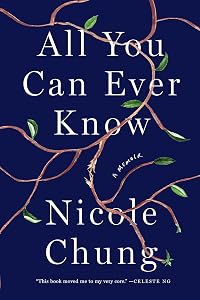
All You Can Ever Know: A Memoir
by Nicole Chung
On This Page
Description
A NATIONAL BESTSELLERThis beloved memoir "is an extraordinary, honest, nuanced and compassionate look at adoption, race in America and families in general" (Jasmine Guillory, Code Switch, NPR)
What does it means to lose your roots—within your culture, within your family—and what happens when you find them?
Nicole Chung was born severely premature, placed for adoption by her Korean parents, and raised by a white family in a sheltered Oregon town. From childhood, she heard the story of show more her adoption as a comforting, prepackaged myth. She believed that her biological parents had made the ultimate sacrifice in the hope of giving her a better life, that forever feeling slightly out of place was her fate as a transracial adoptee. But as Nicole grew up—facing prejudice her adoptive family couldn’t see, finding her identity as an Asian American and as a writer, becoming ever more curious about where she came from—she wondered if the story she’d been told was the whole truth.
With warmth, candor, and startling insight, Nicole Chung tells of her search for the people who gave her up, which coincided with the birth of her own child. All You Can Ever Know is a profound, moving chronicle of surprising connections and the repercussions of unearthing painful family secrets—vital reading for anyone who has ever struggled to figure out where they belong. show less
Tags
Recommendations


Member Reviews
Nicole grew up knowing she was adopted, but it wasn't until she was an adult and pregnant for her own child that she decided to search for her birth family. This memoir recounts her wrestling with being a Korean American in an all-white family and town, knowing she was loved but also discovering that her adoption story wasn't as simple as it seemed.
Adoption is complicated. I've known adoptees who were, similarly to Nicole, told as young children that their birth parents couldn't keep them but loved them enough to give them a better life. I thought of them often while I read Nicole's story, though none of them had the added challenge of a transracial adoption. She deals with all sorts of complications, thinking through exactly why she show more decided to contact her birth family, and what relationships arose as a result (and didn't). Interspersed in her memories are chapters about her sister, Cindy, and her experiences growing up in the family that had chosen to give Nicole up for adoption. Well-told, thought-provoking personal journey, and I'll look forward to discussing it with my book club. show less
Adoption is complicated. I've known adoptees who were, similarly to Nicole, told as young children that their birth parents couldn't keep them but loved them enough to give them a better life. I thought of them often while I read Nicole's story, though none of them had the added challenge of a transracial adoption. She deals with all sorts of complications, thinking through exactly why she show more decided to contact her birth family, and what relationships arose as a result (and didn't). Interspersed in her memories are chapters about her sister, Cindy, and her experiences growing up in the family that had chosen to give Nicole up for adoption. Well-told, thought-provoking personal journey, and I'll look forward to discussing it with my book club. show less
Korean-American Nicole Chung was adopted as a baby into a white family in southern Oregon. She knew from an early age she was adopted, but had very little information about her birth family, and though she largely accepted her parents' narrative that she was meant to be in their family, she was often alone - ostracized and bullied by white classmates in school. Once in college, however, she was surrounded by Asian classmates as well as white ones, and her Asian-ness no longer made her stand out; however, she didn't feel authentically Asian, as she lacked a connection to the Korean culture and language.
Married and pregnant with her first child, she requested nonidentifying information about her birth family, and eventually made contact show more with her birth parents (who had separated) and with a sister and half-sister. Throughout the process, she was able to rethink the standard adoption narrative she'd been given, and begin to think of adoption not as good or bad, but as realistic vs. oversimplified.
Beautifully paced and written, this story is at once common and unique, and can function as a "mirror" for adoptees (especially transracial adoptees) and their families as well as a window for others. Thoughtful, careful, true. Excellent.
Quotes
Family lore given to us as children has such hold over us, such staying power. It can form the bedrock of another kind of faith, one to rival any religion, informing our beliefs about ourselves, and our families, and our place in the world. (4-5)
All parents have ways of saying things about their children as if they are indisputable facts, even when the children don't believe them to be true at all. (7)
Childhood was perhaps something to be endured - but in adulthood, you got to choose your own setting, make your own story. (41)
Long after the papers are signed and the original familial bonds are severed, adoption has a way of isolating the adoptee. (63)
As I looked at [my newborn daughter], I knew the person I had been was gone, unmade in an instant by this tiny girl. The rebuilding, I was certain, would take a lifetime. (138)
There are many different kinds of luck; many different ways to be blessed or cursed. (153)
Every time I [act as my white family's de facto Asian ambassador], I am breaching the sacred pact of our family, our once-shared belief that my race is irrelevant in the presence of their love. (208)
Reunion has done more that restore relationships that had once been beyond my ability to fully imagine; it has enabled a shift in existing ones. (212) show less
Married and pregnant with her first child, she requested nonidentifying information about her birth family, and eventually made contact show more with her birth parents (who had separated) and with a sister and half-sister. Throughout the process, she was able to rethink the standard adoption narrative she'd been given, and begin to think of adoption not as good or bad, but as realistic vs. oversimplified.
Beautifully paced and written, this story is at once common and unique, and can function as a "mirror" for adoptees (especially transracial adoptees) and their families as well as a window for others. Thoughtful, careful, true. Excellent.
Quotes
Family lore given to us as children has such hold over us, such staying power. It can form the bedrock of another kind of faith, one to rival any religion, informing our beliefs about ourselves, and our families, and our place in the world. (4-5)
All parents have ways of saying things about their children as if they are indisputable facts, even when the children don't believe them to be true at all. (7)
Childhood was perhaps something to be endured - but in adulthood, you got to choose your own setting, make your own story. (41)
Long after the papers are signed and the original familial bonds are severed, adoption has a way of isolating the adoptee. (63)
As I looked at [my newborn daughter], I knew the person I had been was gone, unmade in an instant by this tiny girl. The rebuilding, I was certain, would take a lifetime. (138)
There are many different kinds of luck; many different ways to be blessed or cursed. (153)
Every time I [act as my white family's de facto Asian ambassador], I am breaching the sacred pact of our family, our once-shared belief that my race is irrelevant in the presence of their love. (208)
Reunion has done more that restore relationships that had once been beyond my ability to fully imagine; it has enabled a shift in existing ones. (212) show less
A touching memoir by a Korean woman who was given up for adoption in the US by her family. Nicole was born prematurely to parents whose marriage was in distress and decided they could not handle the financial strain of a premmie. Her white adoptive parents raised her lovingly in a small Oregon town, but never addressed her cultural needs, her isolation and the racist and cruel treatment she received, especially at school. No mentor, no counselor stepped forward to help and her parents were completely oblivious, possibly because Nicole was afraid of hurting them and perhaps could not even identify the source of her unhappiness. After she married and became pregnant, Nicole became aware of her options as an adoptee and took steps to reach show more out to her sister Cindy, who had been told that Nicole had died at birth. Their relationship, and Nicole's discovery of her birth mother's treatment of Cindy, is revelatory and beautifully told by an author whom the reader would enjoy hearing from again and again, to follow the family's path to healing and love.
Quote: "Was it something we did, as babies, as little children? Something we lacked that made us easier, possible, to part with? I've never met an adoptee who has blamed their birth parents for their decision - we're more likely to turn inward, looking for fault." show less
Quote: "Was it something we did, as babies, as little children? Something we lacked that made us easier, possible, to part with? I've never met an adoptee who has blamed their birth parents for their decision - we're more likely to turn inward, looking for fault." show less
This book was very buzzy on my Twitter timeline last year, so I jumped on it when I saw it at the library. All You Can Ever Know is a moving memoir, and I'm thinking about picking up my own copy.
I am not an adoptee. I did grow up in Idaho, however, where I was the only Asian in my grade through elementary school and in middle school, we numbered enough I could count on my hands (a hapa girl, me, a Thai guy, and two Korean adoptees). One of the adoptees was a close friend of mine through high school, and I've always wondered if she was ever curious about her birth family, or ever felt a sense of loss. Our school is a moderate size (~1,000 students), but I recall some microaggressions, mostly from people simply not knowing any Asians but show more a handful (though honestly I felt stronger discrimination for being non-Mormon). Like child!Nicole, whenever I visit somewhere with an AsAm community like Seattle, I marvel at what it might've been like to see other faces like mine, to potentially have access to language classes etc. though I do have the tether of family we could visit.
It feels personal to me as well because I had an unplanned pregnancy at 21, and my then-BF's parents strongly pressured me to think about adoption as an option- I pictured the nightmare scenario of there only being so many Asian kids in my community and my parents wondering if their grandchild out there, somewhere. In the end, I chose to abort but it really made me realize that I don't think I personally could adopt out, especially if transracial adoptive parents haven't fully figured out how to approach their child's experiences. I know every story is different, but the anguish Nicole felt keeping her feelings to herself in an Oregon town really punched me in the gut.
Weaving in the story of her sister and the joy of building that connection is beautiful. I haven't read many adoption narratives, but this is a good one. show less
I am not an adoptee. I did grow up in Idaho, however, where I was the only Asian in my grade through elementary school and in middle school, we numbered enough I could count on my hands (a hapa girl, me, a Thai guy, and two Korean adoptees). One of the adoptees was a close friend of mine through high school, and I've always wondered if she was ever curious about her birth family, or ever felt a sense of loss. Our school is a moderate size (~1,000 students), but I recall some microaggressions, mostly from people simply not knowing any Asians but show more a handful (though honestly I felt stronger discrimination for being non-Mormon). Like child!Nicole, whenever I visit somewhere with an AsAm community like Seattle, I marvel at what it might've been like to see other faces like mine, to potentially have access to language classes etc. though I do have the tether of family we could visit.
It feels personal to me as well because I had an unplanned pregnancy at 21, and my then-BF's parents strongly pressured me to think about adoption as an option- I pictured the nightmare scenario of there only being so many Asian kids in my community and my parents wondering if their grandchild out there, somewhere. In the end, I chose to abort but it really made me realize that I don't think I personally could adopt out, especially if transracial adoptive parents haven't fully figured out how to approach their child's experiences. I know every story is different, but the anguish Nicole felt keeping her feelings to herself in an Oregon town really punched me in the gut.
Weaving in the story of her sister and the joy of building that connection is beautiful. I haven't read many adoption narratives, but this is a good one. show less
As the mother of an adopted Korean girl, I immediately bought several copies of this title. It did not disappoint. I have wanted to see someone write a book like this for a long time. It is informative and moving. Words to describe the experience of Korean adoptions and adoptive reunions well have escaped me, and it was wonderful to read this book. Yes, adoption begins sunshine and roses, and yes, the simplified stories we tell young children are full of happiness. But the deep complexities of being another race in a white family -- and part of the white dominate culture are shared with clear and truthful writing in this book. The truth could not often be told in many situations that arise in the book, as in the lives of others in such show more mixed-race families. When the author is finally in the midst of other Asians at college, she finally was relieved to not be surrounded by white people who had no idea what to make of her. In elementary school, she was the only Korean and endured many ignorant comments and teasing. The teachers were apparently unaware. Kids wondered if she could see through her eyes, and more.
She wonders what it would be like to look at her face in the mirror and know you would always belong. She says, "I know my place in my adoptive family is secure. That is not the same thing as always feeling that I belong." Hard-hitting words for adoptive parents. The author says books focus on adopting infants but do not tell what it is like to be an older adoptee. When she was growing up, picture books and novels did not have Asian heroes or heroines; and in TV shows and movies they played minor and even unflattering roles. Hopefully, multicultural children's books and novels are more available now. TV seems to have improved in this area, although Crazy Rich Asians is the first movie in 25 years to have an all Asian cast in the USA.
The author states pretending her race does not matter is no longer a choice she can make. She often felt unseen in her white family.
This is not the story of a foreign adoption as you might think. However, families who have adopted children from Korea will benefit from understanding how the world looks to their children. Hopefully, adoption agencies have more resources for such adoptions than they had before. show less
She wonders what it would be like to look at her face in the mirror and know you would always belong. She says, "I know my place in my adoptive family is secure. That is not the same thing as always feeling that I belong." Hard-hitting words for adoptive parents. The author says books focus on adopting infants but do not tell what it is like to be an older adoptee. When she was growing up, picture books and novels did not have Asian heroes or heroines; and in TV shows and movies they played minor and even unflattering roles. Hopefully, multicultural children's books and novels are more available now. TV seems to have improved in this area, although Crazy Rich Asians is the first movie in 25 years to have an all Asian cast in the USA.
The author states pretending her race does not matter is no longer a choice she can make. She often felt unseen in her white family.
This is not the story of a foreign adoption as you might think. However, families who have adopted children from Korea will benefit from understanding how the world looks to their children. Hopefully, adoption agencies have more resources for such adoptions than they had before. show less
Best for: Anyone interested in a beautifully written memoir that explores adoption, transracial adoption, race, and family.
In a nutshell: Author Nicole Chung was born to Korean parents in the US and adopted by a white couple. In this book, she explores what it meant to be one of the only Asian people around growing up, as well as how she connected with some of her birth family.
Worth quoting:
“People were not so simple; people could be and think and want many different things at once.”
Why I chose it:
I’ve seen so many people online raving about it.
Review:
This is a lovely book. When thinking about words that could describe it, I could also have gone with powerful, honest, or insightful. But I chose lovely because the writing is just show more that, as is the way the author handles complex and complicated issues.
Nicole Chung was born two months premature to parents who had moved to the US from Korea just five years prior to her birth. They already had one child together; they chose to place Ms. Chung up for adoption, but not through what we would probably think of as regular channels (i.e., an agency). Instead, someone working in the hospital knows the couple who would become Ms. Chung’s adoptive parents and alerts them to this possibility.
Ms. Chung is raised in the pacific northwest, in a part of Oregon with very few other Asian individuals. Her parents are always open about the fact of her adoption, but they don’t take steps to help Ms. Chung learn about her Korean heritage, and she doesn’t not pursue it independently much until she reaches college. Once she is married, she decides to see if she can get in touch with her birth family, motivated further when she learns that she may have a sister.
This book explores one story, and it is not claiming to be universal, but still, the issues it addresses can apply to so many of us, I think. There are obviously some specifics (e.g. the reality of transracial adoption) that may only be directly relatable to similarly situated individuals, but the overall concepts of belonging and family, about other possible life scenarios, about whether a choice was the best one (and if that is even the right question to ask), about how our families influence who we become, and even about nature vs. nurture, they all take up space here. I’ll be thinking about this one long after I pick up my next read. show less
In a nutshell: Author Nicole Chung was born to Korean parents in the US and adopted by a white couple. In this book, she explores what it meant to be one of the only Asian people around growing up, as well as how she connected with some of her birth family.
Worth quoting:
“People were not so simple; people could be and think and want many different things at once.”
Why I chose it:
I’ve seen so many people online raving about it.
Review:
This is a lovely book. When thinking about words that could describe it, I could also have gone with powerful, honest, or insightful. But I chose lovely because the writing is just show more that, as is the way the author handles complex and complicated issues.
Nicole Chung was born two months premature to parents who had moved to the US from Korea just five years prior to her birth. They already had one child together; they chose to place Ms. Chung up for adoption, but not through what we would probably think of as regular channels (i.e., an agency). Instead, someone working in the hospital knows the couple who would become Ms. Chung’s adoptive parents and alerts them to this possibility.
Ms. Chung is raised in the pacific northwest, in a part of Oregon with very few other Asian individuals. Her parents are always open about the fact of her adoption, but they don’t take steps to help Ms. Chung learn about her Korean heritage, and she doesn’t not pursue it independently much until she reaches college. Once she is married, she decides to see if she can get in touch with her birth family, motivated further when she learns that she may have a sister.
This book explores one story, and it is not claiming to be universal, but still, the issues it addresses can apply to so many of us, I think. There are obviously some specifics (e.g. the reality of transracial adoption) that may only be directly relatable to similarly situated individuals, but the overall concepts of belonging and family, about other possible life scenarios, about whether a choice was the best one (and if that is even the right question to ask), about how our families influence who we become, and even about nature vs. nurture, they all take up space here. I’ll be thinking about this one long after I pick up my next read. show less
I didn't complete this audiobook but certainly got something out of it. The point of view of the adopted girl growing up in an environment of being aware of her difference. All the attending aspects of adoption from her perspective. There are some thought provoking insights here that have implications for policy and individuals.
Members
- Recently Added By
Lists

Best Biographies, Autobiographies and Memoirs
465 works; 160 members

Top Five Books of 2018
802 works; 265 members

Litsy Awards 2018
248 works; 9 members

History: Asia
103 works; 1 member
Author Information

5+ Works 1,201 Members
Some Editions
Awards and Honors
Awards
Distinctions
Common Knowledge
- Canonical title
- All You Can Ever Know: A Memoir
- Original title
- All You Can Ever Know: A Memoir
- Original publication date
- 2018
- People/Characters
- Nicole; Dan; Cindy; Jessica; Abigail; Rick (show all 8); Mr. Chung; Grace
- Important places
- Seattle, Washington, USA; Oregon, USA
- Epigraph
- I wanted to know,
whoever I was, I was
---MARY OLIVER, "Dogfish"
What? You too? I thought I was the only one.
---C.S. LEWIS, The Four Loves - Dedication
- for Cindy and for our daughters
- First words
- The story my mother told me about them was always the same.
- Quotations
- What was worse, to know nothing? Or to learn things that broke my heart?
- Last words
- (Click to show. Warning: May contain spoilers.)"Let's start at the beginning."
- Blurbers
- Ng, Celeste; Lee, Min Jin; Ortberg, Daniel Mallory; Salesses, Matthew; Chee, Alexander; Rowell, Rainbow (show all 8); Valenti, Jessica; Kwon, R. O.
- Original language*
- English
*Some information comes from Common Knowledge in other languages. Click "Edit" for more information.
Classifications
- Genres
- Biography & Memoir, Nonfiction, General Nonfiction
- DDC/MDS
- 362.734 — Society, government, & culture Social problems and social services Social Welfare Child welfare Adoption Adopted Children
- LCC
- HV874.82 .C457 .A3 — Social sciences Social pathology. Social and public welfare. Criminology Social pathology. Social and public welfare. Protection, assistance and relief Special classes Children Destitute, neglected, and abandoned
- BISAC
Statistics
- Members
- 786
- Popularity
- 35,447
- Reviews
- 34
- Rating
- (3.86)
- Languages
- English
- Media
- Paper, Audiobook, Ebook
- ISBNs
- 12
- ASINs
- 3