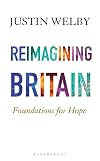
Reimagining Britain: Foundations for Hope
by Justin Welby
On This Page
Description
In a time of political turbulence, and as the Welfare State totters under the strain in a country that has changed dramatically since 1945, Archbishop Justin Welby sets out to identify the values that will enable us to reimagine, and to enact, a more hopeful future. The thesis is that the work of reimagining is as great as it was in 1945, and will happen either by accident - and thus badly - or deliberately. The author draws on Britain's history and Christian tradition to identify this show more country's foundational values, and the building blocks necessary to implement them in a post-Brexit, multicultural society. He explores the areas in which values are translated into action, including the traditional three of recent history: health (especially public, and mental), housing and education. To these he adds family; the environment; economics and finance; peacebuilding and overseas development; immigration; and integration. He looks particularly at the role of faith groups in enabling, and contributing to, a fairer future. When so many are immobilized by political turmoil, this book builds on our past to offer hope for the future, and practical ways of achieving a more equitable society. show lessTags
Recommendations








































Member Reviews
Members
- Recently Added By
Lists

TLS 6010
39 works; 1 member
Author Information
8+ Works 173 Members
Justin Welby is the Archbishop of Canterbury. Before ordination, he worked in the oil industry, becoming group treasurer of a large British exploration and production company. He has for many years been closely involved in reconciliation work, both at home and overseas. He is the author of Dethroning Mammon: The Archbishop of Canterbury's Lent show more Book 2017. show less
Awards and Honors
Distinctions
The Guardian Book of the Day (2018-03-05)
Common Knowledge
- Quotations
- Practices led by faith groups encourage social community, seek the common good, develop a sense of belonging and generosity, and have a sense of resilience and sustainability since they rely on a narrative of the love and com... (show all)passion of God rather than government funding. They nurture implicit values that are designed to carry over into working life or social activities. They are seldom authoritarian and most often are simply stores of grace and love, neither manipulative nor instrumentalizing people's need for their own purposes.
...opposition... arises from the implicit, and often explicit, criticism of attitudes and standards proclaimed outside religious faith. Sometimes this is the result of harshly and hypocritically judgemental attitudes by relig... (show all)ious believers, but frequently it is simply through the way that their words and actions hold up a mirror to others. The reflection is not as attractive or valuable as these others might have hoped.
The greatest challenge that faces a liberal society that is open to question is not subversion, but its own fear of challenge and contradiction.
Classifications
- Genres
- Nonfiction, Sociology, Religion & Spirituality, General Nonfiction, History, Philosophy
- DDC/MDS
- 261.80941 — Religion Christian organization, social work & worship Social theology and interreligious relations and attitudes Christianity and socioeconomic problems
- LCC
- BT738 .W43 — Philosophy, Psychology and Religion Doctrinal Theology Doctrinal Theology Creation
- BISAC
Statistics
- Members
- 31
- Popularity
- 877,406
- Rating
- (3.25)
- Languages
- English
- Media
- Paper, Ebook
- ISBNs
- 3