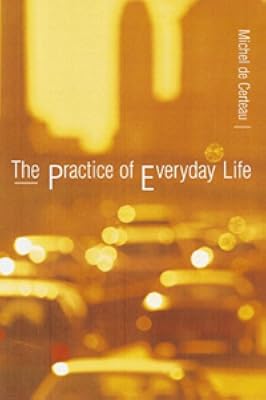
The Practice of Everyday Life
by Michel de Certeau
On This Page
Description
Michel de Certeau considers the uses to which social representation and modes of social behavior are put by individuals and groups, describing the tactics available to the common man for reclaiming his own autonomy from the all-pervasive forces of commerce, politics, and culture. In exploring the public meaning of ingeniously defended private meanings, de Certeau draws on an immense theoretical literature in analytic philosophy, linguistics, sociology, semiology, and anthropology--to speak show more of an apposite use of imaginative literature. show lessTags
Recommendations


















Member Reviews
This is a highly moral book. It is written in a kind of theorese, but one I have a lot of patience for, because you can see Certeau struggling to articulate a vocabulary for talking about previously untheorized and largely unconsidered practices--talking, walking, reading, writing, dying.
Certeau's main argument is that by focusing on the production of culture, we characterize human beings as passive consumers instead of active users, and that this is doing ourselves an injustice. The more relevant distinction than production/consumption is strategy/tactic--strategies are the disciplining sets of concepts, ideologies, rules and parameters that make possible or impossible certain kinds of actions and ways of conceiving, and tactics--which show more in a lovely way Certeau connects with both Sun Tzu and Clausewitz, but also with Kant's notion of logische Takt--logical tact--and metis, the Greek intelligence epitomized by Odysseus (tricky, wrestler of Proteus, etc.) that knows what to do. It's not "appropriateness," because that assumes a strategic outlook--"these are the rules." It's neither tact nor tactic, but a concept breaking down that opposition which I have not come up with a name for yet--tactality? tacticfulness? non-situational metis? Knowing how to improvise?
A tactic depends on a gift economy, where everything's worth is not known. A tactic is distinguished from guerilla warfare by recognizing its weakness, by never seeking to win. There is a lot to say about a tactic. In any case, it's a concept with obvious awesome implications for sticking it to the Man, and Certeau even obligingly lets you know about a sub-concept in France, perruque, which is appropriation of the resources and time of work for your own purposes, be it writing a love poem, checking facebook, stealing staples, or photocopying your buttocks. We be scavengers!
And so on, right? What were we doing, inchoately, with Capture the Flag? Reclaiming urban space and turning it to our own purposes, improvising a game with the city as field of battle. Breaking up the strategic lines of power. If writing is inscription of a master strategy, building an edifice, reading can be tactical, stealing a "white pebble" and taking it home to build a nest. In some ways I wonder what would happen if we were only allowed to talk about our everyday lives using this vocabulary, and only allowed to talk about our intellectual pursuits using the vocabulary of the everyday. show less
Certeau's main argument is that by focusing on the production of culture, we characterize human beings as passive consumers instead of active users, and that this is doing ourselves an injustice. The more relevant distinction than production/consumption is strategy/tactic--strategies are the disciplining sets of concepts, ideologies, rules and parameters that make possible or impossible certain kinds of actions and ways of conceiving, and tactics--which show more in a lovely way Certeau connects with both Sun Tzu and Clausewitz, but also with Kant's notion of logische Takt--logical tact--and metis, the Greek intelligence epitomized by Odysseus (tricky, wrestler of Proteus, etc.) that knows what to do. It's not "appropriateness," because that assumes a strategic outlook--"these are the rules." It's neither tact nor tactic, but a concept breaking down that opposition which I have not come up with a name for yet--tactality? tacticfulness? non-situational metis? Knowing how to improvise?
A tactic depends on a gift economy, where everything's worth is not known. A tactic is distinguished from guerilla warfare by recognizing its weakness, by never seeking to win. There is a lot to say about a tactic. In any case, it's a concept with obvious awesome implications for sticking it to the Man, and Certeau even obligingly lets you know about a sub-concept in France, perruque, which is appropriation of the resources and time of work for your own purposes, be it writing a love poem, checking facebook, stealing staples, or photocopying your buttocks. We be scavengers!
And so on, right? What were we doing, inchoately, with Capture the Flag? Reclaiming urban space and turning it to our own purposes, improvising a game with the city as field of battle. Breaking up the strategic lines of power. If writing is inscription of a master strategy, building an edifice, reading can be tactical, stealing a "white pebble" and taking it home to build a nest. In some ways I wonder what would happen if we were only allowed to talk about our everyday lives using this vocabulary, and only allowed to talk about our intellectual pursuits using the vocabulary of the everyday. show less
I would rename the last chapter, "The Unnameable", and call it "The Unreadable". But otherwise pretty fun.
I echo some of the previous readers' comments about the density and difficulty of De Certeau's sentences - I had to look up words in the dictionary 3 times in one sentence at some point, and this was at the graduate school level. However, I also love love his metaphor of walking in the city as a way of affirming individual ways of doing life, of seeing, of choosing, of practicing everyday life, in contrast to mainstream ways that society is constructed, as expressed in the metaphor by the set routes and paths laid out for us in a typical city grid. There are so many ways this idea applies to discourses of power, identity, memory and a myriad of other areas we look at in life and were challenged to look at in grad school. I want to take show more another stab at the way he approached Derrida - difficult but I think it will be worth mining for ideas. show less
This is a book I recommended frequently to people without actually having read, given that a classmate of mine back in the Medieval Spatial Theory course had explained parts of it very persuasively. It was hard to find in stores so I bought it online, and found it a very beautiful (and very deliciously-smelling) book. I read most of this in the Dublin airport (side-by-side with [b:The Last Unicorn|29127|The Last Unicorn (The Last Unicorn, #1)|Peter S. Beagle|https://d.gr-assets.com/books/1358147318s/29127.jpg|902304]) which might be pretty fitting when you've got a book thinking about even our interactions with space as codifiers of social behaviour. I think it's one that I've got to go over again in smaller sections to really get to show more the meat of different chapters. But I'm glad to now have read the book and am better able to justify recommendations, rather than interpreting an interpretation (though I still will always love & think foremost of that friend's take on the book--I could not help but read it through his lens and I think always will). show less
Ahh, French philosophers! They can write and write, and it makes sense while you read it, but then you look at reality around and wonder what all this bullshit is about, put the book down, only to be blindsided by its pertinence at strange and prevenient times throughout the rest of your life.
Really could not get over the conceit of complaining that everyday language is not discussed in academia whilst using language that is night inaccessible to those that he discusses
An absolutely incredible perceptive trail through modern urban life, told with a voice that seems to understand the heartbeat of a city.
Members
- Recently Added By
Lists

culture
320 works; 1 member
Author Information

60+ Works 2,662 Members
Awards and Honors
Notable Lists
Common Knowledge
- Canonical title*
- The Practice of Everyday Life
- Original title
- L'invention du quotidien. Arts de faire
- Original publication date
- 1980
- Dedication
- To the ordinary man.
*Some information comes from Common Knowledge in other languages. Click "Edit" for more information.
Classifications
- Genres
- Nonfiction, Sociology, Anthropology, Philosophy, Literature Studies and Criticism, General Nonfiction, History
- DDC/MDS
- 301 — Society, government, & culture Social sciences, sociology & anthropology Sociology and anthropology
- LCC
- HN8 .C4313 — Social sciences Social history and conditions. Social problems. Social reform Social history and conditions. Social problems.
- BISAC
Statistics
- Members
- 1,222
- Popularity
- 20,280
- Reviews
- 11
- Rating
- (4.03)
- Languages
- 5 — English, Finnish, French, Italian, Spanish
- Media
- Paper, Ebook
- ISBNs
- 9
- ASINs
- 4