Barbary
by Vonda N. McIntyre
On This Page
Description
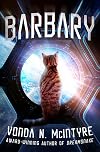
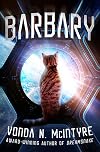
A story of feline first contact by the Hugo and Nebula Award-winning author that "recalls Robert Heinlein's excellent stories for this age group" (Publishers Weekly). Twelve-year-old Barbary has been dreaming of going to space for as long as she can remember. Now, the orphan is on her way, joining the family of her mother's best friend on the research station Einstein--but she won't be going alone. Barbary can't bear to leave behind her only friend, a Manx tabby cat named Mickey. Getting show more used to zero gravity is just one challenge the pair will face on their journey; when they finally land on Einstein, Barbary will have to trust her new sister with her secret stowaway. But Mickey's mischievous nature may get Barbary kicked off of her new home for good--and put all of humanity at risk as an alien ship flies their way... "Excitement about space, living on a frontier, and... down-to-earth mechanical details... McIntyre displays the talent that won her acclaim." --Publishers Weekly "Engrossing. A lot of physics and engineering are woven unobtrusively into the book. Good for buffs and newcomers." --Kirkus Reviews show lessTags
Recommendations
















Member Recommendations

Member Reviews
Seems more like YA. Main character a teen, a dependent minor. Writing style more straightforward, focused on the teen learning about world/self/duty.
The other problem is that the stuff in the blurb doesn't even begin to happen until past halfway. The first half of the book is interesting, but the stuff there should be mentioned in the blurb so as to not provoke frustration. By stuff I mean getting up to the space station, adjusting to new family and to new environment (including low- and no-gravity).
I would have enjoyed this very much if I were younger or less jaded from reading too much. 3.5 stars rounded down; I enjoyed it but can't quite recommend it.
The other problem is that the stuff in the blurb doesn't even begin to happen until past halfway. The first half of the book is interesting, but the stuff there should be mentioned in the blurb so as to not provoke frustration. By stuff I mean getting up to the space station, adjusting to new family and to new environment (including low- and no-gravity).
I would have enjoyed this very much if I were younger or less jaded from reading too much. 3.5 stars rounded down; I enjoyed it but can't quite recommend it.
Barbary by Vonda N. McIntyre
Since I have been reading science fiction literature related to cats lately, I thought I would have a look at this classic story from the 1980s.
This is a work of children's/young-adult fiction, so more mature readers may feel that the content is a little lacking in depth. It is a relatively short book, and the writing style of the author makes it engaging and very easy to read.
The main plotline is about a twelve-year-old girl who smuggles a cat onto a space station, while a first-contact subplot unfolds in the background.
The characters are well developed and realistic, and there are women in positions of influence in science and government. The young people (Barbary and Heather) care about the kinds of show more things you would expect. Thus, while the attention of the adults in the story is firmly fixed on the alien craft swiftly approaching the space station, the two girls are more concerned with the activities of Mickey the cat.
Although this book was written in the relatively recent 1980s (which I remember well), there are aspects which make it feel dated. Firstly, the spaceport security is frighteningly lax, which marks this as a pre-911 work of fiction. Secondly, although the girls interact with talking computers, there are none of the handheld devices which now rule the lives of many people.
Despite those excusable divergences from our reality, the ways in which the laws of physics affect life on a space station are described very convincingly, and are more detailed and accurate than the depictions in many novels written for more mature audiences. Vonda McIntyre's Barbary would undoubtedly be a good introduction to hard science fiction for young people. In addition, the aliens are also quite believable and certainly not of the stereotypical little-green-man kind.
I am sure that if I had read this book as a child, I would have thoroughly enjoyed it. As an adult and regular reader of science fiction, I still found it satisfying. So much so, in fact, that I have gone on without delay to read the award-winning novel Dreamsnake by the same author. show less
Since I have been reading science fiction literature related to cats lately, I thought I would have a look at this classic story from the 1980s.
This is a work of children's/young-adult fiction, so more mature readers may feel that the content is a little lacking in depth. It is a relatively short book, and the writing style of the author makes it engaging and very easy to read.
The main plotline is about a twelve-year-old girl who smuggles a cat onto a space station, while a first-contact subplot unfolds in the background.
The characters are well developed and realistic, and there are women in positions of influence in science and government. The young people (Barbary and Heather) care about the kinds of show more things you would expect. Thus, while the attention of the adults in the story is firmly fixed on the alien craft swiftly approaching the space station, the two girls are more concerned with the activities of Mickey the cat.
Although this book was written in the relatively recent 1980s (which I remember well), there are aspects which make it feel dated. Firstly, the spaceport security is frighteningly lax, which marks this as a pre-911 work of fiction. Secondly, although the girls interact with talking computers, there are none of the handheld devices which now rule the lives of many people.
Despite those excusable divergences from our reality, the ways in which the laws of physics affect life on a space station are described very convincingly, and are more detailed and accurate than the depictions in many novels written for more mature audiences. Vonda McIntyre's Barbary would undoubtedly be a good introduction to hard science fiction for young people. In addition, the aliens are also quite believable and certainly not of the stereotypical little-green-man kind.
I am sure that if I had read this book as a child, I would have thoroughly enjoyed it. As an adult and regular reader of science fiction, I still found it satisfying. So much so, in fact, that I have gone on without delay to read the award-winning novel Dreamsnake by the same author. show less
Barbary, an orphan is delighted to find a new home and a new family. It’s with two scientists and their daughter aboard a space station. There’s only one problem she smuggles her pet cat Mickey onto the Einstein, a place that’s supposed to be a scrupulously clean environment, all the crew members are human who’ve been screened and checked for diseases. No one wants toxic microbes imported where they can breed freely and contaminate the station, and Mikey is unscreened and non-human.
What could possibly go wrong? Find out when the cat gets loose just when the first encounter with extraterrestrials is imminent.
What could possibly go wrong? Find out when the cat gets loose just when the first encounter with extraterrestrials is imminent.
Story about a girl growing up in a pretty constrained society. Makes friends with a cat. Gets into trouble. Small stakes turn into big stakes. A little too short and simplistic but I liked the concept and the world. And the cat. Some parts a little contrived to appeal to a younger audience.
Barbary is a twelve-year-old girl who has spent a good deal of time in the foster system, enjoys magic tricks, and likes cats--one imparticular, named Mike.
When the story starts, she is awaiting placement on a shuttle that should take her to the space station. Her trip to her new family--where she will be under the care of an old friend of her mother--has been repeatedly delayed. Barbary gets more an more nervous, because she is smuggling--and the adventure only gains momentum with the introduction of other beings--aliens approaching the space station!
This is an enjoyable book; the style and the heroine also make it a good novel for young adults. All in all, an enjoyable if quick read.
When the story starts, she is awaiting placement on a shuttle that should take her to the space station. Her trip to her new family--where she will be under the care of an old friend of her mother--has been repeatedly delayed. Barbary gets more an more nervous, because she is smuggling--and the adventure only gains momentum with the introduction of other beings--aliens approaching the space station!
This is an enjoyable book; the style and the heroine also make it a good novel for young adults. All in all, an enjoyable if quick read.
Fairly thin juvenile SF. Though there's an alien vessel entering the solar system, almost the entire short novel is about the mishaps of Barbary as she smuggles her cat onto a research space station. After quite a few chapters, we get a few brief glimpses into what makes Barbary and her "sister" Heather tick. More would have been good. There's a good attempt to describe what it's like to live inside a spinning wheel, but the outside -- hard vacuum in every direction -- is never well conveyed.
Not bad as in throw against the wall, but nothing to seek out.
Not bad as in throw against the wall, but nothing to seek out.
A cute science fiction book for a younger audience. I enjoyed reading this book - both the writing and the story itself. I especially enjoyed the diversity of the cast, and strong female characters for the time it was written (late 80s). It seems like the book could have continued a little longer, since the ending seems a bit abrupt, but I don't think a younger reader would really notice.
Members
- Recently Added By
Lists

Books Set in Outer Space
39 works; 9 members

Books Read in 2018
4,360 works; 110 members

Cats in Fiction
209 works; 9 members
Author Information

Vonda Neel McIntyre was born in Louisville, Kentucky on August 28, 1948. She received a bachelor's degree in biology from the University of Washington in 1970 and studied genetics there as a postgraduate until ending her studies in 1971. In 1973, her short story, Of Mist, Grass, and Sand, won a Nebula Award for best novelette. Her novel, show more Dreamsnake, won a Nebula Award and a Hugo Award in 1978. She wrote five Star Trek novels including The Entropy Effect and Enterprise: The First Adventure. Her other novels included Curve of the World and The Moon and the Sun, which won a Nebula Award in 1997. She died from pancreatic cancer on April 1, 2019 at the age of 70. (Bowker Author Biography) show less
Some Editions
Common Knowledge
- Canonical title
- Barbary
- Original title
- Barbary
- Original publication date
- 1986-06
- People/Characters
- Barbary
- Dedication
- I'm grateful to Dr John G Cramer, of the University of Washington in Seattle. He offered expert advice that helped immeasurably in the creation of the research station Einstein and, particularly, in the descriptions of what i... (show all)t would be like to live and work in an environment in which gravity is provided by radial acceleration.
I'm also indebted to Dr. Gerard K O'Neill, of Princeton, the Geostar Corporation, and the Space Studies Institute (Box 82, Princeton, NJ, 08540). The society to which Barbary emigrates grew out of Dr. O'Neill's proposals for permanent inhabited orbiting colonies, the mass driver, and other practical ideas for allowing human beings to live in space.
For My Other Sister - First words
- High in the corners of the spaceport waiting room, four small TV screens displayed a spaced shuttle, piggybacked on external fuel tanks, shedding clouds of vapor down its flanks.
- Last words
- (Click to show. Warning: May contain spoilers.)"...They're bringing us home."
Classifications
- Genres
- Fiction and Literature, Science Fiction, Young Adult
- DDC/MDS
- 813.54 — Literature & rhetoric American literature in English American fiction in English 1900-1999 1945-1999
- LCC
- PZ7 .M478656 .B — Language and Literature Fiction and juvenile belles lettres Fiction and juvenile belles lettres Juvenile belles lettres
- BISAC
Statistics
- Members
- 290
- Popularity
- 110,856
- Reviews
- 8
- Rating
- (3.31)
- Languages
- English
- Media
- Paper, Audiobook, Ebook
- ISBNs
- 4
- ASINs
- 6