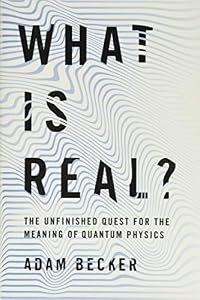
What Is Real?: The Unfinished Quest for the Meaning of Quantum Physics
by Adam Becker
On This Page
Description
"Quantum mechanics is humanity's finest scientific achievement. It explains why the sun shines and how your eyes can see. It's the theory behind the LEDs in your phone and the nuclear hearts of space probes. Every physicist agrees quantum physics is spectacularly successful. But ask them what quantum physics means, and the result will be a brawl. At stake is the nature of the Universe itself. What does it mean for something to be real? What is the role of consciousness in the Universe? And show more do quantum rules apply to very small objects like electrons and protons, but not us? In What is Real?, Adam Becker brings to vivid life the brave researchers whose quest for the truth led them to challenge Bohr: David Bohm, who picked up Einstein's mantle and sought to make quantum mechanics deterministic, all while being hounded by the forces of McCarthyism; Hugh Everett, who argued that everything, big and small, must be governed by the same rules; and John Bell, who went to great lengths to eradicate the power of the god-like observer from the core of quantum physics. And they paid dearly, their reputations, careers, and sometimes lives ruined completely. But history has been kinder to them than their contemporaries were. As Becker shows, the brave intellectual giants have inspired a growing army of physicists and philosophers intent both on making a philosophically more satisfying theory of the universe and a more useful one as well. A gripping story of some of humanity's greatest ideas and the high cost with which many have pursued them, What is Real? is intellectual history at its passionate best"-- show lessTags
Recommendations













Member Reviews
Adam Becker has obviously taken to heart the story that every equation drops the sales of a book by half (or whatever the fraction is)....because I don't think there is an equation in there. And that is no mean feat for a book written by a PhD in Astrophysics, writing (essentially) about quantum theory. Actually, I found the book a delight to read...maybe because of the lack of equations. It's written as a story. The story of the development of ideas about quantum theory and in particular the dominance of the Copenhagen theory (championed by Bohr) and all the other theories that have been put forward to either supplement it or replace it. Famously, Einstein refused to accept the Copenhagen interpretation which basically denies that show more there is any reality associated with the theorems. It's a "shut up and calculate" approach. The theory gives the right answers ...so who cares what it actually means in terms of the underlying reality.
I found this book fascinating on so many levels. At one level it is the story of the attempts by many scientists to peer behind the equations and understand what is "really" going on at the quantum level and at another level it is a sociological study about the way that a paradigm is backed by its supporters and they use every trick in the book to frustrate, confound and undermine any deviations from the orthodoxy ....despite clear evidence that something is not quite right with their theory. It's also an interesting historical study about the rise of Naziism in Europe and the impact that this had on physics; the development of the atomic bomb and the consequent militarisation of physics; the rise of McCarthyism and the persecution on political grounds of some physicists ...noteably David Bohm; and the narrow, specialised education of modern physicists.....divorced from philosophy.
I must say that my own education as a scientist was remote from any philosophy of science. We learned it on the job and absorbed attitudes from other scientists....but it was very much in the mode of: idea>theory> experiment test> confirmation or refutation> next idea. I remember a chemist when I was working in the Riverina who refused to accept the interpolation of data from a range of points on a graph...which made perfect sense to everybody else....including me. He argued, "How do we know that between those two points there is not a peak?". Well...in a sense he was right ..we didn't know but most of us were content to accept Occam's Razor......"don't multiply entities beyond necessity". (At least we had picked this idea up in our science courses). And I've always found that a pretty good guide in life. But I digress...my point is that in my experience scientists are not educated to think about the foundations of their knowledge and most are content to "Shut up and calculate". This even applies to the ethical consequences of what they are doing. Plant breeders have very reluctantly come to accept that there might be some ethical implications from their collections of plant materials from the lands of indigenous people and there might be some ethical (or other issues) with the use of genetically modified organisms. People were only starting to think about plant rights when I was a scientist. And some people were taking out patents. Up until then, plant breeders (in my experience anyway) tended to be totally altruistic. We, agricultural scientists, were about feeding the world... not about trying to make our fortunes. We looked askance at those who had gone "over to the other side" and were working for Dekalb or other seed companies.
In summary....scientists are not being taught philosophy ...and as Becker points out... the physicists are openly contemptuous of philosophy.....usually not realising that they are subscribing to one form of philosophy or another and often to a form that has been disproven or undermined.
Becker does a good job of demonstrating the strength of the Copenhagen interpretation and (I assume that he is correct) the force of personality of Bohm and his acolytes in both developing that and in ruthlessly undermining any others bold enough to question it...or to want to do a PhD in the foundations of quantum mechanics.
I was shocked by the treatment meted out to a number of students who pursued research that was contrary to the Copenhagen interpretation ..and, in particular, to Bohm who really (it seems) developed a viable alternative. Why do these guys have such similar names (Bohr, Bohm, Born)??
I remember the words of Bertram Russell in advising a young graduate......(I paraphrase) ...do something in the accepted paradigm to establish your reputation ....only then can you be bold enough to challenge this. Likewise Einstein commenting upon some line of his research that had come up negative. "It's important that I publish these negative results...because I have established my reputation and others could not afford the risk to their reputation....but it is important that others do not repeat the same mistakes".
Becker, I think, makes the point very well that contrary to the popular story, Einstein was not defeated in the famous Bohr- Einstein debates and the EPR thought experiment was never satisfactorily answered. And Einstein was right in insisting that the Copenhagen interpretation was incomplete.
I really learned a lot from this book. Happy to award it 5 stars. show less
I found this book fascinating on so many levels. At one level it is the story of the attempts by many scientists to peer behind the equations and understand what is "really" going on at the quantum level and at another level it is a sociological study about the way that a paradigm is backed by its supporters and they use every trick in the book to frustrate, confound and undermine any deviations from the orthodoxy ....despite clear evidence that something is not quite right with their theory. It's also an interesting historical study about the rise of Naziism in Europe and the impact that this had on physics; the development of the atomic bomb and the consequent militarisation of physics; the rise of McCarthyism and the persecution on political grounds of some physicists ...noteably David Bohm; and the narrow, specialised education of modern physicists.....divorced from philosophy.
I must say that my own education as a scientist was remote from any philosophy of science. We learned it on the job and absorbed attitudes from other scientists....but it was very much in the mode of: idea>theory> experiment test> confirmation or refutation> next idea. I remember a chemist when I was working in the Riverina who refused to accept the interpolation of data from a range of points on a graph...which made perfect sense to everybody else....including me. He argued, "How do we know that between those two points there is not a peak?". Well...in a sense he was right ..we didn't know but most of us were content to accept Occam's Razor......"don't multiply entities beyond necessity". (At least we had picked this idea up in our science courses). And I've always found that a pretty good guide in life. But I digress...my point is that in my experience scientists are not educated to think about the foundations of their knowledge and most are content to "Shut up and calculate". This even applies to the ethical consequences of what they are doing. Plant breeders have very reluctantly come to accept that there might be some ethical implications from their collections of plant materials from the lands of indigenous people and there might be some ethical (or other issues) with the use of genetically modified organisms. People were only starting to think about plant rights when I was a scientist. And some people were taking out patents. Up until then, plant breeders (in my experience anyway) tended to be totally altruistic. We, agricultural scientists, were about feeding the world... not about trying to make our fortunes. We looked askance at those who had gone "over to the other side" and were working for Dekalb or other seed companies.
In summary....scientists are not being taught philosophy ...and as Becker points out... the physicists are openly contemptuous of philosophy.....usually not realising that they are subscribing to one form of philosophy or another and often to a form that has been disproven or undermined.
Becker does a good job of demonstrating the strength of the Copenhagen interpretation and (I assume that he is correct) the force of personality of Bohm and his acolytes in both developing that and in ruthlessly undermining any others bold enough to question it...or to want to do a PhD in the foundations of quantum mechanics.
I was shocked by the treatment meted out to a number of students who pursued research that was contrary to the Copenhagen interpretation ..and, in particular, to Bohm who really (it seems) developed a viable alternative. Why do these guys have such similar names (Bohr, Bohm, Born)??
I remember the words of Bertram Russell in advising a young graduate......(I paraphrase) ...do something in the accepted paradigm to establish your reputation ....only then can you be bold enough to challenge this. Likewise Einstein commenting upon some line of his research that had come up negative. "It's important that I publish these negative results...because I have established my reputation and others could not afford the risk to their reputation....but it is important that others do not repeat the same mistakes".
Becker, I think, makes the point very well that contrary to the popular story, Einstein was not defeated in the famous Bohr- Einstein debates and the EPR thought experiment was never satisfactorily answered. And Einstein was right in insisting that the Copenhagen interpretation was incomplete.
I really learned a lot from this book. Happy to award it 5 stars. show less
Quantum physics is always fascinating; I think I have read about ten books on the subject in my life, mainly popularizing ones, and it continues to fascinate, intrigue, challenge and frustrate. The merit of this book is that it not only presents the classical evolution of “quantum thinking,” with well-known epigones like Niels Bohr, Erwin Schrödinger, Werner Heisenberg, and ‘outsider’ Albert Einstein, but above all it portrays the discussions from after the Second World War.
Adam Becker has a very fluent writing style, knows what he is writing about (as an astrophysicist), and is moreover a philosopher, allowing him to maintain sufficient distance. His focus lies on the problematic nature of the Copenhague Interpretation, which show more essentially states that one should not question the strange phenomena observed in the quantum world, and should simply limit oneself to what works (“shut up and calculate”). As a result, the entire problem of the relationship between the ultrasmall world (where quantum would be confined to according to the Copenhague Interpretation) and reality as we know it is ignored.
Albert Einstein already found this unacceptable, and apparently, after him, there were a whole host of other scientists who could not resign themselves to such an essentially ‘lazy’ attitude. In this book, names I had never heard of appear, such as David Bohm, Hugh Everett, John Bell, and Alain Aspect. Becker actually elevates them to anti-heroes, who have had to pay a heavy price in their personal careers for going against established orthodoxy.
That also makes this book a very fascinating intellectual history. Becker exposes (perhaps a little too eagerly) how science is largely a matter of personalities, people with their pride, vested interests, prejudices, and subservient loyalties, seriously discouraging people who color outside the lines (and are sometimes proven right only decades later).
Towards the end, Becker becomes a bit too verbose for my taste, jumping from one topic to another, so that the big picture gets lost. And occasionally – without being a specialist – I had the impression that his personal preferences started to play a bit too much of a role. His aversion to logical positivism, for example, and his disparaging remarks about ‘Godfather’ Niels Bohr and his acolytes. But anyway, I thoroughly enjoyed reading this. show less
Adam Becker has a very fluent writing style, knows what he is writing about (as an astrophysicist), and is moreover a philosopher, allowing him to maintain sufficient distance. His focus lies on the problematic nature of the Copenhague Interpretation, which show more essentially states that one should not question the strange phenomena observed in the quantum world, and should simply limit oneself to what works (“shut up and calculate”). As a result, the entire problem of the relationship between the ultrasmall world (where quantum would be confined to according to the Copenhague Interpretation) and reality as we know it is ignored.
Albert Einstein already found this unacceptable, and apparently, after him, there were a whole host of other scientists who could not resign themselves to such an essentially ‘lazy’ attitude. In this book, names I had never heard of appear, such as David Bohm, Hugh Everett, John Bell, and Alain Aspect. Becker actually elevates them to anti-heroes, who have had to pay a heavy price in their personal careers for going against established orthodoxy.
That also makes this book a very fascinating intellectual history. Becker exposes (perhaps a little too eagerly) how science is largely a matter of personalities, people with their pride, vested interests, prejudices, and subservient loyalties, seriously discouraging people who color outside the lines (and are sometimes proven right only decades later).
Towards the end, Becker becomes a bit too verbose for my taste, jumping from one topic to another, so that the big picture gets lost. And occasionally – without being a specialist – I had the impression that his personal preferences started to play a bit too much of a role. His aversion to logical positivism, for example, and his disparaging remarks about ‘Godfather’ Niels Bohr and his acolytes. But anyway, I thoroughly enjoyed reading this. show less
Part of the book is devoted to the title's goal of exploring the interpretations of quantum physics. But the subtitle is the real focus, and a bit meta: the history of the philosophy of the foundations of quantum mechanics.
While I found it interesting to view the development of the field through a chronological progression in the context of the intellectual climate of the time, the emphasis on personalities was a distraction more than an aid in understanding the various theories. The photon doesn't care whether the observer is a nazi or communist, womanizer or woman, and adding sociopolitical considerations just makes things more complicated. As a result, there's too much science for a history/philosophy book, and too much history for show more a science book. Both are valid topics and both are presented well, but a more straightforward explanation of the competing theories sans baggage would have been clearer and easier to evaluate. show less
While I found it interesting to view the development of the field through a chronological progression in the context of the intellectual climate of the time, the emphasis on personalities was a distraction more than an aid in understanding the various theories. The photon doesn't care whether the observer is a nazi or communist, womanizer or woman, and adding sociopolitical considerations just makes things more complicated. As a result, there's too much science for a history/philosophy book, and too much history for show more a science book. Both are valid topics and both are presented well, but a more straightforward explanation of the competing theories sans baggage would have been clearer and easier to evaluate. show less
Betteridge's law states when the headline is in the form of a question, the answer is always "No." Applying that to this book, nothing is real and nothing to get hung about. The subtitle admits that searching for the real is an unfinished quest but implies it is finishable. Indeed, our view of science is that its goal is to get to the bottom of things and is the only way to do so we have.
Full disclosure: I side with J. B. S. Haldane and against David Deutch, both of whom show up in this book that "the universe is not only queerer than we suppose, but queerer than we can suppose." But I'm also a human and would like to know what is real. More disclosure: I don't think science will tell us, at least the science we have now, because I show more don't believe a view from nowhere will come up with a view compatible with a view from my perspective.
I'll explain a little so you don't think I'm one of those Continental philosophers that Steven Hawking and Neil DeGrasse Tyson declared irrelevant. I see science, like cartography, as providing maps and all maps leave some things out. You wouldn't use, say, a subway map to measure the distance between two points. As such, I'm fine with the Copenhagen interpretation that Adam Becker clearly dislikes. He never comes out and says so but I believe he sides with David Albert whom he quotes as calling Copenhagen "gibberish." (More disclosure: I also like Copenhagen's TV shows like Borgen and Forbrydelsen.) My background is in mathematics and I understand the concept of isomorphism which allows complementary descriptions for the same underlying systems. As for "shut up and calculate," I don't require the "shut up" part because, as a sometime teacher, I appreciate the need for good explanations. I'll talk more about good explanations when I review David Deutsch later on.
Adam Becker provides lots of explanations. His "Bell's Theorem" description was among the clearest I'd seen. And his historic approach was enlightening, exposing the political and economic underpinnings of what gets studied and which explanations prevail in a subject that is supposed to only be seeking truth. Also, I somehow hadn't been aware before that Heisenberg was a Nazi. I wonder if that entered into Walter White's borrowing his name.
Adam Becker is comes right out and says that Science is mired in the political, but like a good physicist, hopes this can be minimized in practice. He cites the creationists and climate change deniers as being unable or unwilling to make that effort but he forgets that physicist Freeman Dyson (who also appears in this book) thinks much of the climate science is flawed and that too much is being made of global warming.
All in all, this book is a good approach for novices to the cross between philosophy and quantum physics and I enjoyed reading it. show less
Full disclosure: I side with J. B. S. Haldane and against David Deutch, both of whom show up in this book that "the universe is not only queerer than we suppose, but queerer than we can suppose." But I'm also a human and would like to know what is real. More disclosure: I don't think science will tell us, at least the science we have now, because I show more don't believe a view from nowhere will come up with a view compatible with a view from my perspective.
I'll explain a little so you don't think I'm one of those Continental philosophers that Steven Hawking and Neil DeGrasse Tyson declared irrelevant. I see science, like cartography, as providing maps and all maps leave some things out. You wouldn't use, say, a subway map to measure the distance between two points. As such, I'm fine with the Copenhagen interpretation that Adam Becker clearly dislikes. He never comes out and says so but I believe he sides with David Albert whom he quotes as calling Copenhagen "gibberish." (More disclosure: I also like Copenhagen's TV shows like Borgen and Forbrydelsen.) My background is in mathematics and I understand the concept of isomorphism which allows complementary descriptions for the same underlying systems. As for "shut up and calculate," I don't require the "shut up" part because, as a sometime teacher, I appreciate the need for good explanations. I'll talk more about good explanations when I review David Deutsch later on.
Adam Becker provides lots of explanations. His "Bell's Theorem" description was among the clearest I'd seen. And his historic approach was enlightening, exposing the political and economic underpinnings of what gets studied and which explanations prevail in a subject that is supposed to only be seeking truth. Also, I somehow hadn't been aware before that Heisenberg was a Nazi. I wonder if that entered into Walter White's borrowing his name.
Adam Becker is comes right out and says that Science is mired in the political, but like a good physicist, hopes this can be minimized in practice. He cites the creationists and climate change deniers as being unable or unwilling to make that effort but he forgets that physicist Freeman Dyson (who also appears in this book) thinks much of the climate science is flawed and that too much is being made of global warming.
All in all, this book is a good approach for novices to the cross between philosophy and quantum physics and I enjoyed reading it. show less
Paying particularly deep attention to David Bohm, Hugh Everett III, and John Bell, physicist Becker offers an absorbing and mindful-of-philosophy history of efforts to find a better conceptualization of quantum reality than is provided by the Copenhagen interpretation. He spends no more than a couple of pages on modern psi-epistemic interpretations ("information-theoretic" is his term for them) such as QBism and the Relational interpretation of Carlo Rovelli (whose thinking, by the way, is badly misrepresented in an endnote). Whether this indicates that he assumes such approaches are anti-realist (an assumption I suspect would be erroneous), I'm not entirely sure.
The Universal-Wave-Function vs. The Pilot-Schrödinger-Wave-Function vs. the Collapsing-Schrödinger-Wave-function as a Stab at Explaining Reality.
The diversity of possible comments on this book reflects ironically the Everett paradigm of quantum ontology. There are as many views of reality as there are observers. Thankfully in all instances, given the depth of some of the possible interpretations, the interaction of the observer state wave and that of the rest of the universe is extremely asymmetrical - the universe has a great effect on the observer but the latter's effect on the universe is mercifully, infinitesimally small. There is no doubt that the philosophical implications of the developments in modern scientific thinking are in show more lagging mode. This is because of the extreme complexities of the formalisms created to describe the reality as seen by human observers with a certain evolved sense of perception. The modern philosopher has to tread wearily through the theory before emerging tired and almost at wit's end to be in a position to even expound a valid opinion, least of all an emerging new philosophy, on the ontological basis of the quantum world. This is the first time I’ve read a book on Quantum Mechanics wherein three of the major outlier physicists appear: David Bohm, Hugh Everett III, and John Stewart Bell.
I'm always so frustrated by people who are absolutely sure of themselves, although I wouldn't doubt that I do the same kind of thing more often than I'd like. My suspicion is that people can't help but make probability judgments based only on the information available to them at a given time. Many, especially those in the scientific community, are quick to dismiss certain possible viewpoints because they consider them to have an extraordinarily low probability, therefore requiring "extraordinary" evidence to be explored at all. Even though I consider myself a "skeptic" in many ways, I've always doubted this kind of thinking, which I hear all the time from other skeptics. I'm not sure how to put it into words, but maybe it's the word "extraordinary" that I object to in the first place. Wouldn't many modern scientific "facts" and technologies, for example, be considered "extraordinary" by those in the past, even the recent past in some cases? This exclusionary model of (scientific?) thinking seems fundamentally flawed to me, yet on the other hand, I feel I completely understand why it happens. I believe it's simply a practical matter of human limitations on focus and scope. Ought we to not focus on those that have a higher "probability" of being provable and workable? We seemed to have arrived at some sort of logical paradox here. This seemed the attitude that Bohr and his accolades had when confronted with ideas (by Bohm, Everett and Bell) non-aligned with their vision of what was/is real.
Bottom-line: the Alain Aspect experiment leaves us with ONLY a dual choice in terms of interpreting reality: either (1) a hidden variable interpretation of quantum mechanics (as opposed to a wave-function collapse approach, or whatever) is looking less and less plausible, unless we are really happy to reject special relativity of course, or, (2) reality is non-local in the sense that instantaneous action at a distance is possible.
I'm not sure I agree with either; unfortunately both the theory and the experiments force me to choose one or the other. I don't think Kant, or anyone else, anticipated this. Bloody hell! In quantum mechanics, the results of experiments are probabilistic. But no one really knows how or why. By that I mean, are their properties as we measure them "real" or are we really measuring some abstraction of an underlying reality? It would take far too long to go into that here, but there are proponents on either side of the debate - and even within those sides, there's very different approaches. One'd probably find most people would say (for various reasons) that reality is fundamentally probabilistic (there is no underlying reality - no hidden variables), but it's not actually as pinned down as its proponents claim. Currently the most common idea is that the world is fundamentally probabilistic, but one obviously wouldn't' agree with that as a hard determinist. I think an idea I keep banging on about - not because I think it is necessarily right, but because I can't argue its ability to circumvent Bell's Theorem - is super-determinism. So, I don't think complexity can turn a hard deterministic universe into one that appears probabilistic, at least not at the fundamental level. But give me a few days and I'll probably change my mind on that. The thing with hard determinism and free will is that I don't think the two are compatible. I'm going to do what I'm going to do, irrelevant of any independent influence from "me". It's a nonsensical statement, even. That doesn't mean I don't make rational decisions, but what I'm going to do is already decided. On the other hand, if there is a "me" that can have some arbitrary influence on my decision making - how is that any more a case of free will? What instigates that spark of independence, other than some random action I have no control over? Even with an understanding of complexity, I still think it all boils down to those arguments of principles. I think. Basically, the question of free will does both my balls in…
A ham sandwich is better than understanding what is reality! How do we know that?
1. NOTHING is better than understanding what is reality -- AND
2. A ham sandwich is BETTER than NOTHING!
Ipso facto; QED!
NB: Becker’s attempt at explaining Bell’s inequality theorem by using the casino analogy is nothing short of masterful. Well done Sir! show less
The diversity of possible comments on this book reflects ironically the Everett paradigm of quantum ontology. There are as many views of reality as there are observers. Thankfully in all instances, given the depth of some of the possible interpretations, the interaction of the observer state wave and that of the rest of the universe is extremely asymmetrical - the universe has a great effect on the observer but the latter's effect on the universe is mercifully, infinitesimally small. There is no doubt that the philosophical implications of the developments in modern scientific thinking are in show more lagging mode. This is because of the extreme complexities of the formalisms created to describe the reality as seen by human observers with a certain evolved sense of perception. The modern philosopher has to tread wearily through the theory before emerging tired and almost at wit's end to be in a position to even expound a valid opinion, least of all an emerging new philosophy, on the ontological basis of the quantum world. This is the first time I’ve read a book on Quantum Mechanics wherein three of the major outlier physicists appear: David Bohm, Hugh Everett III, and John Stewart Bell.
I'm always so frustrated by people who are absolutely sure of themselves, although I wouldn't doubt that I do the same kind of thing more often than I'd like. My suspicion is that people can't help but make probability judgments based only on the information available to them at a given time. Many, especially those in the scientific community, are quick to dismiss certain possible viewpoints because they consider them to have an extraordinarily low probability, therefore requiring "extraordinary" evidence to be explored at all. Even though I consider myself a "skeptic" in many ways, I've always doubted this kind of thinking, which I hear all the time from other skeptics. I'm not sure how to put it into words, but maybe it's the word "extraordinary" that I object to in the first place. Wouldn't many modern scientific "facts" and technologies, for example, be considered "extraordinary" by those in the past, even the recent past in some cases? This exclusionary model of (scientific?) thinking seems fundamentally flawed to me, yet on the other hand, I feel I completely understand why it happens. I believe it's simply a practical matter of human limitations on focus and scope. Ought we to not focus on those that have a higher "probability" of being provable and workable? We seemed to have arrived at some sort of logical paradox here. This seemed the attitude that Bohr and his accolades had when confronted with ideas (by Bohm, Everett and Bell) non-aligned with their vision of what was/is real.
Bottom-line: the Alain Aspect experiment leaves us with ONLY a dual choice in terms of interpreting reality: either (1) a hidden variable interpretation of quantum mechanics (as opposed to a wave-function collapse approach, or whatever) is looking less and less plausible, unless we are really happy to reject special relativity of course, or, (2) reality is non-local in the sense that instantaneous action at a distance is possible.
I'm not sure I agree with either; unfortunately both the theory and the experiments force me to choose one or the other. I don't think Kant, or anyone else, anticipated this. Bloody hell! In quantum mechanics, the results of experiments are probabilistic. But no one really knows how or why. By that I mean, are their properties as we measure them "real" or are we really measuring some abstraction of an underlying reality? It would take far too long to go into that here, but there are proponents on either side of the debate - and even within those sides, there's very different approaches. One'd probably find most people would say (for various reasons) that reality is fundamentally probabilistic (there is no underlying reality - no hidden variables), but it's not actually as pinned down as its proponents claim. Currently the most common idea is that the world is fundamentally probabilistic, but one obviously wouldn't' agree with that as a hard determinist. I think an idea I keep banging on about - not because I think it is necessarily right, but because I can't argue its ability to circumvent Bell's Theorem - is super-determinism. So, I don't think complexity can turn a hard deterministic universe into one that appears probabilistic, at least not at the fundamental level. But give me a few days and I'll probably change my mind on that. The thing with hard determinism and free will is that I don't think the two are compatible. I'm going to do what I'm going to do, irrelevant of any independent influence from "me". It's a nonsensical statement, even. That doesn't mean I don't make rational decisions, but what I'm going to do is already decided. On the other hand, if there is a "me" that can have some arbitrary influence on my decision making - how is that any more a case of free will? What instigates that spark of independence, other than some random action I have no control over? Even with an understanding of complexity, I still think it all boils down to those arguments of principles. I think. Basically, the question of free will does both my balls in…
A ham sandwich is better than understanding what is reality! How do we know that?
1. NOTHING is better than understanding what is reality -- AND
2. A ham sandwich is BETTER than NOTHING!
Ipso facto; QED!
NB: Becker’s attempt at explaining Bell’s inequality theorem by using the casino analogy is nothing short of masterful. Well done Sir! show less
While 'What Is Real?' is marketed as a popular science book, it should be mandatory reading for professional physicists, as it is a critical history of their field first and foremost, trying to explain why a problematic theory like the Copenhagen interpretation of quantum mechanics has endured for so long.
It works both as a solid overview of the science and possible interpretations of quantum theory, and as a sociological history of the workings of the field – both from a European and American perspective. There is much to learn here: about quantum science, about science as a practice, and about philosophy of science as well.
(...)
Full review on Weighing A Pig Doesn't Fatten It
It works both as a solid overview of the science and possible interpretations of quantum theory, and as a sociological history of the workings of the field – both from a European and American perspective. There is much to learn here: about quantum science, about science as a practice, and about philosophy of science as well.
(...)
Full review on Weighing A Pig Doesn't Fatten It
Members
- Recently Added By
Lists

Ologies with Alie Ward reading list
42 works; 2 members
Author Information

2 Works 650 Members
Awards and Honors
Common Knowledge
- Epigraph
- The soundest fact may fail or prevail in the style of its telling. -Ursala K. LeGuin
- Dedication
- The author acknowledges with gratitude the support of the Alfred P. Sloan Foundation in the research and writing of this book.
- First words
- The objects in our everyday lives have an annoying inability to appear in two places at once. -Introduction
John Bell first encountered the mathematics of quantum physics as a university student in Belfast, and he was not happy with what he found. -Prologue, The Impossible Done
The people of Tlon are taught that the act of counting modifies the amount counted, turning indefinites into definites. -Chapter 1, A Traquilizing Philosophy - Canonical DDC/MDS
- 530.1209
- Canonical LCC
- QC173.98
Classifications
Statistics
- Members
- 489
- Popularity
- 61,279
- Reviews
- 13
- Rating
- (4.11)
- Languages
- English, German, Swedish
- Media
- Paper, Audiobook, Ebook
- ISBNs
- 16
- ASINs
- 4