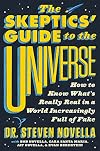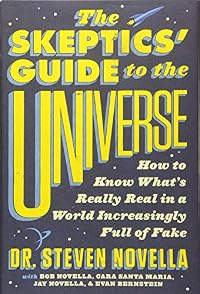
The Skeptics' Guide to the Universe: How to Know What's Really Real in a World Increasingly Full of Fake
by Steven Novella
On This Page
Description
"It is intimidating to realize that we live in a world overflowing with misinformation, bias, myths, deception, and flawed knowledge. There really are no ultimate authority figures--no one has the secret, and there is no place to look up the definitive answers to our questions (not even Google). Luckily, THE SKEPTICS' GUIDE TO THE UNIVERSE is your map through this maze of modern life. Here Dr. Steven Novella--along with Bob Novella, Cara Santa Maria, Jay Novella, and Evan Bernstein--will show more explain the tenets of skeptical thinking and debunk some of the biggest scientific myths, fallacies, and conspiracy theories--from anti-vaccines to homeopathy, UFO sightings to N-rays. You'll learn the difference between science and pseudoscience, essential critical thinking skills, ways to discuss conspiracy theories with that crazy co-worker of yours, and how to combat sloppy reasoning, bad arguments, and superstitious thinking. "--Amazon.com. show lessTags
Recommendations








Member Reviews
The Skeptics' Guide to the Universe is an entertaining, interesting, and useful podcast about science and scientific skepticism (and also nerdy sci-fi references), and it's one I've enjoyed listening to for years. So I was happy to pick up this volume that marks "the skeptical rogues'" first foray into print.
I will say, I don't think the book is quite as fun as the podcast. There are plenty of little humorous asides and some personal anecdotes, but it's not nearly as lively. Which probably makes sense. It covers a lot of ground, and has to deal with a lot of complicated concepts carefully but concisely. It's hard to do that without being at least a little drier than the generally very breezily informal podcast.
Much of the book focuses show more on ways in which humans can go wrong when it comes to figuring out what's true, including cognitive biases and logical fallacies. It also talks about various specific pseudosciences and what makes them unscientific, discusses problems with science reporting and how to skeptically approach things you read online, and showcases the darker side of pseudoscience and why putting one's faith in the wrong things can be dangerous and even deadly.
I'm not sure if this is the very best book for someone to whom these concepts are totally new, as it's possible it might all be a little overwhelming, at least for some readers. And I'm not sure how necessary it is for the kind of person who's spent years listening to skeptical podcasts and reading similar books, since at some point you probably already know most of this stuff, even if it's a very good thing to be reminded of some of it. But I think it is absolutely ideal as a handbook for people who have decided they want to become good critical thinkers but are still figuring out what that means and how to develop and apply those skills. I particularly appreciate the way Novella emphasizes that the most important thing about understanding cognitive biases and logical fallacies is to use them to scrutinize and improve your own thinking, not to deploy them as gotchas to win an argument. (Indeed, as he points out, to declare "you just used a logical fallacy, therefore your entire argument is wrong" is in itself a logical fallacy!) It's a very well-taken piece of advice from someone who knows what he's talking about. Not that you should take his word for things, of course. show less
I will say, I don't think the book is quite as fun as the podcast. There are plenty of little humorous asides and some personal anecdotes, but it's not nearly as lively. Which probably makes sense. It covers a lot of ground, and has to deal with a lot of complicated concepts carefully but concisely. It's hard to do that without being at least a little drier than the generally very breezily informal podcast.
Much of the book focuses show more on ways in which humans can go wrong when it comes to figuring out what's true, including cognitive biases and logical fallacies. It also talks about various specific pseudosciences and what makes them unscientific, discusses problems with science reporting and how to skeptically approach things you read online, and showcases the darker side of pseudoscience and why putting one's faith in the wrong things can be dangerous and even deadly.
I'm not sure if this is the very best book for someone to whom these concepts are totally new, as it's possible it might all be a little overwhelming, at least for some readers. And I'm not sure how necessary it is for the kind of person who's spent years listening to skeptical podcasts and reading similar books, since at some point you probably already know most of this stuff, even if it's a very good thing to be reminded of some of it. But I think it is absolutely ideal as a handbook for people who have decided they want to become good critical thinkers but are still figuring out what that means and how to develop and apply those skills. I particularly appreciate the way Novella emphasizes that the most important thing about understanding cognitive biases and logical fallacies is to use them to scrutinize and improve your own thinking, not to deploy them as gotchas to win an argument. (Indeed, as he points out, to declare "you just used a logical fallacy, therefore your entire argument is wrong" is in itself a logical fallacy!) It's a very well-taken piece of advice from someone who knows what he's talking about. Not that you should take his word for things, of course. show less
This is one of the best books on critical thinking and skepticism since Carl Sagan’s The Demon-Haunted World. Although you would hope, in the 21st century, that it shouldn’t have to be explained why treating eczema with turmeric infusions is a bad idea, gullibility for pseudoscience is a recurring feature of human psychology and in need of constant debunking.
The first part of the book covers the unreliability of our senses, cognitive biases, logical fallacies, and the difference between science and pseudoscience. This part covers the core skills of critical thinking and skepticism and reminds us that we must be constantly vigilant against the plethora of ways we can delude ourselves. In fact, the running theme throughout the book show more is the concept of fallibilism, and how we are all wired to engage in biased and logical fallacious thinking (even self-proclaimed skeptics or critical thinkers). As the authors constantly remind us, this is a tendency we all have to perpetually work to overcome, and that no one is immune to bias just because they identify as a skeptic.
The rest of the book covers specific cases of pseudoscience, pseudo-journalism, and instances where pseudoscience can harm or kill. The book ends with some advice on the practical application of critical thinking skills and how to engage with others persuasively when debating pseudoscientific ideas.
My only complaint: in discussing the line of demarcation between science and pseudoscience and falsifiability, the authors never mention Karl Popper once. Popper is, of course, the most prominent early advocate of falsifiability and one of the greatest philosophers of science of the twentieth century. The authors discuss falsifiability, critical rationalism, error correction, and several other ideas that were popularized by Popper without, to my mind, giving appropriate credit.
Overall, if you’re new to skepticism, this book covers the full assortment of critical thinking, psychology, logic, and science needed to navigate complex issues and engage in independent thinking. If you’re not new to the subject, it will act as a nice refresher and a welcome escape from a world filled with superficial thinking, conspiracy theories, fraud, and outright stupidity. show less
The first part of the book covers the unreliability of our senses, cognitive biases, logical fallacies, and the difference between science and pseudoscience. This part covers the core skills of critical thinking and skepticism and reminds us that we must be constantly vigilant against the plethora of ways we can delude ourselves. In fact, the running theme throughout the book show more is the concept of fallibilism, and how we are all wired to engage in biased and logical fallacious thinking (even self-proclaimed skeptics or critical thinkers). As the authors constantly remind us, this is a tendency we all have to perpetually work to overcome, and that no one is immune to bias just because they identify as a skeptic.
The rest of the book covers specific cases of pseudoscience, pseudo-journalism, and instances where pseudoscience can harm or kill. The book ends with some advice on the practical application of critical thinking skills and how to engage with others persuasively when debating pseudoscientific ideas.
My only complaint: in discussing the line of demarcation between science and pseudoscience and falsifiability, the authors never mention Karl Popper once. Popper is, of course, the most prominent early advocate of falsifiability and one of the greatest philosophers of science of the twentieth century. The authors discuss falsifiability, critical rationalism, error correction, and several other ideas that were popularized by Popper without, to my mind, giving appropriate credit.
Overall, if you’re new to skepticism, this book covers the full assortment of critical thinking, psychology, logic, and science needed to navigate complex issues and engage in independent thinking. If you’re not new to the subject, it will act as a nice refresher and a welcome escape from a world filled with superficial thinking, conspiracy theories, fraud, and outright stupidity. show less
An excellent resource. Having listened to the podcast for more than ten years, I've heard all of these points before, but having it all collected, organised, and focused means the message hits much harder.
What I found most helpful were the frequent reminders that all of the methods of self-deception apply just as strongly to all of us. The idea of learning all the logical fallacies so that you can make someone look stupid and win an argument is not appealing to me, but interrogating my own thinking and catching myself taking shortcuts is. The takeaway is not a feeling of superiority but of humility.
What I found most helpful were the frequent reminders that all of the methods of self-deception apply just as strongly to all of us. The idea of learning all the logical fallacies so that you can make someone look stupid and win an argument is not appealing to me, but interrogating my own thinking and catching myself taking shortcuts is. The takeaway is not a feeling of superiority but of humility.
I cannot praise this book enough. It's coverage of skepticism and critical thinking is comprehensive without belaboring the various topics (it does get long in a few parts, but the topics are complex or multi-faceted). It's longer than the standard ~300-page science writing books, so it doesn't scrimp or sacrifice on quality. It's a must have for skeptics, being practical in it's applicability. I've read scores of other books on skepticism and still learned from the SGU book. I came away with new and fresh insights. It doesn't try to be an end-all-be-all book, but it does a pretty good job. The tone and pacing are good, it's not dogmatic, but authoritative yet humble.
I enjoyed this book so much I want to read it again. It is an instruction book really and the tools it suggests can make us better at making informed choices about the information hurled around every day.There is a lot to take in so it deserves a slower reread.
Critical thinking 101 on steroids. This book should be a reminder to question everything and think for ourselves to determine what really is. I won this in a giveaway and was not familiar with the podcast which will now go into my rotation. I enjoyed the relaxed way it makes you think harder, smarter and smacks you to wake up when you start getting complacent in taking in all the information that is out there.
The Skeptics Guide to the Universe turned out to be the perfect follow-up to Carl Sagan’s [book:The Demon-Haunted World|17349], which I read earlier this year. Both books focus on providing the reader with the tools to sort out what’s real from all the scams, hoaxes, and pseudoscienece arround us. Where this one does it a little better is in the section that describes the different types of logical fallacies. Also, since it was published in 2018, the examples it uses are more up to date. To anyone trying to decide which of the two to read, I'd have to say both and I don't think it matters in what order.
Members
- Recently Added By
Author Information

18 Works 919 Members
Common Knowledge
- Dedication
- Dedicated to Perry DeAngelis, A friend and skeptic of some note
- First words
- Spock lied to me.
- Last words
- (Click to show. Warning: May contain spoilers.)Until next time, this is your Skeptics' Guide to the Universe.
Classifications
Statistics
- Members
- 487
- Popularity
- 61,677
- Reviews
- 16
- Rating
- (4.24)
- Languages
- English, German, Spanish
- Media
- Paper, Audiobook, Ebook
- ISBNs
- 14
- ASINs
- 6