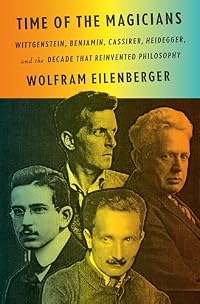
Time of the Magicians: Wittgenstein, Benjamin, Cassirer, Heidegger, and the Decade That Reinvented Philosophy
by Wolfram Eilenberger
On This Page
Description
"A grand narrative of the intertwining lives of Walter Benjamin, Martin Heidegger, Ludwig Wittgenstein, and Ernst Cassirer, major philosophers whose ideas shaped the twentieth century The year is 1919. The horror of the First World War is still fresh for the protagonists of Time of the Magicians, each of whom finds himself at a crucial juncture. Benjamin, whose life is characterized by false starts and unfinished projects, is trying to flee his overbearing father and floundering in his show more academic career, living hand to mouth as a jobbing critic. Wittgenstein, by contrast, has dramatically decided to divest himself of the monumental fortune he stands to inherit, as a scion of one of the biggest industrial families in Europe, in order to commit himself unswervingly to a life of the mind. Meanwhile, Heidegger, having managed to avoid combat in war by serving instead as a meteorologist, is carefully cultivating his career, aligning himself with the great Edmund Husserl, and renouncing his prior Catholic associations. Finally, Cassirer is working furiously on the margins of academia, applying himself intensely to his writing and the possibility of a career at Hamburg University. The stage is set for a great intellectual drama, which will unfold across the next decade. The lives and ideas of this great philosophical quartet will converge as they become world historical figures. But as the Second World War looms on the horizon, their fates will be very different. Wolfram Eilenberger, internationally-bestselling author, stylishly traces the paths of these remarkable and turbulent lives, which feature not only philosophy but some of the most important economists, politicians, journalists, and artists of the century, including John Maynard Keynes, Hannah Arendt, and Bertrand Russell. In doing so, he tells a gripping story about some of history's most ambitious and passionate thinkers, as well as illuminating with rare clarity and economy their brilliant ideas, which all too often have been regarded as enigmatic or opaque"-- show lessTags
Recommendations




























Member Reviews
This book must be reviewed on two different dimensions: the text itself, which was first published in 2018, and this new edition, from 2024.
The text is dazzling. The author conveys a great deal of often very convoluted philosophical argument in a manner that is surprisingly effective and accessible. I've read most of these thinkers before (particularly Heidegger and Wittgenstein), and his overview made points that puzzled me in grad school suddenly clearer. Combined with the new material describing their personal lives, and how the four philosophers intertwine on the same projects, there was a great deal here I know I'll have to go back and mine for later use. As it is, I've already included a cite in a book chapter concerning show more Eilenberger's description of the classification system of the Warburg Library. I hadn't heard of it before, and now it is at the top of my list for the next visit to London.
The fact that there was so much of interest in the book is why this lovely edition presented such a challenge for me. From the manner in which it arrived in a carefully wrapped package, to the author's signature in the back, I wanted to keep the copy in as good a condition as possible. Normally I regard my collection as a working library, rather than one full of unread and lovely editions which are unread to preserve their mint condition. So I refrained from my usual practice of highlighting and marking passages of particular interest for later consideration. But eventually I had to break down, and mark two passages. Despite my best efforts at self restraint, the copy is no longer pristine. The struggle to hold myself back was a distraction as I worked myself through this book. In short, this was probably too nice a copy for me (even with my OCD, I could find only two editorial gaffes). Maybe when I read it again, as I eventually must, I may get a cheap paperback that I won't feel guilty about writing in. show less
The text is dazzling. The author conveys a great deal of often very convoluted philosophical argument in a manner that is surprisingly effective and accessible. I've read most of these thinkers before (particularly Heidegger and Wittgenstein), and his overview made points that puzzled me in grad school suddenly clearer. Combined with the new material describing their personal lives, and how the four philosophers intertwine on the same projects, there was a great deal here I know I'll have to go back and mine for later use. As it is, I've already included a cite in a book chapter concerning show more Eilenberger's description of the classification system of the Warburg Library. I hadn't heard of it before, and now it is at the top of my list for the next visit to London.
The fact that there was so much of interest in the book is why this lovely edition presented such a challenge for me. From the manner in which it arrived in a carefully wrapped package, to the author's signature in the back, I wanted to keep the copy in as good a condition as possible. Normally I regard my collection as a working library, rather than one full of unread and lovely editions which are unread to preserve their mint condition. So I refrained from my usual practice of highlighting and marking passages of particular interest for later consideration. But eventually I had to break down, and mark two passages. Despite my best efforts at self restraint, the copy is no longer pristine. The struggle to hold myself back was a distraction as I worked myself through this book. In short, this was probably too nice a copy for me (even with my OCD, I could find only two editorial gaffes). Maybe when I read it again, as I eventually must, I may get a cheap paperback that I won't feel guilty about writing in. show less
 This review was written for LibraryThing Early Reviewers.
In this excellent work of Intellectual History, Eilenberger weaves together the experiences and thought of four German-speaking philosophers during that most consequential period between the wars, when some of the perennial themes in the field (the limits of language, idealism v. realism, metaphysics and ontology) were refashioned by a confrontation with the destabilizing effects of modernism. The narrative treat is seeing how Eilenberger pairs off or pits against each other Cassirer, Benjamin, Heidegger and Wittenstein in various ways—intellectually, domestically, emotionally—and how friends, lovers, job prospects, and physical setting influenced their ideas.
The 1920s, Berlin, Vienna... All this philosopher is really over my head, but Eilenberger did a good job of laying out some bits and pieces so at least I could get some clue. I think some more context would help. These philosophers seem to come out of nowhere. For example, surely Wittgenstein was responding to Frege and Russell, but we don't get much of that. This book really covers a slice in time. But then, it's not a bad way to keep the thing from expanding... yeah, infinitely!
The core storyline of the book, it's a build up to a debate in 1928 in Davos between Heidegger and Cassirer. I'd say I could follow the sketch of the debate in the book reasonably well. So the build up must have worked!
The core storyline of the book, it's a build up to a debate in 1928 in Davos between Heidegger and Cassirer. I'd say I could follow the sketch of the debate in the book reasonably well. So the build up must have worked!
What a treasure! This beautifully designed and produced book was not what I expected from an Early Reviewer copy.
First, just receiving and opening it was a treat. It arrived in a special box, with special wrapping, so the experience of exploring what the book had to offer commenced immediately upon receipt.
When I requested it, I didn't even fully understand what it was. A revelation. A magical weaving together of four philosopher/writer/critics - Heidegger, Wittgenstein, Cassirer, and Benjamin - that reveals their personal peccadilloes, their responses to the politics, economy, religious thinking, and academic biases of their times.
I've read each of the subjects of this book before but, prior to reading this book, I'm not sure I show more understand any of them as well as I do now. While I know the author's commentary steers the reader in certain directions (i.e., you can feel it), the unique mix of biography and explication of each subject's thought and writing makes their choices, agendas, and preoccupations all seem so much more relatable. It's like a historical novel in its presentation, sometimes. Though, presumably, less fabrication than brilliantly evocative exposition.
The use of parallel tracks for these four thinkers works better than expected. While some of the transitions smack of the author deciding 'need a transition here', they mostly work. More importantly, the side-by-side presentation allows for compare/contrast to serve as a tool for understanding more about each subject.
Finally, the book as object: The bright yellow textile cover feels great, the typeface and layout is clear, bold, and practically oozes the thought and care that went into it. (Designer Spiekermann was already a hero, so receiving a book conceived by him without knowing that's what I was getting just pushed the whole package over the top.)
Will have pride of place in my library, for sure. show less
First, just receiving and opening it was a treat. It arrived in a special box, with special wrapping, so the experience of exploring what the book had to offer commenced immediately upon receipt.
When I requested it, I didn't even fully understand what it was. A revelation. A magical weaving together of four philosopher/writer/critics - Heidegger, Wittgenstein, Cassirer, and Benjamin - that reveals their personal peccadilloes, their responses to the politics, economy, religious thinking, and academic biases of their times.
I've read each of the subjects of this book before but, prior to reading this book, I'm not sure I show more understand any of them as well as I do now. While I know the author's commentary steers the reader in certain directions (i.e., you can feel it), the unique mix of biography and explication of each subject's thought and writing makes their choices, agendas, and preoccupations all seem so much more relatable. It's like a historical novel in its presentation, sometimes. Though, presumably, less fabrication than brilliantly evocative exposition.
The use of parallel tracks for these four thinkers works better than expected. While some of the transitions smack of the author deciding 'need a transition here', they mostly work. More importantly, the side-by-side presentation allows for compare/contrast to serve as a tool for understanding more about each subject.
Finally, the book as object: The bright yellow textile cover feels great, the typeface and layout is clear, bold, and practically oozes the thought and care that went into it. (Designer Spiekermann was already a hero, so receiving a book conceived by him without knowing that's what I was getting just pushed the whole package over the top.)
Will have pride of place in my library, for sure. show less
This review was written for LibraryThing Early Reviewers.More a book of intellectual history than philosophy itself, Eilenberger tracks the lives and thinking of four German and Austrian figures — Walter Benjamin, Ernst Cassirer, Martin Heidegger, and Ludwig Wittgenstein.
The time in which he takes up the stories of the four is definitely one of the most interesting, at least in twentieth century philosophy — the 1920s. We are between the wars. In philosophy, it’s the decline of neo-Kantianism (at least in the Germanic world) and the rise of diverging branches of revolution in philosophy.
There are really three branches, and that’s telling since Eilenberger builds his story around four figures. The three are represented by Benjamin (the Frankfurt School), Wittgenstein (I’ll call it show more the “linguistic turn” although I think Wittgenstein himself may transcend that movement), and Heidegger (who, although he takes a place in the history of phenomenology and existentialism, is stubbornly unique). And then there is Ernst Cassirer.
Cassirer, of the four, might be argued a kind of ending rather than a beginning. Cassirer is a neo-Kantian, although, as comes through in Eilenberger’s account, his Philosophy of Symbolic Forms is a very creative work.
All four though, without a great stretch, can be said to pioneer thought in non-traditional ways of knowing, by contrast with the logical positivists of the same time, who extolled factual knowledge on the model of the natural sciences to the exclusion of all else. Cassirer wraps mythical experience into a story of the evolution of symbolic thought, Benjamin finds knowledge in art, Heidegger in immersed engagement, and Wittgenstein famously distinguishes between saying and showing as ways in which we manifest understanding.
Eilenberger’s plan calls for weaving the stories of the four into a single narrative. He presents their development and their lives side by side, arranged by themes he finds common to the four. Those are the chapters of the book, that I could loosely paraphrase, as language, culture, the self and the other, freedom, symbol, and time. It works, although it’s more an organizing principle than a definable common thread.
I have to admit a bias in my reading, since I’m very familiar with two of the figures (Wittgenstein and Heidegger) and far, far less with the other two. But Eilenberger’s treatment makes them all interesting in some new ways, both for the lives they led and for the dynamics of their thinking.
Ironically, Benjamin of all of them, even with his tortuous style, ties philosophy to the ground by way of actual objects, e.g., the Paris arcades. This was something new to me — a kind of monadic treatment of the everyday object as revealing the world as a whole via its web of conceptual (and pragmatic) relationships. Everything is meaningful, in its concrete presence.
Cassirer and Heidegger, for all Heidegger’s penchant for the pragmatic and the everyday, move and live in abstractions. Wittgenstein conjures a simplicity, e.g., in his examples of “primitive language games”, but they are conjures after all.
Eilenberger’s anecdotes and quotes about Wittgenstein’s experiences among the everyday speakers of language, during his time teaching children in Austria, are kind of tragicomic. He found the people in one of the villages in which he taught “three quarters human” and those in another not human at all. It was never a great idea, in a practical sense, although, as Eilenberger hints, those experiences may have inspired Wittgenstein’s later thinking on language and meaning. The Wittgenstein of the Tractatus seems caught in an academic straightjacket by comparison.
Philosophers, contrary to popular belief, rarely write about “the meaning of life.” But they do have lives. And they are like anyone — they would like their lives to be meaningful. And given that they live their lives so submerged in philosophical thought, they would like their philosophical lives to be meaningful.
That’s something that I think Eilenberger catches in his approach. The styles of life of the four attest to their styles of thinking. Benjamin, the intellectual fly that never actual lights anywhere. Heidegger, the ambitious would-be leader of a grand revolution in the German university as well as in philosophy per se. Wittgenstein, the seeker after simplicity and clarity. And Cassirer — the establishment’s representative.
The story has a climax at the Davos conference in 1929, and the debate there between Heidegger and Cassirer. Although the debate itself can breathe a technical air, it’s a debate between continuity with the past and a break toward a newly conceived future.
Heidegger wins. Cassirer continues, but as Eilenberger’s epilogue tells us, his career in Germany became a casualty of the Third Reich, and he lived out the remainder in exile in Switzerland and the United States. Heidegger meanwhile wins the dubious honor of representing university philosophy on into Hitler’s Germany. It’s a different question whether any of the substance of the debate could be tied conceptually to their respective fates. After all, Cassirer was Jewish, and nothing in the debate was going to change the constraints that would fall over him and other Jewish intellectuals soon afterwards.
Eilenberger writes a very readable (in translation from the original German), engrossing story. Although I think it’s a little bit of a stretch to weave the four figures into a single fabric, this is intellectual history, and the four did co-exist in a single, not always coherent, intellectual world. He can’t be blamed for all the frayed threads. show less
The time in which he takes up the stories of the four is definitely one of the most interesting, at least in twentieth century philosophy — the 1920s. We are between the wars. In philosophy, it’s the decline of neo-Kantianism (at least in the Germanic world) and the rise of diverging branches of revolution in philosophy.
There are really three branches, and that’s telling since Eilenberger builds his story around four figures. The three are represented by Benjamin (the Frankfurt School), Wittgenstein (I’ll call it show more the “linguistic turn” although I think Wittgenstein himself may transcend that movement), and Heidegger (who, although he takes a place in the history of phenomenology and existentialism, is stubbornly unique). And then there is Ernst Cassirer.
Cassirer, of the four, might be argued a kind of ending rather than a beginning. Cassirer is a neo-Kantian, although, as comes through in Eilenberger’s account, his Philosophy of Symbolic Forms is a very creative work.
All four though, without a great stretch, can be said to pioneer thought in non-traditional ways of knowing, by contrast with the logical positivists of the same time, who extolled factual knowledge on the model of the natural sciences to the exclusion of all else. Cassirer wraps mythical experience into a story of the evolution of symbolic thought, Benjamin finds knowledge in art, Heidegger in immersed engagement, and Wittgenstein famously distinguishes between saying and showing as ways in which we manifest understanding.
Eilenberger’s plan calls for weaving the stories of the four into a single narrative. He presents their development and their lives side by side, arranged by themes he finds common to the four. Those are the chapters of the book, that I could loosely paraphrase, as language, culture, the self and the other, freedom, symbol, and time. It works, although it’s more an organizing principle than a definable common thread.
I have to admit a bias in my reading, since I’m very familiar with two of the figures (Wittgenstein and Heidegger) and far, far less with the other two. But Eilenberger’s treatment makes them all interesting in some new ways, both for the lives they led and for the dynamics of their thinking.
Ironically, Benjamin of all of them, even with his tortuous style, ties philosophy to the ground by way of actual objects, e.g., the Paris arcades. This was something new to me — a kind of monadic treatment of the everyday object as revealing the world as a whole via its web of conceptual (and pragmatic) relationships. Everything is meaningful, in its concrete presence.
Cassirer and Heidegger, for all Heidegger’s penchant for the pragmatic and the everyday, move and live in abstractions. Wittgenstein conjures a simplicity, e.g., in his examples of “primitive language games”, but they are conjures after all.
Eilenberger’s anecdotes and quotes about Wittgenstein’s experiences among the everyday speakers of language, during his time teaching children in Austria, are kind of tragicomic. He found the people in one of the villages in which he taught “three quarters human” and those in another not human at all. It was never a great idea, in a practical sense, although, as Eilenberger hints, those experiences may have inspired Wittgenstein’s later thinking on language and meaning. The Wittgenstein of the Tractatus seems caught in an academic straightjacket by comparison.
Philosophers, contrary to popular belief, rarely write about “the meaning of life.” But they do have lives. And they are like anyone — they would like their lives to be meaningful. And given that they live their lives so submerged in philosophical thought, they would like their philosophical lives to be meaningful.
That’s something that I think Eilenberger catches in his approach. The styles of life of the four attest to their styles of thinking. Benjamin, the intellectual fly that never actual lights anywhere. Heidegger, the ambitious would-be leader of a grand revolution in the German university as well as in philosophy per se. Wittgenstein, the seeker after simplicity and clarity. And Cassirer — the establishment’s representative.
The story has a climax at the Davos conference in 1929, and the debate there between Heidegger and Cassirer. Although the debate itself can breathe a technical air, it’s a debate between continuity with the past and a break toward a newly conceived future.
Heidegger wins. Cassirer continues, but as Eilenberger’s epilogue tells us, his career in Germany became a casualty of the Third Reich, and he lived out the remainder in exile in Switzerland and the United States. Heidegger meanwhile wins the dubious honor of representing university philosophy on into Hitler’s Germany. It’s a different question whether any of the substance of the debate could be tied conceptually to their respective fates. After all, Cassirer was Jewish, and nothing in the debate was going to change the constraints that would fall over him and other Jewish intellectuals soon afterwards.
Eilenberger writes a very readable (in translation from the original German), engrossing story. Although I think it’s a little bit of a stretch to weave the four figures into a single fabric, this is intellectual history, and the four did co-exist in a single, not always coherent, intellectual world. He can’t be blamed for all the frayed threads. show less
A fascinating book that explores the thought of Wittgenstein, Heidegger, Ernst Cassirer, and Walter Benjamin, focused particularly on the decade 1919-1929. I would classify the book as intellectual history, which is a particular interest of mine being the field in which my father taught. The older I get the better I understand why the approach and questions of intellectual history are so compelling—by proxy I was steeped in these from an early age.
I might not have picked the book up but for the inclusion of the two lesser known figures, Benjamin and Cassirer. I didn’t know anything about Wittgenstein, except to label him a dry, dull proponent of analytic philosophy. That was wrong! And Heidegger, who I did study a bit in college, is show more so tarnished in my mind by his Nazi associations, that he was not a draw. It was Cassirer and especially Benjamin that drew me. What makes the book a 5-star read is how much I relearned about my assumptions going in and how much new I discovered about all four thinkers.
The book talks about the thought of each man. Some of that material is challenging. Wittgenstein’s ideas are not dry and dull, but they are elusive and veering toward mysticism. I thought at times I could catch a glimpse of what he was getting at. Maybe. Heidegger still annoys me, but he has a poetic gift and although I deplore him there were moments and phrases that I thought were clear and expressive of truth. But it is Cassirer and Benjamin that I want to study further. Because they so fascinate and are so new and complex, I can’t really summarize what I perceive of them. They beckon me.
The other main focus throughout the book were the lives and intersections of these thinkers with each other, as well as their understanding and response to the developments around them, the decline of the Weimar Republic, Communism, the rise of the Nazis, technological change, and so on. The personal details of all four lives are revealing and for two of them sad. Cassirer and Heidegger had the most stable and conventional lives. Both Wittgenstein and Benjamin had rocky paths, and Benjamin’s life ended tragically with his suicide escaping the Nazis in 1944.
I want to read much more about and by Walter Benjamin. He was a wanderer, an unemployed writer of essays, a collector of scraps of thought, and was hard pressed to finish or bring things to conclusion. Money, relationships, and fixed abode were all elusive for him. He was also stunningly original and boundless in his thinking. show less
I might not have picked the book up but for the inclusion of the two lesser known figures, Benjamin and Cassirer. I didn’t know anything about Wittgenstein, except to label him a dry, dull proponent of analytic philosophy. That was wrong! And Heidegger, who I did study a bit in college, is show more so tarnished in my mind by his Nazi associations, that he was not a draw. It was Cassirer and especially Benjamin that drew me. What makes the book a 5-star read is how much I relearned about my assumptions going in and how much new I discovered about all four thinkers.
The book talks about the thought of each man. Some of that material is challenging. Wittgenstein’s ideas are not dry and dull, but they are elusive and veering toward mysticism. I thought at times I could catch a glimpse of what he was getting at. Maybe. Heidegger still annoys me, but he has a poetic gift and although I deplore him there were moments and phrases that I thought were clear and expressive of truth. But it is Cassirer and Benjamin that I want to study further. Because they so fascinate and are so new and complex, I can’t really summarize what I perceive of them. They beckon me.
The other main focus throughout the book were the lives and intersections of these thinkers with each other, as well as their understanding and response to the developments around them, the decline of the Weimar Republic, Communism, the rise of the Nazis, technological change, and so on. The personal details of all four lives are revealing and for two of them sad. Cassirer and Heidegger had the most stable and conventional lives. Both Wittgenstein and Benjamin had rocky paths, and Benjamin’s life ended tragically with his suicide escaping the Nazis in 1944.
I want to read much more about and by Walter Benjamin. He was a wanderer, an unemployed writer of essays, a collector of scraps of thought, and was hard pressed to finish or bring things to conclusion. Money, relationships, and fixed abode were all elusive for him. He was also stunningly original and boundless in his thinking. show less
Eilenberger tells four stories in tandem that cover roughly the years 1918 to 1929, culminating at a philosophical conference in Davos, Switzerland. The four main characters are Ludwig Wittgenstein, Martin Heidegger, Ernst Cassier, and Walter Benjamin. Cassier and Heidegger spoke at the Davos conference, which occurs near the end of the book.
The book provides an enjoyable mix of history, biography, philosophy, and novel—four genres that I enjoy individually. So reading a book with all four genres in one made my day—especially one so well written.
The novelistic quality emerges from Eilenberger as a compelling storyteller with a crystal clear style. The story focuses on the most productive periods in the subjects’ lives, when their show more brilliance shined brightest and their best work was done. This is particularly true for Wittgenstein and Heidegger. Cassier was a little older and farther along in his career. Walter Benjamin doesn’t seem to have done much work at any time, but this is when he generated ideas for which he would later become known. Benjamin’s life as told in the book reads more like soap opera.
The time-travel experience of the book was exciting to me because of my interest in history. I can read “dry” history books all day—reading history with such dynamic characters about whom I already knew a lot—so vividly brought to life—in a period I think is fascinating—thoroughly affirmed my initial impression when I saw the book at a bookstore: I needed to buy it immediately.
Eilenberger delves into some detail of the major works of the four subjects, especially Wittgenstein’s Tractatus logico-philosphicus and Heidegger’s Being and Time.
The author does a great job teasing out the loci of certain philosophical disagreements, such as between Heidegger and Cassier: Cassier’s epistemological neo-Kantian approach to meaning versus Heidegger’s ontological approach, which he viewed as “Kantian” but not “neo-Kantian.” Read the book for more details!
Also between Wittgenstein and the Vienna Circle—the disconnect was palpable between the Vienna Circle’s scientific-empirical approach to analyze meaning via philosophy of language (Viz. Schlick: “The meaning of an assertion lies in the method of its verification” [275]), versus Wittgenstein who writes “…if all possible scientific questions be answered, the problems of life have still not been touched at all” (41), or, ideas such as, the logical form that allows a proposition to represent reality cannot be expressed in language (171). Yet, Wittgenstein was excruciatingly scientific in his study and exposition of philosophical ideas. Wittgenstein drove his Vienna sparring partners batty with his unconventional yet analytically incisive theses. They remained friends but went their separate ways philosophically, and geographically (Wittgenstein ending up at Cambridge).
Why am I so enamored with this book? Because I knew the cast of characters so well. In both undergraduate and graduate studies, I was immersed in Wittgenstein studies under one of the premier authorities on Wittgenstein (Professor Jaakko Hintikka), and I studied Heidegger under an actual colleague of Heidegger’s at Freiburg (Professor William Werkmeister).
Aside: I was in a grad student’s colloquium once, when Dr. Werkmeister contradicted a statement made by the grad student. The student said something like, “I think the evidence in the… “. But Dr. Werkmeister interrupted, “You see the last time I discussed this question with Martin (aka Martin Heidegger!), he said that he meant ….” And so ended the debate. The grad student embarrassed himself but also learned something while experiencing an authentic moment of his own fact of Dasein.
I also studied Cassier, primarily from the angle of the philosophy of mythology. I also studied many of the minor characters in this book: Karl Jaspers, Rudolph Bultmann, Bertrand Russel, Rene Descartes, Immanuel Kant, Gottlob Frege, Maynard Keynes, Frank Ramsey, Rudolph Carnap, Moritz Schlick, and several others in the storyline. So naturally I was excited to see so many familiar names show up in this book. The main gap in my previous knowledge of these figures was Walter Benjamin. His flâneuresque character and desultory intellectual efforts made him more of a distraction and less interesting than the others. In fact the inclusion of Benjamin in the book seemed a bit incongruous.
That incongruity aside, the book is a treasure and a treat for any serious lover of books. It offers delights for just about any taste, and for aficionados of any genre. The philosophical discussions are well developed, and true to the characters. But they are not weighty or dry by any means. Readers will appreciate the author’s clarity and discretion—he gives us just enough to understand what’s happening, and avoids going down any rabbit holes.
Thank you Wolfram Eilenberger for this exceptional reading experience. show less
The book provides an enjoyable mix of history, biography, philosophy, and novel—four genres that I enjoy individually. So reading a book with all four genres in one made my day—especially one so well written.
The novelistic quality emerges from Eilenberger as a compelling storyteller with a crystal clear style. The story focuses on the most productive periods in the subjects’ lives, when their show more brilliance shined brightest and their best work was done. This is particularly true for Wittgenstein and Heidegger. Cassier was a little older and farther along in his career. Walter Benjamin doesn’t seem to have done much work at any time, but this is when he generated ideas for which he would later become known. Benjamin’s life as told in the book reads more like soap opera.
The time-travel experience of the book was exciting to me because of my interest in history. I can read “dry” history books all day—reading history with such dynamic characters about whom I already knew a lot—so vividly brought to life—in a period I think is fascinating—thoroughly affirmed my initial impression when I saw the book at a bookstore: I needed to buy it immediately.
Eilenberger delves into some detail of the major works of the four subjects, especially Wittgenstein’s Tractatus logico-philosphicus and Heidegger’s Being and Time.
The author does a great job teasing out the loci of certain philosophical disagreements, such as between Heidegger and Cassier: Cassier’s epistemological neo-Kantian approach to meaning versus Heidegger’s ontological approach, which he viewed as “Kantian” but not “neo-Kantian.” Read the book for more details!
Also between Wittgenstein and the Vienna Circle—the disconnect was palpable between the Vienna Circle’s scientific-empirical approach to analyze meaning via philosophy of language (Viz. Schlick: “The meaning of an assertion lies in the method of its verification” [275]), versus Wittgenstein who writes “…if all possible scientific questions be answered, the problems of life have still not been touched at all” (41), or, ideas such as, the logical form that allows a proposition to represent reality cannot be expressed in language (171). Yet, Wittgenstein was excruciatingly scientific in his study and exposition of philosophical ideas. Wittgenstein drove his Vienna sparring partners batty with his unconventional yet analytically incisive theses. They remained friends but went their separate ways philosophically, and geographically (Wittgenstein ending up at Cambridge).
Why am I so enamored with this book? Because I knew the cast of characters so well. In both undergraduate and graduate studies, I was immersed in Wittgenstein studies under one of the premier authorities on Wittgenstein (Professor Jaakko Hintikka), and I studied Heidegger under an actual colleague of Heidegger’s at Freiburg (Professor William Werkmeister).
Aside: I was in a grad student’s colloquium once, when Dr. Werkmeister contradicted a statement made by the grad student. The student said something like, “I think the evidence in the… “. But Dr. Werkmeister interrupted, “You see the last time I discussed this question with Martin (aka Martin Heidegger!), he said that he meant ….” And so ended the debate. The grad student embarrassed himself but also learned something while experiencing an authentic moment of his own fact of Dasein.
I also studied Cassier, primarily from the angle of the philosophy of mythology. I also studied many of the minor characters in this book: Karl Jaspers, Rudolph Bultmann, Bertrand Russel, Rene Descartes, Immanuel Kant, Gottlob Frege, Maynard Keynes, Frank Ramsey, Rudolph Carnap, Moritz Schlick, and several others in the storyline. So naturally I was excited to see so many familiar names show up in this book. The main gap in my previous knowledge of these figures was Walter Benjamin. His flâneuresque character and desultory intellectual efforts made him more of a distraction and less interesting than the others. In fact the inclusion of Benjamin in the book seemed a bit incongruous.
That incongruity aside, the book is a treasure and a treat for any serious lover of books. It offers delights for just about any taste, and for aficionados of any genre. The philosophical discussions are well developed, and true to the characters. But they are not weighty or dry by any means. Readers will appreciate the author’s clarity and discretion—he gives us just enough to understand what’s happening, and avoids going down any rabbit holes.
Thank you Wolfram Eilenberger for this exceptional reading experience. show less
Members
- Recently Added By
Lists

Economist Books of the Year 2020
41 works; 5 members

In Our Time books
4,934 works; 2 members
Author Information

27 Works 1,013 Members
Some Editions
Awards and Honors
Work Relationships
Has the (non-series) sequel
Common Knowledge
- Canonical title
- Time of the Magicians: Wittgenstein, Benjamin, Cassirer, Heidegger, and the Decade That Reinvented Philosophy
- Original title
- Zeit der Zauberer. Das grosse Jahrzehnt des Philosophie. 1919-1929
- Original publication date
- J. G. Cotta’sche Buchhandlung Nachfolger, GmbH, gegr. 1659, Stuttgart, 2018
- People/Characters
- Ludwig Wittgenstein; Ernst Cassirer; Martin Heidegger; Walter Benjamin
- Epigraph
- Il meglio che la storia abbia da dare è l’entusiasmo che infonde.
JOHANN WOLFGANG VON GOETHE, Massime e riflessioni - Dedication
- A Eva
- First words
- “Non fatene un dramma, so che non lo capirete mai.”
Classifications
Statistics
- Members
- 618
- Popularity
- 46,913
- Reviews
- 20
- Rating
- (3.95)
- Languages
- 9 — Danish, Dutch, English, Finnish, French, German, Italian, Portuguese (Portugal), Spanish
- Media
- Paper, Audiobook, Ebook
- ISBNs
- 29
- ASINs
- 12