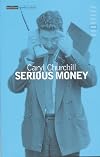
Serious Money
by Caryl Churchill
On This Page
Description
'Serious Money' is a satirical study of the effects of the 'Big Bang'. Though written in response to specific events, Churchill opens the play with an extract from a 17th century comedy about stock jobbers - little has changed, she suggests, and little will. Since its premiere at the Royal Court Theatre, London, in 1987 it has prompted city financiers worldwide both to applaud and decry its presentation of their lives. This edition contains an introduction and a chronology of the show more playwright's life and work. show lessTags
Recommendations

















Member Reviews
It is not that often that I read plays. Sometimes they work well as literary texts and other times, it is just better to see them live. Serious Money, by Caryl Churchill, is for me, a play that falls into the latter category. Mainly because of jumps in speech, the singing, and the fast pace and often doubled scenes. That isn’t to say that the play is not fun to read, just that it would be better live. I must admit that when a play is described as rhyming couplets about the stock exchange in London, my interests are piqued.
I have a love/hate relationship with the rhyming in Churchill’s play. Sometimes it made me laugh and other times it made me cringe. Although, upon reflection, I wonder if that is half the point? The play is show more extremely fast-paced and I loved that the characters are unapologetic about their greed and love of money. Scilla, was by far my favourite character. Despite the fact that she is more interested in her brother’s, Jake’s, investments than she is about his death, Scilla is extremely ballsy. And I think for the time that it was written (the late 80s), Scilla is the beautiful imperfect anti-woman. She is hard, unforgiving, driven, potty-mouthed, and everything that is not demure.
Churchill’s play was received with mixed reviews when it premiered. Some said the play was amazing and others were annoyed by the rhyming and the technical banker/stock exchange jargon. For a person who grew up after the stock exchange Big Bang, countless law suits involving Swiss banks and dirty money, and corruption and consumerism on speed, I was less than shocked by the play’s content. In fact, my lack of shock only reminded me of how cynical I’ve become, or been made.
This play is complicated and despite its short length, you should be warned that it will take you a while to pick up the pace and rhythm of it. It will also introduce you, if you don’t already know, to a game called “Pass the Pigs”. I highly suggest, that if you aren’t interested in the play, at least try the game! It’s a favourite of mine. show less
I have a love/hate relationship with the rhyming in Churchill’s play. Sometimes it made me laugh and other times it made me cringe. Although, upon reflection, I wonder if that is half the point? The play is show more extremely fast-paced and I loved that the characters are unapologetic about their greed and love of money. Scilla, was by far my favourite character. Despite the fact that she is more interested in her brother’s, Jake’s, investments than she is about his death, Scilla is extremely ballsy. And I think for the time that it was written (the late 80s), Scilla is the beautiful imperfect anti-woman. She is hard, unforgiving, driven, potty-mouthed, and everything that is not demure.
Churchill’s play was received with mixed reviews when it premiered. Some said the play was amazing and others were annoyed by the rhyming and the technical banker/stock exchange jargon. For a person who grew up after the stock exchange Big Bang, countless law suits involving Swiss banks and dirty money, and corruption and consumerism on speed, I was less than shocked by the play’s content. In fact, my lack of shock only reminded me of how cynical I’ve become, or been made.
This play is complicated and despite its short length, you should be warned that it will take you a while to pick up the pace and rhythm of it. It will also introduce you, if you don’t already know, to a game called “Pass the Pigs”. I highly suggest, that if you aren’t interested in the play, at least try the game! It’s a favourite of mine. show less
Ratings
Members
- Recently Added By
Author Information

65+ Works 3,329 Members
Carl Churchill, also spelled as Caryl Churchill, was born in London, England, on September 3, 1938. Growing up, Churchill lived in both England and Canada and earned her Bachelor of Arts degree in English from Lady Margaret Hall, Oxford University, in 1960. While at Oxford, Churchill became interested in theatre and went on to write three plays show more while she was there. After graduation, Churchill spent the next ten years writing plays, including "Lovesick" and "Schreber's Nervous Illness," which were broadcast on the BBC. In 1974, Churchill began working for the Royal Court Theatre as a resident playwright and two years later she joined the Joint Stock Theatre Group, an organization that uses collective collaboration between actors, writers, and directors when creating theatrical works. Churchill has also written dozens of books over the years, among them Blue Heart, Cloud Nine, and Hotel: In a Room Anything Can Happen. Looked upon as a voice of post-modernism, Churchill is well known for her use of dramatic structure. (Bowker Author Biography) In the early 1980s, Churchill suddenly became one of the contemporary British dramatists best represented on New York stages, as three of her plays were produced in succession. Cloud Nine (1978), directed by Tommy Tune, held the stage for two years and won an Obie (as did Top Girls, 1982). In England Churchill's career has been less abrupt, a long migration among the characteristic outlets of the new drama. From 1961 to 1972, she wrote radio plays. Owners (1972) was her first stage work commissioned by the Royal Court, where she became resident dramatist in 1974, and which staged Objections to Sex and Violence in 1975. The following year Churchill began working with two of the important fringe theater companies. One company was Joint Stock for which she wrote Light Shining in Buckinghamshire, (1976), Cloud Nine, and Fen (1982). The other was a feminist group named Monstrous Regiment for which she wrote Vinegar Tom (1976), and contributions to the revue Floorshow. The Lucille Lortel Theatre (New York) production of Cloud Nine in 1981 ushered in the most recent, transatlantic phase of Churchill's career. New York's Public Theater, as well as London's Royal Court, staged versions of Top Girls in 1982. Churchill writes many different kinds of plays. Examples are Ortonesque, about the grotesques of Owners, historical as in versions of the seventeenth century in Light Shining, about the English Civil War, and Vinegar Tom, about witchcraft. She also writes expressionist (the cross-sexual casting and doubling in Cloud Nine), and formally experimental (the permutations of situation in her dramatic Mobius strip, Traps). She is increasingly feminist in outlook. But, if her demonstrations of sexual liberation are sometimes pat (as in the second half of Cloud Nine), her theatrical adventurousness is always invigorating. (Bowker Author Biography) show less
Awards and Honors
Work Relationships
Is contained in
Has as a student's study guide
Common Knowledge
- Canonical title
- Serious Money
- People/Characters
- Billy Corman; Zac Zackerman; Scilla Todd
- Important events
- Big Bang (financial markets)
Classifications
Statistics
- Members
- 70
- Popularity
- 446,532
- Reviews
- 1
- Rating
- (4.20)
- Languages
- English
- Media
- Paper, Ebook
- ISBNs
- 8
- ASINs
- 1