On This Page
Description
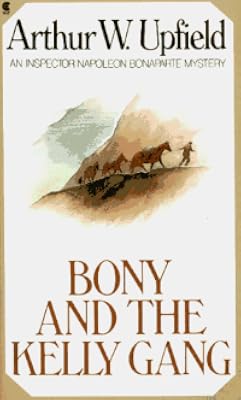
Jack Anderson was a big man with a foul temper, a sadist and a drunk. Five months after his horse appeared riderless, no trace of the man has surfaced and no one seems to care. But Bony is determined to follow the cold trail and smoke out some answers.Tags
Recommendations























Member Reviews
Some elements are still familiar: Bony once again visits a far-flung locale (this one in Queensland) to investigate an old crime (the disappearance of a jackeroo named Anderson). He doesn't work undercover this time, though, and his open investigation creates ripples throughout the people on Karwir Station and the neighboring Meena Station. Not everyone wants Anderson's disappearance to be solved, it seems ...
It was refreshing to find that Bony's educated charm, while it had its usual effect of wiping away racist thoughts from most of the people he meets, met with resistance this time around.
She ought, she was sure, to despise him for his birth, to regard him as she had always regarded half-castes, as unfortunate people, but, well, not show more quite nice. And she was angry with herself, and angry with him that his personality made it impossible for her to despise him.
In past books part of Bony's genius has been his ability to understand the blacks he encounters in a way that his white colleagues don't, here that understanding is used against him in ways that put his life in peril. ("Pointing the bone" is a sort of curse that aboriginals use against their perceived enemies, which generally results in the illness and eventual death of the target.)
In fact, it's the deeper exploration of the aboriginal spiritual practices, which include telepathic communication and the ability to inflict injury through incantations and from a distance, that captured my imagination most in [The Bone Is Pointed]. It was a fascinating look into a culture wholly unfamiliar to me. But if your tolerance for mysticism is low, you may find it difficult to suspend your disbelief enough to fully immerse yourself in the the story. Which would be a shame, because it's a first-rate mystery. And as usual, Upfield's prose rises above the genre standard, as when he describes the beginning of the rabbit migration that forms the backdrop for the novel's climax:
Natural caution and fear were in a flash of time driven out of these Meena rabbits. They became controlled by one mass idea like the people of a totalitarian state. Formerly each individual unit lived independently of other units, swayed by fear and governed by hunger; now they had no desire other than to obey the order. Even the primary instinct of self-preservation had been taken from it. From a shy and docile creature, self-willed and possessing a degree of cunning, it had become an automaton in a mass relentless in purpose, irresistible in movement, entirely fearless. show less
It was refreshing to find that Bony's educated charm, while it had its usual effect of wiping away racist thoughts from most of the people he meets, met with resistance this time around.
She ought, she was sure, to despise him for his birth, to regard him as she had always regarded half-castes, as unfortunate people, but, well, not show more quite nice. And she was angry with herself, and angry with him that his personality made it impossible for her to despise him.
In past books part of Bony's genius has been his ability to understand the blacks he encounters in a way that his white colleagues don't, here that understanding is used against him in ways that put his life in peril. ("Pointing the bone" is a sort of curse that aboriginals use against their perceived enemies, which generally results in the illness and eventual death of the target.)
In fact, it's the deeper exploration of the aboriginal spiritual practices, which include telepathic communication and the ability to inflict injury through incantations and from a distance, that captured my imagination most in [The Bone Is Pointed]. It was a fascinating look into a culture wholly unfamiliar to me. But if your tolerance for mysticism is low, you may find it difficult to suspend your disbelief enough to fully immerse yourself in the the story. Which would be a shame, because it's a first-rate mystery. And as usual, Upfield's prose rises above the genre standard, as when he describes the beginning of the rabbit migration that forms the backdrop for the novel's climax:
Natural caution and fear were in a flash of time driven out of these Meena rabbits. They became controlled by one mass idea like the people of a totalitarian state. Formerly each individual unit lived independently of other units, swayed by fear and governed by hunger; now they had no desire other than to obey the order. Even the primary instinct of self-preservation had been taken from it. From a shy and docile creature, self-willed and possessing a degree of cunning, it had become an automaton in a mass relentless in purpose, irresistible in movement, entirely fearless. show less
I did not particularly care for this story; it was not a page-turner, and I found it a bit boring. The book was my introduction to Arthur W. Upfield and his Detective Inspector Napoleon "Bony" Bonaparte.
The book is a bit antiquated and I tried to take that into consideration. The historical period in Australia as well as facets of race and cultures and the rabbits overtaking the bush was still relevant and interesting. But what I did not find interesting, nor did I really like, was Bony himself. The other characters like the Gordon's and the Lacy's and Blake were fine with the possible exception of the instantaneous shine they took to Bony.
My problem was that Bony's character is steeped in insecurities due to him being half-caste. Bony show more spends around a quarter-to-a-third of the book telling you that he is the greatest detective in the history of the planet. The endless self-aggrandizement got old fast. Another quarter-to-a-third of the book was Bony telling you how he always solves a crime because he takes all the time in the world, is always recalled to return to his office and always flouts the orders to do so, and he is repeatedly sacked, only to be reinstated, always, every time with back pay. The telling once is fine. Maybe even twice. But that was too oft-repeated. The last quarter-to-a-third of the book of the book was Bony trying to prove how much smarter he was than everyone else on the planet. Somewhere squeezed in-between all that was a not terribly interesting piece of crime fiction.
At times there was a certain richness to the story. And the summing-up worked in a heartening fashion, but I thought Bony even managed to bugger that up. He still had to one-up everyone in the process. show less
The book is a bit antiquated and I tried to take that into consideration. The historical period in Australia as well as facets of race and cultures and the rabbits overtaking the bush was still relevant and interesting. But what I did not find interesting, nor did I really like, was Bony himself. The other characters like the Gordon's and the Lacy's and Blake were fine with the possible exception of the instantaneous shine they took to Bony.
My problem was that Bony's character is steeped in insecurities due to him being half-caste. Bony show more spends around a quarter-to-a-third of the book telling you that he is the greatest detective in the history of the planet. The endless self-aggrandizement got old fast. Another quarter-to-a-third of the book was Bony telling you how he always solves a crime because he takes all the time in the world, is always recalled to return to his office and always flouts the orders to do so, and he is repeatedly sacked, only to be reinstated, always, every time with back pay. The telling once is fine. Maybe even twice. But that was too oft-repeated. The last quarter-to-a-third of the book of the book was Bony trying to prove how much smarter he was than everyone else on the planet. Somewhere squeezed in-between all that was a not terribly interesting piece of crime fiction.
At times there was a certain richness to the story. And the summing-up worked in a heartening fashion, but I thought Bony even managed to bugger that up. He still had to one-up everyone in the process. show less
In this tale Bony appears as a Queensland C.I.B. detective on leave, turning up at an outback station where a rouseabout has gone missing during a storm. His horse turns up at the station the morning after the storm riderless and there is no trace of Jack Anderson. No black trackers are available because the whole local tribe has gone to visit a female elder thought to be dying. By the time a tracker can be found heavy rains have obliterated Anderson's tracks.
During the story Bony becomes ill with the "Barcoo sickness" but station owner is convinced that the bones has been pointed at him. At first Bony is determined that he will not succumb but he becomes weaker and weaker despite the attempts of the local policeman to help him.
Bony is show more also proud of his reputation that no case that he has tackled has ever gone unsolved, but that is because he stays on the case until the very end, despite telegrams from his superiors that he must return to the city immediately.
What impressed me was the detailed observations of Aboriginal culture and customs that the author must have recorded. He also presents both sides of the argument with regard to preserving aboriginal heritage. One station family in particular recognise the damage that contact with white people has done to the aborigines, but at the same time are a bit patronising in the way they deal with the aborigines on their station. The character who has disappeared has mistreated aboriginal stockmen, whipping one almost to death, and so is very unpopular. No-one can work out why "Old Lacey" the station owner has kept him on.
There is more than one mystery in this book, and it is good reading, despite the warning from the publisher that Arthur Upfield reflects attitudes of his time, not necessarily views we would share today. show less
During the story Bony becomes ill with the "Barcoo sickness" but station owner is convinced that the bones has been pointed at him. At first Bony is determined that he will not succumb but he becomes weaker and weaker despite the attempts of the local policeman to help him.
Bony is show more also proud of his reputation that no case that he has tackled has ever gone unsolved, but that is because he stays on the case until the very end, despite telegrams from his superiors that he must return to the city immediately.
What impressed me was the detailed observations of Aboriginal culture and customs that the author must have recorded. He also presents both sides of the argument with regard to preserving aboriginal heritage. One station family in particular recognise the damage that contact with white people has done to the aborigines, but at the same time are a bit patronising in the way they deal with the aborigines on their station. The character who has disappeared has mistreated aboriginal stockmen, whipping one almost to death, and so is very unpopular. No-one can work out why "Old Lacey" the station owner has kept him on.
There is more than one mystery in this book, and it is good reading, despite the warning from the publisher that Arthur Upfield reflects attitudes of his time, not necessarily views we would share today. show less
Interesting mystery about a part of the world I know little about---the Australian outback. The hero of the series is Detective-Inspector Napoleon Bonaparte, son of an aborigine mother and a white father. There is a white family who has done their best throughout three generations to protect a local aborigine group from government and religious authorities. At the end of the book a vast number of rabbits migrate.
In the parlance of contemporary society, Upfield's Detective-Inspector Napoleon Bonaparte is biracial, part aboriginal and part white. This fact plays a large part in how Bony works, using traditions from both parts of his make-up. As mysteries go, these are entertaining, making the reader work for the clues and the denouement.
Published in 1947, Upfield's approach to racism and, to a lesser degree, sexism much have seemed fairly radical. In the US, we were still gripped by race riots and the civil rights movement was almost 20 years in the future. The notion of equality towards people with brown skin was horrifying.
Despite this, I did enjoy the mystery and do enjoy the way Bony works. Clearly, I was able to put aside the "isms" and show more enjoy the book itself. show less
Published in 1947, Upfield's approach to racism and, to a lesser degree, sexism much have seemed fairly radical. In the US, we were still gripped by race riots and the civil rights movement was almost 20 years in the future. The notion of equality towards people with brown skin was horrifying.
Despite this, I did enjoy the mystery and do enjoy the way Bony works. Clearly, I was able to put aside the "isms" and show more enjoy the book itself. show less
Inspector Napoleon Bonaparte, Bony to friends, is one of Queensland, Australia's best detectives, albeit a thorn in his bosses sides. He is sent to the outback to solve the 5 month old disappearance of a hated sadistic ranch hand. Bony is a half caste who the aboriginals do not trust, and the whites are often confounded by his investigation skills. Bony is proud of his heritage and his prowess as an investigator. His pride becomes the one thing that allows him to finish his investigation despite interference from the local aboriginal tribe. This was an interesting story written and taking place in the late 1940s. Times were different.
All I really remember from reading this before is tat Bony himself is the victim of the traditional Australian curse decxribed in te title, whch is usually fatal. Whether it is psychosomatic or genuinely supernatural is unclear (though Upfield does seem to accept the genuineness of some Aborigine supernatural powers in some f the novels) but he describing of Bony's sufferings under he curse is horribly vivid.
Members
- Recently Added By
Lists

Top Cops (Detectives in Fiction)
86 works; 24 members

Barzun and Taylor's Classics of Crime
93 works; 3 members

Books With Complete Sentence Titles
374 works; 15 members
Author Information

56+ Works 6,464 Members
Author Arthur W. Upfield was born in Gosport, Hampshire, England on September 1, 1890. He moved to Australia and adopted it as his homeland. He is best known for his series of books featuring Detective Inspector Napoleon "Bony" Bonaparte of the Queensland State Police. He died on February 13, 1964. (Bowker Author Biography)
Awards and Honors
Distinctions
Series

Belongs to Publisher Series
Work Relationships
Common Knowledge
- Canonical title
- The Bone Is Pointed
- Original title
- The Bone Is Pointed
- Original publication date
- 1938
- People/Characters
- Napoleon 'Bony' Bonaparte (Detective Inspector)
- Important places
- Opalton, Queensland, Australia; Queensland, Australia; Australia
- First words
- History repeats itself!
- Last words
- (Click to show. Warning: May contain spoilers.)They continued to wave while the machine dwindled in size to an eagle, a fly, a dust mote.
- Original language
- English
Classifications
Statistics
- Members
- 350
- Popularity
- 90,091
- Reviews
- 8
- Rating
- (3.76)
- Languages
- English, French, German
- Media
- Paper, Audiobook, Ebook
- ISBNs
- 30
- ASINs
- 10