On This Page
Description
ry Criticis Nonfiction.Tags
Member Reviews
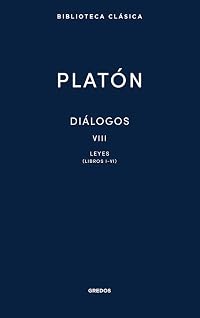
DIÁLOGOS. VIII. LEYES (LIBROS I-VI)
INTRODUCCIÓN
Las Leyes' son una de las obras más complejas y dificiles
del Corpus Platonicum. Su extensión y la diversidad de
sus temas, así como el estilo en que están tratados -con
numerosas y extensas digresiones que aparentemente no
conducen a ninguna parte- han hecho que algunos intérpretes
consideraran que su exposición ordenada constituía
de por sí un tema digno de publicación2. En efecto, no sólo
es el diálogo más extenso de Platón, ya que supera en dos...
I Las principales bibliografias sobre las Leyes pueden consultarse
más abajo págs. 176 s.
2 Tal es el caso de las obras de C. RITTER, Platos Gesetze, I, Leipzig,
1896 (reimpresión Aalen, 1985) y L. STRAUSs, The argument and the
action show more of Plato's Laws, Chicago-Londres, 1975, que ofrecen una paráfrasis
simplificada de la totalidad de la obra. Algo similar puede observarse
de la introducción de A. Dris, «Plan et intention générale des Lois», PLATON,
Euvres complètes, XI 1: Les Lois. Texte établi et traduit par É. DES
PLACES. Introduction de A. DIis et L. GERNET, París, 1951, págs. v-xcIm.
W. JAEGER, Paideia. Die Formung des griechischen Menschen Pai.
deia: los ideales de la cultura griega. [trad. de J. XIRAU y W. RocES],
México, 1942-1945 (reimpresión 1968), pág. 1015, señala las dificultades
con las que ha tropezado la interpretación de esta obra a lo largo de la
tradición desde la Antigüedad. Ya en época de Plutarco sólo existía un
reducido número de conocedores del diálogo. show less
INTRODUCCIÓN
Las Leyes' son una de las obras más complejas y dificiles
del Corpus Platonicum. Su extensión y la diversidad de
sus temas, así como el estilo en que están tratados -con
numerosas y extensas digresiones que aparentemente no
conducen a ninguna parte- han hecho que algunos intérpretes
consideraran que su exposición ordenada constituía
de por sí un tema digno de publicación2. En efecto, no sólo
es el diálogo más extenso de Platón, ya que supera en dos...
I Las principales bibliografias sobre las Leyes pueden consultarse
más abajo págs. 176 s.
2 Tal es el caso de las obras de C. RITTER, Platos Gesetze, I, Leipzig,
1896 (reimpresión Aalen, 1985) y L. STRAUSs, The argument and the
action show more of Plato's Laws, Chicago-Londres, 1975, que ofrecen una paráfrasis
simplificada de la totalidad de la obra. Algo similar puede observarse
de la introducción de A. Dris, «Plan et intention générale des Lois», PLATON,
Euvres complètes, XI 1: Les Lois. Texte établi et traduit par É. DES
PLACES. Introduction de A. DIis et L. GERNET, París, 1951, págs. v-xcIm.
W. JAEGER, Paideia. Die Formung des griechischen Menschen Pai.
deia: los ideales de la cultura griega. [trad. de J. XIRAU y W. RocES],
México, 1942-1945 (reimpresión 1968), pág. 1015, señala las dificultades
con las que ha tropezado la interpretación de esta obra a lo largo de la
tradición desde la Antigüedad. Ya en época de Plutarco sólo existía un
reducido número de conocedores del diálogo. show less
Mar 24, 2018Spanish
Members
- Recently Added By
Author Information

2,722+ Works 100,598 Members
Plato was born c. 427 B.C. in Athens, Greece, to an aristocratic family very much involved in political government. Pericles, famous ruler of Athens during its golden age, was Plato's stepfather. Plato was well educated and studied under Socrates, with whom he developed a close friendship. When Socrates was publically executed in 399 B.C., Plato show more finally distanced himself from a career in Athenian politics, instead becoming one of the greatest philosophers of Western civilization. Plato extended Socrates's inquiries to his students, one of the most famous being Aristotle. Plato's The Republic is an enduring work, discussing justice, the importance of education, and the qualities needed for rulers to succeed. Plato felt governors must be philosophers so they may govern wisely and effectively. Plato founded the Academy, an educational institution dedicated to pursuing philosophic truth. The Academy lasted well into the 6th century A.D., and is the model for all western universities. Its formation is along the lines Plato laid out in The Republic. Many of Plato's essays and writings survive to this day. Plato died in 347 B.C. at the age of 80. (Bowker Author Biography) show less
Work Relationships
Is contained in
Classifications
Statistics
- Members
- 6
- Popularity
- 3,034,102
- Reviews
- 1
- Languages
- Spanish
- Media
- Paper, Ebook
- ISBNs
- 2
- ASINs
- 1