Dinner at Deviant's Palace
by Tim Powers
On This Page
Description
A Philip K. Dick Award Winner from "a brilliant writer": In a ravaged California, a man tries to rescue his lost love from a soul-devouring religious cult (William Gibson). In the twenty-second century, the City of Angels is a tragic shell of its former self, having long ago been ruined and reshaped by nuclear disaster. Before he was in a band in Ellay, Gregorio Rivas was a redeemer, rescuing lost souls trapped in the Jaybirds cult of the powerful maniac Norton Jaybush. Rivas had hoped show more those days were behind him, but a desperate entreaty from a powerful official is pulling him back into the game. The rewards will be plentiful if he can wrest Urania, the official's daughter and Gregorio's first love, from Jaybush's sinister clutches. To do so, the redeemer reborn must face blood-sucking hemogoblins and other monstrosities on his way to discovering the ultimate secrets of this neo-Californian civilization. One of the most ingeniously imaginative writers of our time, Tim Powers dazzles in an early work that displays his unique creative genius, earning him a nomination for the Nebula Award. Alive with wit, intelligence, and wild invention, Dinner at Deviant's Palace is a mad adventure across a dystopian future as only Tim Powers could have imagined it. This ebook features an original introduction by the author. show lessTags
Recommendations























Member Reviews
Six-word review: Severely weird postapocalyptic fantasy delivers shudders.
Extended review:
In the city of Ellay, where life in some mutated form goes on following a nuclear cataclysm, Gregorio Rivas is twice rare: he's a gifted musician and composer with some unique skills, and he's a redeemer, the best there is.
A charismatic cult leader by the name of Jaybush has been amassing followers, keeping them in thrall with drugs and mass hypnosis. Only the most cunning, resourceful, and daring can get in and bring someone out. Rivas is hired to redeem the daughter of a rich and powerful man--a woman who happens to have been his cherished first love. Everything is on the line for him as he struggles to penetrate the cult without falling under show more its spell and ultimately confronts the evil at its core.
In the wake of the 1978 tragedy in Guyana I read a number of books on destructive cults, the psychology of cult programming and deprogramming, and Jim Jones and Jonestown in particular. I continue to find the subject fascinating and deeply disturbing, in fictional treatments as well as personal memoirs. As a dystopian novel, this 1985 fantasy by Tim Powers seems dated in a number of ways, but the imaginative quality is nonetheless extraordinary and the writing compelling. The subject matter drew me in and held me. The particularly repugnant aberrations known as hemogoblins, which may owe a little something to Dante, are far more chilling than any conventional fictitious monster.
I haven't had equally high opinions of everything I've read by Tim Powers, but he is a writer I can trust, and that more than anything else made this a timely choice for me. It was a good time for something absorbing, however dark. show less
Extended review:
In the city of Ellay, where life in some mutated form goes on following a nuclear cataclysm, Gregorio Rivas is twice rare: he's a gifted musician and composer with some unique skills, and he's a redeemer, the best there is.
A charismatic cult leader by the name of Jaybush has been amassing followers, keeping them in thrall with drugs and mass hypnosis. Only the most cunning, resourceful, and daring can get in and bring someone out. Rivas is hired to redeem the daughter of a rich and powerful man--a woman who happens to have been his cherished first love. Everything is on the line for him as he struggles to penetrate the cult without falling under show more its spell and ultimately confronts the evil at its core.
In the wake of the 1978 tragedy in Guyana I read a number of books on destructive cults, the psychology of cult programming and deprogramming, and Jim Jones and Jonestown in particular. I continue to find the subject fascinating and deeply disturbing, in fictional treatments as well as personal memoirs. As a dystopian novel, this 1985 fantasy by Tim Powers seems dated in a number of ways, but the imaginative quality is nonetheless extraordinary and the writing compelling. The subject matter drew me in and held me. The particularly repugnant aberrations known as hemogoblins, which may owe a little something to Dante, are far more chilling than any conventional fictitious monster.
I haven't had equally high opinions of everything I've read by Tim Powers, but he is a writer I can trust, and that more than anything else made this a timely choice for me. It was a good time for something absorbing, however dark. show less
Dinner at Deviant’s Palace is a bit unusual for a Tim Powers’ book, a post-apocalyptic adventure rather than a secret history. In my own mind, it has been overshadowed a bit by The Anubis Gates, possibly Powers’ most famous novel, released two years earlier. Yet, Gregorio Rivas’ quest to rescue his long-lost love from the cult of the Jaybirds is solid, with very classic Powers themes like the attraction of sin and the hazards of adventuring. I think this one may be a bit underappreciated, so let’s take a closer look.
Like Jerry Pournelle, Powers has set a number of his books in and around Los Angeles. I happen to be pretty familiar with LA, but I like this kind of thing even when it is not an area I’m familiar with. But since show more this is a post-apocalyptic LA, Powers gets to have some fun with the location. My personal favorite is the Ellay-Ex Deep, the circular bay that is reputed to glow in the center, and from whence radioactive delights are fished up to be served in the titular palace.
Ellay itself is what passes for a bastion of civilization, a center of trade in a mostly agricultural landscape. Gregorio has a pretty comfortable life there, playing his violin-like pelican in a bar, drinking, whoring, and enjoying the dissipations of being a post-apocalyptic rock star. At least until a baldy sport shows up at Spinks and offers him a ridiculous amount of money to go on one last redemption.
I hadn’t been aware of the use of the term “sport” in a genetic sense until I read Dinner at Deviant’s Palace. I mostly thought of the word “sport” as a upper-crusty way of referring to a friend, like in The Great Gatsby. Greg uses the term as an insult when he rejects the bald man’s offer, nearly getting himself into a duel over it. I enjoy the word play that Powers engages in here, as I suspect most native English readers would not think he was calling the man a mutant to his face. There is a lot of that in this book, and I enjoyed it immensely.
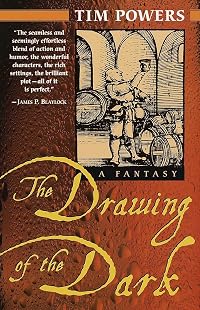
Unlike The Drawing of the Dark, I didn’t often find Dinner at Deviant’s Palace laugh out loud funny. The themes of the book are typical for Powers, but the voice is very different. It is often dry and witty, but also dark, with touches of horror. I appreciate this difference, as Greg is a very different man than Brian Duffy. Brian is a charming old reprobate; Greg is just kind of an asshole. It is possible that this book is a less popular one just because of Greg’s personality, which is distinctly unlovely.
Greg does share some traits with Brian: he’s left-handed, deft with a blade, and more than a bit of a drunkard. That latter item is in itself a common theme of Powers works. Powers himself has said that he had to give up drinking in the mid 1990s, which would have been about ten years later than he wrote this book. Not only Brian Duffy and Greg Rivas, but Scott Crane and other Powers protagonists have tended to drink to excess. For all of these characters, it fits well. Rock stars, old soldiers, and men dealing with grief often turn to drink. However, another profession that tends to be tipplers are authors, and I’ve often felt that Powers was writing from personal experience here.
Yet, despite Greg’s flaws, he is not just a protagonist, but a hero. A genuine white hat. For all his selfishness and vanity, Greg does eventually agree to try and redeem the daughter of the richest man in Ellay [although not without attempting to drive a very hard bargain first]. Because Greg cannot abandon Urania to the tender mercies of the Jaybirds. He knows what they are like, because he was one.
Greg was the best redeemer in Ellay because he knew Norton Jaybush and his followers, the Jaybirds, well enough to infiltrate the group and spirit away new recruits before their minds were ruined. In a providential twist, Greg’s personality equips him well for this role [and his drinking and talent for music come in handy too]. However, Greg is retired from redeeming for a reason: adventuring is a young man’s game.
Greg Rivas isn’t old by any stretch, but I do appreciate Powers’ lively sense of what it means to age. Greg’s knowledge is just as relevant as ever, but when success or failure depends upon the quickness of your knife and how long you can go without sleep, even getting into your thirties is going to lower your odds.
That Greg agrees to do this at all, given that he knows he has a good chance of failure, is why I see Greg as a hero rather than an anti-hero. Little does he realize the price he will pay. In addition to Powers take on getting old, it is rare for a Powers protagonist to make to the end of a book with all of their bits intact. And yet, for all the physical peril that Greg faces, dying is far from the worst thing that could happen to him.
Greg’s quest is both enabled and undermined by his incipient dissolution, and his fate hinges on: who is Gregorio Rivas? Come along on an adventure and find out. show less
Like Jerry Pournelle, Powers has set a number of his books in and around Los Angeles. I happen to be pretty familiar with LA, but I like this kind of thing even when it is not an area I’m familiar with. But since show more this is a post-apocalyptic LA, Powers gets to have some fun with the location. My personal favorite is the Ellay-Ex Deep, the circular bay that is reputed to glow in the center, and from whence radioactive delights are fished up to be served in the titular palace.
Ellay itself is what passes for a bastion of civilization, a center of trade in a mostly agricultural landscape. Gregorio has a pretty comfortable life there, playing his violin-like pelican in a bar, drinking, whoring, and enjoying the dissipations of being a post-apocalyptic rock star. At least until a baldy sport shows up at Spinks and offers him a ridiculous amount of money to go on one last redemption.
I hadn’t been aware of the use of the term “sport” in a genetic sense until I read Dinner at Deviant’s Palace. I mostly thought of the word “sport” as a upper-crusty way of referring to a friend, like in The Great Gatsby. Greg uses the term as an insult when he rejects the bald man’s offer, nearly getting himself into a duel over it. I enjoy the word play that Powers engages in here, as I suspect most native English readers would not think he was calling the man a mutant to his face. There is a lot of that in this book, and I enjoyed it immensely.
Unlike The Drawing of the Dark, I didn’t often find Dinner at Deviant’s Palace laugh out loud funny. The themes of the book are typical for Powers, but the voice is very different. It is often dry and witty, but also dark, with touches of horror. I appreciate this difference, as Greg is a very different man than Brian Duffy. Brian is a charming old reprobate; Greg is just kind of an asshole. It is possible that this book is a less popular one just because of Greg’s personality, which is distinctly unlovely.
Greg does share some traits with Brian: he’s left-handed, deft with a blade, and more than a bit of a drunkard. That latter item is in itself a common theme of Powers works. Powers himself has said that he had to give up drinking in the mid 1990s, which would have been about ten years later than he wrote this book. Not only Brian Duffy and Greg Rivas, but Scott Crane and other Powers protagonists have tended to drink to excess. For all of these characters, it fits well. Rock stars, old soldiers, and men dealing with grief often turn to drink. However, another profession that tends to be tipplers are authors, and I’ve often felt that Powers was writing from personal experience here.
Yet, despite Greg’s flaws, he is not just a protagonist, but a hero. A genuine white hat. For all his selfishness and vanity, Greg does eventually agree to try and redeem the daughter of the richest man in Ellay [although not without attempting to drive a very hard bargain first]. Because Greg cannot abandon Urania to the tender mercies of the Jaybirds. He knows what they are like, because he was one.
Greg was the best redeemer in Ellay because he knew Norton Jaybush and his followers, the Jaybirds, well enough to infiltrate the group and spirit away new recruits before their minds were ruined. In a providential twist, Greg’s personality equips him well for this role [and his drinking and talent for music come in handy too]. However, Greg is retired from redeeming for a reason: adventuring is a young man’s game.
Greg Rivas isn’t old by any stretch, but I do appreciate Powers’ lively sense of what it means to age. Greg’s knowledge is just as relevant as ever, but when success or failure depends upon the quickness of your knife and how long you can go without sleep, even getting into your thirties is going to lower your odds.
That Greg agrees to do this at all, given that he knows he has a good chance of failure, is why I see Greg as a hero rather than an anti-hero. Little does he realize the price he will pay. In addition to Powers take on getting old, it is rare for a Powers protagonist to make to the end of a book with all of their bits intact. And yet, for all the physical peril that Greg faces, dying is far from the worst thing that could happen to him.
Greg’s quest is both enabled and undermined by his incipient dissolution, and his fate hinges on: who is Gregorio Rivas? Come along on an adventure and find out. show less
Powers wrote this very early in his career, but it is of the same very high standard as his later books. He somehow manages to fill it with action and adventure, without that becoming the point. The world he creates is totally convincing, a decaying society a hundred years after the apocalypse, in the lands that were California. Our hero, Rivas, has the strength not only to fight the bad guys, but also, and perhaps requiring more courage, to face himself and the less savoury parts of his own character.
My reaction to reading this novel in 2005.
In this post apocalypse tale, Powers reuses elements of earlier stories and some characteristic plot and viewpoint devices to give us a pretty fast moving adventure story which is a reversal on the hardboiled detective plot that probably inspired it.
The setting is a Los Angeles aka Ellay about 100 years after a nuclear war -- a post-apocalypse quasi-Renaissance Los Angeles with scraps of leftover technology is also the setting of Powers' Epitaph in Rust. As in his The Skies Discrowned, the hero is an artist, specifically a musician. Also, as in that novel, he ends up being unable to settle down.
Duffy, the protagonist of Powers' The Drawing of the Dark was also an artist at one time and hopes show more to rekindle and an affair with an old love, Epiphany, as Gregorio Rivas wants his beloved Urania back. Epiphany dies but Urania lives. However here, Rivas discovers, in a very credible piece of psychology, that he only obsessed about her because he couldn't have her.She proves something of a disappointment, and Rivas discovers that his new self likes Sister Windchime much better.
There are a couple of distinctive Powers elements. One is the maiming of the character (a quite self-conscious plot element of Powers which he rightly thinks raises the stakes involved in his hero's struggles and makes their pain more real).Here Rivas deliberately mutilates his thumb to avoid the full effect of the sacrament. Later on he has to have two infected fingers amputated which may make his career as a musician much harder. The other element is bodyswitching. That isn't done per se here, but a doppleganger of Rivas exists, the vampiric (and wonderfully named) hemogoblin (a pun created by a typo perhaps?-- Powers is quite fond of humor derived from misunderstood words and phrases) created when part of Powers psychic energy is drained by the Jaybush alien. He not only serves as a wonderful way to conclude the climatic struggle with Savatividam at the Deviant's Palace but also as a clever literalized metaphor.
As the hemogoblin feeds on Rivas, he takes not only more of his energy but also more of his personality as he gains in corporeality. This is first and foremost the story of a man who changes from a self-absorbed (his thinking of lyrics based on his experiences while he undergoes various trials seems both very writerly and and self-centered man into someone willing to undergo the submerging of his self, peril to his body, and reconfrontation with the horrors of the Jaybush cult that he knows too well (though, of course, he doesn't know everything about them) to rescue Urania -- never mind that the object of his faithful and heroic sacrifice is not what he thinks. He makes a good faith effort. It is the reversal of the plot where a soft man hardens under adversity. Rivas softens, lets down his zealously guarded borders, and doesn't want to be reabsorbed with the personality elements he has literally left behind with the hemogoblin.
I notice that Powers uses what, for him, is the characteristic style of concentrating almost exclusively on his viewpoint character of Rivas (in other books, like the American Fisher King books, he has several viewpoint characters) but he does have slight interludes from the hemogoblin's point of view, and fellow redeemer (sort of a deprogrammer) Fracas McAn is very briefly a viewpoint character. Powers, even at this point in his career, does a wonderful job with extensive interior monologue which serves well to make Rivas a real character complete with absurd and understandable and realistic reactions to danger. As Powers has noted (after someone else pointed it out to him), this is another book with a climax set on the water -- here at the Deviant's Palace.
A fast moving, post-apocalyse adventure with quite good characterization and a novel reversal of a typical plot. show less
In this post apocalypse tale, Powers reuses elements of earlier stories and some characteristic plot and viewpoint devices to give us a pretty fast moving adventure story which is a reversal on the hardboiled detective plot that probably inspired it.
The setting is a Los Angeles aka Ellay about 100 years after a nuclear war -- a post-apocalypse quasi-Renaissance Los Angeles with scraps of leftover technology is also the setting of Powers' Epitaph in Rust. As in his The Skies Discrowned, the hero is an artist, specifically a musician. Also, as in that novel, he ends up being unable to settle down.
Duffy, the protagonist of Powers' The Drawing of the Dark was also an artist at one time and hopes show more to rekindle and an affair with an old love, Epiphany, as Gregorio Rivas wants his beloved Urania back. Epiphany dies but Urania lives. However here, Rivas discovers, in a very credible piece of psychology, that he only obsessed about her because he couldn't have her.
There are a couple of distinctive Powers elements. One is the maiming of the character (a quite self-conscious plot element of Powers which he rightly thinks raises the stakes involved in his hero's struggles and makes their pain more real).
As the hemogoblin feeds on Rivas, he takes not only more of his energy but also more of his personality as he gains in corporeality. This is first and foremost the story of a man who changes from a self-absorbed (his thinking of lyrics based on his experiences while he undergoes various trials seems both very writerly and and self-centered man into someone willing to undergo the submerging of his self, peril to his body, and reconfrontation with the horrors of the Jaybush cult that he knows too well (though, of course, he doesn't know everything about them) to rescue Urania -- never mind that the object of his faithful and heroic sacrifice is not what he thinks. He makes a good faith effort. It is the reversal of the plot where a soft man hardens under adversity. Rivas softens, lets down his zealously guarded borders, and doesn't want to be reabsorbed with the personality elements he has literally left behind with the hemogoblin.
I notice that Powers uses what, for him, is the characteristic style of concentrating almost exclusively on his viewpoint character of Rivas (in other books, like the American Fisher King books, he has several viewpoint characters) but he does have slight interludes from the hemogoblin's point of view, and fellow redeemer (sort of a deprogrammer) Fracas McAn is very briefly a viewpoint character. Powers, even at this point in his career, does a wonderful job with extensive interior monologue which serves well to make Rivas a real character complete with absurd and understandable and realistic reactions to danger. As Powers has noted (after someone else pointed it out to him), this is another book with a climax set on the water -- here at the Deviant's Palace.
A fast moving, post-apocalyse adventure with quite good characterization and a novel reversal of a typical plot. show less
My favorite of Powers' books, this one taking place in a near-future Los Angeles that is vaguely familiar and yet wonderfully spooky. Set the stage for other authors (like William Gibson and other cyber novelists for example) and offers us a fun look at post-atomic vampire-like creatures. Second time through, I am struck by the fact that Powers borrows many of the same tropes as Tolkien. We have a quest, a corrupting object of power, a character resembling Gollum and a land with danger around every corner. And a hero who seems rather ordinary who ends up acting quite selflessly.
This is really a book I'm not sure I like. I read it a long time ago, and it left an unfavorable impression, but I couldn't recall any of the details.
On a reread - I found it considerable different than what I thought it originally was. The book is well done. We have a post-apocalyptic California west coast. What happened is never mentioned, nor does it matter. Our protagonist, Greg Rivas is retired from a life of retrieving loved ones from an especially devious cult. When Greg's first love joins the cult, he does one last run to save her.
On the whole - this book is weird. Like twisted weird. Its not a bad thing, but it is relentless. From the Jaybird cult, to who Deviant is. Its a completely weird book, and there isn't much that is show more positive in it. Luckily, its short, covers some very interesting ground, and its logically consistent.
As stated originally, its a book I'm not sure I like, but the book is intriguing. show less
On a reread - I found it considerable different than what I thought it originally was. The book is well done. We have a post-apocalyptic California west coast. What happened is never mentioned, nor does it matter. Our protagonist, Greg Rivas is retired from a life of retrieving loved ones from an especially devious cult. When Greg's first love joins the cult, he does one last run to save her.
On the whole - this book is weird. Like twisted weird. Its not a bad thing, but it is relentless. From the Jaybird cult, to who Deviant is. Its a completely weird book, and there isn't much that is show more positive in it. Luckily, its short, covers some very interesting ground, and its logically consistent.
As stated originally, its a book I'm not sure I like, but the book is intriguing. show less
Nominally science fiction, this early Tim Powers novel is better classified as rationalized fantasy. In place of the hero traversing a demon-haunted landscape to rescue his lady fair from a vile sorcerer, we have him in post-nuclear war Southern California seeking to extricate a long-ago girl friend from a weird religious cult. The urban-gothic setting and grotesque fauna are inventive, the characters a bit paint-by-the-numbers, the climax one of the strangest banquets in literary history. For almost any other writer, this book would be a career-crowning achievement; for Powers, it is only average.
Members
- Recently Added By
Author Information

76+ Works 20,937 Members
Some Editions
Awards and Honors
Awards
Common Knowledge
- Original title
- Dinner at Deviant's Palace
- Original publication date
- 1985
- People/Characters
- Gregorio Rivas; Frake McAn; Steve Spink; Norton Jaybush; Sister Sue; Sister Windchime (show all 8); Uri; Sevatividam
- Important places
- Spinks; Deviant's Palace; Ellay
- Dedication
- To the Thursday Night Gang:
Chris Arena, Greg Arena, Bill Bailey, Jim Blaylock, Jenny Bunn, Pete Devries, Phil Dick, Jeff Fontanesi, Don Goudie, Chris Gourlay, Dashiell Hamster, Rick Harding, K. W. Jeter, Tom Kenyon, D... (show all)ave Lamont, Tim Lamont, Steve Malk, Phil Pace, Brendan Powers, Serena Powers, and Phil Thibodeau...
...and the honorary members: Russ Galen, Dean Koontz, Roy Squires, Joel Stein, Ted Wassard, and Paul Williams...
...and with thanks to Beth Meacham, most perceptive, persuasive and tactful of editors. - First words
- Crouched way up at the top of the wall in the rusty bed of the Rocking Truck, Modesto tugged his jacket more tightly across his chest, pushed back his hat and squinted around at the city.
- Last words
- (Click to show. Warning: May contain spoilers.)Hand in hand they ran forward, and hopped and clambered and slid over the tumbled masonry, coughing in the dust and the acid smell of broken stone, and then, out in the sunshine, they ran down the slope toward the river and the abandoned boats.
- Original language
- English
Classifications
Statistics
- Members
- 977
- Popularity
- 26,856
- Reviews
- 22
- Rating
- (3.56)
- Languages
- 6 — English, Finnish, French, German, Italian, Spanish
- Media
- Paper, Audiobook, Ebook
- ISBNs
- 18
- ASINs
- 14