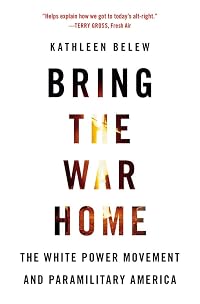
Bring the War Home: The White Power Movement and Paramilitary America
by Kathleen Belew
On This Page
Description
The white power movement in America wants a revolution. It has declared all-out war against the federal government and its agents, and has carried out--with military precision--an escalating campaign of terror against the American public. Its soldiers are not lone wolves but are highly organized cadres motivated by a coherent and deeply troubling worldview of white supremacy, anticommunism, and apocalypse. In Bring the War Home, Kathleen Belew gives us the first full history of the movement show more that consolidated in the 1970s and 1980s around a potent sense of betrayal in the Vietnam War and made tragic headlines in the 1995 bombing of Oklahoma City. Returning to an America ripped apart by a war which, in their view, they were not allowed to win, a small but driven group of veterans, active-duty personnel, and civilian supporters concluded that waging war on their own country was justified. They unified people from a variety of militant groups, including Klansmen, neo-Nazis, skinheads, radical tax protestors, and white separatists. The white power movement operated with discipline and clarity, undertaking assassinations, mercenary soldiering, armed robbery, counterfeiting, and weapons trafficking. Its command structure gave women a prominent place in brokering intergroup alliances and bearing future recruits. Belew's disturbing history reveals how war cannot be contained in time and space. In its wake, grievances intensify and violence becomes a logical course of action for some. Bring the War Home argues for awareness of the heightened potential for paramilitarism in a present defined by ongoing war.-- show lessTags
Recommendations













Member Reviews
Forget Stephen King. This is the scariest book I've ever read.
The book mostly covers the white power movement in the 80s and 90s, ending with the Oklahoma City bombing, which I remember well. But, unbeknownst to me, that bombing launched a "widespread wave of violence as the militia movement, and the broader white power movement, took action around the country."
Guess I wasn't paying attention back then. I'm paying attention now. We all know there's a resurgence of late. They are emboldened. And they're coming to your town. They've already arrived in my liberal town (The Proud Boys) appearing en masse at a school board meeting, flashing their white power hand signs. It's enough to give you nightmares.
This is essential reading for anyone show more who's paying attention! show less
The book mostly covers the white power movement in the 80s and 90s, ending with the Oklahoma City bombing, which I remember well. But, unbeknownst to me, that bombing launched a "widespread wave of violence as the militia movement, and the broader white power movement, took action around the country."
Guess I wasn't paying attention back then. I'm paying attention now. We all know there's a resurgence of late. They are emboldened. And they're coming to your town. They've already arrived in my liberal town (The Proud Boys) appearing en masse at a school board meeting, flashing their white power hand signs. It's enough to give you nightmares.
This is essential reading for anyone show more who's paying attention! show less
Important, deeply researched for the timeframe she chooses to cover. Not a boffo dramatic read, but the people and the story are eye-opening, appalling, and very frightening. The scariest part is just how long these folks have been at this, the technology they have amassed, and the fact that the current iteration - as only the last of many over decades - is emerging as a public force, no longer just hunkered down in the woods of Idaho playing with their guns (and armored vehicles, and grenades, and C-4 plastic explosive, and in one case, enough cyanide to kill more people than have died of Covid in the US), but now marching down our streets with Congresscreatures in their pockets. I found the description of how these groups set up a show more communication system via "Liberty Net" before the internet was even a thing fascinating - they were decades ahead of Facebook, Parler and Gab. She plays fair by also tracing the intense militarization of the police and how it contributed to the atrocity of Ruby Ridge and the Waco debacle. For those of us waking up to the terrors and new prominence of the white power movement (her chosen term to encompass the Klan, Aryan Nations and other white supremacists, which eventually folded in the modern militias), this is a useful and cautionary work of history and background with an urgent currency. show less
When American paranoia spilled out into the open on January 7, 2021, I thought it a good time to re-educate myself about the players on the field.
To an outsider, the attack on the US Capitol looked like a cross between the storming of the Bastille and the burning of the Reichstag with some crazy costumes. It was tragic that four Capitol policemen lost their lives defending the seat of American democracy, and it could have been much worse had the legislators not gotten out of the building ahead of the mob.
What is equally crazy is the stonewalling by the Republican Party over efforts to get the bottom of such pressing questions as:
1) Why was there insufficient policing of the Capitol even though the FBI and the Capitol police knew show more something was underfoot?
2) Who were the organizers and what were their ultimate objectives?
3) Was Donald Trump actively engaged in an attempted coup-d’état?
4) Is another event brewing and if so how can it be stopped?
This brought me to Kathleen Belew’s excellent sociological study “Bring the War Home: The White Power Movement and Paramilitary America.”
As Belew sees it there are distinct contributors to domestic terrorism in America:
- there are the garden variety racists, amply represented by the Klu Klux Klan and their derivatives,
- there are the more generalized racists, alt-right, skinheads and easily identifiable neo-Nazis, anti-semites, and groups like the Proud Boys
- there is the stream of anti-communists stretching back to the Red Scare originating at the turn of the 20th century reaching its summit in the McCarthy Hearings of the 1950’s. Belew tracks a new variant of this epidemic in soldiers returning from Vietnam, and crazies who want us to believe they defended America even though they never did.
- there are groups of unmoored religious cults who variously believe in the Second Coming of Christ and where the men hate Arabs but conveniently believe in the Arab custom of polygamy.
- there are the contemporary and un-sanctioned militia groups who believe the right to bear arms means carrying around semi-automatic rifles to the neighbourhood grocery store. America is unique in having about 300 million licensed firearms in the hands of ordinary citizens.
- there are the anti-taxers, anti-abortionists, anti-unionists, anti-vaxers, and anti-maskers.
You could easily confuse these groups but they represent unique challenges to law enforcement.
In the 1990’s law enforcement took far too extreme measures to disarm a white separatist family in the hills of Idaho. Google Ruby Ridge and you’ll see what I mean. Then there was David Koresh and the Waco Texas standoff.
The ultimate expression of the paranoia was undoubtedly Timothy McVeigh’s bombing of a government building in Oklahoma. McVeigh conspired with militarists, white power, and anti-taxers.
McVeigh did not act alone. There were plenty of weapons and bomb-making expertise in the hands of white power groups. A lot of weapons had been stolen from US military bases. They were used to terrorize minorities, commit murder, and rob banks.
I was less familiar with the Greensboro massacre in 1979 where white power factions attacked and killed members of the Communist Workers Party who had organized a “Death to the Klan” march. The white-power attackers were exonerated by an all-white jury.
We can all see how the current partisan political environment played into the events on Capitol Hill. Donald Trump tried everything to reverse the results of the election with the help of Republican legislators, FOX News, and Vladimir Putin’s troll farm.
The question remains what are the sources of these extremist views? Many are not solely American-made behaviours. Colour-based prejudice, anti-semitism, nativism, and separatism go way back before the founding of the American Republic.
Of course, America was founded to some degree by religious separatists, anti-taxers, and grew up on a dangerous frontier. The historical frontier is long gone, but the frontier as a paranoid fantasy lives on.
And there is plenty of venom and envy to go around. show less
To an outsider, the attack on the US Capitol looked like a cross between the storming of the Bastille and the burning of the Reichstag with some crazy costumes. It was tragic that four Capitol policemen lost their lives defending the seat of American democracy, and it could have been much worse had the legislators not gotten out of the building ahead of the mob.
What is equally crazy is the stonewalling by the Republican Party over efforts to get the bottom of such pressing questions as:
1) Why was there insufficient policing of the Capitol even though the FBI and the Capitol police knew show more something was underfoot?
2) Who were the organizers and what were their ultimate objectives?
3) Was Donald Trump actively engaged in an attempted coup-d’état?
4) Is another event brewing and if so how can it be stopped?
This brought me to Kathleen Belew’s excellent sociological study “Bring the War Home: The White Power Movement and Paramilitary America.”
As Belew sees it there are distinct contributors to domestic terrorism in America:
- there are the garden variety racists, amply represented by the Klu Klux Klan and their derivatives,
- there are the more generalized racists, alt-right, skinheads and easily identifiable neo-Nazis, anti-semites, and groups like the Proud Boys
- there is the stream of anti-communists stretching back to the Red Scare originating at the turn of the 20th century reaching its summit in the McCarthy Hearings of the 1950’s. Belew tracks a new variant of this epidemic in soldiers returning from Vietnam, and crazies who want us to believe they defended America even though they never did.
- there are groups of unmoored religious cults who variously believe in the Second Coming of Christ and where the men hate Arabs but conveniently believe in the Arab custom of polygamy.
- there are the contemporary and un-sanctioned militia groups who believe the right to bear arms means carrying around semi-automatic rifles to the neighbourhood grocery store. America is unique in having about 300 million licensed firearms in the hands of ordinary citizens.
- there are the anti-taxers, anti-abortionists, anti-unionists, anti-vaxers, and anti-maskers.
You could easily confuse these groups but they represent unique challenges to law enforcement.
In the 1990’s law enforcement took far too extreme measures to disarm a white separatist family in the hills of Idaho. Google Ruby Ridge and you’ll see what I mean. Then there was David Koresh and the Waco Texas standoff.
The ultimate expression of the paranoia was undoubtedly Timothy McVeigh’s bombing of a government building in Oklahoma. McVeigh conspired with militarists, white power, and anti-taxers.
McVeigh did not act alone. There were plenty of weapons and bomb-making expertise in the hands of white power groups. A lot of weapons had been stolen from US military bases. They were used to terrorize minorities, commit murder, and rob banks.
I was less familiar with the Greensboro massacre in 1979 where white power factions attacked and killed members of the Communist Workers Party who had organized a “Death to the Klan” march. The white-power attackers were exonerated by an all-white jury.
We can all see how the current partisan political environment played into the events on Capitol Hill. Donald Trump tried everything to reverse the results of the election with the help of Republican legislators, FOX News, and Vladimir Putin’s troll farm.
The question remains what are the sources of these extremist views? Many are not solely American-made behaviours. Colour-based prejudice, anti-semitism, nativism, and separatism go way back before the founding of the American Republic.
Of course, America was founded to some degree by religious separatists, anti-taxers, and grew up on a dangerous frontier. The historical frontier is long gone, but the frontier as a paranoid fantasy lives on.
And there is plenty of venom and envy to go around. show less
Terrifying book, well researched but sometimes repetitive and badly written, about white power activism and organizing from post-Vietnam until now. The “leaderless” strategy that spurred acts like the Oklahoma City bombing has paid off in significant part by convincing journalists and most law enforcement officers that people like Dylann Roof and Timothy McVeigh were “lone wolves” rather than embedded in a larger network that trained and encouraged them. Belew’s thesis that the Vietnam War fundamentally reshaped the white power movement would have been strengthened by more contrast with the pre-Vietnam configurations, and it’s not clear that “Vietnam” structures the current movement’s understanding of its relationship show more with America and America’s government as it did twenty years ago. Her argument that post-Vietnam white power movements understood themselves as fundamentally in opposition to the federal government, as opposed to enforcing a racial hierarchy with which the government agreed, also needs some revisiting post-Trump. (I also wonder how much this is really a change—the KKK members and other racists who terrorized people in the first half of the twentieth century, in North and South, probably also thought that their local governments were really on their side, and they were almost certainly right. Hmm, this makes me think about Arendt’s argument about anti-Semitism’s inherent link to opposition to the modern state, and whether it could be extended to African-Americans’ relationship to the federal versus local governments.) show less
Great review of right-wing groups from various 20th century incarnations of the KKK (KKKK, CKKK, etc.), The Order, major influences such as the Turner Diaries and William Pierce, and the preeminent role of Vietnam in the White Power Movement (both in terms of combat background and the "stab in the back", similar to Hitlerian theories about WW1 which led to his rise). While I've read a lot about right (and left, and Islamic, and other) extremist groups, I hadn't appreciated the degree to which Vietnam was so central to these groups, even well into the 90s.
Interesting reading about early far right use of IT (Apple II-based BBSes like Aryan Nation's Liberty Net), gender roles in these groups (although the lens used by the author is leftist show more academic lolcowery, there's some truth to it), and just how horrible a lot of people and activities have been. Contrasting with the left, where successful actions seemed to lead to lasting success, and jihadi terrorism where 9/11 led to a dramatic over-response and escalation, the biggest "successful activity" of these groups seems to have been McVeigh's OKC bombing, an event which basically ended the movement. show less
Interesting reading about early far right use of IT (Apple II-based BBSes like Aryan Nation's Liberty Net), gender roles in these groups (although the lens used by the author is leftist show more academic lolcowery, there's some truth to it), and just how horrible a lot of people and activities have been. Contrasting with the left, where successful actions seemed to lead to lasting success, and jihadi terrorism where 9/11 led to a dramatic over-response and escalation, the biggest "successful activity" of these groups seems to have been McVeigh's OKC bombing, an event which basically ended the movement. show less
This is an important topic and the book is a worthy read despite its flaws. It’s at its best when presenting verifiable observed events such as direct quotes from eg trials. It’s weaker in its general hoplophobia and some strained, amateurish “in conclusion in this essay I have argued” conclusions that don’t really follow. Make no mistake. She is writing about frightening, execrable people. Some of them are very bright and it’s clear they’ve gone both more subtle and more mainstream since the 90’s - as witnessed by the such stuff as the “unite the right” rally in Charlottsville in which actual racist slogans were chanted, the high placement of actual whites supremacists in the us and other governments etc. This book show more doesn’t really address these developments, but offers a flawed but important background. show less
very impressively researched but i got exhausted by all the focus on the specifics of the legal cases and terrorist tactions. im interested in what the white power movement felt like from the inside and how people thought lived their lives in this violently racist subculture, and i imagine that is much harder to research.
the chapter about the violence faced by vietnamese immigrants was really painful.
shorter than it looks! like 100 pages at the end are just references.
the chapter about the violence faced by vietnamese immigrants was really painful.
shorter than it looks! like 100 pages at the end are just references.
Members
- Recently Added By
Published Reviews
ThingScore 100
The history of the white-power movement can reframe how we think of activists like this [Dylan Roof]. Thinking of people as people with an ideology, even if it’s something we don’t agree with, changes the way that we think about opposition. It discredits the idea of lone wolf operatives or single incidents with mad gunmen and calls on us to try to understand people’s own stated show more motivation, and to find the connections when they exist between different actions and between different groups. show less
added by elenchus
Lists

Club Read's Recommended Nonfiction Written by Women
618 works; 30 members
Author Information

3+ Works 500 Members
Awards and Honors
Awards
Distinctions
Common Knowledge
- Canonical title
- Bring the War Home: The White Power Movement and Paramilitary America
- Original title
- Bring the War Home: The White Power Movement and Paramilitary America
- Original publication date
- 2018
- People/Characters
- Louis Beam (Lone Star); David Duke; Tom Posey; Don Black; Michael Norris; Frank Camper (show all 18); Robert Lisenby; J. R. Hagan; Robert Miles; Richard Butler; Gary Lee Yarbrough (Yosemite Sam); Bob Mathews; Randy Ducy; Randall Rader (Field Marshall & Big Boy); Gordon Khal; Alan Berg; Zillah Craig; James Ellison
- Important places
- Vietnam; Washington, D.C., USA; Hayden Lake, Idaho, USA; Seattle, Washington, USA; Zarephath-Horeb, Missouri, USA; Lee County, North Carolina, USA (show all 8); Ruby Ridge, Idaho, USA; Mount Carmel, Waco, Texas, USA
- Important events
- Vietnam War (1961-1975); Aryan Nations World Congress (1983-07); Turner Diaries published (1974 | 1978); Alan Berg assassination (1984-06-18 | 1984-06-18); Bob Mathews' death on Whidbey Island by federal agents (1984-12); Racketeering & conspiracy conviction of 'Order' members (1985-12-30) (show all 9); Federal agents storm CSA compound (1985-04-19); Ruby Ridge standoff (1992-08); Branch Davidian siege, Mount Carmel, Waco, USA (1993-04)
- Dedication
- For G. and O., with all my best hopes
- First words
- Louis Beam spent eighteen months in Vietnam.
- Last words
- (Click to show. Warning: May contain spoilers.)It powerfully reveals how white power rhetoric and activism, time and again, have influenced mainstream U.S. politics, and most especially in the aftermath of war.
- Canonical DDC/MDS
- 320.56909073
- Canonical LCC
- HS2325.B45
Classifications
- Genres
- History, Nonfiction, Sociology, General Nonfiction, Politics and Government
- DDC/MDS
- 320.56909073 — Society, government, & culture Political science Types of Government Political ideologies Racism Ideologies by ethnic and national groups
- LCC
- HS2325 .B45 — Social sciences Societies: secret, benevolent, etc. Societies: secret, benevolent, etc. Other societies. By classes Political and "patriotic" societies
- BISAC
Statistics
- Members
- 432
- Popularity
- 71,433
- Reviews
- 12
- Rating
- (4.21)
- Languages
- English
- Media
- Paper, Audiobook, Ebook
- ISBNs
- 7
- ASINs
- 3