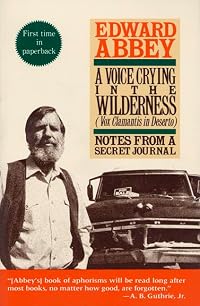
A Voice Crying in the Wilderness (Vox Clamantis in Deserto): Notes from a Secret Journal
by Edward Abbey
On This Page
Description
Thoughts on nature, politics, love, and much more-from the environmentalist and author of such classics as Desert Solitaire and The Monkey Wrench Gang. Finished just two weeks before his death, A Voice Crying in the Wilderness is a collection of Edward Abbey's observations, both bitingly witty and inspirational, on a wide range of topics-from philosophy and writing to music, money, sex, and sports. Abbey chose each passage himself from his own journals and previous writings-and warns us in show more his typical humorous style that some of the notes "may be unconscious plagiarisms from the great and dead (never steal from the living and mediocre)." Abbey's last wish was to be buried in an unmarked grave somewhere out in the vast desert he loved so much. A Voice Crying in the Wilderness is an enduring signal from that desert, through the words of one of the singular American thinkers of our times. show lessTags
Recommendations



















Member Reviews
An aphorism is to an essay as a haiku is to a sonnet. It delivers the message in as few words as possible. Edward Abbey (1927-1989) was a master of these one-sentence essays. Even in his longer work, acclaimed books like “Desert Solitaire,” readers might be tempted to underline choice sentences here and there, those clever statements that pack a punch in very few words.
Just before his death, Abbey compiled many of his best one-liners into the book “A Voice Crying in the Wilderness.” Some of those one-liners were probably written on his death bed just for this book. Reading them, one can switch moods in an instant, from laughter to anger (with Abbey or at him, as the case may be), from compassion to resolve.
They are a mixed lot, show more even when divided by category. Some examples:
On government and politics: "A patriot must always be ready to defend his country against his government."
On education: "The best thing about graduating from the university was that I finally had time to sit on a log and read a good book."
On music: "Music clouds the intellect but clarifies the heart."
On women: "Girls, like flowers, bloom but once. But once is enough."
Abbey is best remembered for his ruthless defense of the natural world, especially the American desert (which helps explains the title of the book). Many of his aphorisms touch on this subject, although they may sometimes seem contradictory, such as: "Nature, like Maimonides said, is mainly a good place to throw beer cans on Sunday afternoons." More characteristic is this one: "If wilderness is outlawed, only outlaws can save wilderness." Or this one: "Phoenix, Arizona: an oasis of ugliness in the midst of a beautiful wasteland."
This may be the best Edward Abbey book I've read. It packs a lifetime of thought into barely a hundred pages. show less
Just before his death, Abbey compiled many of his best one-liners into the book “A Voice Crying in the Wilderness.” Some of those one-liners were probably written on his death bed just for this book. Reading them, one can switch moods in an instant, from laughter to anger (with Abbey or at him, as the case may be), from compassion to resolve.
They are a mixed lot, show more even when divided by category. Some examples:
On government and politics: "A patriot must always be ready to defend his country against his government."
On education: "The best thing about graduating from the university was that I finally had time to sit on a log and read a good book."
On music: "Music clouds the intellect but clarifies the heart."
On women: "Girls, like flowers, bloom but once. But once is enough."
Abbey is best remembered for his ruthless defense of the natural world, especially the American desert (which helps explains the title of the book). Many of his aphorisms touch on this subject, although they may sometimes seem contradictory, such as: "Nature, like Maimonides said, is mainly a good place to throw beer cans on Sunday afternoons." More characteristic is this one: "If wilderness is outlawed, only outlaws can save wilderness." Or this one: "Phoenix, Arizona: an oasis of ugliness in the midst of a beautiful wasteland."
This may be the best Edward Abbey book I've read. It packs a lifetime of thought into barely a hundred pages. show less
It is time for America to rediscover Edward Abbey. If you only know him from The Monkey Wrench Gang, and you liked it, the little collection of his sayings, A Voice Crying in the Wilderness, will give you an insight to Abbey’s inner workings. While he does not have the body of work left by Mark Twain, some of the sayings are just as pity as anything Twain penned.
Since it is a collection of sayings, you don’t need to read it in a linear order. In fact, it may be better not to. It is often enjoyable to just open to any page at random and read whatever your eye falls on. You could almost develop a cult based on daily readings from this book. Not quite Mao’s Red Book, but you get the idea.
This book is best enjoyed sitting in the shade show more of your front porch, or under a shady tree, with a cold one in one hand and some good company by your other hand. If you’re easily offended, too late: you shouldn’t have even read this review. show less
Since it is a collection of sayings, you don’t need to read it in a linear order. In fact, it may be better not to. It is often enjoyable to just open to any page at random and read whatever your eye falls on. You could almost develop a cult based on daily readings from this book. Not quite Mao’s Red Book, but you get the idea.
This book is best enjoyed sitting in the shade show more of your front porch, or under a shady tree, with a cold one in one hand and some good company by your other hand. If you’re easily offended, too late: you shouldn’t have even read this review. show less
The best sayings of Edward Abbey - and some that weren't so good - collected together in a short, readable book that can serve as a valuable reference for anyone who wants something pithy to answer the next time they're confronted with an anti-environmental heckler.
"Whatever we cannot easily understand we call God; this saves much wear and tear on the brain tissues."
"Belief in God? An afterlife? I believe in rock: this apodictic rock beneath my feet."
"From the point of view of a tapeworm, man was created by God to serve the appetite of the tapeworm."
"Proverbs save us the trouble of thinking. What we call folk wisdom is often no more than a kind of expedient stupidity."
"Appearance versus reality? Appearance is reality, God damn it!"
"Fantastic doctrines (like Christianity or Islam or Marxism) require unanimity of belief. One dissenter casts doubt on the creed of millions. Thus the fear and the hate; thus the torture champber, the iron stake, the gallows, the labor camp, the psychiatric ward."
"God is show more Love? Not bloody likely."
"Belief? What do I believe in? I believe in sun. In rock. In the dogma of the sun and the doctrine of the rock. I believe in blood, fire, woman, rivers, eagles, storm, drums, flutes, banjos, and broom-tailed horses..."
"In metaphysics, the notion that earth and all that's on it is a mental construct is the product of people who spend their lives inside rooms. It is an indoor philosophy."
"Belief in the supernatural reflects a failure of the imagination."
"Better a cruel truth than a comfortable delusion."
"We live in a time of twin credulities: the hunger for the miraculous combine with a servile awe of science. The mating of the two gives the superstition plus scientism-- a Mongoloid metaphysic."
"No tyranny is so irksome as petty tyranny: the officious demands of policemen, government clerks, and electromechanical gadgets."
"All revolutions have failed? Perhaps. But rebellion for good cause is self-justifying-- a good in itself. Rebellion transforms slaves into human beings, if only for an hour."
"Men love their ideas more than their lives. And the more preposterous the idea, the more eager they are to die for it. And to kill for it."
"If America could be, once again, a nation of self-reliant farmers, craftsmen, hunters, ranchers, and artists, then the rich would have little power to dominate others. Neither to serve nor to rule: That was the American dream."
"There has never been an original sin: each is quite banal."
"The ready availability of suicide, like sex and alcohol, is one of life's basic consolations."
"The fear of death follows from the fear of life. A man who lives fully is prepared to die at any time."
"We live in a kind of world where courage is the most essential of virtues; without courage, the other virtues are useless."
"In the modern technoindustrial culture, it is possible to proceed from infancy into senility without ever knowing manhood."
"Once upon a time, I dreamed of becoming a great man. Later, a good man. Now, finally, I find it difficult enough and honor enough to be-- a man."
"Those who fear death most are those who enjoy life least."
"To the intelligent man or woman, life appears infinitely mysterious. But the stupid have an answer for every question."
"Art, science, philosophy, religion-- each offers at best only a crude simplification of actual living experience."
"I find more and more, as I grow older, that I prefer women to men, children to adults, animals to humans... And rocks to living things? No, I'm not that old yet." show less
"Belief in God? An afterlife? I believe in rock: this apodictic rock beneath my feet."
"From the point of view of a tapeworm, man was created by God to serve the appetite of the tapeworm."
"Proverbs save us the trouble of thinking. What we call folk wisdom is often no more than a kind of expedient stupidity."
"Appearance versus reality? Appearance is reality, God damn it!"
"Fantastic doctrines (like Christianity or Islam or Marxism) require unanimity of belief. One dissenter casts doubt on the creed of millions. Thus the fear and the hate; thus the torture champber, the iron stake, the gallows, the labor camp, the psychiatric ward."
"God is show more Love? Not bloody likely."
"Belief? What do I believe in? I believe in sun. In rock. In the dogma of the sun and the doctrine of the rock. I believe in blood, fire, woman, rivers, eagles, storm, drums, flutes, banjos, and broom-tailed horses..."
"In metaphysics, the notion that earth and all that's on it is a mental construct is the product of people who spend their lives inside rooms. It is an indoor philosophy."
"Belief in the supernatural reflects a failure of the imagination."
"Better a cruel truth than a comfortable delusion."
"We live in a time of twin credulities: the hunger for the miraculous combine with a servile awe of science. The mating of the two gives the superstition plus scientism-- a Mongoloid metaphysic."
"No tyranny is so irksome as petty tyranny: the officious demands of policemen, government clerks, and electromechanical gadgets."
"All revolutions have failed? Perhaps. But rebellion for good cause is self-justifying-- a good in itself. Rebellion transforms slaves into human beings, if only for an hour."
"Men love their ideas more than their lives. And the more preposterous the idea, the more eager they are to die for it. And to kill for it."
"If America could be, once again, a nation of self-reliant farmers, craftsmen, hunters, ranchers, and artists, then the rich would have little power to dominate others. Neither to serve nor to rule: That was the American dream."
"There has never been an original sin: each is quite banal."
"The ready availability of suicide, like sex and alcohol, is one of life's basic consolations."
"The fear of death follows from the fear of life. A man who lives fully is prepared to die at any time."
"We live in a kind of world where courage is the most essential of virtues; without courage, the other virtues are useless."
"In the modern technoindustrial culture, it is possible to proceed from infancy into senility without ever knowing manhood."
"Once upon a time, I dreamed of becoming a great man. Later, a good man. Now, finally, I find it difficult enough and honor enough to be-- a man."
"Those who fear death most are those who enjoy life least."
"To the intelligent man or woman, life appears infinitely mysterious. But the stupid have an answer for every question."
"Art, science, philosophy, religion-- each offers at best only a crude simplification of actual living experience."
"I find more and more, as I grow older, that I prefer women to men, children to adults, animals to humans... And rocks to living things? No, I'm not that old yet." show less
With sketches by Oracle's own Andy Rush, this Abbey book is the most closely related to Oracle itself, though not geographical in content. It's Abbey's "Notes from a secret journal."
Ratings
Members
- Recently Added By
Author Information

42+ Works 13,938 Members
Edward Abbey was born January 29, 1927 in Indiana, Pennsylvania, and grew up in nearby Home. After military service in Naples, Italy, from 1945-47, he enrolled in Indiana University of Pennsylvania for a year before traveling to the West. He fell in love with the desert Southwest and eventually attended the University of New Mexico, where he show more obtained both graduate and post-graduate degrees. Abbey was a Fulbright Fellow from 1951-52. Abbey was an anarchist and a radical environmentalist; these positions are reflected in his writings. His novel Fire on the Mountain won the Western Heritage Award for Best Novel in 1963. Desert Solitaire: A Season in the Wilderness, considered by many to be his best work, is nonfiction that reflects Abbey's love for the American Southwest and draws on his experiences as a park ranger. Among his best-known works are The Brave Cowboy (1956), The Monkey Wrench Gang (1975), and The Fool's Progress (1988). In 1966 The Brave Cowboy was made into a movie titled Lonely Are the Brave, starring Kirk Douglas. Two collections of essays have been published since his death in 1989: Confessions of a Barbarian in 1994 and The Serpents of Paradise the following year. In 1987, Abbey was offered the American Academy of Arts and Letters Award, but he declined. Abbey died in March 1989, near Tucson, Arizona, from complications following surgery. He did not want a traditional burial but rather requested to be buried in the Arizona desert, where he could nourish the earth which had been the subject of so many of his works. (Bowker Author Biography) show less
Common Knowledge
- Canonical title*
- A voice crying in the wilderness
- Original title
- A voice crying in the wilderness
- Alternate titles*
- Vox clamantis in deserto : notes from a secret journal
- Original publication date
- 1989
*Some information comes from Common Knowledge in other languages. Click "Edit" for more information.
Classifications
Statistics
- Members
- 243
- Popularity
- 133,278
- Reviews
- 5
- Rating
- (4.23)
- Languages
- English, French
- Media
- Paper, Ebook
- ISBNs
- 3
- ASINs
- 4