On This Page
Description
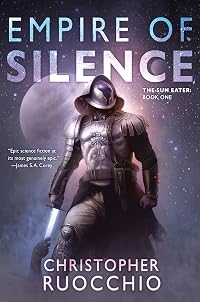
It was not his war. On the wrong planet, at the right time, for the best reasons, Hadrian Marlowe started down a path that could only end in fire. The galaxy remembers him as a hero: the man who burned every last alien Cielcin from the sky. They remember him as a monster: the devil who destroyed a sun, casually annihilating four billion human lives--even the Emperor himself--against Imperial orders. But Hadrian was not a hero. He was not a monster. He was not even a soldier. Fleeing his show more father and a future as a torturer, Hadrian finds himself stranded on a strange, backwater world. Forced to fight as a gladiator and into the intrigues of a foreign planetary court, he will find himself fight a war he did not start, for an Empire he does not love, against an enemy he will never understand. show lessTags
Recommendations




Member Reviews
"Das Imperium der Stille" ist der Debutroman des amerikanischen Autors Christopher Ruocchio und offenbar der erste Band einer mehrteiligen Reihe. Den von vielen Rezensenten im englischsprachigen Bereich genannten Vergleich mit Frank Herberts "Dune" und Patrick Rothfuss‘ "Der Name des Windes" würde ich bestätigen, auch wenn ich letzteres nur aus Erzählungen kenne.
Wie bei "Dune" begegnen wir einer absolut fantastischen Welt. Planeten und Aliens gepaart mit Familiendynastien, Schlössern und Adelstiteln. Das Worldbuilding in "Das Imperium der Stille" ist gigantisch gut. Die feindlichen Aliens, die Cielcin fand ich genauso interessant wie es er Erzähler, Hadrian Marlowe, tat. Ruocchio hat hier wirklich saubere Arbeit geleistet. Im show more Anhang findet man eine ausführliche Auflistung der Dramatis Personae und der Planeten sowie ein Lexikon der fremden Begriffe. Dabei ist alles im Sprachstil des Buches gehalten.
Aber und das muss ich leider sagen, das Buch zu lesen war harte Arbeit. Wir folgen Hadrians Erzählungen über sein Leben beginnend mit seiner Kindheit. Hadrian selbst ist dabei eine Figur, bei der man nicht weiß, ob man einfach nur kopfschüttelnd danebenstehen oder ihr eine runterhauen sollte. Er wirkt extrem entrückt und müsste ich es auf jugendliches Neudeutsch herunterbrechen, dann wäre seine Erzählung über sich selbst ein klassisches first world problems-Mimimi, das mir als Leserin einfach nur mächtig auf die Nerven ging.
Hadrian ist privilegiert, wird aber doch nicht der Erbe des Uraniumimperiums seines Vaters und will eigentlich nur alles über die Cielcin und andere Aliens lernen. Daran ist in der Regel nichts verkehrt. Aber Hadrian wirkt in allen Situationen weltfremd, arrogant und einfach nur dumm. Er macht aus Mücken Elefanten, straft sich mit schweren Entscheidungen, nur um am Ende doch einfach nur eine dumme Entscheidung nach der anderen zu machen.
Die Figuren in der zweiten Reihe sind dabei aber sehr viel interessanter und auch die Beziehungen der Figuren sind kein bisschen langweilig. Einzig die Art, wie Hadrian darüber berichtet, macht das ganze zu einem dahinplätschernden Monolog, bei dem man als Zuhörer abschalten würde.
Es ist auch nicht sehr hilfreich, dass die verwendete Sprache extrem selbstverliebt wirkt und im Englischen durchaus mit self-indulgent betitelt werden könnte. Hinzukommt, dass dem Leser viele Dinge erzählt werden, die aber im Laufe des Buches gar nicht so wirken. Es gibt keine echte Bedrohung. Keinen Gegenspieler. Irgendwie nichts.
Alles in allem also sehr schade, denn das Worldbuilding war interessant und hat mich neugierig auf mehr gemacht. Aber es dauerte um die 200 Seiten, bis überhaupt mal eine Handlung in Erscheinung trat und auch sonst wäre das Buch gut und gerne mit der Hälfte der Seitenzahl ausgekommen. Es hätte der extremen Details, die dem Leser ständig und wiederholt präsentiert werden, einfach nicht bedarft. Spannung baute sich dadurch jedenfalls keine auf.
Fazit
Ich bin sehr hin- und hergerissen. Das Worldbuilding ist, wie gesagt, herausragend und Ruocchio kann seine Sprache. Aber, Spannung sucht man in diesem Buch einfach vergebens. Und während das für mich in der Regel kein ausschlaggebender Punkt sein muss, so hatte ich doch ein riesiges Problem damit, weil auch sonst einfach nichts wirklich passiert, das mich als Leser begeistert hätte. Das Worldbuilding allein kann diese Geschichte leider nicht tragen. Ich denke, empfehlen kann man dieses Buch all jenen, die Dune mit Begeisterung gelesen haben. Aber wie Dune konnte es mich persönlich nicht vollständig überzeugen. show less
Wie bei "Dune" begegnen wir einer absolut fantastischen Welt. Planeten und Aliens gepaart mit Familiendynastien, Schlössern und Adelstiteln. Das Worldbuilding in "Das Imperium der Stille" ist gigantisch gut. Die feindlichen Aliens, die Cielcin fand ich genauso interessant wie es er Erzähler, Hadrian Marlowe, tat. Ruocchio hat hier wirklich saubere Arbeit geleistet. Im show more Anhang findet man eine ausführliche Auflistung der Dramatis Personae und der Planeten sowie ein Lexikon der fremden Begriffe. Dabei ist alles im Sprachstil des Buches gehalten.
Aber und das muss ich leider sagen, das Buch zu lesen war harte Arbeit. Wir folgen Hadrians Erzählungen über sein Leben beginnend mit seiner Kindheit. Hadrian selbst ist dabei eine Figur, bei der man nicht weiß, ob man einfach nur kopfschüttelnd danebenstehen oder ihr eine runterhauen sollte. Er wirkt extrem entrückt und müsste ich es auf jugendliches Neudeutsch herunterbrechen, dann wäre seine Erzählung über sich selbst ein klassisches first world problems-Mimimi, das mir als Leserin einfach nur mächtig auf die Nerven ging.
Hadrian ist privilegiert, wird aber doch nicht der Erbe des Uraniumimperiums seines Vaters und will eigentlich nur alles über die Cielcin und andere Aliens lernen. Daran ist in der Regel nichts verkehrt. Aber Hadrian wirkt in allen Situationen weltfremd, arrogant und einfach nur dumm. Er macht aus Mücken Elefanten, straft sich mit schweren Entscheidungen, nur um am Ende doch einfach nur eine dumme Entscheidung nach der anderen zu machen.
Die Figuren in der zweiten Reihe sind dabei aber sehr viel interessanter und auch die Beziehungen der Figuren sind kein bisschen langweilig. Einzig die Art, wie Hadrian darüber berichtet, macht das ganze zu einem dahinplätschernden Monolog, bei dem man als Zuhörer abschalten würde.
Es ist auch nicht sehr hilfreich, dass die verwendete Sprache extrem selbstverliebt wirkt und im Englischen durchaus mit self-indulgent betitelt werden könnte. Hinzukommt, dass dem Leser viele Dinge erzählt werden, die aber im Laufe des Buches gar nicht so wirken. Es gibt keine echte Bedrohung. Keinen Gegenspieler. Irgendwie nichts.
Alles in allem also sehr schade, denn das Worldbuilding war interessant und hat mich neugierig auf mehr gemacht. Aber es dauerte um die 200 Seiten, bis überhaupt mal eine Handlung in Erscheinung trat und auch sonst wäre das Buch gut und gerne mit der Hälfte der Seitenzahl ausgekommen. Es hätte der extremen Details, die dem Leser ständig und wiederholt präsentiert werden, einfach nicht bedarft. Spannung baute sich dadurch jedenfalls keine auf.
Fazit
Ich bin sehr hin- und hergerissen. Das Worldbuilding ist, wie gesagt, herausragend und Ruocchio kann seine Sprache. Aber, Spannung sucht man in diesem Buch einfach vergebens. Und während das für mich in der Regel kein ausschlaggebender Punkt sein muss, so hatte ich doch ein riesiges Problem damit, weil auch sonst einfach nichts wirklich passiert, das mich als Leser begeistert hätte. Das Worldbuilding allein kann diese Geschichte leider nicht tragen. Ich denke, empfehlen kann man dieses Buch all jenen, die Dune mit Begeisterung gelesen haben. Aber wie Dune konnte es mich persönlich nicht vollständig überzeugen. show less
When I first saw this novel mentioned by one of my fellow bloggers I was intrigued by the story but did not follow immediately on the desire to read it, so that when I recently went back to look for it I discovered that the series now amounts to four published novels, with a fifth slated to come out by the end of the year (not to mention a few novellas filling out some narrative corners). It might be enough to cool the enthusiasm of anyone with an already over-bloated TBR, yet I choose to pursue my initial interest in the story, and now I’m certainly glad I did.
The series takes place some 20.000 years in the far future, when humanity has moved out into the stars creating the Sollan Empire, ruled according to a strict class system: show more Hadrian Marlowe is the protagonist of the saga and at the very start of the novel, written as Hadrian’s memoir, we learn that to remove the menace of the alien Cielcin, with whom humans had been at war for centuries, he destroyed a sun, and in so doing he obliterated both the Cielcin and billions of humans as well. In his youth, as the eldest son of the Marlowe family (lesser nobility from the planet Delos whose uranium mining facilities empowered them with notable financial clout) Hadrian had some difficulties in accepting his role, being gifted with scholarly inclinations and an impulsive character, neither of which sat well with his cold and ruthless father. When an incident threatened his public image, Hadrian was to be replaced as heir by his younger brother Crispin, and sent to the Chantry, the Empire’s religious power worshipping the memory of lost Earth and professing a strict dogma enforced through methods resembling those of the Spanish Inquisition. Trying to evade a fate he found abhorrent, Hadrian ended up on the planet of Emesh, alone, penniless and unable to reveal his identity for fear of being forcibly sent to the Chantry: to survive he entered the brutal gladiatorial games of the Colosso, where a chance encounter with a Cielcin prisoner launched him on the path that would turn him into the man who destroyed a sun…
This is a very compressed synopsis for a novel depicting the early years of a quite eventful life, of which Empire of Silence is only the first part: there is a great deal to parse in this first book of the saga, which proved to be a compelling read despite a few setbacks that can be easily attributed to the novel being a debut work - and as such it’s still a very well crafted one, its problems easily forgiven and forgotten in the engaging tale of Hadrian Marlowe’s journey from riches to rags to… whatever will come along the way. If at times the narrative loses its momentum, stalled by what might feel like an excessive focus on details or inner musings, it’s understandable that the author wanted to give his readers a full immersion in the world he created and let himself be swayed by maybe too much enthusiasm. Still, those moments were not enough to drive me away, because I have to admit that with such a powerful “hook” as the knowledge of Hadrian’s future, the exploration of his past becomes compelling and compulsory.
The world building is fascinating: the empire is ruled by a feudal system that borrows many elements from the Roman Empire, even employing many of its terms and some of its customs like the gladiatorial games in the Colosso, which amuse the nobility and enthrall the populace according to the age-old rule of panem et circenses. The few alien races encountered during humanity’s expansion have been enslaved and are used either as workforce or fodder for the games in the Colosso, any consideration for their rights smothered by the Chantry’s ruthless doctrine and the abject fear they inspire. The ruling classes - or palatines - enjoy genetic enhancements which confer them improved physiques and a longer life-span, the physical differences setting them apart from the rest of the populace just as much as their social station does. It’s an intriguing society we see depicted in this series, one where such technological advancement as genetic engineering go hand in hand with a deep loathing for machines and computers, which is enforced by the Chantry under the stigma of heresy.
The alien Cielcin are presented as equally intriguing, their motives and actions filtered through the wartime propaganda so that readers are left to wonder if they are truly the proverbial monsters or if there is more to their quest than the simple need for expansion: the protracted meetings between Hadrian and a captured Cielcin officer - one of the most harrowing segments of the story, due to the descriptions of callous torture inflicted by Chantry interrogators - seem to lead toward a different interpretation, which of course begs the question about Hadrian’s act of genocide disclosed at the very start of the novel.
As Hadrian describes the background in which his life takes place, he also proceeds in revealing himself with little or no attempt at sugarcoating: he freely shares his triumphs and his mistakes, the impulsive choices which often tend to land him in a situation that’s worse than the one he was trying to escape, his capacity for compassion and the mad urges that put him in danger more than once. There were times when I felt like slapping some sense into him, often forgetting that - at this point in the story - he’s still relatively young and therefore prone to mistakes, not to mention a victim of his upbringing and the cold environment in which he grew up, whose influence we learn by contrast once Hadrian establishes a rapport with his fellow arena fighters:
They cared because they chose to, and they did so with a gruff but quiet indelicacy that propped me up in my despair and whispered that this was what it was to have a family.
Being aware from the beginning of Hadrian’s fate might rob the reading journey of some surprises - we know that any danger he faces will not be a mortal one, for example - but on the other hand we are keenly curious to learn how such an epilogue will come to be, and that is the main attraction of this saga. The first book ends with the start of what promises to be an adventurous voyage of discovery, and while not being a dreaded cliffhanger, it left me anxious to know what kind of challenges the protagonist will face in the next installment. And luckily for me, I will not have to wait long to discover it :-) show less
The series takes place some 20.000 years in the far future, when humanity has moved out into the stars creating the Sollan Empire, ruled according to a strict class system: show more Hadrian Marlowe is the protagonist of the saga and at the very start of the novel, written as Hadrian’s memoir, we learn that to remove the menace of the alien Cielcin, with whom humans had been at war for centuries, he destroyed a sun, and in so doing he obliterated both the Cielcin and billions of humans as well. In his youth, as the eldest son of the Marlowe family (lesser nobility from the planet Delos whose uranium mining facilities empowered them with notable financial clout) Hadrian had some difficulties in accepting his role, being gifted with scholarly inclinations and an impulsive character, neither of which sat well with his cold and ruthless father. When an incident threatened his public image, Hadrian was to be replaced as heir by his younger brother Crispin, and sent to the Chantry, the Empire’s religious power worshipping the memory of lost Earth and professing a strict dogma enforced through methods resembling those of the Spanish Inquisition. Trying to evade a fate he found abhorrent, Hadrian ended up on the planet of Emesh, alone, penniless and unable to reveal his identity for fear of being forcibly sent to the Chantry: to survive he entered the brutal gladiatorial games of the Colosso, where a chance encounter with a Cielcin prisoner launched him on the path that would turn him into the man who destroyed a sun…
This is a very compressed synopsis for a novel depicting the early years of a quite eventful life, of which Empire of Silence is only the first part: there is a great deal to parse in this first book of the saga, which proved to be a compelling read despite a few setbacks that can be easily attributed to the novel being a debut work - and as such it’s still a very well crafted one, its problems easily forgiven and forgotten in the engaging tale of Hadrian Marlowe’s journey from riches to rags to… whatever will come along the way. If at times the narrative loses its momentum, stalled by what might feel like an excessive focus on details or inner musings, it’s understandable that the author wanted to give his readers a full immersion in the world he created and let himself be swayed by maybe too much enthusiasm. Still, those moments were not enough to drive me away, because I have to admit that with such a powerful “hook” as the knowledge of Hadrian’s future, the exploration of his past becomes compelling and compulsory.
The world building is fascinating: the empire is ruled by a feudal system that borrows many elements from the Roman Empire, even employing many of its terms and some of its customs like the gladiatorial games in the Colosso, which amuse the nobility and enthrall the populace according to the age-old rule of panem et circenses. The few alien races encountered during humanity’s expansion have been enslaved and are used either as workforce or fodder for the games in the Colosso, any consideration for their rights smothered by the Chantry’s ruthless doctrine and the abject fear they inspire. The ruling classes - or palatines - enjoy genetic enhancements which confer them improved physiques and a longer life-span, the physical differences setting them apart from the rest of the populace just as much as their social station does. It’s an intriguing society we see depicted in this series, one where such technological advancement as genetic engineering go hand in hand with a deep loathing for machines and computers, which is enforced by the Chantry under the stigma of heresy.
The alien Cielcin are presented as equally intriguing, their motives and actions filtered through the wartime propaganda so that readers are left to wonder if they are truly the proverbial monsters or if there is more to their quest than the simple need for expansion: the protracted meetings between Hadrian and a captured Cielcin officer - one of the most harrowing segments of the story, due to the descriptions of callous torture inflicted by Chantry interrogators - seem to lead toward a different interpretation, which of course begs the question about Hadrian’s act of genocide disclosed at the very start of the novel.
As Hadrian describes the background in which his life takes place, he also proceeds in revealing himself with little or no attempt at sugarcoating: he freely shares his triumphs and his mistakes, the impulsive choices which often tend to land him in a situation that’s worse than the one he was trying to escape, his capacity for compassion and the mad urges that put him in danger more than once. There were times when I felt like slapping some sense into him, often forgetting that - at this point in the story - he’s still relatively young and therefore prone to mistakes, not to mention a victim of his upbringing and the cold environment in which he grew up, whose influence we learn by contrast once Hadrian establishes a rapport with his fellow arena fighters:
They cared because they chose to, and they did so with a gruff but quiet indelicacy that propped me up in my despair and whispered that this was what it was to have a family.
Being aware from the beginning of Hadrian’s fate might rob the reading journey of some surprises - we know that any danger he faces will not be a mortal one, for example - but on the other hand we are keenly curious to learn how such an epilogue will come to be, and that is the main attraction of this saga. The first book ends with the start of what promises to be an adventurous voyage of discovery, and while not being a dreaded cliffhanger, it left me anxious to know what kind of challenges the protagonist will face in the next installment. And luckily for me, I will not have to wait long to discover it :-) show less
"As I had loved drawing ever since I was a child. As I grew up, however, I realized there was something singular about the process. A photograph might capture the facts of an object's appearance, colors and details rendered perfectly at higher resolution than any human eye could appreciate. [...] But in the same way that close reading allows the reader to absorb, to synthetize the truth of what he reads, drawing allows the artist to capture the soul of a thing. The artist sees things not in terms of what is or might be, but in terms of what must be: Of what our world must become. This is why a portrait will - to the human observer - always defeat the photograph. It is why we turn to religion even when science objects and why the least show more scholiast might outperfom a machine. The photograph captures captures Creation as it is; it captures fact. Facts bore me in my old age. It is the truth that interests me, and the truth is in charcoal - or in the vermillion by whose properties I record this account. Not in data or laser light. Truth lies not in rote but in the small and subtly imperfections, the mistakes that define art and humanity both. Beauty, the poet wrote, is truth. Truth, beauty."
In "The Empire of Silence" by Christopher Ruocchio
As I wrote elsewhere, the SF market nowadays is saturated with crap far beyond anything humanity has ever seen. For casual SF readers who do not have time in selecting their next read, this is likely not a big deal. But for long-time SF “connoisseurs” like yours truly, it represents a number of challenges. One of these is finding books that are not exactly the same as another book, but which hold a large number of elements or devices in common. The market for Space Opera the past ten years, for example, seems to have had not only its surface filled out, but all its anal interstices filled in as well. Is it still impossible to be novel in a Space-Opera-setting nowadays? After having read “The Empire of Silence” I believe it is possible. With this afterthought in mind, what then does Christopher Ruocchio have to add with “The Empire of Silence” to SF? Answer: everything. It’s not for nothing that Ruocchio chooses the name Hadrian for the novel’s main character... As with Yourcenar’s “Memoirs of Hadrian”, Ruocchio depicts a Hadrian in the first person, but here not addressing his adopted grandson (in Yourcenar’s novel, Hadrian’s grandson is a descendant of power, and discusses his past with a passionate approach and a confessional force that makes the Roman pontifical for we are an intimate man). Here Hadrian addresses and attempts at defying is father the real power. “The Empire of Silence” lengthens our personality and makes us as readers different. And our life can only thank Ruocchio for transmuting fictional printed lives in a sea of words lived and relived. Through Hadrian's voice, countless others speak, and the memorialistic portrait of his personality, human par excellence, is also the portrait of a SFional era, in rigorous historical reconstruction. His narrative philosophically associates sociological and psychological dimensions. The imperial policy conducted by Ruocchio’s Empire in the vast territories that it conquered inspires lingering considerations to Hadrian, here and there with strange resonances in our own historical conjuncture, such as the pretended civilizing mission of a people towards others, seen as barbarians. Today's distinctions and the ideal of peace distinguish this SFional Hadrian, although a peace based on imperial rule.
The musicality of Ruocchio's writing makes each line an electrical wire that holds the senses to the book, whether in the deep touch of details or in moments of comprehensive design of environments and people, that is, “history” (the story is told in retrospect), in the image of human memory.
Ruocchio does not indulge in experimentalism of language or construction: a linear narrative of facts and episodes in the character's life, profusely enlivened by his rich thought, this “Empire of Silence” is unlikely to be an example of formal searching, at least in the sense of asking for unexpected novels in this day and age of crappy SF.
Along with Clarke’s “Piranesi”, Ruoccho’s “The Empire of Silence” belongs to the best SF I read in 2020.
SF = Speculative Fiction. show less
In "The Empire of Silence" by Christopher Ruocchio
As I wrote elsewhere, the SF market nowadays is saturated with crap far beyond anything humanity has ever seen. For casual SF readers who do not have time in selecting their next read, this is likely not a big deal. But for long-time SF “connoisseurs” like yours truly, it represents a number of challenges. One of these is finding books that are not exactly the same as another book, but which hold a large number of elements or devices in common. The market for Space Opera the past ten years, for example, seems to have had not only its surface filled out, but all its anal interstices filled in as well. Is it still impossible to be novel in a Space-Opera-setting nowadays? After having read “The Empire of Silence” I believe it is possible. With this afterthought in mind, what then does Christopher Ruocchio have to add with “The Empire of Silence” to SF? Answer: everything. It’s not for nothing that Ruocchio chooses the name Hadrian for the novel’s main character... As with Yourcenar’s “Memoirs of Hadrian”, Ruocchio depicts a Hadrian in the first person, but here not addressing his adopted grandson (in Yourcenar’s novel, Hadrian’s grandson is a descendant of power, and discusses his past with a passionate approach and a confessional force that makes the Roman pontifical for we are an intimate man). Here Hadrian addresses and attempts at defying is father the real power. “The Empire of Silence” lengthens our personality and makes us as readers different. And our life can only thank Ruocchio for transmuting fictional printed lives in a sea of words lived and relived. Through Hadrian's voice, countless others speak, and the memorialistic portrait of his personality, human par excellence, is also the portrait of a SFional era, in rigorous historical reconstruction. His narrative philosophically associates sociological and psychological dimensions. The imperial policy conducted by Ruocchio’s Empire in the vast territories that it conquered inspires lingering considerations to Hadrian, here and there with strange resonances in our own historical conjuncture, such as the pretended civilizing mission of a people towards others, seen as barbarians. Today's distinctions and the ideal of peace distinguish this SFional Hadrian, although a peace based on imperial rule.
The musicality of Ruocchio's writing makes each line an electrical wire that holds the senses to the book, whether in the deep touch of details or in moments of comprehensive design of environments and people, that is, “history” (the story is told in retrospect), in the image of human memory.
Ruocchio does not indulge in experimentalism of language or construction: a linear narrative of facts and episodes in the character's life, profusely enlivened by his rich thought, this “Empire of Silence” is unlikely to be an example of formal searching, at least in the sense of asking for unexpected novels in this day and age of crappy SF.
Along with Clarke’s “Piranesi”, Ruoccho’s “The Empire of Silence” belongs to the best SF I read in 2020.
SF = Speculative Fiction. show less
The very good: the most depth in characters I have seen in a long time. Everybody has reasons for their actions, and those reasons also have reasons. I rarely find that in sff and highly appreciated it.
The good: the author can write a lot of information without info-dumping and creates a complex,extensive world.
The bad: in places, the writing is too overburdened, and often the level of details is overblown. Most characters act exactly as expected.
The very, very bad: it's highly unoriginal. In short,it's Dune fan-fiction written in wanna-be Rothfuss style. And not just inspired, it's actually filled with elements taken directly from Dune,not even properly disguised.
The conclusion: Ruocchio has good potential, but it is not fulfilled in show more this copy-cat series. I will try him again, when he writes in a different fictional universe, one of his own. show less
The good: the author can write a lot of information without info-dumping and creates a complex,extensive world.
The bad: in places, the writing is too overburdened, and often the level of details is overblown. Most characters act exactly as expected.
The very, very bad: it's highly unoriginal. In short,it's Dune fan-fiction written in wanna-be Rothfuss style. And not just inspired, it's actually filled with elements taken directly from Dune,not even properly disguised.
The conclusion: Ruocchio has good potential, but it is not fulfilled in show more this copy-cat series. I will try him again, when he writes in a different fictional universe, one of his own. show less
I really wanted to give this 4 stars, and it came so close. The prose is beautiful, and I still really recommend this book, but it can feel like a slog at times. There were points where the language was protracted and overly crafted, turning a moment that could've been a few pages into too many. All of this could've been forgiven if the climax didn't feel so underwhelming. But don't let this put you off. The world is wonderfully crafted, and perhaps Marlowe's journey becomes more fleshed out throughout the series.
I will say the summary doesn’t do this justice. I came in expecting a completely different book from what I got, though I still enjoyed it. Kinda similar vibes to The Will of the Many. I liked the worldbuilding, and I thought the plot was interesting. I wish we’d been given more to connect the “past story” with the future/modern one beyond the occasional 2-3 page interlude. I enjoyed the occasional introspection about class and race. I think it could have been done a little better, but I’m interested to see where it goes in the next book. While enjoyable, I was definitely let down because this felt like backstory. I’ll be reading book 2 though!
I read reviews saying this is derivative work, influenced by Dunes, Name of the Wind and other great works to such a degree that you can find paragraphs that seem to be just copied from the other books and only slightly reworded.
Yes, it feels similar. It reminds me of Name of the Wind, and I sure hope it will not end up over promising and under delivering. The hero recounts his own story and mentions great deeds of mouth watering magnitude for the reader that will happen in an ever distant future. Will Ruocchio get stuck trying to put those on paper later on?
It also reminds me of Dunes, but its small bits only and I was still able to enjoy it just fine, despite the the similarities that were indeed a bit too close to plagiarism show more sometimes.
This is corrected as you advance in the book, and the ending of the this first part feels fresh, fast paced, and interesting enough to make up for the parts that got so many reviewers pointing fingers.
I am eager to start part two. show less
Yes, it feels similar. It reminds me of Name of the Wind, and I sure hope it will not end up over promising and under delivering. The hero recounts his own story and mentions great deeds of mouth watering magnitude for the reader that will happen in an ever distant future. Will Ruocchio get stuck trying to put those on paper later on?
It also reminds me of Dunes, but its small bits only and I was still able to enjoy it just fine, despite the the similarities that were indeed a bit too close to plagiarism show more sometimes.
This is corrected as you advance in the book, and the ending of the this first part feels fresh, fast paced, and interesting enough to make up for the parts that got so many reviewers pointing fingers.
I am eager to start part two. show less
Members
- Recently Added By
Lists

2019 Hugo Eligible Novels
40 works; 12 members

infjsarah's wishlist
408 works; 2 members

Recommended Science-Fiction Books
40 works; 3 members
Author Information

27+ Works 3,704 Members
Some Editions
Awards and Honors
Awards
Series

Belongs to Publisher Series
DAW Book Collectors (1792)
Work Relationships
Is contained in
Common Knowledge
- Canonical title
- Empire of Silence
- Original publication date
- 2018
- People/Characters
- Hadrian Marlowe
- Dedication
- To my grandparents:
Albert and Eleanor, Deslan and James.
This took too long to finish.
I'm sorry it's late. - First words
- Light.
The light of that murdered sun still burns me. - Last words
- (Click to show. Warning: May contain spoilers.)I shall go on alone.
- Publisher's editor
- Hoffman, Katie
- Original language
- English
Classifications
Statistics
- Members
- 1,406
- Popularity
- 16,816
- Reviews
- 32
- Rating
- (3.72)
- Languages
- 6 — English, French, German, Italian, Polish, Spanish
- Media
- Paper, Audiobook, Ebook
- ISBNs
- 23
- ASINs
- 7