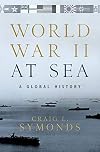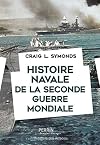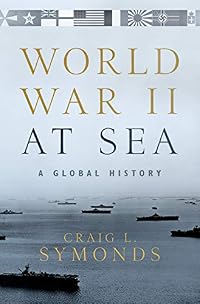
World War II at Sea: A Global History
by Craig L. Symonds
On This Page
Description
"Craig L. Symonds' World War II at Sea offers a definitive naval history of the Second World War presenting the chronology of the naval war, from The London Conference of 1930 to the surrender in Tokyo Bay in 1945, on a global scale for the first time." Author of Lincoln and His Admirals (winner of the Lincoln Prize), The Battle of Midway (Best Book of the Year, Military History Quarterly), and Operation Neptune, (winner of the Samuel Eliot Morison Award for Naval Literature), Craig L. show more Symonds has established himself as one of the finest naval historians at work today. World War II at Sea represents his crowning achievement: a complete narrative of the naval war and all of its belligerents, on all of the world's oceans and seas, between 1939 and 1945. Opening with the 1930 London Conference, Symonds shows how any limitations on naval warfare would become irrelevant before the decade was up, as Europe erupted into conflict once more and its navies were brought to bear against each other. World War II at Sea offers a global perspective, focusing on the major engagements and personalities and revealing both their scale and their interconnection: the U-boat attack on Scapa Flow and the Battle of the Atlantic; the'miracle'evacuation from Dunkirk and the pitched battles for control of Norway fjords; Mussolini's Regia Marina-at the start of the war the fourth-largest navy in the world-and the dominance of the Kido? Butai and Japanese naval power in the Pacific; Pearl Harbor then Midway; the struggles of the Russian Navy and the scuttling of the French Fleet in Toulon in 1942; the landings in North Africa and then Normandy. Here as well are the notable naval leaders-FDR and Churchill, both self-proclaimed'Navy men,'Karl Do?nitz, Franc?ois Darlan, Ernest King, Isoroku Yamamoto, Erich Raeder, Inigo Campioni, Louis Mountbatten, William Halsey, as well as the hundreds of thousands of seamen and officers of all nationalities whose live were imperiled and lost during the greatest naval conflicts in history, from small-scale assaults and amphibious operations to the largest armadas ever assembled. Many have argued that World War II was dominated by naval operations; few have shown and how and why this was the case. Symonds combines precision with story-telling verve, expertly illuminating not only the mechanics of large-scale warfare on (and below) the sea but offering wisdom into the nature of the war itself.--Provided by publisher. show lessTags
Recommendations









Member Reviews
World War II at Sea from Craig Symonds is a comprehensive (not exhaustive) history of the naval war in its entirety told chronologically. In other words, a section about the North Atlantic will be followed by a section on the Pacific if there were events that occurred simultaneously or one right after the other. So told as the war unfolded, which means taking into account what is happening in other parts of the world.
The purpose of this book is to tell the story in a more realistic manner than the books that have focused on specific battles or theaters, not to break new ground with a new piece of information. Having one comprehensive narrative is breaking new ground and the failure to realize that is not the fault of either Symonds or show more the book. Those volumes are tremendously important because they are so focused but they also often lose sight of the big picture: the war as a whole. This volume places the war as a whole at the center and shows how the war at sea unfolded in all waters and for all navies. To criticize this book for not getting every bit of minutiae right is petty at best and empty chest-pounding at worst (and most likely). There are thousands of books with the minutiae, enjoy them, they are wonderful books. But this wasn't trying to be like them.
I would recommend this to anyone interested in World War II, from introductory to historian. As an introduction it allows a person to have a perspective on the battles and events they have or will learn more about. For a historian, professional or amateur, this serves as a reminder that the war was not a collection of separate battles in isolation but very much a series of events that were influenced by previous and concurrent events and thus affected future events. We often, when looking at specific moments, lose track of the whole. This book puts the whole back in focus. In doing so, it will allow the more focused books to be better understood beyond the simple-minded regurgitation of numbers and gun size.
Reviewed from a copy made available through Goodreads First Reads. show less
The purpose of this book is to tell the story in a more realistic manner than the books that have focused on specific battles or theaters, not to break new ground with a new piece of information. Having one comprehensive narrative is breaking new ground and the failure to realize that is not the fault of either Symonds or show more the book. Those volumes are tremendously important because they are so focused but they also often lose sight of the big picture: the war as a whole. This volume places the war as a whole at the center and shows how the war at sea unfolded in all waters and for all navies. To criticize this book for not getting every bit of minutiae right is petty at best and empty chest-pounding at worst (and most likely). There are thousands of books with the minutiae, enjoy them, they are wonderful books. But this wasn't trying to be like them.
I would recommend this to anyone interested in World War II, from introductory to historian. As an introduction it allows a person to have a perspective on the battles and events they have or will learn more about. For a historian, professional or amateur, this serves as a reminder that the war was not a collection of separate battles in isolation but very much a series of events that were influenced by previous and concurrent events and thus affected future events. We often, when looking at specific moments, lose track of the whole. This book puts the whole back in focus. In doing so, it will allow the more focused books to be better understood beyond the simple-minded regurgitation of numbers and gun size.
Reviewed from a copy made available through Goodreads First Reads. show less
This is a book about events that took place between August 1939, and September 1945. Given a copyright of 2018, that means it's about events between 73 and 79 years ago. That is history. The author is quite meticulous in reporting facts without editorializing. The author quotes Samuel Elliott Morrison's 15 volume work about the same period written about 50 years ago. What we have is a fuller reporting of what actually happened without attempts to enhance or diminish the activities of the actors involved. And that's what history does. Wanting to know right away is a mark of our human impatience but in attempts to satisfy that impatience some facts are omitted altogether, others are distorted, and others are really not facts at show more all.
Symonds has done an excellent service and is to be commended for his work.
The Battle of Midway has frequently been cited as the turning point in the naval war in the Pacific. What Symonds reveals is just how incredibly lucky the US forces were to catch the Japanese forces in the few minutes when they were most defenseless. One must not diminish the role of the naval aviators, for it was great and decisive.
Midway was spectacular but the grinding battle of the North Atlantic, though less glamorous, was spectacular in another way with men fighting the elements as they fought above and below the waves. One of my cousins married a man who had three ships sunk under him and yet he kept going out.
It is sad that so much of naval strategy was based on how the previous war was fought. That was probably inevitable. Still, it was costly. show less
Symonds has done an excellent service and is to be commended for his work.
The Battle of Midway has frequently been cited as the turning point in the naval war in the Pacific. What Symonds reveals is just how incredibly lucky the US forces were to catch the Japanese forces in the few minutes when they were most defenseless. One must not diminish the role of the naval aviators, for it was great and decisive.
Midway was spectacular but the grinding battle of the North Atlantic, though less glamorous, was spectacular in another way with men fighting the elements as they fought above and below the waves. One of my cousins married a man who had three ships sunk under him and yet he kept going out.
It is sad that so much of naval strategy was based on how the previous war was fought. That was probably inevitable. Still, it was costly. show less
I try to keep looking for ways to interact with my kids in new ways. My son loves reading about military history, so I though I would add a book on that topic to my reading list. Reading it together would give us more things to talk about.
Oxford University Press was kind enough to send me a review copy of its upcoming release: World War II at Sea: A Global History by Craig L. Symonds. My son and I jumped in and enjoyed this narrative of the naval war and all of its belligerents, on all of the world’s oceans and seas, between 1939 and 1945.
If that sounds like a lot. It is. At almost 800 pages, it’s a tremendous collection of the events of World War II through the lens of big steel ships.
I have to admit, I knew bits and pieces of show more World War II history, but I never put it all together to figure out the chronology of events and how they related to each other.
The book opens with 1930 London Conference, an early attempt at an arms treaty. The goal was to limit the tonnage of naval ships to prevent a build up in naval power among Great Britain, France, Italy, the United States and Japan. The arguments over the numbers of battleships at the beginning of the war become out of touch. Mr. Symonds shows how these limitations on naval warfare become misplaced as the strategies and purpose of the navies changed rapidly during the war. WWII brought major technological advances in warfare that radically changed naval strategy. That conference failed to address aircraft carriers. By the end of the war, aircraft carriers were the key naval strength.
World War II at Sea covers all of these major engagements and their interconnection with other aspects of the conflicts:
the U-boat attack on Scapa Flow
the Battle of the Atlantic
the “miracle” evacuation from Dunkirk
the battles for control of Norway fjords
Mussolini’s Regia Marina, the fourth-largest navy in the world, but ineffective for a lack a fuel
Japanese naval power of the Kidö Butai
Pearl Harbor
Midway
the forced neutrality of the French navy and eventual scuttling
the landings in North Africa and into Italy
the Normandy invasion
I found the story-telling to be top notch. It’s not easy to keep no many battles, ship and personalities in context. I found Mr. Symonds to have done a masterful job of illuminating the mechanics of large-scale warfare in water and the key role it played.
As for my son, he knew most of this information separately. He appreciated so much being put together in place to add more context to the underlying events. He felt it was too brief at times for the areas he wanted to dive more deeply into.
Originally appeared: https://www.compliancebuilding.com/2018/04/14/weekend-reading-world-war-ii-at-se... show less
Oxford University Press was kind enough to send me a review copy of its upcoming release: World War II at Sea: A Global History by Craig L. Symonds. My son and I jumped in and enjoyed this narrative of the naval war and all of its belligerents, on all of the world’s oceans and seas, between 1939 and 1945.
If that sounds like a lot. It is. At almost 800 pages, it’s a tremendous collection of the events of World War II through the lens of big steel ships.
I have to admit, I knew bits and pieces of show more World War II history, but I never put it all together to figure out the chronology of events and how they related to each other.
The book opens with 1930 London Conference, an early attempt at an arms treaty. The goal was to limit the tonnage of naval ships to prevent a build up in naval power among Great Britain, France, Italy, the United States and Japan. The arguments over the numbers of battleships at the beginning of the war become out of touch. Mr. Symonds shows how these limitations on naval warfare become misplaced as the strategies and purpose of the navies changed rapidly during the war. WWII brought major technological advances in warfare that radically changed naval strategy. That conference failed to address aircraft carriers. By the end of the war, aircraft carriers were the key naval strength.
World War II at Sea covers all of these major engagements and their interconnection with other aspects of the conflicts:
the U-boat attack on Scapa Flow
the Battle of the Atlantic
the “miracle” evacuation from Dunkirk
the battles for control of Norway fjords
Mussolini’s Regia Marina, the fourth-largest navy in the world, but ineffective for a lack a fuel
Japanese naval power of the Kidö Butai
Pearl Harbor
Midway
the forced neutrality of the French navy and eventual scuttling
the landings in North Africa and into Italy
the Normandy invasion
I found the story-telling to be top notch. It’s not easy to keep no many battles, ship and personalities in context. I found Mr. Symonds to have done a masterful job of illuminating the mechanics of large-scale warfare in water and the key role it played.
As for my son, he knew most of this information separately. He appreciated so much being put together in place to add more context to the underlying events. He felt it was too brief at times for the areas he wanted to dive more deeply into.
Originally appeared: https://www.compliancebuilding.com/2018/04/14/weekend-reading-world-war-ii-at-se... show less
Ratings
Members
- Recently Added By
Lists

Dan Carlin's Supernova in the East Book List
61 works; 1 member
Author Information

26+ Works 2,809 Members
Craig L. Symonds is Professor Emeritus at the United States Naval Academy, where he taught naval history and Civil War History for thirty years. He is the author of a host of award-winning titles, including most recently World War II at Sea (Oxford U. Press, 2018).
Some Editions
Series
Belongs to Publisher Series
Common Knowledge
- Canonical title*
- Histoire navale de la Seconde guerre mondiale
- Original title
- World War II at sea. A global history
- Original publication date
- 2018 (1e édition originale américaine, Oxford university press) (1e édition originale américaine, Oxford university press); 2020-10-15 (1e traduction et édition française ∙ Domaine étranger ∙ Perrin / Ministère des armées) (1e traduction et édition française ∙ Domaine étranger ∙ Perrin / Ministère des armées)
- Important events*
- 2e guerre mondiale (1939 | 1945)
- Dedication*
- A Marylou, une fois encore
- First words*
- Avant-propos de l’auteur
La Seconde Guerre mondiale demeure le plus grand et le plus violent des cataclysmes de l’histoire de l’humanité. [...]
PROLOGUE
Londres, 1930
À l’entrée du roi George dans la Royal Gallery, suivi du lord-chambellan et du Premier ministre, le murmure des conversations cessa brusquement et un bruissement parcouru... (show all)t l’assemblée des délégués qui se levèrent. Le roi s’avança d’un pas lent mais décidé vers le trône ornementé qui dominait la scène, à une extrémité de la Chambre des lords. [...]
PREMIÈRE PARTIE
LA GUERRE EUROPÉENNE
Adolf Hitler prit le pouvoir en Allemagne moins de trois ans après la signature des accords de Londres. [...] - Original language*
- Anglais (Etats-Unis) (Etats-Unis)
*Some information comes from Common Knowledge in other languages. Click "Edit" for more information.
Classifications
Statistics
- Members
- 272
- Popularity
- 118,252
- Reviews
- 3
- Rating
- (4.04)
- Languages
- English, French, Spanish
- Media
- Paper, Audiobook, Ebook
- ISBNs
- 9
- ASINs
- 3