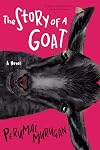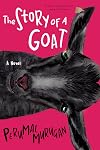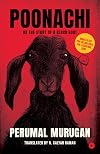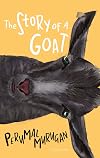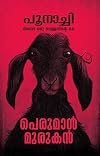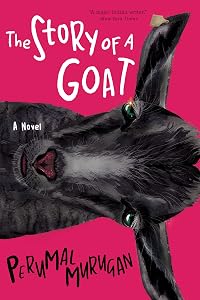
The Story of a Goat
by Perumal Murugan
On This Page
Description
"In his brilliant new novel, Perumal Murugan paints a bucolic yet menacing portrait of the rural lives of India's farming community through the story of a helpless young animal lost in a world it naively misunderstands. A farmer in Tamil Nadu is watching the sun set over his village one evening when a mysterious stranger, a giant man, appears on the horizon. He offers the farmer a black goat kid who is the runt of the litter, surely too frail to survive. The farmer and his wife take care of show more the young she-goat, whom they name Poonachi, and soon the little goat is bounding with joy and growing prodigiously. Intoxicating passages from the goat's perspective offer a bawdy and earthy view of animal existence and a refreshing portrayal of the natural world. But Poonachi's life is not destined to be a rural idyll-dangers lurk around every corner, and may sometimes come from surprising places, including a government that is supposed to protect the weak and needy. With allegorical resonance for contemporary society and examining hierarchies of caste and color, The Story of a Goat is a provocative but heartwarming fable from a world-class storyteller"-- show lessTags
Recommendations








Member Reviews
Reread: July 2022.
“Once, in a village, there was a goat. No one knew where she was born. The birth of an ordinary life never leaves a trace, does it?”
This beginning hints at what you will get from this book. It is the story of an ordinary goat, or is it?
Poonachi is a little black goat who lands up at the house of a poor old couple. Her life isn’t a cakewalk, but Poonachi seems to win against the struggles that routinely come her way. Can life ever be straightforward though? With a hegemonic government, poor rains, and lack of resources, life begins revealing its darker shades. Only time will tell if Poonachi will thrive or wither with the change of circumstances.
Murugan shows us that great storytelling doesn’t need to be show more jazzy storytelling. The language in the book is simple and straightforward, yet used to great effect. There is a subtle hint of magical realism, but most of the content is socio-cultural fiction. The book is short and quick-paced, so you can complete it within 2-3 hours.
The content isn’t as direct as the language. Allegorical in its essence, the book is a medley of political satire and social commentary, while being a reflection on how simple minds also have corrupted thinking. It is somewhat reminiscent of ‘Animal Farm’, though, in this case, it is the humans who are “beings more equal than others.”
The book also spotlights how humans treat animals utterly selfishly. As one line in the book goes,
“No matter how much you give to this heart, it will never be enough.”
We grab and we grab and we grab, until there’s nothing left for anyone, including ourselves. Some of these scenes hit hard and make for very uncomfortable reading; go into the book with a strong heart and stomach.
I liked the first half more that the second half, possibly because it appealed more to my personal taste and my current mood, with Poonachi’s innocence and resilience shining through. The second half is more despondent and depressing, and doesn’t stop the sense of impending doom right till the end, which is exactly as you would assume but not what you would want.
The book was originally written in Tamil. The English translation by N. Kalyan Raman seems to capture the spirit of the book well. It doesn’t make the writing flowery, nor does it wash out the essence of the original language, with a few Tamil colloquialisms retained even in the translation.
Poonachi’s story is a metaphorical ode to greed and this is something common to most people and all governments. Thus it ought to work well with anyone looking for a quirky tale with unusual characters but facing realistic problems. Let me quote a line from the translator’s note:
“Through a feat of storytelling that is both masterly and nuanced, Murugan makes us reflect on our own responses to hegemony and enslavement, selflessness and appetite, resistance and resignation, living and dying.”
Recommended for sure, though it is not for everyone. Given a choice between reading the likes of Alka Joshi/Thrity Umrigar and Perumal Murugan, I would go for the latter without even blinking my eyes.
3.75 stars. (Same feelings as earlier, but was distracted easily this time. Plus, I am a stingy rater nowadays.)
*****************************
1st read: July 2020.
Rating: 4.25 stars.
———————————————
Connect with me through:
My Blog | The StoryGraph | Facebook | Twitter show less
“Once, in a village, there was a goat. No one knew where she was born. The birth of an ordinary life never leaves a trace, does it?”
This beginning hints at what you will get from this book. It is the story of an ordinary goat, or is it?
Poonachi is a little black goat who lands up at the house of a poor old couple. Her life isn’t a cakewalk, but Poonachi seems to win against the struggles that routinely come her way. Can life ever be straightforward though? With a hegemonic government, poor rains, and lack of resources, life begins revealing its darker shades. Only time will tell if Poonachi will thrive or wither with the change of circumstances.
Murugan shows us that great storytelling doesn’t need to be show more jazzy storytelling. The language in the book is simple and straightforward, yet used to great effect. There is a subtle hint of magical realism, but most of the content is socio-cultural fiction. The book is short and quick-paced, so you can complete it within 2-3 hours.
The content isn’t as direct as the language. Allegorical in its essence, the book is a medley of political satire and social commentary, while being a reflection on how simple minds also have corrupted thinking. It is somewhat reminiscent of ‘Animal Farm’, though, in this case, it is the humans who are “beings more equal than others.”
The book also spotlights how humans treat animals utterly selfishly. As one line in the book goes,
“No matter how much you give to this heart, it will never be enough.”
We grab and we grab and we grab, until there’s nothing left for anyone, including ourselves. Some of these scenes hit hard and make for very uncomfortable reading; go into the book with a strong heart and stomach.
I liked the first half more that the second half, possibly because it appealed more to my personal taste and my current mood, with Poonachi’s innocence and resilience shining through. The second half is more despondent and depressing, and doesn’t stop the sense of impending doom right till the end, which is exactly as you would assume but not what you would want.
The book was originally written in Tamil. The English translation by N. Kalyan Raman seems to capture the spirit of the book well. It doesn’t make the writing flowery, nor does it wash out the essence of the original language, with a few Tamil colloquialisms retained even in the translation.
Poonachi’s story is a metaphorical ode to greed and this is something common to most people and all governments. Thus it ought to work well with anyone looking for a quirky tale with unusual characters but facing realistic problems. Let me quote a line from the translator’s note:
“Through a feat of storytelling that is both masterly and nuanced, Murugan makes us reflect on our own responses to hegemony and enslavement, selflessness and appetite, resistance and resignation, living and dying.”
Recommended for sure, though it is not for everyone. Given a choice between reading the likes of Alka Joshi/Thrity Umrigar and Perumal Murugan, I would go for the latter without even blinking my eyes.
3.75 stars. (Same feelings as earlier, but was distracted easily this time. Plus, I am a stingy rater nowadays.)
*****************************
1st read: July 2020.
Rating: 4.25 stars.
———————————————
Connect with me through:
My Blog | The StoryGraph | Facebook | Twitter show less
Reread: July 2022.
“Once, in a village, there was a goat. No one knew where she was born. The birth of an ordinary life never leaves a trace, does it?”
This beginning hints at what you will get from this book. It is the story of an ordinary goat, or is it?
Poonachi is a little black goat who lands up at the house of a poor old couple. Her life isn’t a cakewalk, but Poonachi seems to win against the struggles that routinely come her way. Can life ever be straightforward though? With a hegemonic government, poor rains, and lack of resources, life begins revealing its darker shades. Only time will tell if Poonachi will thrive or wither with the change of circumstances.
Murugan shows us that great storytelling doesn’t need to be show more jazzy storytelling. The language in the book is simple and straightforward, yet used to great effect. There is a subtle hint of magical realism, but most of the content is socio-cultural fiction. The book is short and quick-paced, so you can complete it within 2-3 hours.
The content isn’t as direct as the language. Allegorical in its essence, the book is a medley of political satire and social commentary, while being a reflection on how simple minds also have corrupted thinking. It is somewhat reminiscent of ‘Animal Farm’, though, in this case, it is the humans who are “beings more equal than others.”
The book also spotlights how humans treat animals utterly selfishly. As one line in the book goes,
“No matter how much you give to this heart, it will never be enough.”
We grab and we grab and we grab, until there’s nothing left for anyone, including ourselves. Some of these scenes hit hard and make for very uncomfortable reading; go into the book with a strong heart and stomach.
I liked the first half more that the second half, possibly because it appealed more to my personal taste and my current mood, with Poonachi’s innocence and resilience shining through. The second half is more despondent and depressing, and doesn’t stop the sense of impending doom right till the end, which is exactly as you would assume but not what you would want.
The book was originally written in Tamil. The English translation by N. Kalyan Raman seems to capture the spirit of the book well. It doesn’t make the writing flowery, nor does it wash out the essence of the original language, with a few Tamil colloquialisms retained even in the translation.
Poonachi’s story is a metaphorical ode to greed and this is something common to most people and all governments. Thus it ought to work well with anyone looking for a quirky tale with unusual characters but facing realistic problems. Let me quote a line from the translator’s note:
“Through a feat of storytelling that is both masterly and nuanced, Murugan makes us reflect on our own responses to hegemony and enslavement, selflessness and appetite, resistance and resignation, living and dying.”
Recommended for sure, though it is not for everyone. Given a choice between reading the likes of Alka Joshi/Thrity Umrigar and Perumal Murugan, I would go for the latter without even blinking my eyes.
3.75 stars. (Same feelings as earlier, but was distracted easily this time. Plus, I am a stingy rater nowadays.)
*****************************
1st read: July 2020.
Rating: 4.25 stars.
———————————————
Connect with me through:
My Blog | The StoryGraph | Facebook | Twitter show less
“Once, in a village, there was a goat. No one knew where she was born. The birth of an ordinary life never leaves a trace, does it?”
This beginning hints at what you will get from this book. It is the story of an ordinary goat, or is it?
Poonachi is a little black goat who lands up at the house of a poor old couple. Her life isn’t a cakewalk, but Poonachi seems to win against the struggles that routinely come her way. Can life ever be straightforward though? With a hegemonic government, poor rains, and lack of resources, life begins revealing its darker shades. Only time will tell if Poonachi will thrive or wither with the change of circumstances.
Murugan shows us that great storytelling doesn’t need to be show more jazzy storytelling. The language in the book is simple and straightforward, yet used to great effect. There is a subtle hint of magical realism, but most of the content is socio-cultural fiction. The book is short and quick-paced, so you can complete it within 2-3 hours.
The content isn’t as direct as the language. Allegorical in its essence, the book is a medley of political satire and social commentary, while being a reflection on how simple minds also have corrupted thinking. It is somewhat reminiscent of ‘Animal Farm’, though, in this case, it is the humans who are “beings more equal than others.”
The book also spotlights how humans treat animals utterly selfishly. As one line in the book goes,
“No matter how much you give to this heart, it will never be enough.”
We grab and we grab and we grab, until there’s nothing left for anyone, including ourselves. Some of these scenes hit hard and make for very uncomfortable reading; go into the book with a strong heart and stomach.
I liked the first half more that the second half, possibly because it appealed more to my personal taste and my current mood, with Poonachi’s innocence and resilience shining through. The second half is more despondent and depressing, and doesn’t stop the sense of impending doom right till the end, which is exactly as you would assume but not what you would want.
The book was originally written in Tamil. The English translation by N. Kalyan Raman seems to capture the spirit of the book well. It doesn’t make the writing flowery, nor does it wash out the essence of the original language, with a few Tamil colloquialisms retained even in the translation.
Poonachi’s story is a metaphorical ode to greed and this is something common to most people and all governments. Thus it ought to work well with anyone looking for a quirky tale with unusual characters but facing realistic problems. Let me quote a line from the translator’s note:
“Through a feat of storytelling that is both masterly and nuanced, Murugan makes us reflect on our own responses to hegemony and enslavement, selflessness and appetite, resistance and resignation, living and dying.”
Recommended for sure, though it is not for everyone. Given a choice between reading the likes of Alka Joshi/Thrity Umrigar and Perumal Murugan, I would go for the latter without even blinking my eyes.
3.75 stars. (Same feelings as earlier, but was distracted easily this time. Plus, I am a stingy rater nowadays.)
*****************************
1st read: July 2020.
Rating: 4.25 stars.
———————————————
Connect with me through:
My Blog | The StoryGraph | Facebook | Twitter show less
While watching a sunset, an Old Man of Tamil Nadu in South India is approached by a giant of a man who says he is wandering from village to village trying to sell a day-old black baby female goat. It is the runt of a litter of 7, with the potential of breeding a litter of 7, a very high number. But he wants the goat to be raised with care. He ends up giving the goat to the Old Man and walking away. The Old Man and his wife go to a lot of effort, straining their food supply and time to raise the goat. The story is also told from the viewpoint of the goat. There is definitely political satire, magical or mythical interpretations of events, and the supposition of human emotions to the animals. An enjoyable look at another culture.
This was a cute idea, and in the beginning I really enjoyed it, but it got less and less believable as the book went on. The goat's inner thoughts just didn't work for me. Even such a short book was hard to finish.
I have no idea why I requested this book from the library; apparently I read some glowing review. It is just that: the story of a very small black female goat given in a poor man by a giant. The goat is named Poonachi and is cared for by the man's wife. She is always small, grows some, gets in heat, has seven kids, falls in love, has more kids, dies. I guess it's some fable for life but truly totally escaped me.
i liked it. shame my fellow bakriphiles seem to have abandoned this app. you can learn a lot about bakris from this book ( and more )
Part parable, part commentary, fully readable.
Members
- Recently Added By
Lists

Kirkus Starred Fiction Reviews of Books Published in 2019
411 works; 12 members

Fiction: Asia
85 works; 2 members
Author Information

42 Works 790 Members
Perumal Murugan is an author, scholar and literary chronicler who writes novels in Tamil. C.S. Lakshmi (Ambai) is a renowned author of literary fiction in Tamil and scholar of women's studies.
Some Editions
Awards and Honors
Awards
Notable Lists
Common Knowledge
- Original title
- Poonachi Allathu Oru Vellattin Katai
- Alternate titles
- Poonachi : The Story of a Black Goat
- Original publication date
- 2016
- People/Characters
- Poonachi; Old woman; Old man
- Important places
- Odakkan Hill, India
- First words
- Once in a village, there was a goat.
- Quotations
- Goats always tried to break free of their shackles.
Sheep had none, so they didn't need to make the effort. If it was in your nature to bow down, why would anyone shackle you?
And yet, they were fortunate,... (show all) these sheep. They had no inkling that to bow was to be shackled.
(Chapter 9, p. 64, Black Cat, 2019) - Last words
- (Click to show. Warning: May contain spoilers.)What lay there was not Poonachi, but a stone idol.
- Blurbers
- Sehgal, Parul
- Original language
- Tamil
Classifications
- Genres
- Fiction and Literature, General Fiction
- DDC/MDS
- 894.8 — Literature & rhetoric Literatures of other languages Literatures of Altaic, Uralic, Hyperborean, Dravidian languages; literatures of miscellaneous languages of south Asia Dravidian literatures
- LCC
- PL4758.9 .P389 .P8613 — Language and Literature Languages and literatures of Eastern Asia, Africa, Oceania Languages of Eastern Asia, Africa, Oceania Dravidian languages
- BISAC
Statistics
- Members
- 204
- Popularity
- 160,678
- Reviews
- 8
- Rating
- (3.43)
- Languages
- English, Malayalam, Marathi, Tamil
- Media
- Paper, Ebook
- ISBNs
- 11
- ASINs
- 3