On This Page
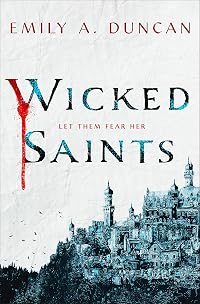
Description
"Prepare for a snow-frosted, blood-drenched fairy tale where the monsters steal your heart and love ends up being the nightmare." - Roshani Chokshi, New York Times bestselling author of The Star-Touched Queen"This book destroyed me and I adored it."- Stephanie Garber, New York Times bestselling author of Caraval
"If you like your young adult fantasy full of ice, blood, and angst, Wicked Saints will sweep you up in its wintery embrace." — NPR
A girl who can speak to gods must save her show more people without destroying herself.
A prince in danger must decide who to trust.
A boy with a monstrous secret waits in the wings.
Together, they must assassinate the king and stop the war.
In a centuries-long war where beauty and brutality meet, their three paths entwine in a shadowy world of spilled blood and mysterious saints, where a forbidden romance threatens to tip the scales between dark and light. Wicked Saints is the thrilling start to Emily A. Duncan's devastatingly Gothic Something Dark and Holy trilogy.
. show less
Tags
Recommendations



Member Reviews
You know, I had hoped this would be better. Perhaps foolishly. I thought the cover was pretty, alas.
TW for self harm and graphic violence.
This was a typical arc for a YA novel. Forbidden romance and such. It was so very predictable in that sense. Of course Nadya (our heroine) would fall for her supposed worst enemy. And then do the whole "I like him, but I don't, but I do, but I don't, but I shouldn't!!! But I do...?" It was honestly annoying. The whole time I was just hoping she'd drop it and go with her gut feeling of "this dude's not safe", even though her heart was apparently like "HE'S SOOOO ATTRACTIVEEEE."
Anyway, let's talk about Nadya otherwise. She's a cleric, able to speak to all of the gods in her pantheon, which is very show more special as usually clerics only have one god to speak to. She was raised in a monastery, where she supposedly received some training. And yet she knows nothing really? about? her? religion????? Except that she prays and the gods maybe talk to her and grant her some magic?? Makes no sense. I understand being introduced to other people who might make her doubt, but also... she talks to her gods... so.... she has proof they exist.
Aside from that, she really is not that relatable. She's a flat character and a pushover most of the time and is not at all interesting. She spirals through this self doubt that manifests in nothing important. All she does is waffle between her religion and the so-called heretics, who are blood mages but otherwise have no explanation about why they are heretical. They just are, okay?!
And now we come to Malachiasz, the forbidden love interest. He is enemy!!!! Why? We are at war!! Why are we at war??? WE DON'T KNOW. There is no history of why the war is happening! It just is!! Maybe because heretics or something. Not entirely sure.
Anyway, he's the dark and stormy type. The whole "anxious, broken" character who is also very powerful and veeeerrryyyy mysterious and alluring. And a liar, musn't forget that part. He's also flat, his motives are unclear, and he's just so torn about what to do. Except not really.
And our Prince Serefin? Same. Flat, boring, blah.
Side characters? You could delete them completely and the story wouldn't change.
No one is really interested in each other. Most of the questions are variations on "can I trust you?" or "how are we going to kill the king?" No thought beyond that, like... what their plan afterward would be.. or... maybe consequences... or.. maybe actually forming meaningful relationships....
Our surroundings are similar. What do we know about Tranavia? It has many lakes. About Kalyazin? It is cold and snowy. About Akola? It's warm and sandy, and we don't even go there in the book. It's just kinda like, yea, there's another country, you know, whatever. But our characters will be damned if they are not loyal to their homeland!!
You know what else this book loves besides being vague? BLOOD. It looooves blood. Everyone gets full of it. All over skin and clothes and it drips out of all orifices! There's pools of it everywhere and it even rains from the sky!! Seriously, everyone ought to be dead because of the amount of blood loss in this book. It's not tasteful, it's just plain excessive. And that's coming from me, someone who enjoys gore. I just couldn't suspend my disbelief after a while.
I read this book super slow and the ultimate reason for that was that it was boring. I wasn't engaged, I didn't care, and I just wanted it to go away, but I was too stubbornly hopeful that it would improve. It did not. Part of me wants to give the rest of the series a chance. The other part is like, "nah bro, it just ain't worth it." I'll probably listen to the latter. show less
TW for self harm and graphic violence.
This was a typical arc for a YA novel. Forbidden romance and such. It was so very predictable in that sense. Of course Nadya (our heroine) would fall for her supposed worst enemy. And then do the whole "I like him, but I don't, but I do, but I don't, but I shouldn't!!! But I do...?" It was honestly annoying. The whole time I was just hoping she'd drop it and go with her gut feeling of "this dude's not safe", even though her heart was apparently like "HE'S SOOOO ATTRACTIVEEEE."
Anyway, let's talk about Nadya otherwise. She's a cleric, able to speak to all of the gods in her pantheon, which is very show more special as usually clerics only have one god to speak to. She was raised in a monastery, where she supposedly received some training. And yet she knows nothing really? about? her? religion????? Except that she prays and the gods maybe talk to her and grant her some magic?? Makes no sense. I understand being introduced to other people who might make her doubt, but also... she talks to her gods... so.... she has proof they exist.
Aside from that, she really is not that relatable. She's a flat character and a pushover most of the time and is not at all interesting. She spirals through this self doubt that manifests in nothing important. All she does is waffle between her religion and the so-called heretics, who are blood mages but otherwise have no explanation about why they are heretical. They just are, okay?!
And now we come to Malachiasz, the forbidden love interest. He is enemy!!!! Why? We are at war!! Why are we at war??? WE DON'T KNOW. There is no history of why the war is happening! It just is!! Maybe because heretics or something. Not entirely sure.
Anyway, he's the dark and stormy type. The whole "anxious, broken" character who is also very powerful and veeeerrryyyy mysterious and alluring. And a liar, musn't forget that part. He's also flat, his motives are unclear, and he's just so torn about what to do. Except not really.
And our Prince Serefin? Same. Flat, boring, blah.
Side characters? You could delete them completely and the story wouldn't change.
No one is really interested in each other. Most of the questions are variations on "can I trust you?" or "how are we going to kill the king?" No thought beyond that, like... what their plan afterward would be.. or... maybe consequences... or.. maybe actually forming meaningful relationships....
Our surroundings are similar. What do we know about Tranavia? It has many lakes. About Kalyazin? It is cold and snowy. About Akola? It's warm and sandy, and we don't even go there in the book. It's just kinda like, yea, there's another country, you know, whatever. But our characters will be damned if they are not loyal to their homeland!!
You know what else this book loves besides being vague? BLOOD. It looooves blood. Everyone gets full of it. All over skin and clothes and it drips out of all orifices! There's pools of it everywhere and it even rains from the sky!! Seriously, everyone ought to be dead because of the amount of blood loss in this book. It's not tasteful, it's just plain excessive. And that's coming from me, someone who enjoys gore. I just couldn't suspend my disbelief after a while.
I read this book super slow and the ultimate reason for that was that it was boring. I wasn't engaged, I didn't care, and I just wanted it to go away, but I was too stubbornly hopeful that it would improve. It did not. Part of me wants to give the rest of the series a chance. The other part is like, "nah bro, it just ain't worth it." I'll probably listen to the latter. show less
DNF.
I gave this book over 100 pages to give me a reason to read the whole thing and it didn't manage to do that, and if the author can't be bothered to give me a reason to keep reading, then I can't be bothered to read it.
Nothing is explained very well, nor is it attempted to be explained. Particularly noticeable is the underdeveloped religion. The people of Kalyazi view the people of Tranavia as heretics, but it’s never really explained how pervasive the religion is in Kalyazi. Is this country a theocracy? Perhaps, but even then the view of Tranavians as ‘heretics’ severely lacks the nuance that is warranted. The fact that the main character doesn't need to do anything special or ritualistic in order to communicate with the gods show more just had me thinking that the author didn't spend the time to actually develop the religion beyond 'ask the god, magic happens, the end.' There are a lot of gods, and it's hard to keep their names straight, probably because the author explained nothing about them beyond being the 'god of silence' or the 'god of truth' or whatever. Also unexplained is how Nadya was chosen to be the first cleric (clerics are the only ones who can directly communicate with the gods) in 30 years or, more importantly, why she was chosen. I don't need all these answers right away, but nothing about it is explained at all, so I have no reason to really care about it. As it stands I was just asking questions and instead of answering them, this book threw more things at me for me to question.
Things kept happening but there's no motivations for any of it that I can see. I have no reason to care, nor do I know which side I should be rooting or want to root for. I gotta say, the side that keeps getting referred to as 'heretics' made themselves a lot more appealing to me just for that reason, when I'm pretty sure we're supposed to be on the side of the pagan zealots? (New drinking game: Take a drink every time this book uses the word 'heretic'.) Also I have no reason to actually dislike any of those characters other than that they're 'heretics' who bypass the gods to do magic. I guess the author'd have to actually develop them beyond face value to give me a reason to dislike them, which is expecting too much clearly.
Action and dialogue is pretty much all you're given, with the occasional random Slavic term thrown into the lacking narrative to remind you that this setting is Eastern European. Do we really need an italicized word every other paragraph with a following definition just to know the setting? It doesn't add anything to the story and it didn't read as natural at all, rather than showing us this setting through the narrative we just keep getting told random, unnecessary, irrelevant things to remind us. On the same page two different mythical beings get named- you don't see them or evidence of them, by the way, it's just mentioned that they and a host of other things exist in this setting- just to- I don't know- prove to us how much the author knows about Slavic mythology? Okay, I'll admit that I'm aware that I'm being harsh here. I'm sure that wasn't the intention, but it is, completely honestly, how it came off as I was reading it.
There's action, there's a lot of blood, there's torture, there's more blood, there's self-harm, and there's more blood, and did I mention.... there's blood! None of these things bother me, there's very few things that I'd call 'squicks' and 0 things I'd call triggers for myself, but they were gratuitous and over the top and came off more as a parody of the edgelord emo aesthetic than anything else. I half expected this book to call me a prep as an insult. I bet it shopped at Hot Topic circa 2009. That said, it took itself way too seriously to be a parody. In fact this book is so self-serious that I, as a reader, could not take it seriously.
This book should definitely come with a self-harm trigger warning. Among others. I wasn't expecting it going in and- as I said- it just all seemed gratuitous, and I know for a fact that plenty of people would be bothered by this. It's one thing when it's adding something important to the story, when there's a narrative reason for it, and even then it probably should have a trigger warning. But just to assert your edginess? Come on. show less
I gave this book over 100 pages to give me a reason to read the whole thing and it didn't manage to do that, and if the author can't be bothered to give me a reason to keep reading, then I can't be bothered to read it.
Nothing is explained very well, nor is it attempted to be explained. Particularly noticeable is the underdeveloped religion. The people of Kalyazi view the people of Tranavia as heretics, but it’s never really explained how pervasive the religion is in Kalyazi. Is this country a theocracy? Perhaps, but even then the view of Tranavians as ‘heretics’ severely lacks the nuance that is warranted. The fact that the main character doesn't need to do anything special or ritualistic in order to communicate with the gods show more just had me thinking that the author didn't spend the time to actually develop the religion beyond 'ask the god, magic happens, the end.' There are a lot of gods, and it's hard to keep their names straight, probably because the author explained nothing about them beyond being the 'god of silence' or the 'god of truth' or whatever. Also unexplained is how Nadya was chosen to be the first cleric (clerics are the only ones who can directly communicate with the gods) in 30 years or, more importantly, why she was chosen. I don't need all these answers right away, but nothing about it is explained at all, so I have no reason to really care about it. As it stands I was just asking questions and instead of answering them, this book threw more things at me for me to question.
Things kept happening but there's no motivations for any of it that I can see. I have no reason to care, nor do I know which side I should be rooting or want to root for. I gotta say, the side that keeps getting referred to as 'heretics' made themselves a lot more appealing to me just for that reason, when I'm pretty sure we're supposed to be on the side of the pagan zealots? (New drinking game: Take a drink every time this book uses the word 'heretic'.) Also I have no reason to actually dislike any of those characters other than that they're 'heretics' who bypass the gods to do magic. I guess the author'd have to actually develop them beyond face value to give me a reason to dislike them, which is expecting too much clearly.
Action and dialogue is pretty much all you're given, with the occasional random Slavic term thrown into the lacking narrative to remind you that this setting is Eastern European. Do we really need an italicized word every other paragraph with a following definition just to know the setting? It doesn't add anything to the story and it didn't read as natural at all, rather than showing us this setting through the narrative we just keep getting told random, unnecessary, irrelevant things to remind us. On the same page two different mythical beings get named- you don't see them or evidence of them, by the way, it's just mentioned that they and a host of other things exist in this setting- just to- I don't know- prove to us how much the author knows about Slavic mythology? Okay, I'll admit that I'm aware that I'm being harsh here. I'm sure that wasn't the intention, but it is, completely honestly, how it came off as I was reading it.
There's action, there's a lot of blood, there's torture, there's more blood, there's self-harm, and there's more blood, and did I mention.... there's blood! None of these things bother me, there's very few things that I'd call 'squicks' and 0 things I'd call triggers for myself, but they were gratuitous and over the top and came off more as a parody of the edgelord emo aesthetic than anything else. I half expected this book to call me a prep as an insult. I bet it shopped at Hot Topic circa 2009. That said, it took itself way too seriously to be a parody. In fact this book is so self-serious that I, as a reader, could not take it seriously.
This book should definitely come with a self-harm trigger warning. Among others. I wasn't expecting it going in and- as I said- it just all seemed gratuitous, and I know for a fact that plenty of people would be bothered by this. It's one thing when it's adding something important to the story, when there's a narrative reason for it, and even then it probably should have a trigger warning. But just to assert your edginess? Come on. show less
Book Review**Thanks to @netgalley @wednesdaybooks**Think Victorian spires and gargoyles. Think shards of glass and rusted nails scattered in burned out hulls. Think white snow turning the deepest crimson. And, feeling the darkest of all darkness in the black night. Welcome to #WickedSaints by Emily A. Duncan @glitzandshadows
Summary**
A girl, Nadya, raised in a monestary. She is the only known cleric in existence, meaning she was chosen by the gods as a vessel to communicate, and do their bidding. Nadya's mission is to save her country, Kalyazin,from the heretics who practice blood magic in Tranavia. One day, her home is attacked by the Tranavian high prince, Serefin, and his army. Nadya is too valuable to die, so she flees. In her show more flight, she chances upon Rashid and Parijahan, Akolans fleeing their country, and a mysterious boy named Malachiasz. Nadya immediately distrusts him. Realizing they all want the Tranavian king dead, they take refuge in an abandoned church. Soon, they are attacked. Obviously, some fighting and other things occur, but no spoilers.
They form a plan to get into Tranavia, and kill the king, thus, allowing Nadya to end blood magic, and restore the gods. We learn that Malachiasz is a Tranavian blood mage, ergo, a heretic. Persuasively, he causes Nadya to question her beliefs about her power and about Malachiasz. Who is he? Enemy or friend? What are his motives?
At the same time, Serefin is called home from the war for an overblown tradition to choose a wife. When he arrives in Tranavia, he begins to have suspicions about many things. Is he just being paranoid? Will Nadya and Malachiasz succeed? Is Malachiasz who he appears to be or a liar? Is Nadya's power true, or are her beliefs mistaken?
My Thoughts**
I expected some dark magic and diety worship at opposites while saving the world. What I found was a revelation of a new very dark world rendered more so because of the
eastern European vibe. It gave me chills. The dialogue is heart pounding intense. The religious arguments made me question who is actually right. The love hate relationships are steamy. Motives are unclear. The ending left me numb. It's so unexpected and original. Read it! show less
Summary**
A girl, Nadya, raised in a monestary. She is the only known cleric in existence, meaning she was chosen by the gods as a vessel to communicate, and do their bidding. Nadya's mission is to save her country, Kalyazin,from the heretics who practice blood magic in Tranavia. One day, her home is attacked by the Tranavian high prince, Serefin, and his army. Nadya is too valuable to die, so she flees. In her show more flight, she chances upon Rashid and Parijahan, Akolans fleeing their country, and a mysterious boy named Malachiasz. Nadya immediately distrusts him. Realizing they all want the Tranavian king dead, they take refuge in an abandoned church. Soon, they are attacked. Obviously, some fighting and other things occur, but no spoilers.
They form a plan to get into Tranavia, and kill the king, thus, allowing Nadya to end blood magic, and restore the gods. We learn that Malachiasz is a Tranavian blood mage, ergo, a heretic. Persuasively, he causes Nadya to question her beliefs about her power and about Malachiasz. Who is he? Enemy or friend? What are his motives?
At the same time, Serefin is called home from the war for an overblown tradition to choose a wife. When he arrives in Tranavia, he begins to have suspicions about many things. Is he just being paranoid? Will Nadya and Malachiasz succeed? Is Malachiasz who he appears to be or a liar? Is Nadya's power true, or are her beliefs mistaken?
My Thoughts**
I expected some dark magic and diety worship at opposites while saving the world. What I found was a revelation of a new very dark world rendered more so because of the
eastern European vibe. It gave me chills. The dialogue is heart pounding intense. The religious arguments made me question who is actually right. The love hate relationships are steamy. Motives are unclear. The ending left me numb. It's so unexpected and original. Read it! show less
Emily Duncan, you had me at monsters, magic, and murder set in an eastern European-esque land. Then you threw in a Joan of Arc type character, political machinations, and an entire book made up of gray area, and I was completely lost. Dark and disturbing, Wicked Saints is not for the faint of heart, but for those who love brutal but well-told Gothic stories, you need to put it on your radar.
Thanks to @netgalley @wednesdaybooks for an arc in exchange for an honest review*
Think Victorian spires and gargoyles. Think shards of glass and rusted nails scattered in burned out hulls. Think white snow turning the deepest crimson. And, feeling the darkest of all darkness in the blackest night. Welcome to #WickedSaints by Emily A. Duncan @glitzandshadows
Summary**
A girl, Nadya, raised in a monestary. She is the only known cleric in existence, meaning she was chosen by the gods as a vessel to communicate, and do their bidding. Nadya's mission is to save her country, Kalyazin,from the heretics who practice blood magic in Tranavia. One day, her home is attacked by the Tranavian high prince, Serefin, and his army. Nadya is too valuable to show more die, so she flees. In her flight, she chances upon Rashid and Parijahan, Akolans fleeing their country, and a mysterious boy named Malachiasz. Nadya immediately distrusts him. Realizing they all want the Tranavian king dead, they take refuge in an abandoned church. Soon, they are attacked. Obviously, some fighting and other things occur, but no spoilers. They form a plan to get into Tranavia, and kill the king, thus, allowing Nadya to end blood magic, and restore the gods. We learn that Malachiasz is a Tranavian blood mage, ergo, a heretic. Persuasively, he causes Nadya to question her beliefs about her power and about Malachiasz. Who is he? Enemy or friend? What are his motives?
At the same time, Serefin is called home from the war for an overblown tradition to choose a wife. When he arrives in Tranavia, he begins to have suspicions about many things. Is he just being paranoid? Will Nadya and Malachiasz succeed? Is Malachiasz who he appears to be or a liar? Is Nadya's power true, or are her beliefs mistaken?
My Thoughts**
I can't even begin to explain the inner turmoil over this story. I expected some dark magic and diety worship at opposites while saving the world. What I found was a revelation of a new very dark world rendered even more so because of the grayscale dismally cold eastern European vibe. It gave me chills. From beginning to end it's atmospherically haunting. The big question is who do you believe? These characters live and breath and stand beside you all day long, even when you hate them. Nadya and Malachiasz are so volatile and intense it's insane. Like a force of nature. The dialogue is pure heart pounding exhaustion, and I'm hanging on every word. The religious arguments made me question who is actually right. Is one belief system better than the other, or are they simply different? Still, any differences will never be tolerated by the opposition. The love hate relationships are sinfully steamy. Motives are maddeningly unclear. The ending left me numbly devastated. Wanting to throw something. Yeah, it's the kind of story that you live in for days oblivious to everything else, until you are suddenly cast out into reality. Just brutal! It's so unexpected and original. It destroyed me, but I devoured it all the same. Read it! You'll be sorry if you miss out on Wicked Saints. show less
Think Victorian spires and gargoyles. Think shards of glass and rusted nails scattered in burned out hulls. Think white snow turning the deepest crimson. And, feeling the darkest of all darkness in the blackest night. Welcome to #WickedSaints by Emily A. Duncan @glitzandshadows
Summary**
A girl, Nadya, raised in a monestary. She is the only known cleric in existence, meaning she was chosen by the gods as a vessel to communicate, and do their bidding. Nadya's mission is to save her country, Kalyazin,from the heretics who practice blood magic in Tranavia. One day, her home is attacked by the Tranavian high prince, Serefin, and his army. Nadya is too valuable to show more die, so she flees. In her flight, she chances upon Rashid and Parijahan, Akolans fleeing their country, and a mysterious boy named Malachiasz. Nadya immediately distrusts him. Realizing they all want the Tranavian king dead, they take refuge in an abandoned church. Soon, they are attacked. Obviously, some fighting and other things occur, but no spoilers. They form a plan to get into Tranavia, and kill the king, thus, allowing Nadya to end blood magic, and restore the gods. We learn that Malachiasz is a Tranavian blood mage, ergo, a heretic. Persuasively, he causes Nadya to question her beliefs about her power and about Malachiasz. Who is he? Enemy or friend? What are his motives?
At the same time, Serefin is called home from the war for an overblown tradition to choose a wife. When he arrives in Tranavia, he begins to have suspicions about many things. Is he just being paranoid? Will Nadya and Malachiasz succeed? Is Malachiasz who he appears to be or a liar? Is Nadya's power true, or are her beliefs mistaken?
My Thoughts**
I can't even begin to explain the inner turmoil over this story. I expected some dark magic and diety worship at opposites while saving the world. What I found was a revelation of a new very dark world rendered even more so because of the grayscale dismally cold eastern European vibe. It gave me chills. From beginning to end it's atmospherically haunting. The big question is who do you believe? These characters live and breath and stand beside you all day long, even when you hate them. Nadya and Malachiasz are so volatile and intense it's insane. Like a force of nature. The dialogue is pure heart pounding exhaustion, and I'm hanging on every word. The religious arguments made me question who is actually right. Is one belief system better than the other, or are they simply different? Still, any differences will never be tolerated by the opposition. The love hate relationships are sinfully steamy. Motives are maddeningly unclear. The ending left me numbly devastated. Wanting to throw something. Yeah, it's the kind of story that you live in for days oblivious to everything else, until you are suddenly cast out into reality. Just brutal! It's so unexpected and original. It destroyed me, but I devoured it all the same. Read it! You'll be sorry if you miss out on Wicked Saints. show less
The most compelling histories are the ones that almost happened.
In Wicked Saints, [a:Emily A. Duncan|15600590|Emily A. Duncan|https://images.gr-assets.com/authors/1534514878p2/15600590.jpg] crafts a novel so original and assured it reads as less a debut than a gauntlet tossed down. Richly mined Slavic lore provides a bedrock for world-changing political fantasy and a cradle for characters who feel simultaneously familiar, as though you've met them in a half-remembered childhood fairy tale, and wholly original to their surroundings. Nadya's religious turmoil and Serefin's court maneuverings read realistically, embedding the reader in a world close enough to ours that it feels like an alternate history, a forgotten chapter of magical show more warfare and holy orphans--while Malachiasz and the Vultures are nightmares who could only be born of one mind. Familiar terrain of countries at war is made uneasy with the characters' shifting awareness of who is on which side, and what powers are at their command, while the huge scale of lifelong battle is brought down to earth by the continuing, uncomfortable knowledge that those characters are very young people. The quest format of high fantasy is tempered by poignant relationships (friendship and romance!), difficult decisions of small and earthshaking types, and an array of delightfully twisted tropes, from Cinderella-esque betrothal rituals to divinely inspired Chosen Ones.
The best fiction provides many angles to one truth, and this book is no exception. As Nadya's gods draw farther from her and Malachiasz's power grows beyond his own reach, few firm answers are given--only a sense of a black horizon, and each character faced with choices that will break or free them. show less
In Wicked Saints, [a:Emily A. Duncan|15600590|Emily A. Duncan|https://images.gr-assets.com/authors/1534514878p2/15600590.jpg] crafts a novel so original and assured it reads as less a debut than a gauntlet tossed down. Richly mined Slavic lore provides a bedrock for world-changing political fantasy and a cradle for characters who feel simultaneously familiar, as though you've met them in a half-remembered childhood fairy tale, and wholly original to their surroundings. Nadya's religious turmoil and Serefin's court maneuverings read realistically, embedding the reader in a world close enough to ours that it feels like an alternate history, a forgotten chapter of magical show more warfare and holy orphans--while Malachiasz and the Vultures are nightmares who could only be born of one mind. Familiar terrain of countries at war is made uneasy with the characters' shifting awareness of who is on which side, and what powers are at their command, while the huge scale of lifelong battle is brought down to earth by the continuing, uncomfortable knowledge that those characters are very young people. The quest format of high fantasy is tempered by poignant relationships (friendship and romance!), difficult decisions of small and earthshaking types, and an array of delightfully twisted tropes, from Cinderella-esque betrothal rituals to divinely inspired Chosen Ones.
The best fiction provides many angles to one truth, and this book is no exception. As Nadya's gods draw farther from her and Malachiasz's power grows beyond his own reach, few firm answers are given--only a sense of a black horizon, and each character faced with choices that will break or free them. show less
Action packed, brutal, and layered with mountains of secrets, this read sinks in its claws and leaves a mark.
Two countries are at war. One worships the gods. The other has set themselves against them. Nadya lives in the first of these and is a cleric, the only one to whom all gods speak with and funnel their powers through. Her magic is strong, and she knows it will one day be her duty alone to stop the war. But when the enemy forces unexpectedly attack the abbey she's been training in and her best friend dies, her goal changes. She wants revenge. Running for her life, she runs across one of the enemies, a boy who not only wields the sacrilege blood magic but claims he's turned against his own king and wants to destroy him. Nadya agrees show more to help and sneaks into the enemy castle with one intent—kill the king.
From the very first page, this read grabs and holds. Nadya immediately finds herself in danger and grabs empathy as she tries to escape from the sudden attack. The tension shoots off right away, and the author even manages to make the entire scene open up with logic and no holes. Nadya is determined and strong, and yet, unsure as she has to embark on her destiny much earlier than she expected. She doesn't feel ready, and it's exactly this which makes her easy to relate to.
This is not a read for the more sensitive adventurers but embraces morbid aggression, brutality and rivers of blood. The blood magic is not a light endeavor, and the dark side of it is not masked. Nadya is on a dangerous mission and for very good reasons, and the author does not play this down.
The other characters in the story embody gray areas as well as outright evil. Nobody seems to be completely pure, which makes Nadya shine all the more...and teeter on her own morals. It's a game of walk the fence, where it is always clear where the correct path really lies. It's exactly this fight along what is right and what is really wrong which digs in deep.
With all of the wondrous world building, intrigue and tension, there is also a romance. While this played along a very intriguing line and worked to pull some interesting strings at the end, it wasn't laid quite right, and the chemistry didn't convince to the extent it had to. Even the ending didn't hit the required note as the characters progressed too much in a certain direction and too quickly...even a little confusingly. The state they reach, unfortunately, shot past what I was able to relate to and care about, making me question how anything can advance in the next book on a scale which makes the characters easy to relate to.
Still, it's a tense read and one darker fantasy fans are sure to enjoy.
I received a complimentary copy through Netgalley and was completely pulled in by this read. show less
Two countries are at war. One worships the gods. The other has set themselves against them. Nadya lives in the first of these and is a cleric, the only one to whom all gods speak with and funnel their powers through. Her magic is strong, and she knows it will one day be her duty alone to stop the war. But when the enemy forces unexpectedly attack the abbey she's been training in and her best friend dies, her goal changes. She wants revenge. Running for her life, she runs across one of the enemies, a boy who not only wields the sacrilege blood magic but claims he's turned against his own king and wants to destroy him. Nadya agrees show more to help and sneaks into the enemy castle with one intent—kill the king.
From the very first page, this read grabs and holds. Nadya immediately finds herself in danger and grabs empathy as she tries to escape from the sudden attack. The tension shoots off right away, and the author even manages to make the entire scene open up with logic and no holes. Nadya is determined and strong, and yet, unsure as she has to embark on her destiny much earlier than she expected. She doesn't feel ready, and it's exactly this which makes her easy to relate to.
This is not a read for the more sensitive adventurers but embraces morbid aggression, brutality and rivers of blood. The blood magic is not a light endeavor, and the dark side of it is not masked. Nadya is on a dangerous mission and for very good reasons, and the author does not play this down.
The other characters in the story embody gray areas as well as outright evil. Nobody seems to be completely pure, which makes Nadya shine all the more...and teeter on her own morals. It's a game of walk the fence, where it is always clear where the correct path really lies. It's exactly this fight along what is right and what is really wrong which digs in deep.
With all of the wondrous world building, intrigue and tension, there is also a romance. While this played along a very intriguing line and worked to pull some interesting strings at the end, it wasn't laid quite right, and the chemistry didn't convince to the extent it had to. Even the ending didn't hit the required note as the characters progressed too much in a certain direction and too quickly...even a little confusingly. The state they reach, unfortunately, shot past what I was able to relate to and care about, making me question how anything can advance in the next book on a scale which makes the characters easy to relate to.
Still, it's a tense read and one darker fantasy fans are sure to enjoy.
I received a complimentary copy through Netgalley and was completely pulled in by this read. show less
Members
- Recently Added By
Lists

LGBTQ+ Speculative Fiction
821 works; 51 members

Strong Characters
39 works; 2 members
Talk Discussions
Past Discussions
Found: YA Fantasy, girl talks to gods in Name that Book (December 2021)
Author Information

6+ Works 2,831 Members
Series

Common Knowledge
- Canonical title
- Wicked Saints
- Original title
- Wicked Saints
- Original publication date
- 2019
- Publisher's editor
- Lame, Vicki
Classifications
Statistics
- Members
- 1,764
- Popularity
- 12,492
- Reviews
- 45
- Rating
- (3.55)
- Languages
- English, German, Italian, Polish
- Media
- Paper, Audiobook, Ebook
- ISBNs
- 15
- ASINs
- 3