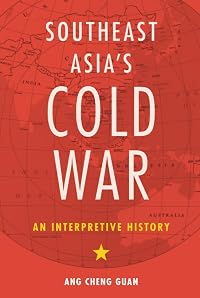
Southeast Asia’s Cold War: An Interpretive History
by Cheng Guan Ang
12 Members (4.00)
On This Page
Description
The historiography of the Cold War has long been dominated by American motivations and concerns, with Southeast Asian perspectives largely confined to the Indochina wars and Indonesia under Sukarno. Southeast Asia's Cold War corrects this situation by examining the international politics of the region from within rather than without. It provides an up-to-date, coherent narrative of the Cold War as it played out in Southeast Asia against a backdrop of superpower rivalry. When viewed through a show more Southeast Asian lens, the Cold War can be traced back to the interwar years and antagonisms between indigenous communists and their opponents, the colonial governments and their later successors. Burma, Malaysia, Singapore, Brunei, and the Philippines join Vietnam and Indonesia as key regional players with their own agendas, as evidenced by the formation of SEATO and the Bandung conference. The threat of global Communism orchestrated from Moscow, which had such a powerful hold in the West, passed largely unnoticed in Southeast Asia, where ideology took a back seat to regime preservation. China and its evolving attitude toward the region proved far more compelling: the emergence of the communist government there in 1949 helped further the development of communist networks in the Southeast Asian region. Except in Vietnam, the Soviet Union's role was peripheral: managing relationships with the United States and China was what preoccupied Southeast Asia's leaders. The impact of the Sino-Soviet split is visible in the decade-long Cambodian conflict and the Sino-Vietnamese War of 1979. This succinct volume not only demonstrates the complexity of the region, but for the first time provides a narrative that places decolonization and nation-building alongside the usual geopolitical conflicts. It focuses on local actors and marshals a wide range of literature in support of its argument. Most importantly, it tells us how and why the Cold War in Southeast Asia evolved the way it did and offers a deeper understanding of the Southeast Asia we know today. show lessTags
Member Reviews
Members
- Recently Added By
Author Information
11 Works 40 Members
Ang Cheng Guan is head of graduate studies at the S. Rajaratnam School of International Studies at Nanyang Technological University, Singapore.
Classifications
Statistics
- Members
- 12
- Popularity
- 1,873,357
- Rating
- (4.00)
- Languages
- English
- Media
- Paper, Ebook
- ISBNs
- 4