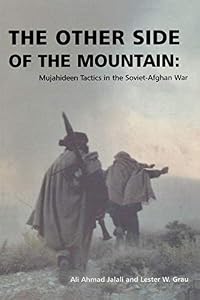
The Other Side of the Mountain: Mujahideen Tactics in the Soviet-Afghan War
by Ali Ahmad Jalali, Lester W. Grau
On This Page
Description
Illustrated with over a hundred maps. When the Soviet Union invaded Afghanistan in 1979, few experts believed that the fledgling Mujahideen resistance movement had a chance of withstanding the modern, mechanized, technologically-advanced Soviet Army. Most stated that resistance was futile and that the Soviet Union had deliberately expanded their empire to the south. The Soviet Union had come to stay. Although some historians looked at the British experience fighting the Afghan mountain show more tribesmen, most experts discounted any parallels since the Soviet Union possessed an unprecedented advantage in fire power, technology and military might. Although Arab leaders and the West supplied arms and material to the Mujahideen, they did so with the hope of creating a permanent, bleeding ulcer on the Soviet flank, not defeating the Soviet Union. They did not predict that the Soviet Union would voluntarily withdraw from Afghanistan in 1989. There have been few studies of guerrilla warfare from the guerrilla's perspective. To capture this perspective and the tactical experience of the Mujahideen, the United States Marine Corps commissioned this study and sent two retired combat veterans to interview Mujahideen. The authors were well received and generously assisted by various Mujahideen who willingly talked about their long, bitter war. The authors have produced a unique book which tells the guerrillas' story as interpreted by military professionals. This is a book about small-unit guerrilla combat. This is a book about death and survival, adaptation and perseverance. show lessTags
Recommendations















































Member Recommendations
nathanm Tactics from both sides of the war
Member Reviews
This is the stronger of Grau's books on the Soviet-Afghan War by far. Based on hundreds of interviews with former mujahideen in the mid 1990s, it is an invaluble account of how asymmetric warfare looks from the guerrilla's side.
When the mujahideen had it good, they had it very good indeed. Soviet convoy tactics were laughable, and skilled fighters were able to pick trucks off with ease, while avoiding the counterfire of armored escorts. Afghan Army outposts were basically supply depots, with guards that were cowardly and unwilling to fight. Conversely, when things went poorly, they went very poorly very quickly. Soviet airborne forces were a minority in battle, but they were supremely effective. Heavy artillery and aircraft pounded show more anyone exposed. The mujahideen logistics system and command structure never went beyond 'ramshackle'. This was both a weakness and a strength. While the mujahideen were unable to press an operational advantage, they were also impossible to decapitate. New leaders always rose to replace casualties. The Soviets, following the adage that the guerrilla swims like a fish in the sea of the people, attempted to drain the sea. Aerial bombardment and massive mining operations turned millions of Afghans into refugees, and lead directly to the Taliban, 9/11, the American invasion, and Afghanistan today.
The Other Side of the Mountain is focused solely on tactics, and probably should be read with a broader history of the region. But for what it does, it is the best book I've read!
Oh, and one more thing. show less
When the mujahideen had it good, they had it very good indeed. Soviet convoy tactics were laughable, and skilled fighters were able to pick trucks off with ease, while avoiding the counterfire of armored escorts. Afghan Army outposts were basically supply depots, with guards that were cowardly and unwilling to fight. Conversely, when things went poorly, they went very poorly very quickly. Soviet airborne forces were a minority in battle, but they were supremely effective. Heavy artillery and aircraft pounded show more anyone exposed. The mujahideen logistics system and command structure never went beyond 'ramshackle'. This was both a weakness and a strength. While the mujahideen were unable to press an operational advantage, they were also impossible to decapitate. New leaders always rose to replace casualties. The Soviets, following the adage that the guerrilla swims like a fish in the sea of the people, attempted to drain the sea. Aerial bombardment and massive mining operations turned millions of Afghans into refugees, and lead directly to the Taliban, 9/11, the American invasion, and Afghanistan today.
The Other Side of the Mountain is focused solely on tactics, and probably should be read with a broader history of the region. But for what it does, it is the best book I've read!
Oh, and one more thing. show less
Ratings
Members
- Recently Added By
Lists

LtGen James Mattis' Reading List
58 works; 2 members
Author Information

4 Works 253 Members

11+ Works 653 Members
Common Knowledge
- Canonical title
- The Other Side of the Mountain: Mujahideen Tactics in the Soviet-Afghan War
- Alternate titles
- Afghan Guerrilla Warfare: In the Words of the Mjuahideen Fighters
- Original publication date
- 1996
- Important places
- Afghanistan
- Important events
- Soviet-Afghan War
- First words
- Afghanistan, a multi-ethnic state in southwest Asia, is home to diverse social communities that share common experience through interaction with dominant states, empires, invading armies, trade and cultural movements that tra... (show all)versed the land during their thousands of years of history.
- Last words
- (Click to show. Warning: May contain spoilers.)It would be years before the DRA collapsed and the Mujahideen tried to unite to rebuild Afghanistan.
Classifications
Statistics
- Members
- 236
- Popularity
- 137,404
- Reviews
- 1
- Rating
- (3.90)
- Languages
- English
- Media
- Paper, Audiobook, Ebook
- ISBNs
- 14
- UPCs
- 1
- ASINs
- 6