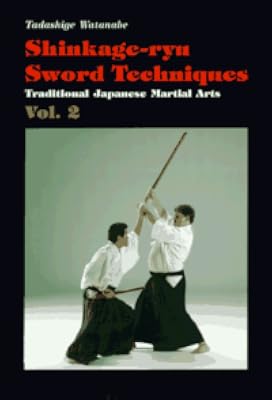
Shinkage-Ryu Sword Techniques: Traditional Japanese Martial Arts Vol.2
by Tadashige Watanabe
On This Page
Description
In this second volume, the author introduces the theories behind this ancient sport, and instructs in the movements specific to Shinkage-ryu style of kendo or swordplay.Tags
Member Reviews
Kami-izumi-ise-no-kami Nobutsuna was born in 1508 as the son of the lord of Kami-Izume castle (located in present day Kami-Izumi, Maebashi city, Gumma Prefecture). At this time in history, the feudal lords of Japan were embroiled in a leadership conflict and this period is referred to as 'The Era of Warring States' (Sengoku-Jidai-ca. 1480-ca. 1570). From childhood he devoted his time not only to academic studies, but also to the practice of Zen and training in martial arts. Having mastered the military arts of the Ogasawara school, he earned a reputation as a great warrior and tactician. He showed particular interest in the study of swordsmanship. His training in swordsmanship was based largely on Katori-Shinto-Ryu and, later, on the show more two other major schools, Nen-Ryu and Kage-Ryu as the cornerstone of Shinkage-ryu. As a warrior he was oppoosed to involving his subordinates, or those belonging to one of his fiefs, in battles in which it was probable that they would lose their lives and, whenever possible, avoided such futile and profitless conflict, thus displaying an attitude unusual among members of the warrior class of those times. It is almost certain that such thinking was born of long years of Zen discipline. Normally, in swordsmanship, one is taught techniques for defeating and killing one's enemy with the sword, however, during his travels, Kami-Izumi-Ise-no-Kami preached a somewhat different approach. He taught that 'the techniques of Shinkage-ryu are unbeatable; this arises not from the needless taking of life, but from the true courage required to avoiid unnecessary conflict.' Kami-Izumi-Ise-no-Kami taught and spread these principles to his followers around the contry in the belief that an increase in the number of those who adhered to these principlees would herald the end of the era of wardfare and the beginning of a peaceful society. Eventually, these concepts came to bear fruit under Yagyu Munenori, master swordsman to the shogun famuly, and were established as the basis of the 300 yeas of the tokugawa Shogun (feudal rulers of Japan) line and their Daimyo (feudal lords). Regarded highly in such elevated circles, it was not only one of the elements that supported the entire feudal structure, but also a source of knowledge and learning for the warrior class and a basic constituent of the code by which that warrior class conducted their lives (bushido). The movements of Shinkage-ryu can be broadly divided into four categories; those designed to lead children and beginners into Shinkage-ryu, those for beginning and intermediate students, those for upper lever students and those for advanced students. These books aim at the second of these levels, that is the beginning to intermediate level.
Contents
Preface
Chapter 1: The Basics of Shinkage-ryu
1 Measurements of the Sword used in Practice
2 Holding the Sword
3 Shinkage-ryu Sword Techniques
4 Main Postures--'Kurai', Mukei-no-kukrai (Neutral Posture)
5 Bowing-Sokou-rei ('fingernail' bow), Tachi-rei (Standing bow), Za-rei (Kneeling bow pics 1-47)
6 Den-i (Rankings)
Chapter 2: Sangauen-no-tachi
* Naiden-ken-no-tachi
1 Itto-ryodan, 2 Zantei-settesu, 3 Hankai-hanko, 4 Usen-saten, 5 Chotan-ichimi
Chapter 3: Kuka-no-tachi
*Gaiden-kei-no-tachi
1 Hissho, 2 Gyaku-fu, 3 Todachi, 4 Ka-boku, 5 Sho-kei, 6 Kozume, 7 Ozume, 8 Yae-gaki,
9 Mura-kumo
Chapter 4: Ai-Raito Hassei
1 Gasshi-uchi, 2 Shitsu-Raito-Junsei, 3 Shitsu-Raito-Gyakusei,
4 Senyokuto-Gyaku-Aikake-Kaeshi, 5 Gokasei, 7 Suishasei-Jun-Aikake-Kaeshi,
8 Suishasei-Sen-uchi show less
Contents
Preface
Chapter 1: The Basics of Shinkage-ryu
1 Measurements of the Sword used in Practice
2 Holding the Sword
3 Shinkage-ryu Sword Techniques
4 Main Postures--'Kurai', Mukei-no-kukrai (Neutral Posture)
5 Bowing-Sokou-rei ('fingernail' bow), Tachi-rei (Standing bow), Za-rei (Kneeling bow pics 1-47)
6 Den-i (Rankings)
Chapter 2: Sangauen-no-tachi
* Naiden-ken-no-tachi
1 Itto-ryodan, 2 Zantei-settesu, 3 Hankai-hanko, 4 Usen-saten, 5 Chotan-ichimi
Chapter 3: Kuka-no-tachi
*Gaiden-kei-no-tachi
1 Hissho, 2 Gyaku-fu, 3 Todachi, 4 Ka-boku, 5 Sho-kei, 6 Kozume, 7 Ozume, 8 Yae-gaki,
9 Mura-kumo
Chapter 4: Ai-Raito Hassei
1 Gasshi-uchi, 2 Shitsu-Raito-Junsei, 3 Shitsu-Raito-Gyakusei,
4 Senyokuto-Gyaku-Aikake-Kaeshi, 5 Gokasei, 7 Suishasei-Jun-Aikake-Kaeshi,
8 Suishasei-Sen-uchi show less
Members
- Recently Added By
Lists

Bujutsu treaties and manuals: old Japanese (Koryu)
34 works; 1 member
Author Information
2 Works 22 Members
Classifications
- Genres
- Sports and Leisure, Nonfiction
- DDC/MDS
- 796.86 — Arts & recreation Recreation, sports, and performing arts Athletic and outdoor sports and games Wrestling / Martial Arts, Judo, Karate Fencing
- LCC
- GV1150 .W383 — Geography, Anthropology and Recreation Recreation. Leisure Recreation. Leisure Sports Fighting sports: Bullfighting, boxing, fencing, etc.
- BISAC
Statistics
- Members
- 19
- Popularity
- 1,338,868
- Reviews
- 1
- Rating
- (5.00)
- Languages
- English
- Media
- Paper
- ISBNs
- 2