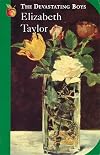
The Devastating Boys
by Elizabeth Taylor
On This Page
Tags
Recommendations















Member Reviews
I’m sure most of you know by now just how much I love Elizabeth Taylor – but I still haven’t read quite everything she wrote. I have been saving the last two volumes of short stories for quite a while – now there is only one left. The short story form, seems to have suited Elizabeth Taylor perfectly, and The Devastating Boys first published in 1972 I have seen described as her best. It is pretty much sheer perfection.
There are eleven stories in this collection – and they are all quite brilliant, though I am not going to write about each story separately – but attempt to give a flavour of the whole collection. On of things that Elizabeth Taylor can do in her short stories is to have her characters step fully formed from the show more pages, and the reader is immediately involved in their lives. These stories take place both at home and abroad, and concern a variety of types. We have remembrances of childhood holidays and the infatuations they bring. Loneliness and humour sit side by side throughout this delicious collection. In two of the stories there is certainly an acknowledgement of the changing face of Britain, as Elizabeth Taylor introduces us to some more diverse characters than we perhaps usually associate with her, in the title story and in Tall Boy. This later story tells the rather poignant story of Jasper; a young man, an immigrant not long arrived in England. I don’t want to say too much about that one as it could spoil it – but it is certainly one of my favourites in the collection.
“He imagined home having the same time as England. He would have felt quite lost to his loved ones if when he woke in the night, he could not be sure that they were lying in darkness too and, when his own London morning came, their also came, the sun streamed through the cracks of their hut in shanty-town, and the little girls began to chirp and skip about.” (Tall Boy)
The title story, the first one in the book, is an absolute delight, some of the language is a little old fashioned, though never offensive, it brings together two vastly different worlds. Laura and Harold are a fairly typical Taylor married couple, upper middle class, they live in a nice house within easy reach of a railway link to London, their daughters have grown up and left home. Harold came up with the idea of having disadvantaged London children to stay for a holiday. Having read of the scheme, Harold had volunteered himself and Laura (though it will be Laura who will have to entertain them) insisting that the children they take should be black. So, when summer comes, it is a nervous Laura who waits at the station for these two young London boys, Septimus Smith and Benny Reece.
“They stood on the platform, looking about them, holding their little cardboard cases.
‘My name is Laura,’ she said. She stooped and clasped them to her, and kissed their cheeks. Sep’s in particular, was extraordinarily soft, like the petal of a poppy. His big eyes stared up at her, without expression. He wore a dark long-trousered suit. So that he was all over sombre and unchildlike. Benny had a mock-suede coat with a nylon-fur collar and a trilby hat with a feather. They did not speak. Not only was she, Laura, strange to them, but they were strange to one another. There had only been a short train-journey in which to sum up their chances of becoming friends.” (The Devastating Boys)
Two weeks stretches out before them all, what will Laura do with these silent, large eyed small boys. Elizabeth Taylor writes these characters with such affection and without any of the patronising condescension that other writers of her class have been known to adopt when writing of the working classes. The Devastating Boys is a story I could read over and over – by the end – when the children must return to London – there is a definite feeling that Septimus and Benny will always be a part of Harold and Laura’s life.
In stories like Sisters – Elizabeth Taylor achieves quite a lot in just a few pages. Here we have Mrs Mason, a widow, she prides herself on her respectability. We quickly learn all we need to know, Mrs Mason is childless, attends coffee mornings in aid of worthy charities, plays bridge regularly, takes tea in a nearby tea-rooms. She is a respected figure in her English county town, and she shudders at the thought that her respectability could be threatened when a journalist appears asking questions about the sister that no one in the town knows anything about.
An annoyingly precocious child spends her summer holidays making daily visits to various houses in the story In and Out the Houses. At each house, she drops snippets of information about the other households she has visited that day. Small jealousies and pretensions are revealed, as Kitty Miller happily skips from house to house leaving tiny seeds of chaos in her wake.
Several stories take place abroad; the differences in a newly married couple becoming painfully apparent in Hôtel Du Commerce, the ending almost inevitable is nevertheless brilliant. Blowsy pub landlady Phyl; contemplates a fling while on holiday in a sunbathed Mediterranean resort, in the story Flesh. Even here, we meet a recognisable type of person, and as ever Taylor recreates them perfectly.
“For the sake of a tan, she was wasting her holiday – just to be a five minutes’ wonder in the bar on her return, the deepest brown any of them had that year.” (Flesh).
The one story which feels a bit like the odd one out (not to say it isn’t brilliant because it is) is The Fly Paper, which I have read before in another collection. It is a real spine chiller – reminding me a little of those Tales of the Unexpected that I used to watch with partial dread, occasionally, when I was in my teens. Sylvia is an eleven year old, travelling on a bus to her music lesson, it is a journey she makes regularly, but what happens to Sylvia on this particular Wednesday – really is the stuff of nightmares – and yet Taylor writes it with such exquisite subtlety.
The Devastating Boys is a truly superb collection, and one which demonstrates Elizabeth Taylor’s skill at revealing the truths within communities. Dangerous Calm is the final collection of Elizabeth Taylor stories I have to read, I want to have it to look forward to for a little while yet. show less
There are eleven stories in this collection – and they are all quite brilliant, though I am not going to write about each story separately – but attempt to give a flavour of the whole collection. On of things that Elizabeth Taylor can do in her short stories is to have her characters step fully formed from the show more pages, and the reader is immediately involved in their lives. These stories take place both at home and abroad, and concern a variety of types. We have remembrances of childhood holidays and the infatuations they bring. Loneliness and humour sit side by side throughout this delicious collection. In two of the stories there is certainly an acknowledgement of the changing face of Britain, as Elizabeth Taylor introduces us to some more diverse characters than we perhaps usually associate with her, in the title story and in Tall Boy. This later story tells the rather poignant story of Jasper; a young man, an immigrant not long arrived in England. I don’t want to say too much about that one as it could spoil it – but it is certainly one of my favourites in the collection.
“He imagined home having the same time as England. He would have felt quite lost to his loved ones if when he woke in the night, he could not be sure that they were lying in darkness too and, when his own London morning came, their also came, the sun streamed through the cracks of their hut in shanty-town, and the little girls began to chirp and skip about.” (Tall Boy)
The title story, the first one in the book, is an absolute delight, some of the language is a little old fashioned, though never offensive, it brings together two vastly different worlds. Laura and Harold are a fairly typical Taylor married couple, upper middle class, they live in a nice house within easy reach of a railway link to London, their daughters have grown up and left home. Harold came up with the idea of having disadvantaged London children to stay for a holiday. Having read of the scheme, Harold had volunteered himself and Laura (though it will be Laura who will have to entertain them) insisting that the children they take should be black. So, when summer comes, it is a nervous Laura who waits at the station for these two young London boys, Septimus Smith and Benny Reece.
“They stood on the platform, looking about them, holding their little cardboard cases.
‘My name is Laura,’ she said. She stooped and clasped them to her, and kissed their cheeks. Sep’s in particular, was extraordinarily soft, like the petal of a poppy. His big eyes stared up at her, without expression. He wore a dark long-trousered suit. So that he was all over sombre and unchildlike. Benny had a mock-suede coat with a nylon-fur collar and a trilby hat with a feather. They did not speak. Not only was she, Laura, strange to them, but they were strange to one another. There had only been a short train-journey in which to sum up their chances of becoming friends.” (The Devastating Boys)
Two weeks stretches out before them all, what will Laura do with these silent, large eyed small boys. Elizabeth Taylor writes these characters with such affection and without any of the patronising condescension that other writers of her class have been known to adopt when writing of the working classes. The Devastating Boys is a story I could read over and over – by the end – when the children must return to London – there is a definite feeling that Septimus and Benny will always be a part of Harold and Laura’s life.
In stories like Sisters – Elizabeth Taylor achieves quite a lot in just a few pages. Here we have Mrs Mason, a widow, she prides herself on her respectability. We quickly learn all we need to know, Mrs Mason is childless, attends coffee mornings in aid of worthy charities, plays bridge regularly, takes tea in a nearby tea-rooms. She is a respected figure in her English county town, and she shudders at the thought that her respectability could be threatened when a journalist appears asking questions about the sister that no one in the town knows anything about.
An annoyingly precocious child spends her summer holidays making daily visits to various houses in the story In and Out the Houses. At each house, she drops snippets of information about the other households she has visited that day. Small jealousies and pretensions are revealed, as Kitty Miller happily skips from house to house leaving tiny seeds of chaos in her wake.
Several stories take place abroad; the differences in a newly married couple becoming painfully apparent in Hôtel Du Commerce, the ending almost inevitable is nevertheless brilliant. Blowsy pub landlady Phyl; contemplates a fling while on holiday in a sunbathed Mediterranean resort, in the story Flesh. Even here, we meet a recognisable type of person, and as ever Taylor recreates them perfectly.
“For the sake of a tan, she was wasting her holiday – just to be a five minutes’ wonder in the bar on her return, the deepest brown any of them had that year.” (Flesh).
The one story which feels a bit like the odd one out (not to say it isn’t brilliant because it is) is The Fly Paper, which I have read before in another collection. It is a real spine chiller – reminding me a little of those Tales of the Unexpected that I used to watch with partial dread, occasionally, when I was in my teens. Sylvia is an eleven year old, travelling on a bus to her music lesson, it is a journey she makes regularly, but what happens to Sylvia on this particular Wednesday – really is the stuff of nightmares – and yet Taylor writes it with such exquisite subtlety.
The Devastating Boys is a truly superb collection, and one which demonstrates Elizabeth Taylor’s skill at revealing the truths within communities. Dangerous Calm is the final collection of Elizabeth Taylor stories I have to read, I want to have it to look forward to for a little while yet. show less
This collection of eleven short stories explores various themes including couples’ relationships, cultural and class differences, and traveling abroad. In the title story, a couple with grown children decide to host two London children for a 2-week holiday at their home in the country. The boys are from immigrant families; the husband takes pride in hosting these children but his wife is largely left on her own to work through their cultural differences. One of my favorite stories was Praises, about a department store’s final day of operations. Told from the point of view of a woman who has given most of her life to the shop, it’s quite poignant.
As with any short story collection, readers will enjoy some stories more than others. show more But there isn’t a single “bad” story in the bunch. show less
As with any short story collection, readers will enjoy some stories more than others. show more But there isn’t a single “bad” story in the bunch. show less
The last in the books that I have read in honor of Elizabeth Taylor's Centenary celebration on the Virago thread (from 2012). Probably the least satisfying read of them, unfortunately, as I found these stories, written twenty or so years later than the first book, didn't show much development - in choice of subject matter, characters etc. Perhaps this is a little unfair of me, but Taylor did manage that in Mrs. Palfrey, a bit of a clash between generations and behaviours, but it isn't evident here beyond the very first story, "The Devastating Boys" about a woman in late middle age taking on some black children for a summer visit. It has a delightful light touch to it, and no p.c. missteps that I could see, digging down right to the show more human level and staying there. A couple of stories I would even say shouldn't have been included, The Flypaper for one, a predictable menacing story that had no depth or reason to exist - not entirely unlike the second to last story in The Blush. (This also was placed penultimately and also appears to be more of a writing exercise than anything else, as in, can I write a creepy story?). All the same, there are moments - like this one, marked on the very first page of the very first story as Laura waits for the train with her summer guests - she's early and everything is very still, the 'all' refers to 'inanimate things' in a previous phrase: ... all were menacingly intent on being themselves, and separately themselves- the slanting shadow of railings across the platform, the glossiness of leaves, and the closed door of the office looking more closed, she thought, than any door she had ever seen.
N.B. Just noticed that the reviewer below LOVED The Flypaper - so there you go - everyone has different reactions to everything and I'm glad! ***1/2 show less
N.B. Just noticed that the reviewer below LOVED The Flypaper - so there you go - everyone has different reactions to everything and I'm glad! ***1/2 show less
Overall, I give it 4 stars - my favorites were Flesh, about two people at a seaside resort who decide to have a fling, and Sisters, about a widow who gets a visit from an author asking about her sister. I enjoyed my time with Elizabeth Taylor in this collection.
E. Taylor is in top form in this collection of wonderfully varied and intimate character studies. Most of the stories are sober and pensive, but In and Out of Houses is very funny. Great collection!
Read: July 2023
Rating: 1/5 stars
I have read so many wonderful reviews for this short story collection I feel bad for only giving it one star, but I simply didn't like it. I have previously read Mrs Palfrey at the Claremont by Elizabeth Taylor and found it a bit of a chore to get through - and this one was even worse. I think I just find her work vaguely depressing and so it is not really for me!
Rating: 1/5 stars
I have read so many wonderful reviews for this short story collection I feel bad for only giving it one star, but I simply didn't like it. I have previously read Mrs Palfrey at the Claremont by Elizabeth Taylor and found it a bit of a chore to get through - and this one was even worse. I think I just find her work vaguely depressing and so it is not really for me!
The latest of the four short-story anthologies published in Taylor's lifetime, so it tends to be an example of Taylor at her best. "The Fly-Paper" is definitely among my favorite stories, PERIOD. This out-of-print Virago, though, is now superseded by the 2012 Virago publication of Taylor's Complete Short Stories, available in both over-sized trade ppb and, for a more convenient read, a very nicely formatted Kindle edition.
Members
- Recently Added By
Lists

Favourite Virago Modern Classics
183 works; 38 members

Books Read in 2016
4,666 works; 199 members
Author Information

30+ Works 7,829 Members
Some Editions
Series
Belongs to Publisher Series
Virago Modern Classics (163)
Work Relationships
Is contained in
Common Knowledge
- Canonical title
- The Devastating Boys
- Original title
- The Devastating Boys
- Original publication date
- 1972
- Dedication
- To
HARRIET, MATTHEW, REBECCA
and
FLORA - First words
- Laura was always too early; and this was as bad as being late, her husband, who was late himself, told her. (The Devastating Boys)
"She seemed to have been made for widowhood, and had her own little set, for bridge and coffee mornings, and her committee-meetings for the better known charities - such as the
National Society for the Prevention of Cruel... (show all)ty to Children and the Royal Society for the Prevention of Cruelty to Animals." Elizabeth Taylor is describing, with her customary economy, the complacent Mrs Mason in the story "Sister". (Introduction) - Last words
- (Click to show. Warning: May contain spoilers.)You can love George Eliot, as I do, and still love what Elizabeth Taylor achieved, as I do, intensely. (Introduction)
- Original language
- English
Classifications
Statistics
- Members
- 189
- Popularity
- 173,114
- Reviews
- 7
- Rating
- (3.89)
- Languages
- Dutch, English, French
- Media
- Paper
- ISBNs
- 5
- ASINs
- 4