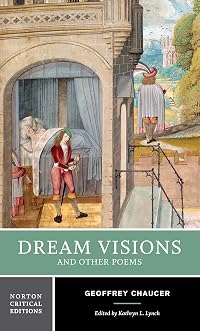
Dream Visions and Other Poems [Norton Critical Edition]
by Geoffrey Chaucer
On This Page
Description
"This Norton Critical Edition presents Chaucer's four dream visions - the Book of the Duchess, the House of Fame, the Parliament of Fowls, and the Legend of Good Women - and selected shorter poems and is suitable for both beginning and advanced students. The texts are extensively glossed and are accompanied by individual introductions and explanatory annotations. A lightly regularized system of spellings has been adopted. No prior knowledge of Chaucer is assumed."--BOOK JACKET.Tags
Recommendations









Member Reviews
It isn't exactly a dream come true.
This volume contains what it says: Chaucer's dream poems, plus a few others. So we have The Book of the Duchess, The House of Fame, The Parliament of Fowls, The Legend of Good Women, and some (not all) of his minor poems. Since the minor poems supllied here include most of the better and more noteworthy ones (Anelida and Arcite, Truth, Gentilesse, Lack of Steadfastness, Adam Scriven), this volume, plus the other Norton volumes on The Canterbury Tales and Troilus and Criseyde, will give you almost a complete edition of Chaucer.
The text is not the standard Riverside Chaucer, but is a modified edition of Skeat's old workhorse edition. This is understandable, since the two editions are more or less in show more competition, and Skeat's text is good enough for most purposes. The texts are suitably glossed, with notes on the page; it is an easy-to-use edition. And the introductions to the individual poems are solid.
But Norton's anthologies usually include translations of an author's sources, plus a section on criticism. The sources section, which includes relevant material from Virgil, Ovid, Cicero, Boccaccio, and others, is good. But the criticism... is strange. "The Feminization of Men in Chaucer's Legend of Good Women"? This was frankly hard for me to comprehend. Most of the other critical pieces weren't much better.
Of the three Norton volumes on Chaucer, this one is probably has the most potential interest, because these are the writings that get the least attention. Yet they show how Chaucer matured as a poet, and some of the short writings (notably "Truth") give a real insight into his thought processes. Yet I came away with very little that I didn't know. I fear the Riverside Chaucer still holds the field. show less
This volume contains what it says: Chaucer's dream poems, plus a few others. So we have The Book of the Duchess, The House of Fame, The Parliament of Fowls, The Legend of Good Women, and some (not all) of his minor poems. Since the minor poems supllied here include most of the better and more noteworthy ones (Anelida and Arcite, Truth, Gentilesse, Lack of Steadfastness, Adam Scriven), this volume, plus the other Norton volumes on The Canterbury Tales and Troilus and Criseyde, will give you almost a complete edition of Chaucer.
The text is not the standard Riverside Chaucer, but is a modified edition of Skeat's old workhorse edition. This is understandable, since the two editions are more or less in show more competition, and Skeat's text is good enough for most purposes. The texts are suitably glossed, with notes on the page; it is an easy-to-use edition. And the introductions to the individual poems are solid.
But Norton's anthologies usually include translations of an author's sources, plus a section on criticism. The sources section, which includes relevant material from Virgil, Ovid, Cicero, Boccaccio, and others, is good. But the criticism... is strange. "The Feminization of Men in Chaucer's Legend of Good Women"? This was frankly hard for me to comprehend. Most of the other critical pieces weren't much better.
Of the three Norton volumes on Chaucer, this one is probably has the most potential interest, because these are the writings that get the least attention. Yet they show how Chaucer matured as a poet, and some of the short writings (notably "Truth") give a real insight into his thought processes. Yet I came away with very little that I didn't know. I fear the Riverside Chaucer still holds the field. show less
Chaucer is mostly known for The Canterbury Tales, but they and his other poetic works and translations fill more than 750 of the 1300-page Riverside edition of his complete works. While the Tales provide a highly entertaining and wide-ranging selection of stories, it is a daunting task to read them in their entirety in the original Middle English, which is the best approach because so much of the charm and humor of Chaucer's writing is lost in translation to modern English. Middle English comes at that point where Anglo-Saxon and French are in the process of blending together into what will become the modern English language. Standard spellings are not yet established, the old inflections are inconsistent and the vocabulary is much more show more limited. Many words serve double and triple duty with widely varying definitions, and words that look familiar have frequently evolved over the ages to mean something quite different than they did in the 1300s.
When spoken aloud Middle English is much more comprehensible than just seeing it on the page. Reading aloud seems to turn one into a participant, and the delights of hearing the sounds of the language cannot be adequately described. One simply must experience it to appreciate it. To the modern ear Middle English sounds like a remote dialect, which gives the illusion that it is just on the edge of being understandable. Unfortunately, it is not quite that simple, but once into it and aware of the pitfalls, one can pick it up relatively quickly.
Until relatively recently Chaucer's shorter poetical works were accessible only to serious students and scholars, but these shorter works are in some ways much more approachable than the Tales, in addition to conveying the essence of both Chaucer and his dialect.
Norton Critical Editions has provided a perfect introduction in Geoffrey Chaucer: Dream Visions and Other Poems, beautifully selected, edited and introduced by Kathryn Lunch, who also wrote The High Medieval Dream Vision: Poetry, Philosophy, and Literary Form, a book I devoured and reported on a few years ago. This Norton edition provides line by line glosses which save the reader from the necessity of constantly referring to a separate vocabulary. Footnotes at the bottom of the page explain difficult passages and mythological, historical, biographical and literary references.
What exactly is a "dream vision"? It is a recounting of a dream that is so memorable or significant that it almost seems like a vision. It was one of the most popular literary genres of the Middle Ages, and many examples abound that are well known today. Boethius' Consolation of Philosophy was the prototype, and Dante's Divine Comedy is perhaps the culmination and the most famous. Of Chaucer's four stand-alone dream visions only two were finished, The Book of the Duchess and the Parliament of Fowls. The House of Fame and The Legend of Good Women both end abruptly mid-sentence, and no one knows why they were not completed. These works all pre-date The Canterbury Tales, so we don't know whether Chaucer simply lost interest or set them aside and simply never got back to them.
The Book of the Duchess was written for John of Gaunt to honor his wife Blanche who had recently died. It deals with the pain of loss without sinking into sentimentality. The Parliament of Fowls may be the first literary commemoration of Saint Valentine's Day and celebrates the advent of spring. The subject matter is difficult to pin down as it begins with a brief discussion of poetic art but shifts to how the poet is stymied by his attempts to deal with Love. It then turns to books before it evolves into a debate among the birds about which of three male eagles the lady eagle should choose as a mate. The House of Fame tells of the narrator's dream of being carried into the heavens to the realm of the goddess Fame, and in the course of the story demonstrates how Fame is nearly as capricious as Fortune. In The Legend of Good Women, a dream vision provides the frame for a series of lives of virtuous women and the men who betrayed them.
In addition to these four dream visions, Chaucer's narrative poem Anelida and Arcite and a selection of his very short poems are included.
True to Norton tradition, a selection of contextual materials are provided, in this case excerpts from Chaucer's sources including Virgil, Ovid, Cicero, Boethius, Alain de Lille, Jean de Meun, Dante, Guillaume de Machaut and Boccaccio. Finally, several critical essays from different periods and with widely varying perspectives are presented. This is perhaps the weakest element of an otherwise superb book. I would have chosen differently in some cases, but I am thinking in terms of introductory materials. The editor has a more academic perspective.
The total effect here is of a commonplace book which can form the basis for many hours of enjoyment and indeed a jumping off point for delving into some of the full works excerpted and into more treasures from Chaucer's pen. For the reader who is thinking of giving Chaucer and Middle English a try, there cannot be a more rewarding place to begin than with this volume. show less
When spoken aloud Middle English is much more comprehensible than just seeing it on the page. Reading aloud seems to turn one into a participant, and the delights of hearing the sounds of the language cannot be adequately described. One simply must experience it to appreciate it. To the modern ear Middle English sounds like a remote dialect, which gives the illusion that it is just on the edge of being understandable. Unfortunately, it is not quite that simple, but once into it and aware of the pitfalls, one can pick it up relatively quickly.
Until relatively recently Chaucer's shorter poetical works were accessible only to serious students and scholars, but these shorter works are in some ways much more approachable than the Tales, in addition to conveying the essence of both Chaucer and his dialect.
Norton Critical Editions has provided a perfect introduction in Geoffrey Chaucer: Dream Visions and Other Poems, beautifully selected, edited and introduced by Kathryn Lunch, who also wrote The High Medieval Dream Vision: Poetry, Philosophy, and Literary Form, a book I devoured and reported on a few years ago. This Norton edition provides line by line glosses which save the reader from the necessity of constantly referring to a separate vocabulary. Footnotes at the bottom of the page explain difficult passages and mythological, historical, biographical and literary references.
What exactly is a "dream vision"? It is a recounting of a dream that is so memorable or significant that it almost seems like a vision. It was one of the most popular literary genres of the Middle Ages, and many examples abound that are well known today. Boethius' Consolation of Philosophy was the prototype, and Dante's Divine Comedy is perhaps the culmination and the most famous. Of Chaucer's four stand-alone dream visions only two were finished, The Book of the Duchess and the Parliament of Fowls. The House of Fame and The Legend of Good Women both end abruptly mid-sentence, and no one knows why they were not completed. These works all pre-date The Canterbury Tales, so we don't know whether Chaucer simply lost interest or set them aside and simply never got back to them.
The Book of the Duchess was written for John of Gaunt to honor his wife Blanche who had recently died. It deals with the pain of loss without sinking into sentimentality. The Parliament of Fowls may be the first literary commemoration of Saint Valentine's Day and celebrates the advent of spring. The subject matter is difficult to pin down as it begins with a brief discussion of poetic art but shifts to how the poet is stymied by his attempts to deal with Love. It then turns to books before it evolves into a debate among the birds about which of three male eagles the lady eagle should choose as a mate. The House of Fame tells of the narrator's dream of being carried into the heavens to the realm of the goddess Fame, and in the course of the story demonstrates how Fame is nearly as capricious as Fortune. In The Legend of Good Women, a dream vision provides the frame for a series of lives of virtuous women and the men who betrayed them.
In addition to these four dream visions, Chaucer's narrative poem Anelida and Arcite and a selection of his very short poems are included.
True to Norton tradition, a selection of contextual materials are provided, in this case excerpts from Chaucer's sources including Virgil, Ovid, Cicero, Boethius, Alain de Lille, Jean de Meun, Dante, Guillaume de Machaut and Boccaccio. Finally, several critical essays from different periods and with widely varying perspectives are presented. This is perhaps the weakest element of an otherwise superb book. I would have chosen differently in some cases, but I am thinking in terms of introductory materials. The editor has a more academic perspective.
The total effect here is of a commonplace book which can form the basis for many hours of enjoyment and indeed a jumping off point for delving into some of the full works excerpted and into more treasures from Chaucer's pen. For the reader who is thinking of giving Chaucer and Middle English a try, there cannot be a more rewarding place to begin than with this volume. show less
Ratings
Members
- Recently Added By
Author Information

468+ Works 45,855 Members
Geoffrey Chaucer, one of England's greatest poets, was born in London about 1340, the son of a wine merchant and deputy to the king's butler and his wife Agnes. Not much is known of Chaucer's early life and education, other than he learned to read French, Latin, and Italian. His experiences as a civil servant and diplomat are said to have show more developed his fascination with people and his knowledge of English life. In 1359-1360 Chaucer traveled with King Edward III's army to France during the Hundred Years' War and was captured in Ardennes. He returned to England after the Treaty of Bretigny when the King paid his ransom. In 1366 he married Philippa Roet, one of Queen Philippa's ladies, who gave him two sons and two daughters. Chaucer remained in royal service traveling to Flanders, Italy, and Spain. These travels would all have a great influence on his work. His early writing was influenced by the French tradition of courtly love poetry, and his later work by the Italians, especially Dante, Boccaccio, and Petrarch. Chaucer wrote in Middle English, the form of English used from 1100 to about 1485. He is given the designation of the first English poet to use rhymed couplets in iambic pentameter and to compose successfully in the vernacular. Chaucer's Canterbury Tales is a collection of humorous, bawdy, and poignant stories told by a group of fictional pilgrims traveling to the shrine of St. Thomas a Becket. It is considered to be among the masterpieces of literature. His works also include The Book of the Duchess, inspired by the death of John Gaunt's first wife; House of Fame, The Parliament of Fowls, and The Legend of Good Women. Troilus and Criseyde, adapted from a love story by Boccaccio, is one of his greatest poems apart from The Canterbury Tales. Chaucer died in London on October 25, 1400. He was buried in Westminster Abbey, in what is now called Poet's Corner. (Bowker Author Biography) show less
All Editions
Series
Belongs to Publisher Series
Common Knowledge
- Canonical title
- Dream Visions and Other Poems [Norton Critical Edition]
- Original publication date
- 2007
- People/Characters
- Geoffrey Chaucer; Blanche, Duchess of Lancaster; John of Gaunt, Duke of Lancaster; Black Knight; The Eagle; Anelida (show all 8); Arcite; Cicero, Marcus Tullius, 106-43 BC
- Dedication
- for Michael and Rachel
"Al this mene I by Love." - First words
- Preface
This Norton Critical Edition is intended both for students just beginning their acquaintance with Chaucer and for those coming to what are sometimes referred to as his "minor poems" -- his dream visions, sho... (show all)rt lyrics, complains -- for a deeper knowledge of the power after reading his masterworks, the Canterbury Tales and Troilus and Criseyde. - Quotations
- Forth, pilgrim, forth! Forth, beste, out of thy stal!
Know thy contree, look up, thank God of al;
Hold the hye wey, and lat thy gost thee lede,
And trouthe shal delivere, it is no drede.
p. 219, "Truth," lines 18-... (show all)21.
Classifications
Statistics
- Members
- 179
- Popularity
- 183,358
- Reviews
- 2
- Rating
- (3.83)
- Languages
- English
- Media
- Paper
- ISBNs
- 1
- ASINs
- 1