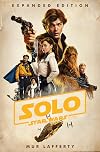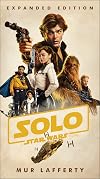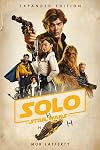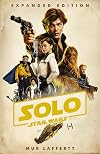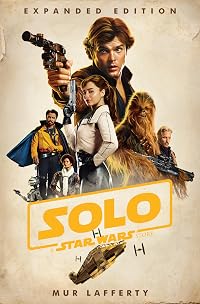
Solo: A Star Wars Story
by Mur Lafferty
Star Wars: Movie Novelizations (3.4), Star Wars: Canon - chronological order (13-10 BBY, Imperial Era), Star Wars Universe
On This Page
Description
Young Han Solo dreams of someday soaring into space at the helm of his own starship and leaving his home, the gritty industrial planet Corellia, far behind. But as long as he's trapped in a life of poverty and crime - and under the thumb of the sinister Lady Proxima - reaching the distant stars seems impossible. When Han tries to escape with his girlfriend and partner in crime, Ai'ra, he makes it out - but she doesn't. Desperate for a way to free her, Han enlists in the Imperial Navy - the show more last place for a rebellious loner who doesn't play well with others. When the Empire clips his wings, Han goes rogue and plunges into the shady world of smugglers, gamblers, and con artists. There he meets the charming and cunning high roller Lando Calrissian, makes an unlikely friend in a cantankerous Wookiee called Chewbacca, and first lays eyes on the Millennium Falcon. To snag his piece of the outlaw pie, Han joins the crew of pirates to pull off a risky heist. The stakes are high, the danger is great, and the odds are slim. But never tell Han Solo the odds. show lessTags
Recommendations
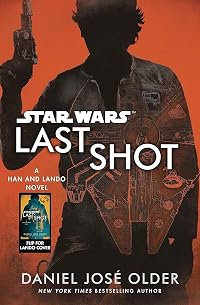




Member Reviews
Mur Lafferty’s novelization of Ron Howard’s Solo: A Star Wars Story continues the tradition of Del Rey’s adaptations of the new films by including scenes deleted from the theatrical cuts of the film. In this case, Lafferty not only tells the story itself, but shows how Han went from enlisting in the Imperial Navy to working in the infantry on Mimban: he was a good pilot, but his innovative flying style and unwillingness to blindly follow orders led to his demotion. This scene also includes a fun cameo from Kevin Rubio and Lucas Marangon’s characters, Tag Greenley and Bink Otauna, the Rosencrantz and Guildenstern of the Star Wars universe, whom screenwriters Jon Kasdan and Toby Hefferman were to portray in the film until the show more scene was cut (pgs. 58-59).
Lafferty’s adaptation works so well because the plot of the film was always better suited to a novel, like Brian Daley’s Han Solo Adventures or A.C. Crispin’s Han Solo Trilogy. The story, focusing on Han Solo escaping his life as a scrumrat on Corellia, joining and then washing out of the Imperial Navy, and becoming a smuggler to take on a major heist, all while facing ethical dilemmas that challenge his self-image as an independent and aloof scoundrel is a fun one and Lafferty tells it well. The various “Easter Eggs” from the film –including references to Bossk and Aurra Sing, the role of Crimson Dawn, the martial art Teräs Käsi, the planets Glee Anselm and Dathomir, and more – all work best as the kinds of references found in the Star Wars novels that most successfully integrate themselves into the larger canon. The scene of Lando Calrissian dictating his memoirs, specifically referencing L. Neil Smith’s 1983 novel, Lando Calrissian and the Mindharp of Sharu, works just as well in this novel as it does in the film, helping to explain Neil’s unique tone that didn’t match much of the Ballantine-era of Star Wars novels.
Beyond the Tag and Bink reference, Lafferty also uses the crew’s trip to Kessel to include scenes building up the friendship between Chewbacca and Lando, thereby foreshadowing their easy banter in The Empire Strikes Back (pg. 159), and, perhaps most importantly, Lafferty helps to explain Qi’ra’s backstory and motivations, helping to establish her character in a more significant way than the film did (pg. 162). This backstory, and the conversation with L3-37, later plays a key role in Qi’ra’s actions, helping to add depth to her actions beyond being the token tragic love interest (pg. 264). Finally, Lafferty’s epilogue hints at what could have been a connected series of Star Wars Stories had Lucasfilm not decided to halt production of the standalone films following Solo’s poor box-office performance. Lafferty tells an engaging and entertaining story, just not one that necessarily needed to be a feature film. show less
Lafferty’s adaptation works so well because the plot of the film was always better suited to a novel, like Brian Daley’s Han Solo Adventures or A.C. Crispin’s Han Solo Trilogy. The story, focusing on Han Solo escaping his life as a scrumrat on Corellia, joining and then washing out of the Imperial Navy, and becoming a smuggler to take on a major heist, all while facing ethical dilemmas that challenge his self-image as an independent and aloof scoundrel is a fun one and Lafferty tells it well. The various “Easter Eggs” from the film –including references to Bossk and Aurra Sing, the role of Crimson Dawn, the martial art Teräs Käsi, the planets Glee Anselm and Dathomir, and more – all work best as the kinds of references found in the Star Wars novels that most successfully integrate themselves into the larger canon. The scene of Lando Calrissian dictating his memoirs, specifically referencing L. Neil Smith’s 1983 novel, Lando Calrissian and the Mindharp of Sharu, works just as well in this novel as it does in the film, helping to explain Neil’s unique tone that didn’t match much of the Ballantine-era of Star Wars novels.
Beyond the Tag and Bink reference, Lafferty also uses the crew’s trip to Kessel to include scenes building up the friendship between Chewbacca and Lando, thereby foreshadowing their easy banter in The Empire Strikes Back (pg. 159), and, perhaps most importantly, Lafferty helps to explain Qi’ra’s backstory and motivations, helping to establish her character in a more significant way than the film did (pg. 162). This backstory, and the conversation with L3-37, later plays a key role in Qi’ra’s actions, helping to add depth to her actions beyond being the token tragic love interest (pg. 264). Finally, Lafferty’s epilogue hints at what could have been a connected series of Star Wars Stories had Lucasfilm not decided to halt production of the standalone films following Solo’s poor box-office performance. Lafferty tells an engaging and entertaining story, just not one that necessarily needed to be a feature film. show less
This is the novelisation of the Star Wars spin-off film on the early life of Han Solo, which I was inspired to read after watching the Rise of Skywalker film just before Christmas. I remembered less about the detail of the film (which I have watched only once, on its cinematic release in May 2018) than about most of the others, but this well written novelisation brought a lot of it back. By virtue of its unique status among Star Wars films as being effectively a spin-off rather than a (more or less) direct prequel or sequel to another film, it feels like the action has more room to breathe and create original characters and situations than is often the case. This novel expands on the relationships between Han and Qi'ra, and between show more Lando and his droid co-pilot, and also makes most of the characters seem fairly three dimensional. An enjoyable read and a real feel for what made Han Solo the cocky and arrogant character we met in A New Hope. show less
Excellent adaption of the movie, terrific reading (as always) by Marc Thompson.
This novelization is a great example of how the movie tie-ins can work to turn a fun action movie into a very good SF story. When it works (and it does very well here) the author can add the logic, narrative and exposition a fast paced movie inevitably lacks. I love the background parts (Han's Imperial service, L3-37's awakening and transition) that are now in my mind's eye version of the movie.
Thompson as narrator does his usual job of creating - from one voice - a full cast of characters. His rendition Dryden Vos and Becket are particularly striking.
This novelization is a great example of how the movie tie-ins can work to turn a fun action movie into a very good SF story. When it works (and it does very well here) the author can add the logic, narrative and exposition a fast paced movie inevitably lacks. I love the background parts (Han's Imperial service, L3-37's awakening and transition) that are now in my mind's eye version of the movie.
Thompson as narrator does his usual job of creating - from one voice - a full cast of characters. His rendition Dryden Vos and Becket are particularly striking.
All things considered, there was nothing considerably "wrong" with this or the story. Its completely the script for the movie with just a few scenes added, sadly lacking much "depth" to many things. I believe the biggest amount of depth added to the novelization compared to that of the movie is L3's "death" and then integration into the Falcon. Which is something that REALLY needed expounding on, given how little play it was given in the movie.
Qi'Ra is still very flat, diminished, and her choices and thoughts aren't portrayed well. Especially the ending.
In fact, the whole Dryden Vos/Beckett/Qi'Ra/Han ending is basically a cluster*. And handled very poorly, and once things are done, you wonder why they just didn't do X from the get go. show more Especially when you realize just how simple it all turned out to be.
The DM reveal at the end gets even less play in the novel and is left completely vague-ish, even moreso than the movie.
The writing style is typical for the new novels and new EU canon. "Contemporary", littered with new euphemisms and vernacular with the times (2010s) and aimed at a millenial / youthful audience (teens/mid-twenties) compared to a lived in universe like the old EU and more of a 'literature' basis. I really don't feel like the current EU writing style (Wendig's trilogy, Last Shot, From a Certain Point of View, this novelization, etc.) will hold up on further readings in years to come, whereas the old EU will hold up based on the writing style. (I could be wrong, but this is just my perspective/point of view.)
This is a "fine" novel, in the same way that the movie is "fine". Sadly it just took me forever to read it, having to get it out of the library about 8 different times just to try and force myself to read it, since it's such a copying of the movie that there's so little extra to learn from it, with having seen the movie it all felt unnecessary. show less
Qi'Ra is still very flat, diminished, and her choices and thoughts aren't portrayed well. Especially the ending.
In fact, the whole Dryden Vos/Beckett/Qi'Ra/Han ending is basically a cluster*. And handled very poorly, and once things are done, you wonder why they just didn't do X from the get go. show more Especially when you realize just how simple it all turned out to be.
The DM reveal at the end gets even less play in the novel and is left completely vague-ish, even moreso than the movie.
The writing style is typical for the new novels and new EU canon. "Contemporary", littered with new euphemisms and vernacular with the times (2010s) and aimed at a millenial / youthful audience (teens/mid-twenties) compared to a lived in universe like the old EU and more of a 'literature' basis. I really don't feel like the current EU writing style (Wendig's trilogy, Last Shot, From a Certain Point of View, this novelization, etc.) will hold up on further readings in years to come, whereas the old EU will hold up based on the writing style. (I could be wrong, but this is just my perspective/point of view.)
This is a "fine" novel, in the same way that the movie is "fine". Sadly it just took me forever to read it, having to get it out of the library about 8 different times just to try and force myself to read it, since it's such a copying of the movie that there's so little extra to learn from it, with having seen the movie it all felt unnecessary. show less
This is the story of Han Solo prior to the movie saga. It start with his life on Corellia. It goes through his first encounters with Chewbacca and Lando, getting into his smuggling career and his acquisition of the Millennium Falcon.
The book is an action story. Han goes from one event to another. Parts of the book really bothered me, character actions didn’t seem quite right, some events seemed to be just plot points. Some of Han’s schemes didn’t seem quite reasonable, even if they failed, it seems he could come up with a better bluff or idea. It wasn’t particularly bad, it just should have been a lot more.
The book is an action story. Han goes from one event to another. Parts of the book really bothered me, character actions didn’t seem quite right, some events seemed to be just plot points. Some of Han’s schemes didn’t seem quite reasonable, even if they failed, it seems he could come up with a better bluff or idea. It wasn’t particularly bad, it just should have been a lot more.
I am one of the few (it seems) who truly enjoyed the movie. This book was...disappointing. The story was right. The characters were okay. But something about the story was...off. Maybe I didn't like the writing style, or maybe I just felt this book didn't do the story justice.
Edit
I have since discovered that this is a novel version of the movie. Not sure what do to with that, but I guess that makes the stars go down a little since it already had something to use/go off of.
2.0 stars? I can't say for sure, because I haven't seen the movie.
/edit
DNF within first chapter.
2.5 star, maybe 3 if you ignore action/PC flaws and really like these types of tv based books.
With that said, it reads like a badly made politically correct fanfiction.
Wording is somewhat easy (maybe too simple), unless we're considering kids are reading this. That is, except during action scenes where either none of it made sense, or its too convoluted to follow smoothly. Sometimes the wording makes no sense at all. Some word pairings just show more seem nonsensical. (maybe I'll get to adding them here, sometime)
Beginning fight seems too dragged out. There's no need to make it that long. And, no need for all that unnecessary (sometimes random/filler) description.
I know, I'm being kinda harsh for just reading the first chapter, but it really does seem to me like its not going to be a *great* book, and I've read my share of TV based books.
It seems books like this translate best when they're based on episodic TV shows with a lot of seasons. That way, the author can change what he/she wants and it just seems like another TV season change. Tv shows with a lot of seasons rarely end up with no character or plots changes, so it gives the author lots of leeway while also still staying in bounds of the canon.
Otherwise, Han's character seemed to be written ok. Unlike some tv books that get the characters completely wrong, han was a least in the realm of han. The first scene had pretty good scenery. It felt like starwars. (even though the writing itself did not.)
I might come back to finish this; I might not. But I want something different right now (more in depth, less easy read), and this doesn't fit the bill. show less
I have since discovered that this is a novel version of the movie. Not sure what do to with that, but I guess that makes the stars go down a little since it already had something to use/go off of.
2.0 stars? I can't say for sure, because I haven't seen the movie.
/edit
DNF within first chapter.
2.5 star, maybe 3 if you ignore action/PC flaws and really like these types of tv based books.
With that said, it reads like a badly made politically correct fanfiction.
Wording is somewhat easy (maybe too simple), unless we're considering kids are reading this. That is, except during action scenes where either none of it made sense, or its too convoluted to follow smoothly. Sometimes the wording makes no sense at all. Some word pairings just show more seem nonsensical. (maybe I'll get to adding them here, sometime)
Beginning fight seems too dragged out. There's no need to make it that long. And, no need for all that unnecessary (sometimes random/filler) description.
I know, I'm being kinda harsh for just reading the first chapter, but it really does seem to me like its not going to be a *great* book, and I've read my share of TV based books.
It seems books like this translate best when they're based on episodic TV shows with a lot of seasons. That way, the author can change what he/she wants and it just seems like another TV season change. Tv shows with a lot of seasons rarely end up with no character or plots changes, so it gives the author lots of leeway while also still staying in bounds of the canon.
Otherwise, Han's character seemed to be written ok. Unlike some tv books that get the characters completely wrong, han was a least in the realm of han. The first scene had pretty good scenery. It felt like starwars. (even though the writing itself did not.)
I might come back to finish this; I might not. But I want something different right now (more in depth, less easy read), and this doesn't fit the bill. show less
Members
- Recently Added By
Lists

Amazon best fictional genre picks monthly for 2018
418 works; 9 members

Books Read in 2021
5,361 works; 113 members

Star Wars Canon Reading List
204 works; 1 member
Author Information

66+ Works 4,647 Members
Some Editions
Awards and Honors
Awards
Series


Work Relationships
Is an adaptation of
Common Knowledge
- Canonical title
- Solo: A Star Wars Story
- Original publication date
- 2018-09-04; 2019-04-30 (paperback) (paperback)
- People/Characters
- Han Solo; Chewbacca; Qi'ra; Tobias Beckett; Lando Calrissian; Dryden Vos (show all 52); L3-37; Almudin; Pride Aully; Denwade Banevans; Bolandin; Triosa Broog; Chussido; DD-BD; DV-4D4; Lyttan Dree; Rio Durant; Jyn Erso; Silvasu Fi; Tag Greenley; Saw Gerrera; Aemon Gremm; Kilmo; Korso; Lex; Margo; Darth Maul; MGK-300; Moloch; Drawd Munbrin; Enfys Nest; Bink Otauna; Ottilie; Baroosh Pawk; Proxima; Luleo Primac; Toht Ra; Ralakili; Rebolt; Sagwa; Falthina Sharest; Staz; Syke; Quay Tolsite; Ubbel; Val; Aurodia Ventafoli; Susaut Volupicite; Waydurk; Wazellman; WG-22; Nettic Whain
- Important places
- Carida; Corellia; Mimban; Numidian Prime; Vandor; Kessel (show all 7); Savareen
- Related movies
- Solo: A Star Wars Story (2018 | IMDb)
- Original language
- English
Classifications
Statistics
- Members
- 278
- Popularity
- 116,280
- Reviews
- 10
- Rating
- (3.71)
- Languages
- English, French, German
- Media
- Paper, Audiobook, Ebook
- ISBNs
- 21
- ASINs
- 3