On This Page
Description
It's been four weeks since the bloody showdown at Black Mesa, and Maggie Hoskie, Diné monster hunter, is trying to make the best of things. Only her latest bounty hunt has gone sideways, she's lost her only friend, Kai Arviso, and she's somehow found herself responsible for a girl with a strange clan power. Then the Goodacre twins show up at Maggie's door with the news that Kai and the youngest Goodacre, Caleb, have fallen in with a mysterious cult, led by a figure out of Navajo legend show more called the White Locust. The Goodacres are convinced that Kai's a true believer, but Maggie suspects there's more to Kai's new faith than meets the eye. She vows to track down the White Locust, then rescue Kai and make things right between them. Her search leads her beyond the Walls of Dinétah and straight into the horrors of the Big Water world outside. With the aid of a motley collection of allies, Maggie must battle body harvesters, newborn casino gods and, ultimately, the White Locust himself. But the cult leader is nothing like she suspected, and Kai might not need rescuing after all. When the full scope of the White Locust's plans are revealed, Maggie's burgeoning trust in her friends, and herself, will be pushed to the breaking point, and not everyone will survive. show lessTags
Recommendations













Member Reviews
One of my few pre-orders for the year, this book was highly anticipated and it did not disappoint. For some reason it took a bit to put its hooks in me -- I kept reading a chapter or two then picking up something else, but that may have been my distracting life rather than the book, because once I sat down to read it with intent I finished it very quickly.
When we left our beloved character at the end of book one, most of Maggie's relationships were blown up -- or at least a little burnt around the edges. This book starts by introducing us to Ben, a teen girl who also has clan powers (related to tracking), who Maggie is quickly forced/decides to take responsibility for. Not long after, she gets word that Kai (who she's been estranged show more from) is likely in trouble -- and our story is in motion.
This book takes us outside the Walls of Dinétah and dives into what the apocalypse has done to the world out there -- and it's not pretty. Old characters return, new ones are met, all while Maggie tries to piece together all the rumors, encounters, and signs of the White Locust -- the leader of a cult/movement/terrorist-army? that currently has Kai.
I love the girl gang taking on the world guns blazing. I love the wariness as our very unreliable each in their own ways characters circle and decide when and when not to trust each other. I do wish that I understood Kai and his reasoning a little better (though fair enough, I guess Maggie does, too), because sometimes he comes across a bit of a gender-swapped damsel in distress here. Which is okay, I guess. He can be broken. Maggie can rescue him.
Will they both be whole and in their powers in the next book? AND WHEN CAN I HAZ IT? show less
When we left our beloved character at the end of book one, most of Maggie's relationships were blown up -- or at least a little burnt around the edges. This book starts by introducing us to Ben, a teen girl who also has clan powers (related to tracking), who Maggie is quickly forced/decides to take responsibility for. Not long after, she gets word that Kai (who she's been estranged show more from) is likely in trouble -- and our story is in motion.
This book takes us outside the Walls of Dinétah and dives into what the apocalypse has done to the world out there -- and it's not pretty. Old characters return, new ones are met, all while Maggie tries to piece together all the rumors, encounters, and signs of the White Locust -- the leader of a cult/movement/terrorist-army? that currently has Kai.
I love the girl gang taking on the world guns blazing. I love the wariness as our very unreliable each in their own ways characters circle and decide when and when not to trust each other. I do wish that I understood Kai and his reasoning a little better (though fair enough, I guess Maggie does, too), because sometimes he comes across a bit of a gender-swapped damsel in distress here. Which is okay, I guess. He can be broken. Maggie can rescue him.
Will they both be whole and in their powers in the next book? AND WHEN CAN I HAZ IT? show less
I was delighted by Rebecca Roanhorse's first book in her Sixth World series, "Trail of Lightning". It was original, exciting, vividly told and finally gave Urban Fantasy a First Nation voice. "Trail Of Lightning" left me hungry for more so I pre-ordered the second book, "Storm Of Locusts". I devoured it when it arrived and was very happy to find that Rebecca Roanhorse has achieved something rare, a second book in a series that is better than the first.
"Storm Of locusts" takes place four weeks after the violence at Black Mesa at end of "Trail Of Lightning", where Maggie Hoskie reluctantly earned herself the title "God Slayer" and became estranged from her friend and ally, Kai Arviso.
Maggie isn't given much time to grieve, The Thirsty show more Boys turn up on the first page and enlist Maggie in fight that will bring her head to head with The Swarm, a new Locust cult, and take her outside the borders of the Dinétah into the post-apocalyptic chaos of the land of the Big Water where the white men struggle to survive.
The plot moves so fast that, by the time I was a quarter of the way through I already I had one unexpected death, one interesting new character, tension between all the old characters and a really spooky, creepy, don't-let-that-thing-get-in-my-hair kind of baddy.
As with "Trail Of Lightning", "Storm Of Locusts" is told in skillfully executed first person present tense style that is the perfect platform for the rapid action of the plot and for displaying Maggie's brusque, don't-mess-with-me attitude combined with the guilty exaltation she feels when she has the chance to kill and the joy she hopes for but doesn't quite feel worthy of. The opening paragraphs of the book are a good example of the writing style:
"Four men with guns stand in my yard.
It’s just past seven in the morning, and in other places in Dinétah, in other people’s yards, men and women are breaking theirfast with their families. Husbands grumble half-heartedly about the heat already starting to drag down the December morning. Mothers remind children of the newest Tribal Council winter water rations before sending them out to feed the sheep. Relatives make plans to get together over the coming Keshmish holiday.
But these four men aren’t here to complain about the weather or to make holiday plans. They certainly aren’t here for the pleasure of my company. They’ve comebecause they want me to kill something.
Only it’s my day off, so this better be good."
One of my few criticisms of "Trail Of Lightning" was that the plot was fairly simple and there were times when it wandered a little. "Storm Of Locusts" has a rich plot which Rebecca Roanhorse has completely under control. The pace is perfect. The action is continuous and spectacular but it's always used to drive the development of the character and the relationships between them.
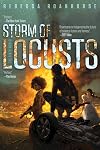
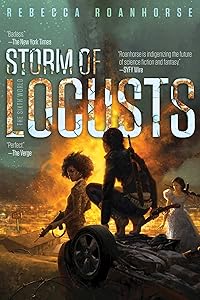
In "Trail Of Lightning" it was Maggie, with some support from Kai, against the world. In "Storm Of Locusts" we have Maggie leading a group of fighters with the core being the trio of women on the dramatic book cover: Maggie, the fierce and vengeful Risa Goodacre and Ben, an eager teenager who has just come into her clan powers as a tracker. These three storm across the Big Water lands, encountering enemies and Gods (sometimes in the same person) and leaving destruction behind them as they chase The Swarm.
One of the things that sets the Sixth World series apart for me is that the attitudes towards death and violence and good and evil are not the ones I normally find in Urban Fantasy. The Sixth World is harder, less forgiving and less unambiguous than most Urban Fantasy. The violence is frequent, vivid and entirely functional - you kill for a reason and you do it as fast as you can. The Gods are neither good nor evil, they're just Gods doing what Gods do. There are definitely evil people in book, men who make their living off the pain and death of others, but there are no people who are entirely good. To survive in this world means getting your hands bloody from time to time.
As with the last book, there is a strong sense of place in "Storm Of Locusts". I've been to the spot where the final conflict takes place and Rebecca Roanhorse captures its scale perfectly. Part of the book is set in the Amangiri Resort and Spa and I loved that it became quite a different place when I saw it through Maggie's Dinétah eyes:
"The Amangiri Resort and Spa is bigger than it seemed from Aaron’s brochure. And colder. Not in temperature, although the desert has dipped to freezing with the sun down, but in architecture. All the buildings are built along sharp angles, the materials not adobe or even wood, but cold concrete. The place has none of the curves of the earth, nothing that speaks of Dinétah, of wooden hogans or warmth. It is entirely foreign. A place made by bilagáanas, for bilagáanas. That is a truth I feel deep in my bones. Bones that plead for me to turn around, that I don’t belong here, that this place has no love for a child of Dinétah."
I'm completely hooked on this series now. I've heard good things of Tanis Parenteau's narration of the audiobook version of this series, both of which are out now, so I've bought a copy to use as are-read in preparation for reading the third book next year. show less
"Storm Of locusts" takes place four weeks after the violence at Black Mesa at end of "Trail Of Lightning", where Maggie Hoskie reluctantly earned herself the title "God Slayer" and became estranged from her friend and ally, Kai Arviso.
Maggie isn't given much time to grieve, The Thirsty show more Boys turn up on the first page and enlist Maggie in fight that will bring her head to head with The Swarm, a new Locust cult, and take her outside the borders of the Dinétah into the post-apocalyptic chaos of the land of the Big Water where the white men struggle to survive.
The plot moves so fast that, by the time I was a quarter of the way through I already I had one unexpected death, one interesting new character, tension between all the old characters and a really spooky, creepy, don't-let-that-thing-get-in-my-hair kind of baddy.
As with "Trail Of Lightning", "Storm Of Locusts" is told in skillfully executed first person present tense style that is the perfect platform for the rapid action of the plot and for displaying Maggie's brusque, don't-mess-with-me attitude combined with the guilty exaltation she feels when she has the chance to kill and the joy she hopes for but doesn't quite feel worthy of. The opening paragraphs of the book are a good example of the writing style:
"Four men with guns stand in my yard.
It’s just past seven in the morning, and in other places in Dinétah, in other people’s yards, men and women are breaking theirfast with their families. Husbands grumble half-heartedly about the heat already starting to drag down the December morning. Mothers remind children of the newest Tribal Council winter water rations before sending them out to feed the sheep. Relatives make plans to get together over the coming Keshmish holiday.
But these four men aren’t here to complain about the weather or to make holiday plans. They certainly aren’t here for the pleasure of my company. They’ve comebecause they want me to kill something.
Only it’s my day off, so this better be good."
One of my few criticisms of "Trail Of Lightning" was that the plot was fairly simple and there were times when it wandered a little. "Storm Of Locusts" has a rich plot which Rebecca Roanhorse has completely under control. The pace is perfect. The action is continuous and spectacular but it's always used to drive the development of the character and the relationships between them.
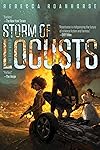
In "Trail Of Lightning" it was Maggie, with some support from Kai, against the world. In "Storm Of Locusts" we have Maggie leading a group of fighters with the core being the trio of women on the dramatic book cover: Maggie, the fierce and vengeful Risa Goodacre and Ben, an eager teenager who has just come into her clan powers as a tracker. These three storm across the Big Water lands, encountering enemies and Gods (sometimes in the same person) and leaving destruction behind them as they chase The Swarm.
One of the things that sets the Sixth World series apart for me is that the attitudes towards death and violence and good and evil are not the ones I normally find in Urban Fantasy. The Sixth World is harder, less forgiving and less unambiguous than most Urban Fantasy. The violence is frequent, vivid and entirely functional - you kill for a reason and you do it as fast as you can. The Gods are neither good nor evil, they're just Gods doing what Gods do. There are definitely evil people in book, men who make their living off the pain and death of others, but there are no people who are entirely good. To survive in this world means getting your hands bloody from time to time.
As with the last book, there is a strong sense of place in "Storm Of Locusts". I've been to the spot where the final conflict takes place and Rebecca Roanhorse captures its scale perfectly. Part of the book is set in the Amangiri Resort and Spa and I loved that it became quite a different place when I saw it through Maggie's Dinétah eyes:
"The Amangiri Resort and Spa is bigger than it seemed from Aaron’s brochure. And colder. Not in temperature, although the desert has dipped to freezing with the sun down, but in architecture. All the buildings are built along sharp angles, the materials not adobe or even wood, but cold concrete. The place has none of the curves of the earth, nothing that speaks of Dinétah, of wooden hogans or warmth. It is entirely foreign. A place made by bilagáanas, for bilagáanas. That is a truth I feel deep in my bones. Bones that plead for me to turn around, that I don’t belong here, that this place has no love for a child of Dinétah."
I'm completely hooked on this series now. I've heard good things of Tanis Parenteau's narration of the audiobook version of this series, both of which are out now, so I've bought a copy to use as are-read in preparation for reading the third book next year. show less
3 1/2 STARS
Last year I encountered a new Urban Fantasy series that felt quite different from the usual format, and its first installment,Trail of Lightning, encouraged me to keep an eye out for its sequels: book two of Rebecca Roanohorse’s Sixth World Series is just as engaging as its predecessor but it also left me with mixed feelings, because while I loved what the author did with the characters - both the old and the new ones - part of the storyline felt less defined and at times too… convenient (for want of a better word) to be completely believable. But let’s proceed with order…
The rising oceans have changed the face of the world, and one of the few places where life is still possible is Dinétah, the former Navajo show more reservation now walled off from the rest of the world. It’s not a totally safe place, though, since ancient gods and monsters - both old and new - share the territory alongside humans. Maggie Hoskie is a monster slayer for hire, and in recent times she also became a god slayer when she vanquished Neizghání, the lightning god who used to be her mentor and lover. It’s now a few weeks after this happened at Black Mesa, where Maggie also had to kill her friend and love interest Kai Arviso, whose healing powers brought him back to life but not back in Maggie’s life, so she’s trying to deal with the aftermath of it all - trying being the operative word…
When she’s called in for help against the dangerous cult of the White Locusts, she learns that the “resurrected” Kai is either their prisoner or a willing adept, and to get to the core of the matter she teams up for a search and rescue mission with two of the Goodacre siblings and a young girl with clan powers, Ben, who has been entrusted to her care. Gathering human and godlike allies along the way, the group ventures from the borders of Dinétah into the Malpais - the devastated outside world - discovering that the White Locusts and their charismatic leader Gideon are planning something that might mean the destruction of all they hold dear.
The narrative elements that made the first book in this series stand out are still here: the walled-in enclave of Dinétah where humans and supernatural beings coexist in this weird world whose face was literally changed by the rising oceans; the fascinating cultural and social milieu of Native Americans that brings a new, intriguing perspective to the genre; the land itself, with its harsh, unforgiving beauty. Maggie remains a fascinating character, her hard-won independence, her self-sufficiency still there but now tempered by the realization that opening herself to other people does not threaten those qualities but rather enhances them. And here comes the biggest change in the interpersonal dynamics of the overall story, because it transforms what early on was a one-woman battle into a group effort and a delightful quest that takes us outside the borders of Dinétah and into the Big, Bad Outside World.
Much as life in the Diné enclave might look difficult, the Malpais proves to be dangerous, and deadly: in the best tradition of post-apocalyptic stories, Maggie and her team encounter an organized gang of slavers and organ traffickers whose settlement of Knifetown has a definite Mad Max quality, complete with what looks like a deranged overlord, while the mention of the neighboring Mormon Kingdom and its theocratic rule fulfills the worst predictions of what could happen with the collapse of civilization. It’s therefore hardly surprising that in this kind of background a cult like that of the White Locusts could easily gain supporters, won over by their leader’s Gideon seductive power and his promise of a new, better world.
Storm of Locusts sees Maggie traveling through these dangers with a crew of allies - friends - that, with the exception of reformed bandit Aaron, is dominated by women: Maggie herself, who’s trying to change her ways and not resort to mindless killing as a way of solving problems, and who is acknowledging her newfound connection to humanity and somehow finding that she enjoys it; Rissa Goodacre, who begins the journey with huge moral reservations toward Maggie and then slowly changes her outlook recognizing there can ben mutual respect and friendship between them; the cat goddess Mosì, whose feline indifference offers some of the lighter moments in the story; and young Ben, the best addition to the series because of what she comes to represent for Maggie.
Ben is a teenager who just suffered a grievous loss on top of earlier childhood trauma, the one that woke her clan powers: Maggie sees much of herself there, and where at first she somehow resents being saddled with the responsibility for the teenager’s safety, she starts to see her earlier self reflected in Ben, recognizing the signs of the downward spiral she traveled in the past, and decides to spare her the same hurtful journey by giving the young woman the support she needs to come to terms with what she is. Despite the tragedy in her recent past, Ben’s character is an engaging counterpoint to Maggie’s, thanks to her youthful enthusiasm and drive that little by little manage to erode Maggie’s hard shell and bring her closer to her forgotten humanity.
Where character exploration offers the best elements in the story, I found that the plot felt less… solid, starting with the sensation that the questing team was never truly in danger: their experience in Knifetown, where it seems Maggie and Rissa might lose their lives and Ben be sold as a slave bride, is resolved fairly quickly by what looks like a deus ex machina set of circumstances. In a similar way, the swift conversion of outlaw Aaron, or the easy help offered by a divinity appearing as a crusty old man, look a little too convenient to feel completely believable. And I’m still not convinced by the soundness of Kai’s motivations for joining Gideon’s cult, or by the mutual bond between Kai and Maggie, which does not offer solid vibes for me…
Still, whatever doubts I might have had about this second installment in the series were vanquished by the closing paragraph of the novel and its ominous promise of more interesting darkness to come: the next book might very well compensate for my partial disappointment with this one. show less
Last year I encountered a new Urban Fantasy series that felt quite different from the usual format, and its first installment,Trail of Lightning, encouraged me to keep an eye out for its sequels: book two of Rebecca Roanohorse’s Sixth World Series is just as engaging as its predecessor but it also left me with mixed feelings, because while I loved what the author did with the characters - both the old and the new ones - part of the storyline felt less defined and at times too… convenient (for want of a better word) to be completely believable. But let’s proceed with order…
The rising oceans have changed the face of the world, and one of the few places where life is still possible is Dinétah, the former Navajo show more reservation now walled off from the rest of the world. It’s not a totally safe place, though, since ancient gods and monsters - both old and new - share the territory alongside humans. Maggie Hoskie is a monster slayer for hire, and in recent times she also became a god slayer when she vanquished Neizghání, the lightning god who used to be her mentor and lover. It’s now a few weeks after this happened at Black Mesa, where Maggie also had to kill her friend and love interest Kai Arviso, whose healing powers brought him back to life but not back in Maggie’s life, so she’s trying to deal with the aftermath of it all - trying being the operative word…
When she’s called in for help against the dangerous cult of the White Locusts, she learns that the “resurrected” Kai is either their prisoner or a willing adept, and to get to the core of the matter she teams up for a search and rescue mission with two of the Goodacre siblings and a young girl with clan powers, Ben, who has been entrusted to her care. Gathering human and godlike allies along the way, the group ventures from the borders of Dinétah into the Malpais - the devastated outside world - discovering that the White Locusts and their charismatic leader Gideon are planning something that might mean the destruction of all they hold dear.
The narrative elements that made the first book in this series stand out are still here: the walled-in enclave of Dinétah where humans and supernatural beings coexist in this weird world whose face was literally changed by the rising oceans; the fascinating cultural and social milieu of Native Americans that brings a new, intriguing perspective to the genre; the land itself, with its harsh, unforgiving beauty. Maggie remains a fascinating character, her hard-won independence, her self-sufficiency still there but now tempered by the realization that opening herself to other people does not threaten those qualities but rather enhances them. And here comes the biggest change in the interpersonal dynamics of the overall story, because it transforms what early on was a one-woman battle into a group effort and a delightful quest that takes us outside the borders of Dinétah and into the Big, Bad Outside World.
Much as life in the Diné enclave might look difficult, the Malpais proves to be dangerous, and deadly: in the best tradition of post-apocalyptic stories, Maggie and her team encounter an organized gang of slavers and organ traffickers whose settlement of Knifetown has a definite Mad Max quality, complete with what looks like a deranged overlord, while the mention of the neighboring Mormon Kingdom and its theocratic rule fulfills the worst predictions of what could happen with the collapse of civilization. It’s therefore hardly surprising that in this kind of background a cult like that of the White Locusts could easily gain supporters, won over by their leader’s Gideon seductive power and his promise of a new, better world.
Storm of Locusts sees Maggie traveling through these dangers with a crew of allies - friends - that, with the exception of reformed bandit Aaron, is dominated by women: Maggie herself, who’s trying to change her ways and not resort to mindless killing as a way of solving problems, and who is acknowledging her newfound connection to humanity and somehow finding that she enjoys it; Rissa Goodacre, who begins the journey with huge moral reservations toward Maggie and then slowly changes her outlook recognizing there can ben mutual respect and friendship between them; the cat goddess Mosì, whose feline indifference offers some of the lighter moments in the story; and young Ben, the best addition to the series because of what she comes to represent for Maggie.
Ben is a teenager who just suffered a grievous loss on top of earlier childhood trauma, the one that woke her clan powers: Maggie sees much of herself there, and where at first she somehow resents being saddled with the responsibility for the teenager’s safety, she starts to see her earlier self reflected in Ben, recognizing the signs of the downward spiral she traveled in the past, and decides to spare her the same hurtful journey by giving the young woman the support she needs to come to terms with what she is. Despite the tragedy in her recent past, Ben’s character is an engaging counterpoint to Maggie’s, thanks to her youthful enthusiasm and drive that little by little manage to erode Maggie’s hard shell and bring her closer to her forgotten humanity.
Where character exploration offers the best elements in the story, I found that the plot felt less… solid, starting with the sensation that the questing team was never truly in danger: their experience in Knifetown, where it seems Maggie and Rissa might lose their lives and Ben be sold as a slave bride, is resolved fairly quickly by what looks like a deus ex machina set of circumstances. In a similar way, the swift conversion of outlaw Aaron, or the easy help offered by a divinity appearing as a crusty old man, look a little too convenient to feel completely believable. And I’m still not convinced by the soundness of Kai’s motivations for joining Gideon’s cult, or by the mutual bond between Kai and Maggie, which does not offer solid vibes for me…
Still, whatever doubts I might have had about this second installment in the series were vanquished by the closing paragraph of the novel and its ominous promise of more interesting darkness to come: the next book might very well compensate for my partial disappointment with this one. show less
This was eminently satisfying and I liked it better than Trail of Lightning! There’s more of an original story here, more of an original villain, and it’s a wonderful expansion of the world Roanhorse has created, to boot. There are more gods and different clan powers and much more of a sense of the world beyond Dinetah’s borders and the way everyone else dealt with the eco-apocalypse. Plus it’s fun, with good quips and action and Maggie being her grumpy self, and both a good conclusion and a good setting up for further stories.
And because it feels more original and less by-the-tropes urban fantasy, there’s more of a sense of danger to the story too and more unpredictability for where the story goes. I also enjoyed that show more Roanhorse is continuing to have a cast that’s nearly completely of colour and to deal with pain and trauma with compassion, not that I’d expect otherwise.
What I liked best, though, is seeing Maggie start to open up more and also the dynamics between her and the two other women on the mission, because they’re all headstrong badasses which means they don’t get along. Also Maggie as a reluctant role model is just awesome. There’s a lot of “yes, I do that, please don’t also that.”
So yeah, a pretty good book and a good example for me of what urban fantasy can do! I’m not quite chomping at the bit for the next installment, but there are definitely Things That Happen that I’m looking forward to seeing the repercussions of. Definitely recommended, but you’ve got to read Trail of Lightning first or there’ll be spoilers.
7.5/10
To bear in mind: Canon-typical violence. Human traffickers and organ harvesters as minor villains. Rape threats, dealt with extremely effectively. Bugs. Maroon 5 jokes. Cults and…
what can be read as cult-related mass suicide. Mention of pre-apocalypse forced adoption of Indigenous children and the cultural disconnect and psychological harm that causes. show less
And because it feels more original and less by-the-tropes urban fantasy, there’s more of a sense of danger to the story too and more unpredictability for where the story goes. I also enjoyed that show more Roanhorse is continuing to have a cast that’s nearly completely of colour and to deal with pain and trauma with compassion, not that I’d expect otherwise.
What I liked best, though, is seeing Maggie start to open up more and also the dynamics between her and the two other women on the mission, because they’re all headstrong badasses which means they don’t get along. Also Maggie as a reluctant role model is just awesome. There’s a lot of “yes, I do that, please don’t also that.”
So yeah, a pretty good book and a good example for me of what urban fantasy can do! I’m not quite chomping at the bit for the next installment, but there are definitely Things That Happen that I’m looking forward to seeing the repercussions of. Definitely recommended, but you’ve got to read Trail of Lightning first or there’ll be spoilers.
7.5/10
To bear in mind: Canon-typical violence. Human traffickers and organ harvesters as minor villains. Rape threats, dealt with extremely effectively. Bugs. Maroon 5 jokes. Cults and…
what can be read as cult-related mass suicide. Mention of pre-apocalypse forced adoption of Indigenous children and the cultural disconnect and psychological harm that causes. show less
I've been trying to figure out why I like this book even better than Trail of Lightning and I think a major factor is the development of Maggie's character through her relationships with Rissa and Ben in this book. Kai's great and all, but there's something about friendship between women that allows readers access to a character in a way that just isn't really possible with a romantic relationship. I LOVED this book and am almost mad at myself for getting an eARC through Edelweiss; the wait for the third book will feel even longer.
Because it has been a while since I read the first one, it took a minute to remember who everyone was and what had happened. But once I remembered, I was hooked. I loved the addition of Ben to the cast, and that we got a cool girl gang for most of the book. I'm not sure if/when the next book will come out, but I can't wait for it!
I absolutely loved Roanhorse’s debut Trail of Lightning. And while I enjoyed the sequel, I was able to put it down for a couple of stretches because the plot had no momentum.
It opens with Haskins coming to Maggie for help with a new cult-like leader. With him is his niece, Ben, who has a strange clan power for tracking. When things go wrong, Maggie and Ben set off with Rissa Goodacre to track the White Locust. For Maggie, it’s personal. He has taken Kai with him.
Maggie must travel beyond the great wall around Dinétah to track them. I was excited at first to see what the world was like after the Big Water. Unfortunately, the excellent worldbuilding stalled here. The outside doesn’t come across as that different from the inside. show more This was a problem because the characters spent most of the novel on this journey, encountering and overcoming bad guys without moving the main plot forward. Don’t get me wrong; some exciting things happen when Maggie comes across a few Native gods, learns about the sword she now carries and starts to build a tentative relationship with both Ben and Rissa. However, when she finally gets to the White Locust and his cult, everything is wrapped up quickly in a couple of chapters. After so much build-up, that was a little disappointing.
Despite these problems, I still love the characters and the world Roanhorse has created. The ending is rushed, but still satisfying. There’s a final “hook” to set up the next installment without being a cliffhanger. I look forward to the next book. show less
It opens with Haskins coming to Maggie for help with a new cult-like leader. With him is his niece, Ben, who has a strange clan power for tracking. When things go wrong, Maggie and Ben set off with Rissa Goodacre to track the White Locust. For Maggie, it’s personal. He has taken Kai with him.
Maggie must travel beyond the great wall around Dinétah to track them. I was excited at first to see what the world was like after the Big Water. Unfortunately, the excellent worldbuilding stalled here. The outside doesn’t come across as that different from the inside. show more This was a problem because the characters spent most of the novel on this journey, encountering and overcoming bad guys without moving the main plot forward. Don’t get me wrong; some exciting things happen when Maggie comes across a few Native gods, learns about the sword she now carries and starts to build a tentative relationship with both Ben and Rissa. However, when she finally gets to the White Locust and his cult, everything is wrapped up quickly in a couple of chapters. After so much build-up, that was a little disappointing.
Despite these problems, I still love the characters and the world Roanhorse has created. The ending is rushed, but still satisfying. There’s a final “hook” to set up the next installment without being a cliffhanger. I look forward to the next book. show less
Members
- Recently Added By
Lists

2020 Hugo Eligible Novels
71 works; 12 members

Books Read in 2023
5,547 works; 145 members

Books Read in 2019
4,052 works; 110 members

Indigenous America Reader
145 works; 12 members

Favorite Books from the 2010s
75 works; 3 members

Five star books
1,767 works; 110 members

2020 Ignyte Awards
15 works; 1 member

Kindle Fantasy/Science Fiction
206 works; 1 member
Author Information

30+ Works 9,709 Members
Rebecca Roanhorse is a speculative fiction writer, based in Northern New Mexico. Her background is Ohkay Owingeh/Black, Navajo in-law. She is a graduate of Yale University and a lawyer. Her novels include Trail of Lightning (2018), which is the first book in the Sixth World series, and Storm of Locusts (2019). She is the author of Welcome to your show more Authentic Indian Experience, which won the 2018 Hugo Award and Nebula Award for best novelette. (Bowker Author Biography) show less
Some Editions
Awards and Honors
Awards
Series

Work Relationships
Is contained in
Common Knowledge
- Canonical title
- Storm of Locusts
- Original publication date
- 2019-04-23
- People/Characters
- Maggie Hoskie; Kai Arviso; Caleb Goodacre; the White Locust; Hastiin
- Important places
- Dinétah; Las Vegas
- Dedication
- To all the woman who are hard to love, and to the people who love them anyway
- First words
- Four men with guns stand in my yard.
- Last words
- (Click to show. Warning: May contain spoilers.)"We must prepare for war."
- Publisher's editor
- Monti, Joe
- Original language
- English
- Canonical DDC/MDS
- 813.6
- Canonical LCC
- PS3618.O283
Classifications
Statistics
- Members
- 707
- Popularity
- 40,273
- Reviews
- 40
- Rating
- (4.03)
- Languages
- English
- Media
- Paper, Audiobook, Ebook
- ISBNs
- 7
- ASINs
- 6