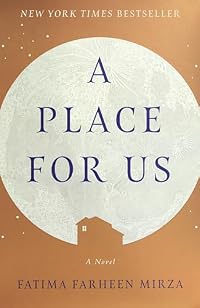
A Place for Us
by Fatima Farheen Mirza
On This Page
Description
A story of family identity and belonging follows an Indian family through the marriage of their daughter, from the parents' arrival in the United States to the return of their estranged son. As an Indian wedding gathers a family back together, parents Rafiq and Layla must reckon with the choices their children have made. There is Hadia: their headstrong, eldest daughter, whose marriage is a match of love and not tradition. Huda, the middle child, determined to follow in her sister's show more footsteps. And their estranged son, Amar, returns to the family for the first time in three years to take his place as brother of the bride. What secrets and betrayals have caused this close-knit family to fracture? -- show lessTags
Recommendations








Member Reviews
Beautiful story describing the dynamics and dysfunction of a Muslim family in the US. Baba, the father and the Muslim community at large are strict guardians and enforcers of their Islamic rules and traditions.
As with most authoritarian religions this means that men decide what is expected of family members, especially the women. Women are to dress modestly, communicate with other men only when necessary, girls must avoid interacting or associating with boys or men. Housework, cooking / shopping, and child care are their domain.
Because daughters Hadia and Huda are compliant and "easier" Layla, Mumma (mother) and Baba take them for granted. Their very different energies are directed to their youngest child, the son, Amar who is more of show more a challenge. No matter, Layla loves him protectively, obessessively attentive to his needs and wants. Baba feels his fatherly responsibility is to guide, even push this curious, questioning, and sensitive son to obedience, and adherence to Islamic tenets.
But... because his daughters obeyed him, because he believes Layla spoils Amar, and because Amar tests his patience, he doesn't show him love, address Amar's questions. He just makes it clear how disappointed and angry he is with Amar. Amar responds in kind, and soon feels he doesn't belong in this family, or community. His behavior deteriorates, he spends more time with disreputable friends, drinks, doesn't attend religious services. The community notices and tells Layla and Rafiq, which humiliates and angers them. A terrible fight between Rafiq and Amar result in Amar's leaving home, taking a dark path.
The drama of Hadia's wedding to which Amar shows up 3 years after leaving home is disconcerting. Amar learns more about his father's life of not being close to his father, and then losing that father much too young, and having to live with his uncle. This helps him think kindly about his father. But a revelation about his mother shocks and enrages Amar. (I don't understand why Amira would at this point in time reveal this to him.) Poor kid!
As the wedding draws to a close his father finally speaks with Amar. It is obvious he is not the same man as before. It feels like they are finally opening their hearts to each other. I had hoped this might be what Amar needed to begin a reconciliation. But Amar is drunk; not fully alert. Baba needs to return to his daughter's wedding. And so this opportunity was too short.
And what occurs in the years to come, and the thoughts Baba describes about himself, the sorrow he feels because of the mistakes he made with his children are simply beautiful. It seems most of us learn unconditional love much later than we should.
Phenomenal read. show less
As with most authoritarian religions this means that men decide what is expected of family members, especially the women. Women are to dress modestly, communicate with other men only when necessary, girls must avoid interacting or associating with boys or men. Housework, cooking / shopping, and child care are their domain.
Because daughters Hadia and Huda are compliant and "easier" Layla, Mumma (mother) and Baba take them for granted. Their very different energies are directed to their youngest child, the son, Amar who is more of show more a challenge. No matter, Layla loves him protectively, obessessively attentive to his needs and wants. Baba feels his fatherly responsibility is to guide, even push this curious, questioning, and sensitive son to obedience, and adherence to Islamic tenets.
But... because his daughters obeyed him, because he believes Layla spoils Amar, and because Amar tests his patience, he doesn't show him love, address Amar's questions. He just makes it clear how disappointed and angry he is with Amar. Amar responds in kind, and soon feels he doesn't belong in this family, or community. His behavior deteriorates, he spends more time with disreputable friends, drinks, doesn't attend religious services. The community notices and tells Layla and Rafiq, which humiliates and angers them. A terrible fight between Rafiq and Amar result in Amar's leaving home, taking a dark path.
The drama of Hadia's wedding to which Amar shows up 3 years after leaving home is disconcerting. Amar learns more about his father's life of not being close to his father, and then losing that father much too young, and having to live with his uncle. This helps him think kindly about his father. But a revelation about his mother shocks and enrages Amar. (I don't understand why Amira would at this point in time reveal this to him.) Poor kid!
As the wedding draws to a close his father finally speaks with Amar. It is obvious he is not the same man as before. It feels like they are finally opening their hearts to each other. I had hoped this might be what Amar needed to begin a reconciliation. But Amar is drunk; not fully alert. Baba needs to return to his daughter's wedding. And so this opportunity was too short.
And what occurs in the years to come, and the thoughts Baba describes about himself, the sorrow he feels because of the mistakes he made with his children are simply beautiful. It seems most of us learn unconditional love much later than we should.
Phenomenal read. show less
I very much enjoyed "A Place For Us". Although I have little in common with the characters, I found myself relating to them and appreciating the impact that change and years had made in each of them. It took me an incredibly long time to finish the book, not because I didn't want to read, but rather because I had too many irons in the fire. In spite of that, I still found myself engaged and fascinated by the story each time I picked it up.
"Otherness" is something that is currently a concern for many people. By focusing on differences in culture, religion, or race, people can marginalize those who intimidate them, or who they see as threatening. This book opened my eyes to the way that this pressure can cause a breakdown within a family show more unit. The vast changes from one generation to another can as well threaten those family relationships and enhance their differences in perspective. In this story, each of the three children finds their own way to a life apart from their parents. The result pulled at my heart and helped me recognize that part of the message of this book is that we all are searching for a place where we fit in and can grow and flourish as individuals. The immigrant experience is one in which this trying to fit in is perhaps the most profoundly challenged.
One of the techniques that worked well for the author is to use the different characters to tell the story. The focus shifts from one to another and lets the author give different perspectives of any one event. This allows the reader to really get into the head of each of the characters. I found myself understanding them better thanks to this way of telling the story. The author also switches from event to event without keeping them consecutive. This might be a bit confusing, but again helps the reader to better understand the choices and rationals made by the characters. I really cared about them and thus cared about this book. I think it's a great book to use as a book club choice or as a topic starter for consideration of immigrants and current topics dealing with racism and Islamophobia.
My thanks to NetGalley and the publisher for the opportunity to read and review this title. show less
"Otherness" is something that is currently a concern for many people. By focusing on differences in culture, religion, or race, people can marginalize those who intimidate them, or who they see as threatening. This book opened my eyes to the way that this pressure can cause a breakdown within a family show more unit. The vast changes from one generation to another can as well threaten those family relationships and enhance their differences in perspective. In this story, each of the three children finds their own way to a life apart from their parents. The result pulled at my heart and helped me recognize that part of the message of this book is that we all are searching for a place where we fit in and can grow and flourish as individuals. The immigrant experience is one in which this trying to fit in is perhaps the most profoundly challenged.
One of the techniques that worked well for the author is to use the different characters to tell the story. The focus shifts from one to another and lets the author give different perspectives of any one event. This allows the reader to really get into the head of each of the characters. I found myself understanding them better thanks to this way of telling the story. The author also switches from event to event without keeping them consecutive. This might be a bit confusing, but again helps the reader to better understand the choices and rationals made by the characters. I really cared about them and thus cared about this book. I think it's a great book to use as a book club choice or as a topic starter for consideration of immigrants and current topics dealing with racism and Islamophobia.
My thanks to NetGalley and the publisher for the opportunity to read and review this title. show less
A Place for Us is a lush and lyrical family saga about an Indian-American Muslim family finding its way through this life. The novel flashes back and forth through time and switches POV so you get a better understanding of how each character feels about the same memories. Mirza's characters are complex and wholly believable. This is an aching portrait of love and loss and a reminder that there is always a way back.
This novel is centered almost exclusively on one family. It is narrated by four of its members at different points throughout the book. The parents, Rafiq and Layla, are devout Shia Muslims living in California and trying to raise their three children in the tenets of a very absorbing faith. The oldest child, their daughter Hadia, is getting married as the book begins, but we never stay in one particular time period for long, with the temporal perspective shifting even inside each chapter.
The only son, Amar, is in some ways the focus of all of the family. For one thing, in their culture [note to self: resist urge to add, and in almost every culture], males are valued more than females. Females are first the responsibility of fathers, show more then of husbands. Hadia feels this difference acutely, musing “…hundreds and hundreds of years had passed [since the time of the Prophet], and it was still the son they cherished, the son their pride depended on, the son who would carry their name into the next generation.” Hadia makes some fateful choices in her life based on her competitive desire to matter more than the son to her father.
Rafiq and Layla’s daughters resist some of the traditional customs of their culture, such as having their spouses selected for them by their parents, but for the most part, their entire lives are based around their faith and the obligations required of them because of it. But Amar did not buy into that faith, and it made him feel like an outsider in his own home, as well as in their insular community.
Amar was especially worried by the story his mother told them when they were little. She warned that every sin is written down by an angel. Moreover, “you get a speck on your heart, a dark, small speck. . . . . each of them like stains.” “A permanent marker stain?” Amar asked. “Yes,” Mumma said, “a permanent stain. And with every sin, the heart grows harder and darker. Until it is so heavy and black it cannot tell good from evil anymore. It cannot even tell that it wants to be good.” This story affected Amar deeply. He goes through his life, unbelieving, sinning, and fearing that he is not only “ruined” for this life, but for the next.
Students of David Hume will recognize the problem that besets Amar. As Hume wrote in Dialogues Concerning Natural Religion in 1779, both fear and hope are part of religious belief, but: "When melancholy, and dejected, [the believer] has nothing to do but brood upon the terrors of the invisible world, and to plunge himself still deeper in affliction."
Layla is not a depicted as a villain in spite of the stories she told her children and in spite of another huge harm she does to Amar later in life. As the author limns her character, Layla is a mother trying to do her best for children she loves. Similarly, Rafiq is rough on the kids at times, but doesn’t know a better way to be. When Rafiq finally narrates in the last part of the book, we learn about his motivations, his fears, and his hopes, and it is a stunning insight into a perspective of which not even his children or his wife were aware.
Evaluation: This is a very impressive novel. The only odd note is that the fourth child, Huda, never narrates, and we never get to know her much at all. Still, the book is full of issues to mull and discuss, from the place of religious beliefs in one’s life and how best to impart them, to gender roles and expectations, to the pitfalls and rewards of parenting. The fact that this family is Muslim rather than Christian or Jewish does not affect the relevance of the universal problems of raising kids, growing up, and growing older. Highly recommended! show less
The only son, Amar, is in some ways the focus of all of the family. For one thing, in their culture [note to self: resist urge to add, and in almost every culture], males are valued more than females. Females are first the responsibility of fathers, show more then of husbands. Hadia feels this difference acutely, musing “…hundreds and hundreds of years had passed [since the time of the Prophet], and it was still the son they cherished, the son their pride depended on, the son who would carry their name into the next generation.” Hadia makes some fateful choices in her life based on her competitive desire to matter more than the son to her father.
Rafiq and Layla’s daughters resist some of the traditional customs of their culture, such as having their spouses selected for them by their parents, but for the most part, their entire lives are based around their faith and the obligations required of them because of it. But Amar did not buy into that faith, and it made him feel like an outsider in his own home, as well as in their insular community.
Amar was especially worried by the story his mother told them when they were little. She warned that every sin is written down by an angel. Moreover, “you get a speck on your heart, a dark, small speck. . . . . each of them like stains.” “A permanent marker stain?” Amar asked. “Yes,” Mumma said, “a permanent stain. And with every sin, the heart grows harder and darker. Until it is so heavy and black it cannot tell good from evil anymore. It cannot even tell that it wants to be good.” This story affected Amar deeply. He goes through his life, unbelieving, sinning, and fearing that he is not only “ruined” for this life, but for the next.
Students of David Hume will recognize the problem that besets Amar. As Hume wrote in Dialogues Concerning Natural Religion in 1779, both fear and hope are part of religious belief, but: "When melancholy, and dejected, [the believer] has nothing to do but brood upon the terrors of the invisible world, and to plunge himself still deeper in affliction."
Layla is not a depicted as a villain in spite of the stories she told her children and in spite of another huge harm she does to Amar later in life. As the author limns her character, Layla is a mother trying to do her best for children she loves. Similarly, Rafiq is rough on the kids at times, but doesn’t know a better way to be. When Rafiq finally narrates in the last part of the book, we learn about his motivations, his fears, and his hopes, and it is a stunning insight into a perspective of which not even his children or his wife were aware.
Evaluation: This is a very impressive novel. The only odd note is that the fourth child, Huda, never narrates, and we never get to know her much at all. Still, the book is full of issues to mull and discuss, from the place of religious beliefs in one’s life and how best to impart them, to gender roles and expectations, to the pitfalls and rewards of parenting. The fact that this family is Muslim rather than Christian or Jewish does not affect the relevance of the universal problems of raising kids, growing up, and growing older. Highly recommended! show less
On the surface, everything looks good: it's Hadia's wedding day. Her family is all present, even estranged brother Amar, who ran away three years previously. But, looking closer, anyone can see that the situation is tenuous, and any wrong move might cause an emotional explosion. What caused Amar to leave, all those years ago, and what will happen after the wedding?
This novel meanders through the life of the family, slowly building to certain key points. The plot isn't straightforward, so you might read a scene from when Amar was a teenager, followed by a scene from when Hadia was a little girl, followed by a scene from what's happening at Hadia's wedding, for instance. It works well to build dramatic tension, since it's not the story of show more one major scene, but rather the story of the life of a family. The book deals with a lot of deep questions about faith and familial love. It was interesting to me to see a story so deeply grounded in a faith that is not my own, and to see the similarities and differences of how that played out in the family pictured in the book. (I felt a little sorry for middle sister Huda, though, who was the only member of the family who never got to be a point-of-view character!)
I listened to the audiobook, and while that was helpful to me, especially in the matter of pronouncing unfamiliar names and such, I found that the structure of the book itself is not ideal for the audio format. Since scenes are not presented chronologically, and there's often no indicator between them other than a slight pause in the narration, it was often hard to figure out where I was in the story, whether what I was hearing was a continuation of the current scene, or a new scene in a completely different year. So, I don't know if I would necessarily recommend the audiobook, but I do recommend this book to anyone who enjoys a sweeping family drama. show less
This novel meanders through the life of the family, slowly building to certain key points. The plot isn't straightforward, so you might read a scene from when Amar was a teenager, followed by a scene from when Hadia was a little girl, followed by a scene from what's happening at Hadia's wedding, for instance. It works well to build dramatic tension, since it's not the story of show more one major scene, but rather the story of the life of a family. The book deals with a lot of deep questions about faith and familial love. It was interesting to me to see a story so deeply grounded in a faith that is not my own, and to see the similarities and differences of how that played out in the family pictured in the book. (I felt a little sorry for middle sister Huda, though, who was the only member of the family who never got to be a point-of-view character!)
I listened to the audiobook, and while that was helpful to me, especially in the matter of pronouncing unfamiliar names and such, I found that the structure of the book itself is not ideal for the audio format. Since scenes are not presented chronologically, and there's often no indicator between them other than a slight pause in the narration, it was often hard to figure out where I was in the story, whether what I was hearing was a continuation of the current scene, or a new scene in a completely different year. So, I don't know if I would necessarily recommend the audiobook, but I do recommend this book to anyone who enjoys a sweeping family drama. show less
Wow!! I just blown away by the fact that this is a first novel, the story and theme so universal. A Muslim Indian family in America, trying to maintain it's own beliefs and culture, while facing modernity. This family, mother, father, two daughters ,Hadia and Huda, and the you test, a son Amar who never really feels he belongs. We come to know this family inside and out,the book starts with the marriage of Hadia,and then goes back and forth, to various beginnings and endings. While their beliefs may not be mine, many of the problems between parents and siblings are indeed universal.
As they struggle to find their place in the larger world, the children also struggle to find their place in the family. Living up to parental expectations, show more or in Amar's case the struggle to find his place anywhere at all. Trying to carvea path between cultural and religious beliefs and the lessening of this expectation to fit with the place they now find themselves. The story of this family in all its totality is both moving and insightful. The barriers to acceptance by children and parents after 911, when all Muslims were viewed with suspicion and in many cases outright hate. By showing us the commonalities in their family and our own, this young author has shown us that ww may in fact may not be so different.
The last part of the book focuses on the father's point of view,alone. How he thought, what went wrong and what he wished he had done differently. It is full of anguish and remorse, and we clearly see for the first time what this Muslim, husband, father has gone through, from his own childhood to the way he tried to instill family values and religious beliefs in his children. It does end on a note of positivity, sadness yes, but hopefully as well. This is an outstanding piece of fiction, in my opinion, I quite frankly fell hard for this family, with all it's flaws and things mistakenly done out of love. I wasn't ready to leave them at books end, and I believe if you read, or at least I hope, that you will see some of the same values, if not the religious beliefs, that we try to instill in our own families.
This is also the first book published under the Sarah Jessica Parker imprint of Random House, and it is a wonderful beginning.
ARC from bookbrowse and Random House. show less
As they struggle to find their place in the larger world, the children also struggle to find their place in the family. Living up to parental expectations, show more or in Amar's case the struggle to find his place anywhere at all. Trying to carvea path between cultural and religious beliefs and the lessening of this expectation to fit with the place they now find themselves. The story of this family in all its totality is both moving and insightful. The barriers to acceptance by children and parents after 911, when all Muslims were viewed with suspicion and in many cases outright hate. By showing us the commonalities in their family and our own, this young author has shown us that ww may in fact may not be so different.
The last part of the book focuses on the father's point of view,alone. How he thought, what went wrong and what he wished he had done differently. It is full of anguish and remorse, and we clearly see for the first time what this Muslim, husband, father has gone through, from his own childhood to the way he tried to instill family values and religious beliefs in his children. It does end on a note of positivity, sadness yes, but hopefully as well. This is an outstanding piece of fiction, in my opinion, I quite frankly fell hard for this family, with all it's flaws and things mistakenly done out of love. I wasn't ready to leave them at books end, and I believe if you read, or at least I hope, that you will see some of the same values, if not the religious beliefs, that we try to instill in our own families.
This is also the first book published under the Sarah Jessica Parker imprint of Random House, and it is a wonderful beginning.
ARC from bookbrowse and Random House. show less
It’s Hadia’s wedding day and more than anything else she has wished for her brother Amar to show up and take part in it. She hasn’t seen him for quite some time and then he is there. However, things do not turn out so well, but they never have with Amar. Flashback to the times when the kids were still young and all five of them a family: Rafiq who left his home country in the Middle East when he was still a teenager to make a career in the US, mother Layla who came to the country when she married Rafiq, the two daughters Hadia and Huda and their younger brother Amar. Raising three kids in Muslim believe in a foreign country, handing on your convictions and traditions when they are daily endangered by a different set of believes show more and culture is never easy. Conflicts must arise and so they do until Amar leaves the family. But there are still things none of them knows and Hadia’s wedding might be the day to reveal some secrets.
There is no single word to describe Fatima Farheen Mirza’s novel. I was stunned, excited, angry, understanding, I felt pity for the characters, I loathed them, I could understand them and I just wondered about them. I guess there are few emotions that did not come up when reading it and certainly it never left me cold. Is there more you can expect when reading a book? I don’t think so.
There is so much in it that I hardly know where to begin: there are typical family relationships that are questioned when children grow up. We have the problem of immigrant parents who do not fully assimilate with the welcoming culture but want to hand on something from their native background which necessarily collides within the children. There is love, forbidden love and rules of how a partner is to be found. There are differences made between the daughters and the son, rivalry between the siblings and we have parents who have to question the way they interact with their children and sometimes do not know what to do at all.
It might stem from the fact that I am female, but I liked Hadia best and felt most sympathetic with her. Even though Rafiq explains that he only wanted to protect his daughters, the fact that he limited her in all respects: friends, personal freedom as a child or teenager, even her academic success wasn’t greeted with enthusiasm because the father wanted his daughter to become a mother a take care of a future husband. She had to fight so many wars and was always treated inferior solely because she was a girl, I absolutely fest sorry for her.
Rafiq never reaches the point where he can fully accept his daughters as equals and this is the point where I most detested him. He understood what he did wrong with his son, but he makes masses of excuses and justifies his parenting with his own experiences and upbringing. This is just pitiable because he is stuck in a view of the world which he could have overcome in all the years in a western society. I can follow his thoughts at the end of the novel and surely this is quite authentic, I know people in reality whose world view shares a lot of similarities and I surely would like to know how one can open their eyes and make them overcome the stubborn ideas of women being inferior and parents knowing everything best. I was actually pretty angry at the end when Rafiq finally gets a voice and can ultimately share his thoughts since there isn’t much I could agree with.
All in all, an outstanding novel which addresses so many of today’s issues and surely shouldn’t be missed. show less
There is no single word to describe Fatima Farheen Mirza’s novel. I was stunned, excited, angry, understanding, I felt pity for the characters, I loathed them, I could understand them and I just wondered about them. I guess there are few emotions that did not come up when reading it and certainly it never left me cold. Is there more you can expect when reading a book? I don’t think so.
There is so much in it that I hardly know where to begin: there are typical family relationships that are questioned when children grow up. We have the problem of immigrant parents who do not fully assimilate with the welcoming culture but want to hand on something from their native background which necessarily collides within the children. There is love, forbidden love and rules of how a partner is to be found. There are differences made between the daughters and the son, rivalry between the siblings and we have parents who have to question the way they interact with their children and sometimes do not know what to do at all.
It might stem from the fact that I am female, but I liked Hadia best and felt most sympathetic with her. Even though Rafiq explains that he only wanted to protect his daughters, the fact that he limited her in all respects: friends, personal freedom as a child or teenager, even her academic success wasn’t greeted with enthusiasm because the father wanted his daughter to become a mother a take care of a future husband. She had to fight so many wars and was always treated inferior solely because she was a girl, I absolutely fest sorry for her.
Rafiq never reaches the point where he can fully accept his daughters as equals and this is the point where I most detested him. He understood what he did wrong with his son, but he makes masses of excuses and justifies his parenting with his own experiences and upbringing. This is just pitiable because he is stuck in a view of the world which he could have overcome in all the years in a western society. I can follow his thoughts at the end of the novel and surely this is quite authentic, I know people in reality whose world view shares a lot of similarities and I surely would like to know how one can open their eyes and make them overcome the stubborn ideas of women being inferior and parents knowing everything best. I was actually pretty angry at the end when Rafiq finally gets a voice and can ultimately share his thoughts since there isn’t much I could agree with.
All in all, an outstanding novel which addresses so many of today’s issues and surely shouldn’t be missed. show less
Members
- Recently Added By
Lists

Recommend the 20 best books you've read in the last five years
2,167 works; 606 members

Top Five Books of 2019
387 works; 107 members

Amazon best fictional genre picks monthly for 2018
418 works; 9 members

Books Read in 2019
4,052 works; 110 members

To Read
617 works; 7 members
Evan's Wish List
86 works; 2 members
Author Information

1+ Work 1,263 Members
Fatima Farheen Mirza was born in 1991 in California. Her parents are of Indian descent; her mother is from Birmingham, her father from Hyderabad. She is a graduate of the Iowa Writers' Workshop, where she was a Teaching-Writing Fellow. A Place for Us is her first novel. (Bowker Author Biography)
Some Editions
Awards and Honors
Awards
Distinctions
Notable Lists
Work Relationships
Is contained in
Common Knowledge
- Canonical title
- A Place for Us
- Original publication date
- 2018
- People/Characters
- Rafiq; Layla; Hadia; Amar
- Important places
- California, USA; India
- Epigraph
- I am not to speak to you, I am to think of you when I sit alone, or wake at night alone,
I am to wait, I do not doubt I am to meet you again,
I am to see to it that I do not lose you.
—WALT WHITMAN, “TO A STRANGE... (show all)R” - Dedication
- In the name of God, the Compassionate, the Merciful
For my parents, Shereen & Mohammed,
who taught me that love is an ever-expanding force
And for my brothers, Mohsin, Ali-Moosa, Mahdi,
who call me home - First words
- AS AMAR WATCHED THE HALL FILL WITH GUESTS ARRIVING for his sister’s wedding, he promised himself he would stay.
- Last words
- (Click to show. Warning: May contain spoilers.)We will walk together, as equals.
Classifications
Statistics
- Members
- 1,271
- Popularity
- 19,111
- Reviews
- 79
- Rating
- (3.99)
- Languages
- Dutch, English, German
- Media
- Paper, Audiobook, Ebook
- ISBNs
- 21
- ASINs
- 7