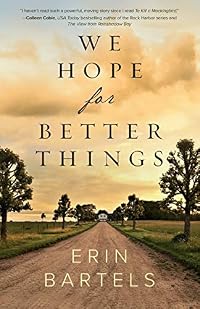
We Hope for Better Things
by Erin Bartels
On This Page
Description
When Detroit Free Press reporter Elizabeth Balsam meets James Rich, his strange request--that she look up a relative she didn't know she had in order to deliver an old camera and a box of photos--seems like it isn't worth her time. But when she loses her job after a botched investigation, she suddenly finds herself with nothing but time. At her great-aunt's 150-year-old farmhouse, Elizabeth uncovers a series of mysterious items, locked doors, and hidden graves. As she searches for answers to show more the riddles around her, the remarkable stories of two women who lived in this very house emerge as testaments to love, resilience, and courage in the face of war, racism, and misunderstanding. And as Elizabeth soon discovers, the past is never as past as we might like to think. Debut novelist Erin Bartels takes readers on an emotional journey through time--from the volatile streets of 1960s Detroit to the Underground Railroad during the Civil War--to uncover the past, confront the seeds of hatred, and discover where love goes to hide. show lessTags
Recommendations












Member Reviews
Reading this book is a little bit like viewing history through a kaleidoscope; as you turn the wheel, the colors shift slightly to make a different picture, but one that is made up of the same elements as the one before. Bartels writes vividly across three storylines, each taking place in a different time. The three time periods (1861-75, 1963-7, and modern time) blend and separate as each tell a story about racism and family.
Mary unwittingly and then wholeheartedly opens her home to escaping slaves during the Civil War. Her granddaughter Nora must face the realities of racism when she falls in love with and marries a black photographer. Elizabeth, Nora's great-niece, and an aspiring journalist, thinks she's found the story of a show more lifetime when she's given a camera to return to this aunt she's never met. The story of each woman echoes the others as they search for the truth of themselves, their family, and its history.
Because there is a generation missing between Mary and Nora, and between Nora and Elizabeth, some of the past remains hidden, and Bartels avoids several opportunities to wrap everything up with a neat bow. Usually, loose ends at the end of a book make me crazy, but Bartels demonstrates her gifts as a writer by making even this seem like a natural part of the story. show less
Mary unwittingly and then wholeheartedly opens her home to escaping slaves during the Civil War. Her granddaughter Nora must face the realities of racism when she falls in love with and marries a black photographer. Elizabeth, Nora's great-niece, and an aspiring journalist, thinks she's found the story of a show more lifetime when she's given a camera to return to this aunt she's never met. The story of each woman echoes the others as they search for the truth of themselves, their family, and its history.
Because there is a generation missing between Mary and Nora, and between Nora and Elizabeth, some of the past remains hidden, and Bartels avoids several opportunities to wrap everything up with a neat bow. Usually, loose ends at the end of a book make me crazy, but Bartels demonstrates her gifts as a writer by making even this seem like a natural part of the story. show less
This story is told in three timelines: the Civil War the time of Nathaniel and Mary Balsam; the Detroit riots of the 1960s when Nora Balsam fell in love with the wrong man; and the present, when Elizabeth Balsam discovers previously unknown relatives as she is struggling with the feeling that she is “utterly lost and confused”. The connection these three women have is explained through their experiences with interracial relationships and the heartbreaking consequences that a bigoted, narrow-minded society can wreak.
These timelines reinforce that some things never change. Racism, intolerance, inequity, hateful behavior find their way in each generational segment of this book. We always hope for better things but as we know history show more has a way of repeating itself. This story hurts on so many levels. Hidden love, guilty love, love that is rejected by the population at large, and the lovers who have to fight for their small bit of happiness that should be sacrosanct.
There is a mystery to be unraveled, a family tree that needs to be followed, its branches begging for discovery. The descriptions are interesting, the dialog flowing.The twists are subtle, insidious and of the left field variety. This author has tackled a thorny, complicated topic and brought fresh eyes and voices to the challenge of relating history without grandstanding and haranguing her audience. I liked the book even while I was getting angry, feeling uncomfortable and comprehending unnecessary hurt so easily inflicted.
Thank you NetGalley and Revell for a copy. show less
These timelines reinforce that some things never change. Racism, intolerance, inequity, hateful behavior find their way in each generational segment of this book. We always hope for better things but as we know history show more has a way of repeating itself. This story hurts on so many levels. Hidden love, guilty love, love that is rejected by the population at large, and the lovers who have to fight for their small bit of happiness that should be sacrosanct.
There is a mystery to be unraveled, a family tree that needs to be followed, its branches begging for discovery. The descriptions are interesting, the dialog flowing.The twists are subtle, insidious and of the left field variety. This author has tackled a thorny, complicated topic and brought fresh eyes and voices to the challenge of relating history without grandstanding and haranguing her audience. I liked the book even while I was getting angry, feeling uncomfortable and comprehending unnecessary hurt so easily inflicted.
Thank you NetGalley and Revell for a copy. show less
Only a week into the new year, and I have discovered a book that will definitely be on the best of the best list. We Hope for Better Things by debut author Erin Bartels is a novel that you want to savor, yet must keep reading to find out what will happen. Beautifully written, it is a complex mix of present day and the past, because what happens in the past often impacts everything we know today. I came to love the characters even as they act in destructive ways. They are deeply flawed, yet feel ever so right. Added to all this is the backdrop of the Civil War and the Civil Rights eras. There was much to learn about the setting, time periods, and my reaction to it all. This book receives the very rare Very Highly Recommended rating — a show more six-star, if such a thing existed.
We Hope for Better Things begins in present day Detroit with main character Elizabeth, a young journalist hungry for the big story, the juicier the better. But she soon finds herself out of a job and in rural Lapeer, Michigan. A family homestead harbors a reclusive great-aunt and stories that may have a greater impact than Elizabeth could ever dream.
Although We Hope for Better Things has not just one, or two, but three story lines, they are so skillfully interwoven that the reader feels just how integral they are to each other. Three very strong female characters dominate — Mary Balsam, a young woman left to run a farm when her husband enlists to fight for the Union, Nora Balsam Rich, who falls in love with the right man at the wrong time, and Elizabeth, who finds her family legacy more important than her own ambition. The novel moves from one story to the other — the 1860/1870s, the 1960s, and the present day — with never a misstep or loss of continuity. The breaks between stories just kept me turning page after page as fast as I could. There’s a lot of history that is involved, but it is really the individual reactions of the characters that steer their destiny. I really liked that. It is easy to see historical movements or circumstances as the product of a society as a whole, but in We Hope for Better Things individual choices are important to the development of those movements and to future generations. There are a lot of parallels between the women, showing that one time doesn’t have any greater or lesser moral authority than another. Racism is the overarching theme in the novel with the author again showing it in very personal ways. Its insidiousness reaches into all aspects of life, including the life of the church. Bartels subtle hand doesn’t take away from the big truths shining through. In the end, the reader knows more than the characters, but there are still some mysteries left unsolved or hinted at. I liked that too, because it is those questions that will fuel great reader discussions. And this novel is perfect for book clubs — you will definitely want to talk about this book.
I could go on and on about the merits of We Hope for Better Things, but I will leave you with just one final thing — Read. This. Book. You will love it.
Very Highly Recommended.
Audience: adults.
(Thanks to Revell for a complimentary copy. All opinions expressed are mine alone.) show less
We Hope for Better Things begins in present day Detroit with main character Elizabeth, a young journalist hungry for the big story, the juicier the better. But she soon finds herself out of a job and in rural Lapeer, Michigan. A family homestead harbors a reclusive great-aunt and stories that may have a greater impact than Elizabeth could ever dream.
Although We Hope for Better Things has not just one, or two, but three story lines, they are so skillfully interwoven that the reader feels just how integral they are to each other. Three very strong female characters dominate — Mary Balsam, a young woman left to run a farm when her husband enlists to fight for the Union, Nora Balsam Rich, who falls in love with the right man at the wrong time, and Elizabeth, who finds her family legacy more important than her own ambition. The novel moves from one story to the other — the 1860/1870s, the 1960s, and the present day — with never a misstep or loss of continuity. The breaks between stories just kept me turning page after page as fast as I could. There’s a lot of history that is involved, but it is really the individual reactions of the characters that steer their destiny. I really liked that. It is easy to see historical movements or circumstances as the product of a society as a whole, but in We Hope for Better Things individual choices are important to the development of those movements and to future generations. There are a lot of parallels between the women, showing that one time doesn’t have any greater or lesser moral authority than another. Racism is the overarching theme in the novel with the author again showing it in very personal ways. Its insidiousness reaches into all aspects of life, including the life of the church. Bartels subtle hand doesn’t take away from the big truths shining through. In the end, the reader knows more than the characters, but there are still some mysteries left unsolved or hinted at. I liked that too, because it is those questions that will fuel great reader discussions. And this novel is perfect for book clubs — you will definitely want to talk about this book.
I could go on and on about the merits of We Hope for Better Things, but I will leave you with just one final thing — Read. This. Book. You will love it.
Very Highly Recommended.
Audience: adults.
(Thanks to Revell for a complimentary copy. All opinions expressed are mine alone.) show less
EXCELLENT writing!! This story is a gradual build-up. I felt like the writer was taking me on a leisurely stroll through time, casually relating events in the lives of three women, blood relatives. As we continued to walk along I could feel the tension mounting until it reached a crescendo, and I couldn’t bear to abandon it until I turned the last adventure-filled page!
We Hope for Better Things is set in and around Detroit, MI, and follows a triple timeline—Lapeer County, 1861 (civil war); the 1960’s (civil rights movement and Detroit riots); and modern day Detroit.
When Journalist, Elizabeth Balsam, is given a camera and the promise of some old photographs to deliver to a great aunt she’s never known, by a black man who claims show more his uncle was married to her aunt, her interest is piqued. The photos, which were allegedly taken during the ‘67 Detroit riots, are just the thing Elizabeth could use to develop the kind of story that aligns with her reputation as one who exposes corruption and neglect. Recently fired, Elizabeth is eager to get her hands on the elusive photographs, but first she has to visit with their rightful owner, her old great aunt, Nora Balsam. Nora lives in the old family house in Lapeer County, Michigan, which was also the home of Nora’s great-grandmother, Mary Balsam. All three women, Mary, Nora and Elizabeth, are linked by blood, and as Elizabeth stays on at the Lapeer house and gets to know Nora through the many objects in her home, where she finds treasures from the attic to the cellar, she’s intrigued. What does it all mean? Close-lipped thus far, Elizabeth hopes that in time Nora will open up and contribute to her story in her own words. As time goes on, and Nora starts talking, secrets about the past overshadow Elizabeth’s career ambitions and she becomes more determined to devote herself to contributing to her family’s legacy.
Forbidden relationships, racism, secrets, lies, betrayals, tragedy. Yup, it’s all in there, cleverly constructed with each little fragment eventually coming together to form a unique, atmospheric tale that was impressive. I couldn’t believe this was the author’s first book.
Here’s another thing that I loved. Although there were tumultuous scenes and turbulent times depicted, there was not one profane word or gruesome account. That’s what I call excellent writing. When I can envision what a riot must be like through dialog or prose, without having it described to me in expletives, I consider that the mark of a great writer. Very highly recommended. show less
We Hope for Better Things is set in and around Detroit, MI, and follows a triple timeline—Lapeer County, 1861 (civil war); the 1960’s (civil rights movement and Detroit riots); and modern day Detroit.
When Journalist, Elizabeth Balsam, is given a camera and the promise of some old photographs to deliver to a great aunt she’s never known, by a black man who claims show more his uncle was married to her aunt, her interest is piqued. The photos, which were allegedly taken during the ‘67 Detroit riots, are just the thing Elizabeth could use to develop the kind of story that aligns with her reputation as one who exposes corruption and neglect. Recently fired, Elizabeth is eager to get her hands on the elusive photographs, but first she has to visit with their rightful owner, her old great aunt, Nora Balsam. Nora lives in the old family house in Lapeer County, Michigan, which was also the home of Nora’s great-grandmother, Mary Balsam. All three women, Mary, Nora and Elizabeth, are linked by blood, and as Elizabeth stays on at the Lapeer house and gets to know Nora through the many objects in her home, where she finds treasures from the attic to the cellar, she’s intrigued. What does it all mean? Close-lipped thus far, Elizabeth hopes that in time Nora will open up and contribute to her story in her own words. As time goes on, and Nora starts talking, secrets about the past overshadow Elizabeth’s career ambitions and she becomes more determined to devote herself to contributing to her family’s legacy.
Forbidden relationships, racism, secrets, lies, betrayals, tragedy. Yup, it’s all in there, cleverly constructed with each little fragment eventually coming together to form a unique, atmospheric tale that was impressive. I couldn’t believe this was the author’s first book.
Here’s another thing that I loved. Although there were tumultuous scenes and turbulent times depicted, there was not one profane word or gruesome account. That’s what I call excellent writing. When I can envision what a riot must be like through dialog or prose, without having it described to me in expletives, I consider that the mark of a great writer. Very highly recommended. show less
I received this book for free from the publisher (Revell Reads) in exchange for an honest review.
This was an insightful historical novel about three generations of women from Detroit. It takes place during the civil war, the Detroit riots, and present day.
Out of the three stories, I found Mary’s (the civil war one) to be the most compelling and interesting. The present day storyline was probably the weakest just because there wasn’t anything super exciting going on and it was more focused on discovering what happened in the past.
I liked how the three stories intersected and connected. The events were woven together nicely and I liked how the secrets slowly unraveled. I also liked that it took place in Detroit and talked about the show more riots because that isn’t a topic that is often discussed.
I also appreciated that the author included a note at the end of the book discussing that any shortcomings or pitfalls are her own fault and acknowledging the fact that she is a white woman writing about people of color. I love that level of awareness and am always happy to see authors admit that.
The thing that prevented me from giving it 5 stars, was that it took me a while to connect with the story and characters. It wasn’t until I was near the end that I felt that emotional connection with them.
Overall, I enjoyed this look into the past and found this to be a wonderful debut book. show less
This was an insightful historical novel about three generations of women from Detroit. It takes place during the civil war, the Detroit riots, and present day.
Out of the three stories, I found Mary’s (the civil war one) to be the most compelling and interesting. The present day storyline was probably the weakest just because there wasn’t anything super exciting going on and it was more focused on discovering what happened in the past.
I liked how the three stories intersected and connected. The events were woven together nicely and I liked how the secrets slowly unraveled. I also liked that it took place in Detroit and talked about the show more riots because that isn’t a topic that is often discussed.
I also appreciated that the author included a note at the end of the book discussing that any shortcomings or pitfalls are her own fault and acknowledging the fact that she is a white woman writing about people of color. I love that level of awareness and am always happy to see authors admit that.
The thing that prevented me from giving it 5 stars, was that it took me a while to connect with the story and characters. It wasn’t until I was near the end that I felt that emotional connection with them.
Overall, I enjoyed this look into the past and found this to be a wonderful debut book. show less
I received an advance copy of this book from the publisher and was excited to get my hands on it.
Bartels deftly weaves together three American women's experiences with race relations over three time periods. The generations and stories are linked through the family's historic house near Detroit, where each woman's personal struggle with racism in her society's era unfolds. Through love, sacrifice and loss, they all learn the hard lesson that, as far as each generation has come, we still have further to go.
Bartels also subtly explores gender expectations and limitations in each time period, and the nuanced way the women handled interpersonal relationships within (and outside of) the restrictions placed upon them. The photography and show more quilting metaphors also added a welcome level of depth, and helped to tie the stories' themes together.
My biggest struggle with the book in the beginning was keeping track of the many characters in multiple timelines. However, Bartels' short chapters and beautiful prose kept me invested and turning pages, until I couldn't wait to pick it up again each night.
We Hope For Better Things is one of those books that I'm going to read over and over, because I know that each time, I'm going to gain something more from it. The strength, courage and humanity of these women, and the timeliness of their stories, have stayed with me. I have a feeling they will for some time. show less
Bartels deftly weaves together three American women's experiences with race relations over three time periods. The generations and stories are linked through the family's historic house near Detroit, where each woman's personal struggle with racism in her society's era unfolds. Through love, sacrifice and loss, they all learn the hard lesson that, as far as each generation has come, we still have further to go.
Bartels also subtly explores gender expectations and limitations in each time period, and the nuanced way the women handled interpersonal relationships within (and outside of) the restrictions placed upon them. The photography and show more quilting metaphors also added a welcome level of depth, and helped to tie the stories' themes together.
My biggest struggle with the book in the beginning was keeping track of the many characters in multiple timelines. However, Bartels' short chapters and beautiful prose kept me invested and turning pages, until I couldn't wait to pick it up again each night.
We Hope For Better Things is one of those books that I'm going to read over and over, because I know that each time, I'm going to gain something more from it. The strength, courage and humanity of these women, and the timeliness of their stories, have stayed with me. I have a feeling they will for some time. show less
This three generational story had me crying, cheering and raving mad. A perfect debit for Erin Bartels. Mary, Nora and Elizabeth were strong women who each find their worlds being turned upside down. Mary during the Civil War as an abolitionist who helped escaped slaves turn their lives free by teaching, helping and employing these slaves at her own home. Nora during the Civil Rights movement falls in love with William where interracial relationships are highly forbidden or looked down upon. This puts both William and Nora in danger and then Elizabeth finding out her ancestry, the strength of her ancestors and the truth about her own history all because of photographs resurrected from a camera belonging to her great aunt’s estranged show more husband.
We Hope For Better Things is a rich tapestry sewn together with threads of slavery, segregation and understanding. I feel edified, educated and entertained just from reading this fantastic historical fiction. I look forward to reading more from Erin Bartels she has a shining star ascending in the world of writing. show less
We Hope For Better Things is a rich tapestry sewn together with threads of slavery, segregation and understanding. I feel edified, educated and entertained just from reading this fantastic historical fiction. I look forward to reading more from Erin Bartels she has a shining star ascending in the world of writing. show less
Members
- Recently Added By
Lists

Books Read in 2020
4,379 works; 123 members
Author Information

9 Works 759 Members
Awards and Honors
Notable Lists
Common Knowledge
- Original publication date
- 2019
Classifications
Statistics
- Members
- 221
- Popularity
- 147,015
- Reviews
- 43
- Rating
- (4.10)
- Languages
- English
- Media
- Paper, Audiobook, Ebook
- ISBNs
- 9
- ASINs
- 2