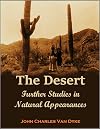
The desert (Literature of the American wilderness)
by John C. Van Dyke
Peregrine Smith Literary Naturalists
On This Page
Description
Before the publication of John C. Van Dyke's The Desert in 1901, Americans thought of deserts as scorpion-infested wastelands - with names like Devil's Domain and the Lands That God Forgot. The Desert sought to draw attention to the beauty that existed in the American west. With an introduction by Peter Wild, this edition offers insights and truths about this author and his best-known work. Van Dyke was not, it seems, the plaster saint of the desert. He was not entirely honest with his show more readers about the journeys that inspired the book, and his natural history includes serious errors. But in this reading, Wild notes, Van Dyke emerges as a more fascinating writer and his work becomes more intriguing. show lessTags
Recommendations















Member Reviews
"And so it is that my book is only an excuse for talking about the beautiful things in this desert world that stretches down the Pacific Coast, and across Arizona and Senora....”
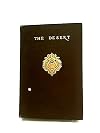
Lightly aged brown cloth boards with gilt lettering and design on cover and spine, tightly bound with former owner name written on bottom inside cover, minor shelf wear.
As noted in "The Secret Life of John C. Van Dyke: Decalcomania on the Desert" by David Teague and Peter Wild in the Journal of the Southwest (Volume 37, No. 1, Spring 1995, pages 1-52): "Few cultural changes in America are as easily pinpointed as the radical shift in attitudes toward the Southwest's deserts. The pivotal date was 1901 the year John C. Van Dyke (1856-1932) published "The show more Desert"...Along with most pioneers, the utilitarian nation despised deserts as "God's mistakes", as wastelands. Yet attitudes changed over the decades, and Van Dyke's "The Desert" marked the culmination of a huge swing, from traditional scorn to viewing the Southwest as a region to be appreciated for its wild beauty. So essential was the Volume's role in completing the cultural shift that Lawrence Clark Powell declares, "All Southwestern book trails lead to "The Desert" and that modern-day icon of desert lovers, Edward Abbey, puts "The Desert" on his short list of essential reading."
In 1878, Van Dyke was appointed the librarian of the Gardner Sage Library at the New Brunswick Theological Seminary, and in 1891 as a professor of art history at Rutgers College (now Rutgers, The State University of New Jersey). With his appointment, the Rutgers president's residence was converted to classroom and studio space for the college's Department of Fine Arts. He was elected to the National Institute of Arts and Letters in 1908. Van Dyke wrote a series of critical guide books: New Guides to Old Masters. He edited Modern French Masters (1896); Old Dutch and Flemish Masters (1901); Old English Masters; and a series of histories covering the history of art in America. show less
Lightly aged brown cloth boards with gilt lettering and design on cover and spine, tightly bound with former owner name written on bottom inside cover, minor shelf wear.
As noted in "The Secret Life of John C. Van Dyke: Decalcomania on the Desert" by David Teague and Peter Wild in the Journal of the Southwest (Volume 37, No. 1, Spring 1995, pages 1-52): "Few cultural changes in America are as easily pinpointed as the radical shift in attitudes toward the Southwest's deserts. The pivotal date was 1901 the year John C. Van Dyke (1856-1932) published "The show more Desert"...Along with most pioneers, the utilitarian nation despised deserts as "God's mistakes", as wastelands. Yet attitudes changed over the decades, and Van Dyke's "The Desert" marked the culmination of a huge swing, from traditional scorn to viewing the Southwest as a region to be appreciated for its wild beauty. So essential was the Volume's role in completing the cultural shift that Lawrence Clark Powell declares, "All Southwestern book trails lead to "The Desert" and that modern-day icon of desert lovers, Edward Abbey, puts "The Desert" on his short list of essential reading."
In 1878, Van Dyke was appointed the librarian of the Gardner Sage Library at the New Brunswick Theological Seminary, and in 1891 as a professor of art history at Rutgers College (now Rutgers, The State University of New Jersey). With his appointment, the Rutgers president's residence was converted to classroom and studio space for the college's Department of Fine Arts. He was elected to the National Institute of Arts and Letters in 1908. Van Dyke wrote a series of critical guide books: New Guides to Old Masters. He edited Modern French Masters (1896); Old Dutch and Flemish Masters (1901); Old English Masters; and a series of histories covering the history of art in America. show less
Pristine condition
Ratings
Members
- Recently Added By
Author Information
37+ Works 250 Members
Awards and Honors
Notable Lists
Series

Belongs to Publisher Series
Common Knowledge
- Original publication date
- 1901 (Scribners, New York) (Scribners, New York); 1980 (Peregrine Smith, now Gibbs Smith) (Peregrine Smith, now Gibbs Smith)
Classifications
- Genres
- Science & Nature, Nonfiction, Travel, General Nonfiction
- DDC/MDS
- 508.315 — Natural sciences & mathematics Science Natural history Environments / Habitats
- LCC
- F786 .V24 — Local History of the United States, Canada and Latin America United States local history New Southwest. Colorado River, Canyon, and Valley
- BISAC
Statistics
- Members
- 105
- Popularity
- 309,143
- Reviews
- 2
- Rating
- (3.78)
- Languages
- English
- Media
- Paper, Ebook
- ISBNs
- 11
- ASINs
- 7