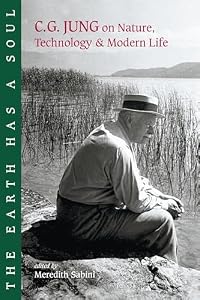
The Earth Has a Soul: C.G. Jung on Nature, Technology & Modern Life
by C. G. Jung
On This Page
Description
While never losing sight of the rational, cultured mind, Jung speaks for the natural mind, source of the evolutionary experience and accumulated wisdom of our species. Through his own example, Jung shows how healing our own living connection with Nature contributes to the whole.Tags
Recommendations









Member Reviews
From Jung's prolific writings, editor Sabini selected essays, letters, lectures, articles, and book segments that explore the connections between the conscious and unconscious of modern humans (1920s-1950s). Although "nature" represents the collective unconscious of humanity in this work, it is easy to extrapolate Jung's discussions to include current concerns about global warming, environmental destruction, mega-corporations, and fragile, vulnerable populations of all species, including humans. The first Jung book I've been able to read, understand and complete, this text makes Jungian psychology accessible to most readers, touching on a variety of topics, including the need for balance in the human psyche, consequences of imbalance, show more archetypes, WW II, and others. The book includes B&W photos of Jung, suggested readings, an index, and embedded coded references to Jung's original works. Wonderfully dense and readable, there are many literary gems throughout the book, providing "Aha!" moments and poetic grace.
"You trust your unconscious as if it were a loving father. But it is nature and cannot be made use of as if it were a reliable human being. It is inhuman and it needs the human mind to function usefully for man's purposes. Nature is an incomparable guide if you know how to follow her....
"The unconscious is useless without the human mind. It always seeks its collective purposes and never your individual destiny. Your destiny is the result of the collaboration between the conscious and the unconscious." show less
"You trust your unconscious as if it were a loving father. But it is nature and cannot be made use of as if it were a reliable human being. It is inhuman and it needs the human mind to function usefully for man's purposes. Nature is an incomparable guide if you know how to follow her....
"The unconscious is useless without the human mind. It always seeks its collective purposes and never your individual destiny. Your destiny is the result of the collaboration between the conscious and the unconscious." show less
Join Jung as he rediscovers the original unity of nature, and the spirits inside matter come to life once again. These selections, not just from his published writings, but also from speeches, obscure seminars, interview, and letters, show a less familiar side of the famous Swiss psychiatrist, whose deep concern over the loss of our emotional and mythic relationship with Nature is expressed in moving, poetic terms. Included are excerpts from Memories, Dreams, Reflections among Jung’s other works. While never losing sight of the rational, cultured mind, Jung speaks for the natural mind, source of the evolutionary experience and accumulated wisdom of our species. Through his own example, Jung shows how healing our own living connection show more with Nature contributes to the whole. show less
This book is a selection of Carl Jung's books, articles and personal letters, that are supposed to suggest Jung’s view on Man's relation to Nature. I read the book because a review had suggested that it was somehow related to environmentalism. It does, but in a more general sense than the way that I usually think of “environmentalism”.
In order to make it easier to accurately describe how Man interacts with Nature, Jung defines 2 types of “men”: he makes a distinction between what he considers “modern man” and “primitive man”. He emphasizes that “primitive man” is not condescending or judgmental term, but only denotes the simpler way that mankind in certain cultures interacts with Nature.
The book is very readable. show more Generally, I avoid books on psychology, but I would highly recommend this one. The chapters are:
1 – Jung’s Own Relationship with Nature
2 – Consciousness Slipped from Its Natural Foundation
3 – Nature Was Once Fully Spirit and Matter
4 – The Primitive Knows How to Converse with the Soul
5 – We Have Conquered Nature Is a Mere Slogan
6 – Our Civilizing Potential Has Led Us Down the Wrong Path
7 – We Know Nothing of Man
8 – Nature Must Not Win but Cannot Lose
My favorite is chapter 8, and the title is derived from a quote from Jung. That quote seems to summarize a theme in a lot of Jung's writing in this book: Man and Nature are in a conflict, and although modern man has acquired knowledge and technology to greatly minimize Natures threats to Man's survival, it would be undesirable and impossible to completely defeat Nature.
The book wasn’t quite what I expected, based on the subtitle. It does not discuss the Man/Nature conflict in terms of pollution, exhaustion of natural resources, extinctions, etc. Instead, Jung was interested in modern man’s diminishing familiarity and contact with the natural world. Based on his travels to Africa and to the American southwest, in the early 1900’s, Jung was convinced that there was a significant difference between the way people in these much less technically advanced cultures (i.e. “primative man”) related to the environment. Although he would not prefer to live in the primitive culture, he felt that modern man has lost a natural connection with Nature, and for his own sake, must rediscover it.
Anyone who was ever repulsed, bored, depressed, irritated, or confused by a college freshman psychology course, might find this a refreshing alternative to a typical textbook. Readers already familiar with psychology (Jungian or other), might still enjoy reading about the subject reviewed an uncommon perspective. The editor did a very good job compiling and linking together sources of material. show less
In order to make it easier to accurately describe how Man interacts with Nature, Jung defines 2 types of “men”: he makes a distinction between what he considers “modern man” and “primitive man”. He emphasizes that “primitive man” is not condescending or judgmental term, but only denotes the simpler way that mankind in certain cultures interacts with Nature.
The book is very readable. show more Generally, I avoid books on psychology, but I would highly recommend this one. The chapters are:
1 – Jung’s Own Relationship with Nature
2 – Consciousness Slipped from Its Natural Foundation
3 – Nature Was Once Fully Spirit and Matter
4 – The Primitive Knows How to Converse with the Soul
5 – We Have Conquered Nature Is a Mere Slogan
6 – Our Civilizing Potential Has Led Us Down the Wrong Path
7 – We Know Nothing of Man
8 – Nature Must Not Win but Cannot Lose
My favorite is chapter 8, and the title is derived from a quote from Jung. That quote seems to summarize a theme in a lot of Jung's writing in this book: Man and Nature are in a conflict, and although modern man has acquired knowledge and technology to greatly minimize Natures threats to Man's survival, it would be undesirable and impossible to completely defeat Nature.
The book wasn’t quite what I expected, based on the subtitle. It does not discuss the Man/Nature conflict in terms of pollution, exhaustion of natural resources, extinctions, etc. Instead, Jung was interested in modern man’s diminishing familiarity and contact with the natural world. Based on his travels to Africa and to the American southwest, in the early 1900’s, Jung was convinced that there was a significant difference between the way people in these much less technically advanced cultures (i.e. “primative man”) related to the environment. Although he would not prefer to live in the primitive culture, he felt that modern man has lost a natural connection with Nature, and for his own sake, must rediscover it.
Anyone who was ever repulsed, bored, depressed, irritated, or confused by a college freshman psychology course, might find this a refreshing alternative to a typical textbook. Readers already familiar with psychology (Jungian or other), might still enjoy reading about the subject reviewed an uncommon perspective. The editor did a very good job compiling and linking together sources of material. show less
Sabini seems to selectively utilize Jung here to lend support to the modern environmental worldview and promotes the attitudes in the Lynn White thesis. That's not necessarily a bad thing or wildly inaccurate but it is a bit lopsided and indicative that the editor has an agenda here. I would actually consider this an environmental advocacy book before I would call it a psychology book. Anyone interested in the relationship between Nature (capital N) and the individual and Jung's thoughts on the matter might find this to be a good read however.
pretty good
notebook # 840
notebook # 840
Ratings
Members
- Recently Added By
Author Information

881+ Works 42,499 Members
Carl Gustav Jung was born in Switzerland on July 26, 1875. He originally set out to study archaeology, but switched to medicine and began practicing psychiatry in Basel after receiving his degree from the University of Basel in 1902. He became one of the most famous of modern psychologists and psychiatrists. Jung first met Sigmund Freud in 1907 show more when he became his foremost associate and disciple. The break came with the publication of Jung's Psychology of the Unconscious (1912), which did not follow Freud's theories of the libido and the unconscious. Jung eventually rejected Freud's system of psychoanalysis for his own "analytic psychology." This emphasizes present conflicts rather than those from childhood; it also takes into account the conflict arising from what Jung called the "collective unconscious"---evolutionary and cultural factors determining individual development. Jung invented the association word test and contributed the word complex to psychology, and first described the "introvert" and "extrovert" types. His interest in the human psyche, past and present, led him to study mythology, alchemy, oriental religions and philosophies, and traditional peoples. Later he became interested in parapsychology and the occult. He thought that unidentified flying objects (UFOs) might be a psychological projection of modern people's anxieties. He wrote several books including Studies in Word Association, Flying Saucers: A Modern Myth of Things Seen in the Skies, and Psychology and Alchemy. He died on June 6, 1961 after a short illness. (Bowker Author Biography) show less
Classifications
- Genres
- Nonfiction, Science & Nature, General Nonfiction, Philosophy
- DDC/MDS
- 150.1954 — Philosophy and Psychology Psychology Psychology Theory And Instruction Systems, schools, viewpoints Psychoanalytic systems Jungian system
- LCC
- BF173 .J7238 — Philosophy, Psychology and Religion Psychology Psychology Psychoanalysis
- BISAC
Statistics
- Members
- 201
- Popularity
- 161,906
- Reviews
- 5
- Rating
- (4.15)
- Languages
- English
- Media
- Paper
- ISBNs
- 1