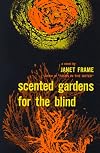
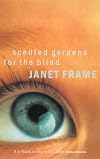
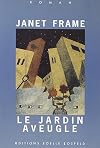
Scented Gardens for the Blind
by Janet Frame
On This Page
Description
Vera is the mother who has willed herself sightless, Erlene, her daughter, has ceased to speak, and Edward, the husband and father, has taken refuge in a distant land. Beyond this is a mind that has burst the confines of everyday individual consciousness and invented its own tormented reality.Tags
Recommendations






















Member Reviews
As in her three previous novels, in Scented Gardens for the Blind (1963), Janet Frame is again writing about damaged and deluded people living diminished lives. The focus of the novel is the Glace family of New Zealand. Vera Glace lives with her mute adult daughter Erlene in the family home in the town where she grew up. But Erlene’s muteness is the least of their problems. The Glace family is fractured, barely functional, stymied by fear. “I deprived myself of each of my senses,” Vera declares. “It was I who was blind.” Vera’s blindness is apparently a choice: the condition seems to come and go. And there’s this: years earlier, Edward Glace left his family and moved to London to conduct genealogical research into the show more Strang family. In London Edward has access to a rich assortment of libraries, archives and government records, but he lives alone in a rooming house and seemingly has no friends. Edward’s life is empty, but for the Strangs and his collection of toy soldiers. When people inquire of Edward where his interest in an ordinary family comes from, he doesn’t answer, and in fact doesn’t seem sure of the answer. But Edward has reached a turning point, and this is a source of severe anxiety: he has found out all he can about the historical (dead) Strangs and, to move his project forward, must now approach those who are alive. Back in New Zealand Vera is exceedingly worried about Erlene, who refuses to speak and spends her days in her room staring out the window. Vera pleads daily with her daughter to say something and lectures her on the importance of speech for the survival of the human race, but to no avail. Midway through the novel Vera makes an appointment for Erlene with Dr. Clapper, whom she hopes will get to the bottom of Erlene’s muteness, which has no apparent physical cause, and get her talking again. The thrust of Frame’s tumultuous, pulsating narrative seems to be the role sensory perception plays in human experience, and the imbalance that results when means of social exchange are withdrawn. The novel is composed of parallel internal monologues from the perspectives of the three main characters, in which each faces their greatest fears. Vera’s fear is of being abandoned, a condition that her daughter’s silence exacerbates. Erlene, whose life of the imagination is vibrant and graphic, fears that meddlesome interventions will force her to speak up and rejoin humanity, resulting in exposure to human pressures and the loss of her imaginary companions. And Edward fears the human contact that the next stage of his research demands of him. But all of this is turned on its head in the book’s final chapter, where the source of the churning angst that fills the preceding pages is revealed. By 1963 Janet Frame’s confidence in her art and development as a novelist freed her to take imaginative leaps for which critics and readers would have been woefully unprepared. In Scented Gardens for the Blind her eccentric prose structures and the power of her imagery produce astonishing flights of fancy (“When Uncle Black-Beetle took off his apron and set aside his cutting, cleaning and polishing tools, she noticed that his skin was brown and shining, his eyes were large and black, overhanging his face like street-lamps, and there were dark tracks up and down his face which, lit by his eyes, became caverns, ravines flowing with underground rivers.”). By turns disturbing and playful, and often delightfully, unapologetically weird, Scented Gardens for the Blind continues Janet Frame’s exploration through fiction of the human mind in crisis and the destructive power of isolation and loneliness. show less
I loved this book. It is poetic, surreal (at times very strange), mesmerizing, and beautifully written. It is a book about the senses, a book about madness, emotions, communication; it is a lush fantasy, a garden of words grown for the human condition. I've dog-eared multiple pages, underlined several passages...and had to stop. A very curious book...uncommon.
Beautiful: I know, i'm a loser. I wasn't aware of Janet Frame until I saw "Angel at My Table." Better late... The strange and estranged life of the Glace family, all sensory-deprived-- father Edward has left wife and daughter and now spends his time studying the geneology of another family, daughter Erlene has gone mute, and wife Vera has gone blind. Each character lives in a lush world of their own making, never quite understanding what the others want of them. Frame's writing is right on target--she never wastes a word.
I despised this novel for a bit. Then I started to get more into it, and by the end I really liked it. In retrospect, I'm not sure what to make of that, frankly. It was original and imaginative, to be sure. The writing was a bit condescending at times, and it was certainly slow to take off. I'd try her again.
This is the sort of novel you immediately want to read all over again once you come to the end. Poetic, sad, strange and absolutely wonderful.
Ratings
Members
- Recently Added By
Published Reviews
The virtue, joy, necessity, and strangeness of human speech is the subject of this odd free-form novel. Through [its characters] in crisis, the author talks dazzlingly about speech, life, human perceptions, and the rims and imperceptible edges of communication. A disquieting, troubled, often brilliant outburst of a book.
added by poppycocteau
Author Information

51+ Works 4,672 Members
Janet Frame is a writer. She was born in Dunedin, New Zealand in 1924. Frame has written eleven novels, five collections of short stories, a volume of poetry, and a children's book. She has received the Commonwealth Literature Prize, the Turnavsky Prize, a Katherine Mansfield Fellowship, a Robert Burns Fellowship, and a Sargeson Fellowship. She show more was awarded an honorary doctorate in literature from Otago University and is an honorary member of the American Academy of Arts and Letters and she is a past President of Honour of the New Zealand Society of Authors. Her three autobiographies, To the Island, An Angel at My Table, and The Envoy from Mirror City, were turned into a three-part television series, and then a 1990 motion picture directed by Jane Campion. Frame was awarded the CBE in 1983. In 2015 Janet Frame's 1957 debut novel, Owls Do Cry, topped the second annual Great Kiwi Classic poll run by the New Zealand Book Council and Auckland Writers Festival. (Bowker Author Biography) show less
Awards and Honors
Notable Lists
Work Relationships
Is contained in
Classifications
Statistics
- Members
- 172
- Popularity
- 189,549
- Reviews
- 5
- Rating
- (3.90)
- Languages
- 5 — English, French, Italian, Portuguese, Swedish
- Media
- Paper
- ISBNs
- 8
- ASINs
- 1