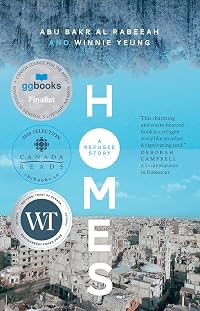
Homes: A Refugee Story
by Abu Bakr al Rabeeah
On This Page
Description
Biography & Autobiography. History. Nonfiction. In 2010, the al Rabeeah family left their home in Iraq in hope of a safer life. They moved to Homs, in Syria – just before the Syrian civil war broke out. Abu Bakr, one of eight children, was ten years old when the violence began on the streets around him: car bombings, attacks on his mosque and school, firebombs late at night. Homes tells of the strange juxtapositions of growing up in a war zone: horrific, unimaginable events punctuated by show more normalcy – soccer, cousins, video games, friends. Homes is the remarkable true story of how a young boy emerged from a war zone – and found safety in Canada – with a passion for sharing his story and telling the world what is truly happening in Syria. As told to her by Abu Bakr al Rabeeah, writer Winnie Yeung has crafted a heartbreaking, hopeful, and urgently necessary book that provides a window into understanding Syria. show lessTags
Recommendations






Member Reviews
This is the book that, in my opinion, should have won Canada Reads 2019.
This memoir is co-written by a teen-aged refugee, Abu Bakr al Rabeeah, and his English teacher, Winnie Yeung. It tells the story of Abu Bakr's life in Syria during the outbreak of the civil war. His family move around within Syria in search of a safer life, while also registering with the UN as refugees. Eventually, they are able to come to Canada.
Abu Bakr is a young boy when the war breaks out. He tells of finding a human jaw bone in his back yard, of playing with spent bullet cartridges, of school cancellations because of bombing. He also tells of ordinary kid things: playing soccer with friends, playing video games with his cousins. And when he moves to Canada, show more he is happy to be safe, but he misses his extended family and friends back "home". This novel shows the strong attachment so many of us feel to our home country or town.
Why should it have won Canada Reads? I think we are living in a time when Islamiphobia is on the rise. Here we see an Islamic family where the father cares deeply about his children and their safety. Where he understands persecution as a Sunni Muslim in an area of Shia dominance. Where he struggles to make a living and a life for those he loves. This is an important perspective we see little of. show less
This memoir is co-written by a teen-aged refugee, Abu Bakr al Rabeeah, and his English teacher, Winnie Yeung. It tells the story of Abu Bakr's life in Syria during the outbreak of the civil war. His family move around within Syria in search of a safer life, while also registering with the UN as refugees. Eventually, they are able to come to Canada.
Abu Bakr is a young boy when the war breaks out. He tells of finding a human jaw bone in his back yard, of playing with spent bullet cartridges, of school cancellations because of bombing. He also tells of ordinary kid things: playing soccer with friends, playing video games with his cousins. And when he moves to Canada, show more he is happy to be safe, but he misses his extended family and friends back "home". This novel shows the strong attachment so many of us feel to our home country or town.
Why should it have won Canada Reads? I think we are living in a time when Islamiphobia is on the rise. Here we see an Islamic family where the father cares deeply about his children and their safety. Where he understands persecution as a Sunni Muslim in an area of Shia dominance. Where he struggles to make a living and a life for those he loves. This is an important perspective we see little of. show less
Homes is a book written by Winnie Yeung, but taken from the true accounts of Abu Bakr and his family. It's a dramatic nonfiction, retelling the events that took place in Homs, Syria at the beginning of the civil war.
As a reader you simply fall into this book and become a child growing up in a war torn place. The first hand accounts of the family have become something dramatic that settles in your heart and mind for a long time after you read it. You realize that the events become so normal to you that you have the two sides of a balance; the terror of bombs and raids, of being the wrong type of Muslim or not having your papers, and the fun of soccer, video games, and jokes with family.
The writing is simply perfect and it was so easy to show more believe that I was actually there, having felt what Abu Bakr felt. The book is expertly descriptive, which I'm not saying to mean that I can visualize everything, but I can FEEL everything. Though the visuals from running away from the explosion are still fresh in my mind weeks after finishing the book. It is rare that you come out of reading something feeling as if you just came out of the experience itself and this book does that. I never thought there was a way to understand the experience of a refugee until now.
I finished the book feeling as if I had just come through a war myself. Getting to the last page I felt relief, not because I had finished, but because I could look up and see my usual surroundings and accept that I was safe where I was. I liked that about this book, the ability to completely submerge myself in the story. It made me grateful for everything I have in my life. I highly recommend it to anyone and everyone. show less
As a reader you simply fall into this book and become a child growing up in a war torn place. The first hand accounts of the family have become something dramatic that settles in your heart and mind for a long time after you read it. You realize that the events become so normal to you that you have the two sides of a balance; the terror of bombs and raids, of being the wrong type of Muslim or not having your papers, and the fun of soccer, video games, and jokes with family.
The writing is simply perfect and it was so easy to show more believe that I was actually there, having felt what Abu Bakr felt. The book is expertly descriptive, which I'm not saying to mean that I can visualize everything, but I can FEEL everything. Though the visuals from running away from the explosion are still fresh in my mind weeks after finishing the book. It is rare that you come out of reading something feeling as if you just came out of the experience itself and this book does that. I never thought there was a way to understand the experience of a refugee until now.
I finished the book feeling as if I had just come through a war myself. Getting to the last page I felt relief, not because I had finished, but because I could look up and see my usual surroundings and accept that I was safe where I was. I liked that about this book, the ability to completely submerge myself in the story. It made me grateful for everything I have in my life. I highly recommend it to anyone and everyone. show less
Abu Bakr is an appealing boy whose family moved to Syria in 2010 when life became too dangerous for Sunnis in Shi'a dominated Iraq. When civil war erupts in Syria, his happy life shared with cousins and filled with the normal activities of a 10 year old is punctuated by gunfire, bombs and incessant danger. Somehow soccer, prayer, happy Friday night rituals mingle with the horrors of war to become part of life.
Eventually the family are delighted to be accepted as refugees by Canada and after a long journey arrive in Edmonton, Alberta. There are many difficulties to be faced in the new country too. He was introduced to a translation app to help communicate the briefest conversation. My heart went out to Abu Bakr and his family. The show more reader is happy that they found a safe haven, but we are reminded of the many who are still seeking refuge. When he told the story of his past to teacher Winnie Yeung, she offered to write it for him. His young voice comes through clearly in this captivating story about his family and his life. show less
Eventually the family are delighted to be accepted as refugees by Canada and after a long journey arrive in Edmonton, Alberta. There are many difficulties to be faced in the new country too. He was introduced to a translation app to help communicate the briefest conversation. My heart went out to Abu Bakr and his family. The show more reader is happy that they found a safe haven, but we are reminded of the many who are still seeking refuge. When he told the story of his past to teacher Winnie Yeung, she offered to write it for him. His young voice comes through clearly in this captivating story about his family and his life. show less
Read for Big Library Reads April 1-15th.
First book I've ever read about refugees at all. Interesting story. I can't imagine what it would be like to grow up this way, having to be cautious and avoiding armed groups, never being able to sleep truly at peace, feeling safe in my home city or a new city. Really rough and real to read about, while still feeling like it should be found only in fiction. Puts a new personal light on the plight being faced by people across the world.
First book I've ever read about refugees at all. Interesting story. I can't imagine what it would be like to grow up this way, having to be cautious and avoiding armed groups, never being able to sleep truly at peace, feeling safe in my home city or a new city. Really rough and real to read about, while still feeling like it should be found only in fiction. Puts a new personal light on the plight being faced by people across the world.
I first heard about this book when it was one of the 5 books chosen for the 2019 Canada Reads contest. It didn't strike me at the time as something that would interest me but as I watched the debates Chuck Comeau who was defending this book really impressed me with how passionate he was about it. This book came second in that contest and I decided that I would read it. I suggested it to my book club for the 2019/2020 group of books and we picked it for February 2020.
Abu Bakr was born in Iraq, the third youngest child of eight. His father had been raised as a Shi'a Muslim but changed to become Sunni as an adult and all the children were raised as Sunni Muslims. In Iran (in contrast to many other Arab nations) the dominant sect is Shi'a. show more Abu Bakr is a significantly Sunni name and this brought him into conflict at an early age. On the first day of Grade Two when the teacher called Abu Bakr's name he slapped Abu Bakr across the face and said "What kind of a name is that?" Other members of the family were also persecuted for their beliefs. In 2010 the family moved from Iraq to the city of Homs in Syria which has a majority of Sunni Muslims but is governed by a Shi'a sect. That split led to the Syrian Civil War which started soon after the al Rabeeah family moved to Syria. Violence spilled into their neighbourhood causing disruptions in worship, shopping, school. To get away from the violence in Homs the family moved again in 2012 to Damascus. There life was even more confined than it had been in Homs; the children didn't go to school as it was too dangerous and women barely left their apartments. After only six months the family moved back to Homs but Abu Bakr's father was desperately hoping their application for refugee status would be accepted. After years they learned that Canada would accept them so in November 2014 the family packed what they could into two bags each and left Syria behind. For Abu Bakr this meant leaving his cousins with whom he was very close without knowing if they would ever meet again. The family settled in Edmonton where Abu Bakr's mother had relatives. Soon Abu Bakr started school again where he was tutored for a while so he could become proficient in English. Abu Bakr missed Syria and his cousins tremendously but slowly the peace of Canada (and the soccer games at school) filled his heart. When he met Winnie Yeung, his English teacher, he was finally able to fulfill his promise to tell what life was like in Syria. Their partnership resulted in this book. show less
Abu Bakr was born in Iraq, the third youngest child of eight. His father had been raised as a Shi'a Muslim but changed to become Sunni as an adult and all the children were raised as Sunni Muslims. In Iran (in contrast to many other Arab nations) the dominant sect is Shi'a. show more Abu Bakr is a significantly Sunni name and this brought him into conflict at an early age. On the first day of Grade Two when the teacher called Abu Bakr's name he slapped Abu Bakr across the face and said "What kind of a name is that?" Other members of the family were also persecuted for their beliefs. In 2010 the family moved from Iraq to the city of Homs in Syria which has a majority of Sunni Muslims but is governed by a Shi'a sect. That split led to the Syrian Civil War which started soon after the al Rabeeah family moved to Syria. Violence spilled into their neighbourhood causing disruptions in worship, shopping, school. To get away from the violence in Homs the family moved again in 2012 to Damascus. There life was even more confined than it had been in Homs; the children didn't go to school as it was too dangerous and women barely left their apartments. After only six months the family moved back to Homs but Abu Bakr's father was desperately hoping their application for refugee status would be accepted. After years they learned that Canada would accept them so in November 2014 the family packed what they could into two bags each and left Syria behind. For Abu Bakr this meant leaving his cousins with whom he was very close without knowing if they would ever meet again. The family settled in Edmonton where Abu Bakr's mother had relatives. Soon Abu Bakr started school again where he was tutored for a while so he could become proficient in English. Abu Bakr missed Syria and his cousins tremendously but slowly the peace of Canada (and the soccer games at school) filled his heart. When he met Winnie Yeung, his English teacher, he was finally able to fulfill his promise to tell what life was like in Syria. Their partnership resulted in this book. show less
This book is currently featured as OverDrive’s latest Big Library Read. It tells the story of a refugee family from the perspective of a young man who was nine years old at the beginning of the family’s journey. Abu Bakr and his family lived in Iraq at a time when Sunni Muslims were persecuted by the Shia Muslims in power. Abu Bakr and one of his sisters had distinctly Sunni names so it was difficult for them to escape the bullying of other children and the disfavor of teachers. The family relocated to Syria, intending for this to be a brief stopping point before emigrating to Europe or North America. They arrived in Syria just before the Arab spring and endured several years of shootings in mosques and in the streets, car bombings, show more and mortar shellings. Several years later, the family received approval to emigrate to Canada. Before he left Syria, Abu Bakr’s friends and cousins asked him to tell their story. Abu Bakr’s ESL teacher helped him realize this dream. The plight of Syrian refugees has been in the news for several years. For those who want to dig deeper into this issue, this book is well worth the read. show less
Homes: A Refugee Story left me with many emotions. Gratitude for being born when and where I was. A deep sadness at the horrors we inflict upon one another. Disbelief that right now there are people out there just hoping for for one more day of safety for their family.
Telling this from the view of a young boy made it even more moving for me, a child should never have to live under those circumstances but yet they do every day.
I can't stop thinking of the quote attributed to Plato. "Be kind, for every one you meet is fighting a hard battle." A good reminder to be patient with people who may not understand things right away. No one wants to leave their home and become a refugee. It must be terrifying.
Highly recommended - the world would show more be a better place if we all read this book show less
Telling this from the view of a young boy made it even more moving for me, a child should never have to live under those circumstances but yet they do every day.
I can't stop thinking of the quote attributed to Plato. "Be kind, for every one you meet is fighting a hard battle." A good reminder to be patient with people who may not understand things right away. No one wants to leave their home and become a refugee. It must be terrifying.
Highly recommended - the world would show more be a better place if we all read this book show less
Members
- Recently Added By
Published Reviews
ThingScore 100
Both Homes and The Boy on the Beach humanize a conflict that has too often been condensed to numbers, statistics, and nameless victims. The western gaze reduces Syria to an abstraction of civil war, hunger, violence, and conflicting political and religious factions. But these books force the reader to face the complexities of place. In addition to war and suffering, Syria is also a home, a show more locus of family and memory. Kurdi and al Rabeeah are both aware of the magnanimity of Syrian hospitality – the kindness of neighbours and strangers alike, regardless of faith – that prevails even in the face of death. To reduce Syria to a hollowed-out symbol of war is to wilfully ignore the spirit of its people, which persists even in the most dire circumstances.
In Homes, al Rabeeah recalls the challenges of adapting to Canadian culture, weather, and language, and he expresses guilt for struggling to find his footing in a new land. He speaks of the solitude that descended on his family: “we were each so wrapped up in our own kinds of loneliness that we got used to our little islands of grief.” Fear remains in his body but manifests now in the aching absence of gunfire – it lives in what is unheard and unseen, and what is left behind. show less
In Homes, al Rabeeah recalls the challenges of adapting to Canadian culture, weather, and language, and he expresses guilt for struggling to find his footing in a new land. He speaks of the solitude that descended on his family: “we were each so wrapped up in our own kinds of loneliness that we got used to our little islands of grief.” Fear remains in his body but manifests now in the aching absence of gunfire – it lives in what is unheard and unseen, and what is left behind. show less
added by VivienneR
Lists

Canada Reads Winners and Nominees
129 works; 9 members

Books Read in 2020
4,379 works; 124 members
Author Information
1 Work 175 Members
All Editions
Awards and Honors
Common Knowledge
- Original publication date
- 2018-04-10
- Important places
- Iraq; Homs, Syria; Damascus, Syria; Edmonton, Alberta, Canada
- Important events
- Iraq war; Syrian Civil war
Classifications
- Genres
- Nonfiction, Biography & Memoir, General Nonfiction
- DDC/MDS
- 305.9 — Society, government, & culture Social sciences, sociology & anthropology Social group - Age, Gender, Ethnicity People by occupation and miscellaneous social statuses
- LCC
- HV640.5 .I76 .A47 — Social sciences Social pathology. Social and public welfare. Criminology Social pathology. Social and public welfare. Refugee problems
- BISAC
Statistics
- Members
- 175
- Popularity
- 187,202
- Reviews
- 18
- Rating
- (3.98)
- Languages
- English
- Media
- Paper, Audiobook, Ebook
- ISBNs
- 5
- ASINs
- 2