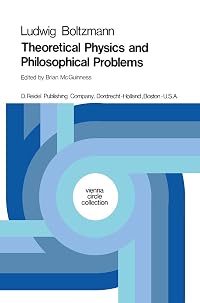
Theoretical physics and philosophical problems : selected writings
by Ludwig Boltzmann
8 Members (4.00)
On This Page
Description
l. The work of Ludwig Boltzmann (1844-1906) consists of two kinds of writings: in the first part of his active life he devoted himself entirely to problems of physics, while in the second part he tried to find a philosoph 1 ical background for his activities in and around the natural sciences. Most scientists are much more aware of his creative work in physics than of his digressions on the meaning and structure of science. I think in the present case the reason is not so much that most show more scientists are usually almost entirely occupied with their trade, because Boltzmann's philosophical work is also concerned with the (natural) sciences. I rather believe that the quality and consistency of Boltzmann's purely scientific work is of a more appealing nature than his less structured considerations on human activity in science and in life in general. 2. I think that it may be appropriate for the readers of this anthology to say a few words on the main findings of Boltzmann in physics, since in the end their 'philosophical' inlpact has been larger than the effect of his later writings. Moreover some knowledge of his scientific achievements can be helpful for the understanding and appreciation of the essays printed in this book, which almost all stem from Boltzmann's philosophical period. Boltzmann was one of the main protagonists - at least in continental Europe - of atomistics for explaining the phenomena of physics. show lessTags
Member Reviews
Members
- Recently Added By
Author Information

14 Works 87 Members
Ludwig Boltzmann, an Austrian theoretical physicist, was born and educated in Vienna. Boltzmann moved from post to post throughout Europe and visited the United States three times. Independent of the pioneering research of James Clerk Maxwell, Boltzmann developed the kinetic theory of gases. He also established a firm theoretical foundation for show more statistical mechanics by successfully interpreting the second law of thermodynamics in terms of order and disorder. Using thermodynamics, he derived the law governing the radiation rate of a black body. In the late nineteenth century, Boltzmann championed the controversial subject of the atomic theory of matter. As a result of serious depression caused by these bitter professional debates, he committed suicide in 1906. Ironically, this happened just before the last of his opponents finally accepted the atomic theory. Boltzmann's famous equation, SklogW, which relates the entropy S of a system to its probability W, is engraved on his tombstone. Boltzmann died in 1906. (Bowker Author Biography) show less
Classifications
Statistics
- Members
- 8
- Popularity
- 2,507,192
- Rating
- (4.00)
- Languages
- English
- Media
- Paper, Ebook
- ISBNs
- 3