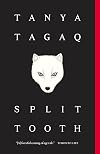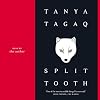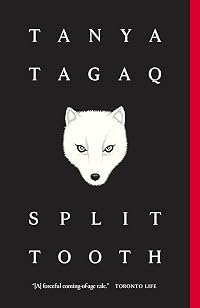
Split Tooth
by Tanya Tagaq
On This Page
Description
Longlisted for the 2018 Scotiabank Giller PrizeShortlisted for the 2019 Amazon First Novel Award
Shortlisted for the 2019 Kobo Emerging Writer Prize
Winner of the 2019 Indigenous Voices Award for Published Prose in English
Winner of the 2018 Alcuin Society Awards for Excellence in Book Design – Prose Fiction
Longlisted for the 2019 Sunburst Award
From the internationally acclaimed Inuit throat singer who has dazzled and enthralled the world with music it had never heard before, a fierce, show more tender, heartbreaking story unlike anything you've ever read.
Fact can be as strange as fiction. It can also be as dark, as violent, as rapturous. In the end, there may be no difference between them.
A girl grows up in Nunavut in the 1970s. She knows joy, and friendship, and parents' love. She knows boredom, and listlessness, and bullying. She knows the tedium of the everyday world, and the raw, amoral power of the ice and sky, the seductive energy of the animal world. She knows the ravages of alcohol, and violence at the hands of those she should be able to trust. She sees the spirits that surround her, and the immense power that dwarfs all of us.
When she becomes pregnant, she must navigate all this.
Veering back and forth between the grittiest features of a small arctic town, the electrifying proximity of the world of animals, and ravishing world of myth, Tanya Tagaq explores a world where the distinctions between good and evil, animal and human, victim and transgressor, real and imagined lose their meaning, but the guiding power of love remains.
Haunting, brooding, exhilarating, and tender all at once, Tagaq moves effortlessly between fiction and memoir, myth and reality, poetry and prose, and conjures a world and a heroine readers will never forget. show less
Tags
Recommendations










Member Reviews
A Terrible Beauty
(Another reviewer mentioned this book should contain a trigger warning for sexual abuse. I concur.)
Should I put down my initial reactions to this book now I've just finished listening to it? Or should I take time to digest it a little so I can be sure not to say anything off colour? Most people seem to agree this book is brilliant. I suppose it is. It's raw. It's brutal. It speaks of the natural world in a beautiful way. It also speaks of the natural world as seen from the point of view of a carnivore and an active predator and who likes to eat flesh still living or raw or as close to pulsing life as possible to get maximum energy from it. It speaks of beauty and horror combined, harshly and dispassionately.
We living show more in the "southern" parts of Canada can't begin to imagine the kinds of harsh and frigid cold the Inuit must face as part of their daily existence, the punishing quality of it. Kids are only let off school in the Great North when the weather hits minus 50 degrees Celsius or less (that's -58 Fahrenheit). Sexual abuse is so common that Tagaq's character speaks of being jealous when she sees her teacher touching other girls's private parts in the same way, because, one is led to understand, this is part of a young girl's "normal" sexual development in those parts. Many passages made me want to... I don't know... vomit? cry? lay down on the sidewalk trembling and foaming at the mouth? All told with this oh so gentle voice, all part of everyday life. This is a place where people can't spare empathy for each other, much less for their animals. When there's not enough food for their dogs, they must be put down. When the fox population become too numerous, they starve and attack the children, so they must be exterminated, and Tagaq describes taking satisfaction from the popping sounds as they hit their targets while shooting at them, as part of a father/daughter bonding experience. There is no mystery about sex and certainly no such thing as modesty about it. Not in a world where parents and uncles and family friends regularly get blind drunk and children get high with whatever substance they can get their hands on, and I suppose one is naturally drawn to warm places. But Tagaq recounts all this with a clear, gentle, girlish... I want to say pure voice, and in between snatches of story/poetry there is the throat singing she is famous for, which is sometimes sublime and more often disconcerting and frankly disturbing, much like this book as a whole. That being said, if there ever was a book one should experience as an audiobook for the full effect, then this would be it.
Inextricably, melding the sordid with the sublime, there is the world of spirit and mythology. Ancient stories of humans transforming into sea creatures, who then take their vengeance on men for wrongs done to them. Representing man's endless struggle with cold and starvation and the unforgiving sea. There are astral voyages... out of body experiences she recounts as simply as if she were describing going to the store to buy a pint of milk; she lets her spirit roam to escape the horror of the violently drunk adults in the room, who are a regular feature of every young person's life. The Northern Lights are ever-present, and eventually, they impregnate her in a kind of psychedelic journey which yields actual babies, though whether they are fully human is never fully clear. She tells all these stories in the first person, as if this has all been part of her personal experience, but you eventually figure out that she has weaved together the story of her people, perhaps of her generation. It is part memoir, part myth, part history, part fantasy, part fiction and part non-fiction too.
I'm not a prude, I'm certainly not religious and I've never been a Christian, but this book made me feel like a Puritan at times. Tagaq managed to shock me with the raw sexuality and sheer savagery she described. This book took on a nightmarish quality for me. The kind of nightmares which both seduce and repel you. You desperately want to wake up for them to stop, but then again you want to follow those strange creatures around that structure to see where they might take you, though your heart is pounding and you're absolutely certain you're about to die because you know they're leading you to something truly horrific and from which you won't possibly be able to escape. Tagaq's mind, the culture she was describing seemed like it was from a completely different universe, and perhaps the throat singing made it seem more so, certainly it made the whole thing take on a different dimension. I thought I knew something about the Great North and its people before, had some kind of notion at least, but no. And now, here is an opportunity to hear a creative, smart, multi-talented, deep-thinking woman, one with a gentle and kind voice no less, and she terrified me with the raw brutality of her poetry. I suppose that's what she set out to do. Shake us Southerners out of our complacency and our comfort zone. She managed that extremely well. Never did I feel so much like the "other". Or so damn white. And have to wonder: is that really such a bad thing? And why must I be apologizing? And must I?. All questions which are big taboos if one is a liberal and loves all humanity equally. But when confronted with so much otherness, can one really not ask oneself those questions?
I will not say I loved this book. I did not. Nor did I like it. The same way I do not love the nightmares that visit me every night. My nightmares are filled with symbolism and strange creatures and memories that are sometimes my own and sometimes not too. But nightmares, much like Tanya Tagaq, are trying to convey important messages to us, and like it or not, we must listen. Some of us might be enchanted by what she has to say, some of us will not be. All the same, I'm glad I listened to this book. It felt like an important thing to do, and it certainly had a terrible beauty. I'm just thankful my nightmares can't possibly be worse than they are already, or this book would have proved traumatic in a truly lasting way. show less
(Another reviewer mentioned this book should contain a trigger warning for sexual abuse. I concur.)
Should I put down my initial reactions to this book now I've just finished listening to it? Or should I take time to digest it a little so I can be sure not to say anything off colour? Most people seem to agree this book is brilliant. I suppose it is. It's raw. It's brutal. It speaks of the natural world in a beautiful way. It also speaks of the natural world as seen from the point of view of a carnivore and an active predator and who likes to eat flesh still living or raw or as close to pulsing life as possible to get maximum energy from it. It speaks of beauty and horror combined, harshly and dispassionately.
We living show more in the "southern" parts of Canada can't begin to imagine the kinds of harsh and frigid cold the Inuit must face as part of their daily existence, the punishing quality of it. Kids are only let off school in the Great North when the weather hits minus 50 degrees Celsius or less (that's -58 Fahrenheit). Sexual abuse is so common that Tagaq's character speaks of being jealous when she sees her teacher touching other girls's private parts in the same way, because, one is led to understand, this is part of a young girl's "normal" sexual development in those parts. Many passages made me want to... I don't know... vomit? cry? lay down on the sidewalk trembling and foaming at the mouth? All told with this oh so gentle voice, all part of everyday life. This is a place where people can't spare empathy for each other, much less for their animals. When there's not enough food for their dogs, they must be put down. When the fox population become too numerous, they starve and attack the children, so they must be exterminated, and Tagaq describes taking satisfaction from the popping sounds as they hit their targets while shooting at them, as part of a father/daughter bonding experience. There is no mystery about sex and certainly no such thing as modesty about it. Not in a world where parents and uncles and family friends regularly get blind drunk and children get high with whatever substance they can get their hands on, and I suppose one is naturally drawn to warm places. But Tagaq recounts all this with a clear, gentle, girlish... I want to say pure voice, and in between snatches of story/poetry there is the throat singing she is famous for, which is sometimes sublime and more often disconcerting and frankly disturbing, much like this book as a whole. That being said, if there ever was a book one should experience as an audiobook for the full effect, then this would be it.
Inextricably, melding the sordid with the sublime, there is the world of spirit and mythology. Ancient stories of humans transforming into sea creatures, who then take their vengeance on men for wrongs done to them. Representing man's endless struggle with cold and starvation and the unforgiving sea. There are astral voyages... out of body experiences she recounts as simply as if she were describing going to the store to buy a pint of milk; she lets her spirit roam to escape the horror of the violently drunk adults in the room, who are a regular feature of every young person's life. The Northern Lights are ever-present, and eventually, they impregnate her in a kind of psychedelic journey which yields actual babies, though whether they are fully human is never fully clear. She tells all these stories in the first person, as if this has all been part of her personal experience, but you eventually figure out that she has weaved together the story of her people, perhaps of her generation. It is part memoir, part myth, part history, part fantasy, part fiction and part non-fiction too.
I'm not a prude, I'm certainly not religious and I've never been a Christian, but this book made me feel like a Puritan at times. Tagaq managed to shock me with the raw sexuality and sheer savagery she described. This book took on a nightmarish quality for me. The kind of nightmares which both seduce and repel you. You desperately want to wake up for them to stop, but then again you want to follow those strange creatures around that structure to see where they might take you, though your heart is pounding and you're absolutely certain you're about to die because you know they're leading you to something truly horrific and from which you won't possibly be able to escape. Tagaq's mind, the culture she was describing seemed like it was from a completely different universe, and perhaps the throat singing made it seem more so, certainly it made the whole thing take on a different dimension. I thought I knew something about the Great North and its people before, had some kind of notion at least, but no. And now, here is an opportunity to hear a creative, smart, multi-talented, deep-thinking woman, one with a gentle and kind voice no less, and she terrified me with the raw brutality of her poetry. I suppose that's what she set out to do. Shake us Southerners out of our complacency and our comfort zone. She managed that extremely well. Never did I feel so much like the "other". Or so damn white. And have to wonder: is that really such a bad thing? And why must I be apologizing? And must I?. All questions which are big taboos if one is a liberal and loves all humanity equally. But when confronted with so much otherness, can one really not ask oneself those questions?
I will not say I loved this book. I did not. Nor did I like it. The same way I do not love the nightmares that visit me every night. My nightmares are filled with symbolism and strange creatures and memories that are sometimes my own and sometimes not too. But nightmares, much like Tanya Tagaq, are trying to convey important messages to us, and like it or not, we must listen. Some of us might be enchanted by what she has to say, some of us will not be. All the same, I'm glad I listened to this book. It felt like an important thing to do, and it certainly had a terrible beauty. I'm just thankful my nightmares can't possibly be worse than they are already, or this book would have proved traumatic in a truly lasting way. show less
Maybe 4.5 just because the subject matter is so raw. This is another short one and another one that is hard to read because of emotionally difficult content, but unlike Mrs. March, this one creates care for the narrator and her situation. It is a beautiful multi-genre approach, incorporating prose, poetry and pictures - each medium suits its revelation throughout the book. The basic premise is the coming of age of a girl in the indigenous region of Nunavut in the Canadian Arctic in the 1970s and 80s. What spins off from that basis is thoughtful but painful truths of a culture tampered with, influenced in the worst way and struggling to maintain its identify of unity with the natural world. The girl has many human experiences, some show more shocking, and many mystical experiences, some also shocking. Ultimately she faces the impossibility of living in both. In a small town in the middle of nowhere, literally, with adults who are negligent at best, the children band together or break apart with rivalries, and find ways to pass the time that are typically destructive to themselves. A feeling of hopelessness persists, and the freezing cold (40 below!) temperatures and white nights and austerity of the tundra don't help. But the narrator finds some of the broken beauty - creatures under plywood, northern lights, the care of an elder and this shapes who she becomes. The language and the unique telling are what set this book apart from conventional stories and make it and the narrator unforgettable. show less
As soon as I knew this book existed, I put a hold on it at the library. And when I started reading it, I read it straight through in a single day.
This is one of those genre-defying books. It starts out fairly straightforward. A young girl growing up in a small town in the far, far north in the 1970s. It's fairly bleak -- with bullying, alcoholism, molestation, violence. But children always make their own worlds with whatever scraps of freedom they can paste together -- but even there you can see the same cycles growing, repeated.
There is also something else. Wild nature, magic, mythology. And these scenes break through on the "realistic" story with increasing frequency as the story progresses. At first these breakthroughs can be show more explained as dreams or the influence of alcohol/drugs. As they build, it can be bewildering what we are supposed to interpret as "real" or not. If you aren't comfortable with that kind of ambiguity, this story probably isn't for you.
Visceral, electric, and haunting. An incredible read. show less
This is one of those genre-defying books. It starts out fairly straightforward. A young girl growing up in a small town in the far, far north in the 1970s. It's fairly bleak -- with bullying, alcoholism, molestation, violence. But children always make their own worlds with whatever scraps of freedom they can paste together -- but even there you can see the same cycles growing, repeated.
There is also something else. Wild nature, magic, mythology. And these scenes break through on the "realistic" story with increasing frequency as the story progresses. At first these breakthroughs can be show more explained as dreams or the influence of alcohol/drugs. As they build, it can be bewildering what we are supposed to interpret as "real" or not. If you aren't comfortable with that kind of ambiguity, this story probably isn't for you.
Visceral, electric, and haunting. An incredible read. show less
One of the most unique things I've ever "read". This is a sort of mythopoetic memoir - Inuit myths are interwoven with the tale of a young woman growing up in Nunavut. Tagaq's own poetry is interspersed throughout the novel. The impressionistic short prose pieces wonderfully depict a hardscrabble, sometimes disturbing, but never completely bleak childhood in the Canadian Artic. Discussion of rape, sexual assault, and drugs abounds, so be warned. The audiobook is great, read by the author, however, the structure (or lack thereof) of the novel makes it hard to follow on audio. This is, ultimately, my one complaint: I could have done wiith more structure. Drags in the middle before the "endgame" reveals itself. Very much worth reading for show more its overall uniqueness and great prose, but you may not feel it all comes together in the end. show less
“This is where my lesson was learned: pain is to be expected, courage is to be welcomed. There is no choice but to endure. There is no other way than to renounce self-doubt. It is the time of the Dawning in more ways than one. The sun can rise, and so can I.”
Split Tooth is the prize-winning debut work of Inuit throat singer Tanya Tagaq. The story is about an Inuit girl who grows up in Nunavut, northern Canada in the 1970s. It is part memoir, part magical realism and mythology and part poetry.
This is a difficult book to review as it is gritty, beautiful, tender, confronting and disturbing all at once. It deals with the harsh realities of life including alcoholism, domestic violence, sexual abuse of girls, rape, solvent and drug use. show more Through this though you feel like Tagaq is fighting for women and shows an inner strength and resilience. She says, “Forgive them they say. Forgive those that have hurt you. Don’t hang onto the past they say. You will only hurt yourself. The past has birthed the bricks that build my bones…. The past is the house of these breaths. I do not forgive and forget. I protect and prevent. Make them eat shame and repent. I forgive me.”
The book also gives a vivid insight into the natural world, and paints a picture of the rhythms, majesty and wild beauty of arctic life. It does not shy away from the brutality of nature and a life that leaves no room for empathy.
The difficulty for me was that the lyrical poetic feel of the book, and the transitioning from myth to reality, meant the narrative flow was lost and ultimately I had no idea what happened. The main character was sexually molested by a teacher, had sex with the Northern Lights and also a huge dream fox, and possibly was raped by someone else, gave birth to twins, or maybe she didn’t. The story had a fever dream or nightmarish quality to it.
If you do read this book the audio version is essential as there are strains of her unique throat singing between the chapters. Overall for me this was not a book I enjoyed or understood but it felt like a valuable and important read. 3.5 stars for me. show less
Split Tooth is the prize-winning debut work of Inuit throat singer Tanya Tagaq. The story is about an Inuit girl who grows up in Nunavut, northern Canada in the 1970s. It is part memoir, part magical realism and mythology and part poetry.
This is a difficult book to review as it is gritty, beautiful, tender, confronting and disturbing all at once. It deals with the harsh realities of life including alcoholism, domestic violence, sexual abuse of girls, rape, solvent and drug use. show more Through this though you feel like Tagaq is fighting for women and shows an inner strength and resilience. She says, “Forgive them they say. Forgive those that have hurt you. Don’t hang onto the past they say. You will only hurt yourself. The past has birthed the bricks that build my bones…. The past is the house of these breaths. I do not forgive and forget. I protect and prevent. Make them eat shame and repent. I forgive me.”
The book also gives a vivid insight into the natural world, and paints a picture of the rhythms, majesty and wild beauty of arctic life. It does not shy away from the brutality of nature and a life that leaves no room for empathy.
The difficulty for me was that the lyrical poetic feel of the book, and the transitioning from myth to reality, meant the narrative flow was lost and ultimately I had no idea what happened. The main character was sexually molested by a teacher, had sex with the Northern Lights and also a huge dream fox, and possibly was raped by someone else, gave birth to twins, or maybe she didn’t. The story had a fever dream or nightmarish quality to it.
If you do read this book the audio version is essential as there are strains of her unique throat singing between the chapters. Overall for me this was not a book I enjoyed or understood but it felt like a valuable and important read. 3.5 stars for me. show less
A haunting and unique portrayal of life in the far North. Tanya Tagak is fearless and gets real weird with her debut novel, so even when the style didn't always work for me I have to respect the boldness of her creative vision. Also after having read this I think I'm now afraid of the Northern lights, having babies, ice, foxes, and dying.
While I admire her creativity and unique talent I can't say I enjoyed her book but maybe 'enjoyment' is not intended. I'm classing this as fiction but it is taken from Tagaq's own experiences and philosophy. Her story ranging from poetic to harrowing is not for the faint-hearted. I listened to the audiobook, expertly narrated by the author and interspersed with her award-winning throat singing. It's a difficult book to rate because although the story was not to my liking the distinctive execution was superb.
Members
- Recently Added By
Published Reviews
ThingScore 75
To unpack Split Tooth’s labyrinthine structure in a single review is a challenge. On its most straightforward level, it tells the story of an unnamed adolescent girl growing up in Nunavut in the 1970s, although this time frame is communicated only through subtle clues. Tagaq instead foregrounds the inherent timelessness of a place that seasonally cycles between 24-hour day and perpetual show more night: “Life pops forth brightly and death is a soft exhalation … not so much living and dying as glowing and darkening.” This view of time as cyclical rather than linear is key to the story and is alternately grounding and disorienting.
Though the protagonist’s coming-of-age story, generously and lovingly documented by Tagaq, is the anchor, Split Tooth is not a book that can be fully absorbed in one sitting. It’s possible to sink deeper and deeper into the narrative with each successive reading. Like a smirking teenager, Split Tooth blithely gives typical literary expectations the finger, daring us to see and experience narrative as chaotic, emotional, and deeply instinctive. And it succeeds. show less
Though the protagonist’s coming-of-age story, generously and lovingly documented by Tagaq, is the anchor, Split Tooth is not a book that can be fully absorbed in one sitting. It’s possible to sink deeper and deeper into the narrative with each successive reading. Like a smirking teenager, Split Tooth blithely gives typical literary expectations the finger, daring us to see and experience narrative as chaotic, emotional, and deeply instinctive. And it succeeds. show less
added by VivienneR
Lists

Indigenous America Reader
145 works; 12 members

Books Read in 2022
5,226 works; 115 members

To Read (Prospector)
86 works; 1 member
Author Information

8+ Works 651 Members
Awards and Honors
Awards
Distinctions
Common Knowledge
- Original publication date
- 2018
- Important places
- Nunavut, Canada
- Epigraph
- "What is a poet? An unhappy man who hides deep anguish in his heart, but whose lips are so turned that when the sigh and cry of through them, it sounds like lovely music. ... And people flock around the poet and say, 'Sing ag... (show all)ain soon' -- that is, 'May new suffering torment your soul but your lips be fashioned as before, for the cry would only frighten us, but the music, that is blissful.'"
SØREN KIERKEGAARD, Either/Or - Dedication
- For the Missing and Murdered Indigenous Women and Girls, and survivors of residential schools.
- Original language
- English
Classifications
Statistics
- Members
- 563
- Popularity
- 52,633
- Reviews
- 17
- Rating
- (3.93)
- Languages
- English, French, German
- Media
- Paper, Audiobook, Ebook
- ISBNs
- 15
- ASINs
- 5