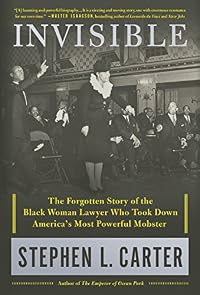
Invisible: The Forgotten Story of the Black Woman Lawyer Who Took Down America's Most Powerful Mobster
by Stephen L. Carter
On This Page
Description
"She was brilliant, ambitious, and unafraid to break barriers. As the only member of a squad of twenty high-powered lawyers who was not a white male, she devised the strategy that in the 1930s sent Mafia chieftain Lucky Luciano to prison. She achieved so much--but what could she have accomplished if not for barriers of race and gender?..."--back cover. "She was black and a woman and a prosecutor, a graduate of Smith College and the granddaughter of slaves, as dazzlingly unlikely a show more combination as one could imagine in the New York of the 1930s--and without the strategy she devised, Lucky Luciano, the most powerful Mafia boss in history, would never have been convicted. When special prosecutor Thomas E. Dewey selected twenty lawyers to help him clean up the city's underworld, she was the only member of his team who was not a white male. Eunice Hunton Carter, Stephen Carter's grandmother, was raised in a world of stultifying expectations about race and gender, yet by the 1940s her professional and political successes had made her one of the most famous black women in America. But her triumphs were shadowed by prejudice and tragedy. Greatly complicating her rise was her difficult relationship with her younger brother, Alphaeus, an avowed Communist who--together with his friend Dashiell Hammett--would go to prison during the McCarthy era. Yet she remained unbowed. Moving, haunting, and as fast paced as a novel, [this book] tells the true story of a woman who often found her path blocked by the social and political expectations of her time. But Eunice Carter never accepted defeat, and thanks to her grandson's remarkable book, her long-forgotten story is once again visible."--Dust jacket. show lessTags
Recommendations




Member Reviews
Stellar storytelling, stellar research, stellar writing.
A couple of notes:
-I really appreciated how Carter embraces the unknown. He makes assumptions but is careful to examine ALL the possibilities. And when there are gaps in his knowledge, due to lack of sources, etc., he is quick to admit that they are there. This creates trust between him and the reader.
-Similarly, he is quick to point out perceived disconnects between beliefs and behavior. Again, creating trust in him as a reliable researcher and narrator.
-Why wasn't Addie Hunton in my MA reading list? Unfortunately, I know why. A terrible byproduct of racism is the elimination of important and valuable voices. Her lectures would have been incredibly useful for my thesis. These show more are writers and speakers that need to be brought back into the "canon." *
- This opens up the reader's eyes to historical, turn-of-the-prior-century racism. Even in the North. The "Harlem Rennaisance" needs to be taught differently. Unfortunately, in many classes and books, it's often the token nod to a hugely influential part of our history.
- It also illustrates how things have changed with technology. It really used to be all about people. Real people who traveled and spoke and worked together. Now... technology has almost erased the need for crusaders like Addie. And that is a huge tragedy.
-I'm not sure if he meant to do this, but I found tracking political parties and their values invariably fascinating. Values in those parties seem to fluctuate and change through time, as much as party fanatics might claim otherwise.
Finally, Carter's summation is a wonderful tribute to his grandmother and those of her generation and the following generations that fought and still fight racism. "The wall is weakening."
Let's help it come down.
*Note-- I feel like it's exclusion was not purposeful on everybody's part. The issue is that the first generation deemed those lectures to be useless and, therefore, they were forgotten by many and not taught to the succeeding generation of educators. However, this is still an issue. Academia owes it to itself to research those that may have been excluded and insert them back into the canon. show less
A couple of notes:
-I really appreciated how Carter embraces the unknown. He makes assumptions but is careful to examine ALL the possibilities. And when there are gaps in his knowledge, due to lack of sources, etc., he is quick to admit that they are there. This creates trust between him and the reader.
-Similarly, he is quick to point out perceived disconnects between beliefs and behavior. Again, creating trust in him as a reliable researcher and narrator.
-Why wasn't Addie Hunton in my MA reading list? Unfortunately, I know why. A terrible byproduct of racism is the elimination of important and valuable voices. Her lectures would have been incredibly useful for my thesis. These show more are writers and speakers that need to be brought back into the "canon." *
- This opens up the reader's eyes to historical, turn-of-the-prior-century racism. Even in the North. The "Harlem Rennaisance" needs to be taught differently. Unfortunately, in many classes and books, it's often the token nod to a hugely influential part of our history.
- It also illustrates how things have changed with technology. It really used to be all about people. Real people who traveled and spoke and worked together. Now... technology has almost erased the need for crusaders like Addie. And that is a huge tragedy.
-I'm not sure if he meant to do this, but I found tracking political parties and their values invariably fascinating. Values in those parties seem to fluctuate and change through time, as much as party fanatics might claim otherwise.
Finally, Carter's summation is a wonderful tribute to his grandmother and those of her generation and the following generations that fought and still fight racism. "The wall is weakening."
Let's help it come down.
*Note-- I feel like it's exclusion was not purposeful on everybody's part. The issue is that the first generation deemed those lectures to be useless and, therefore, they were forgotten by many and not taught to the succeeding generation of educators. However, this is still an issue. Academia owes it to itself to research those that may have been excluded and insert them back into the canon. show less
I, for one, did not know that Lucky Luciano was taken down by an African American woman prosecutor in the 30s. Amazingly enough, this is only a tiny part of the story of Eunice Hunton Carter (the grandmother of the author), a remarkable woman, who should have had a more brilliant career than she did, being constantly passed over for higher positions because of her sex and race. The life of EHC is fully embedded in the activism of her parents (her mother toured the segregated and lynching South, on her own, to organize African Americans, her father was an officer in the WMCA), the Harlem Renaissance, luminaries such as W.E.B. Dubois, Thurgood Marshall, and the rest of the African American cultural elite. EHC both resented and had to show more submit to the demands of institutional racism and sexism, but also the demands the Harlem's Great Social Pyramid ruled by the Czarinas.
The book starts with the Atlanta riots of 1906 (her family lived there at the time) all the way to the McCarthy era (her brother was a communist who ended up leaving the US and joining Dubois in Ghana, and then settling in Zambia). EHC had judicial and political ambitions tied to Thomas Dewey and the GOP, squashed on both counts (and also because the FBI, under Hoover, had listed her brother as one to arrest in case of national emergency and had a 700-page file on), later reinventing herself as an internationalist after the creation of the UN (she did not like FDR but stroke a friendship with Eleanor Roosevelt). As successful as she was, there is no question that systemic and personal elements outside of her control (racism, sexism, red scare) thwarted what should have been an even more major career than she had. show less
The book starts with the Atlanta riots of 1906 (her family lived there at the time) all the way to the McCarthy era (her brother was a communist who ended up leaving the US and joining Dubois in Ghana, and then settling in Zambia). EHC had judicial and political ambitions tied to Thomas Dewey and the GOP, squashed on both counts (and also because the FBI, under Hoover, had listed her brother as one to arrest in case of national emergency and had a 700-page file on), later reinventing herself as an internationalist after the creation of the UN (she did not like FDR but stroke a friendship with Eleanor Roosevelt). As successful as she was, there is no question that systemic and personal elements outside of her control (racism, sexism, red scare) thwarted what should have been an even more major career than she had. show less
Eunice Hunton Carter was a towering figure of American history whose many accomplishments have been forgotten or never given their true due because she was a Black woman. Carter became a lawyer in the 1930s and ended up working with Thomas Dewey as he prosecuted gangsters in New York City, and moved on to become one of the most known Black Americans in the 1940s as she worked tirelessly for equality and recognition. Her grandson’s biography, Invisible, tells her story with a solid base of primary sources and a passable effort at unbias reporting. Invisible is an excellent nonfiction book for history buffs looking for an unlikely but true tale of Black perseverance in the 1930s through the 1950s.
From the prologue: ”In the fall of 2014, two episodes o HBO's 'Boardwalk Empire', which is set during and just after Prohibition, featured a black female lawyer who worked for the New York district attorney. The role was small. She had perhaps two lines, Still, viewers were incredulous. Online comment threads swiftly filled with mockery: Ridiculous. Anachronistic. One post after another insisted that there weren't ablack lawyers back then – not black women lawyers, anyway. And certainly there were no black female prosecutors. The casting, the skeptics insisted, was just another example of Hollywood political correctness run amok.
'But they were wrong. My Nana Eunice was real and really did prosecute mobsters … and lived a show more remarkable life ...” p. xvii
This is a story that shouldn't be lost to history. Author Stephen L. Carter's grandmother was an amazing woman, becoming the first black woman prosecuting attorney for New York in the 1930's. Later she was an advocate on the national and international stage.
Unfortunately, due to the times she did not accomplish her dream of becoming New York's first black woman judge. She was a staunch Republican and backed the 'wrong horse', her boss Thomas E Dewey in the Presidential elections against Franklin D. Roosevelt. In addition, her brother was an ardent communist in an era when J Edgar Hoover and Joseph McCarthy blackballed family members for their association.
Stymied on the national stage, Ms Carter turned to international projects.
It's a fascinating story and well researched, but a little dry.
I see it as a great addition to Black history, in a time when many can only offer a very small handful of names of early black activists and pioneers in their field.
I do believe the publisher has sadly misrepresented this book by giving it the subtitle “The Forgotten Story of the Black Woman Lawyer Who Took Down America's Most Powerful Mobster.” Yes, she did this, but it's only a very small part of her story. Readers believing this book focuses on the 'true crime' aspect may be disappointed. show less
'But they were wrong. My Nana Eunice was real and really did prosecute mobsters … and lived a show more remarkable life ...” p. xvii
This is a story that shouldn't be lost to history. Author Stephen L. Carter's grandmother was an amazing woman, becoming the first black woman prosecuting attorney for New York in the 1930's. Later she was an advocate on the national and international stage.
Unfortunately, due to the times she did not accomplish her dream of becoming New York's first black woman judge. She was a staunch Republican and backed the 'wrong horse', her boss Thomas E Dewey in the Presidential elections against Franklin D. Roosevelt. In addition, her brother was an ardent communist in an era when J Edgar Hoover and Joseph McCarthy blackballed family members for their association.
Stymied on the national stage, Ms Carter turned to international projects.
It's a fascinating story and well researched, but a little dry.
I see it as a great addition to Black history, in a time when many can only offer a very small handful of names of early black activists and pioneers in their field.
I do believe the publisher has sadly misrepresented this book by giving it the subtitle “The Forgotten Story of the Black Woman Lawyer Who Took Down America's Most Powerful Mobster.” Yes, she did this, but it's only a very small part of her story. Readers believing this book focuses on the 'true crime' aspect may be disappointed. show less
 This review was written for LibraryThing Early Reviewers.
Having been a fan of Carter’s novels for a dozen years or so, I was quite excited to read this even though at the time I chose it I didn’t know it was about his grandmother. When I realized that my expectations shifted; I anticipated something more personal, but what I got was distance, as if he wasn’t related to Eunice at all. All through the book I wondered if family strife kept him from having a relationship with her, but no, he met her. At the very end he shares his regret that he didn’t get to know her better when he had the chance.
It might have been to keep a neutral voice or to keep from judging her decisions and actions by the light of today, or just to guard against sentimentality, but whatever it was it made for a show more more clinical “just the facts” sort of book, even though many of those facts don’t seem to come straight from Eunice. For a woman so driven, so educated, so lauded you would think there would be more of a paper trail. Alas, there are no letters, minutes, memoranda, journals or even legal briefs to be found. That kept me at a remove from her, as maybe she would have liked, but I would have liked Carter to personalize this more - to inject his memories and memorabilia into things to give it some heart. She was in many respects a remarkable woman - for her time, for our time, for any time. Her story was informative and interesting, but took some willpower to get through. show less
It might have been to keep a neutral voice or to keep from judging her decisions and actions by the light of today, or just to guard against sentimentality, but whatever it was it made for a show more more clinical “just the facts” sort of book, even though many of those facts don’t seem to come straight from Eunice. For a woman so driven, so educated, so lauded you would think there would be more of a paper trail. Alas, there are no letters, minutes, memoranda, journals or even legal briefs to be found. That kept me at a remove from her, as maybe she would have liked, but I would have liked Carter to personalize this more - to inject his memories and memorabilia into things to give it some heart. She was in many respects a remarkable woman - for her time, for our time, for any time. Her story was informative and interesting, but took some willpower to get through. show less
This review was written for LibraryThing Early Reviewers.Brilliant and ambitious, Eunice Hunton Carter was the only woman lawyer, and a colored one at that, among nineteen white males hired by Thomas E. Dewey to create a legal squad to take down the mob. It was Eunice listening to citizens' complaints about prostitution; untouchable madams and invulnerable brothels whose girls always went free. She dug through records that had been compiled by the Committee of Fourteen pertaining to New York City's vice and discovered a pattern. Trying to get Dewey or any of her male counterparts to listen to her was another story. She persisted and succeeded in persuading in Murray Gurfein and Thomas Dewey that the prostitution was being organized on a higher level by the mob. Eunice organized raids where show more the police quietly arrested bookers and fixers so that when the brothels were raided the madams and their girls would have no one to spring them. Despite her brilliance Eunice was thwarted in her quest to become a judge and while she often appeared in newspapers she didn't want become another Harlem"sassiety" Czarina trying to maintain her spot on The Great Social Pyramid. She would blame her lack of advancement on her brother's scandalous behavior and communist activities which led to his imprisonment. His name was linked to hers whenever his was in the news. A very interesting book show less
This review was written for LibraryThing Early Reviewers.Stephen Carter, whose novels I hope to read, gives us this biography of his grandmother, Eunice Hunton Carter, an attorney and a black woman taking on the Mafia and standing strong in the face of racism, corruption and social expectations. He has meticulously researched and documented this life story, and at times he gives us just too many details. Nonetheless, this is an amazing story of a person who, born into a family of prestige and note within the community of color, still faced what would seem to be insurmountable odds. The author spends as much, perhaps even more, time on Eunice's family life and personal relations that on her stellar career. This is understandable, as he is a member of her family - her grandson. There is love, show more family pride, tragedy, all the things that happen in life, and throughout the book one is impressed by Eunice's determination, brilliance and endurance. A very worthwhile read. show less
This review was written for LibraryThing Early Reviewers.Members
- Recently Added By
Lists

Books Read in 2018
4,360 works; 110 members

BLM
210 works; 1 member

Best Biographies of Notable Women
277 works; 101 members
Author Information

22+ Works 6,817 Members
Stephen L. Carter was born in Washington, D.C. on October 26, 1954. He received a bachelor's degree in history from Stanford University in 1976 and a law degree from Yale University in 1979. After graduation, he served as a law clerk for Judge Spottswood W. Robinson, III, of the United States Court of Appeals for the District of Columbia Circuit, show more and for Supreme Court Justice Thurgood Marshall. In 1982, he joined the Yale University faculty and is currently the William Nelson Cromwell Professor of Law. He is the author of numerous non-fiction works including Reflections of an Affirmative Action Baby (1991); The Culture of Disbelief: How American Law and Politics Trivialize Religious Devotion (1993); The Confirmation Mess: Cleaning Up the Federal Appointments Process (1994); Integrity (1996); The Dissent of the Governed: A Meditation on Law, Religion, and Loyalty (1998); Civility: Manners, Morals, and the Etiquette of Democracy (1998); and God's Name in Vain: The Wrongs and Rights of Religion in Politics (2000). He has also written several fiction works including The Emperor of Ocean Park and Jericho's Fall. He was the first non-theologian to receive the prestigious Louisville-Grawemeyer Award in religion. (Bowker Author Biography) show less
Awards and Honors
Common Knowledge
- Canonical title
- Invisible: The Forgotten Story of the Black Woman Lawyer Who Took Down America's Most Powerful Mobster
- Original publication date
- 2018-10-09
- People/Characters
- Lucky Luciano; Eunice Hunton Carter
- Important places
- Harlem, New York, New York, USA
- Epigraph
- They wove a spell and took possession of one, yet all
the while one was conscious of a certain familiarity.
Eunice Roberta Hunton, "Replica" (1924) - Dedication
- To Leah Christina Aird Carter,
without whose dedication, imagination,
research, travel, interviews, love for the subject,
and keen editorial advice he project would
have been impossible.
This book is he... (show all)rs as well as mine. - First words
- Atlanta was burning.
- Last words
- (Click to show. Warning: May contain spoilers.)In the end, however, the logic of justice and the demands for freedom will overwhelm it.
- Blurbers
- Isaacson, Walter; Williams, Juan; Gordon-Reed, Annette
Classifications
Statistics
- Members
- 282
- Popularity
- 113,735
- Reviews
- 23
- Rating
- (3.63)
- Languages
- English, Italian
- Media
- Paper, Audiobook, Ebook
- ISBNs
- 10
- ASINs
- 2