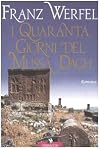
The Forty Days of Musa Dagh
by Franz Werfel
On This Page
Description
The internationally acclaimed novel based on the heroic resistance during the Armenian genocide of 1915. This is the story of how the people of several Armenian villages in the mountains along the coast of present-day Turkey and Syria chose not to obey the Turkish government's deportation order. Instead, they fortified a plateau on the slopes of Musa Dagh-Mount Moses-and repelled Turkish soldiers and military police during the summer of 1915 while hoping for the Allies to save them ... show more Translator James Reidel and scholar Violet Lutz have revised and expanded the original English translation by Geoffrey Dunlop. The Dunlop translation, had excised approximately 25% of the original text to accommodate the Book-of-the-Month club and to streamline the novel for film adaptation. The restoration of these passages and their new translation provide a fuller picture of the characters' lives, especially the hero Gabriel Bagradian, his wife Juliette, their son Stephan, and Iskuhi Tomasian. What is more apparent now is the personal story that Werfel tells, informed by events and people in his own life, in which the author, his wife Alma, his stepdaughter Manon Gropius, and others in his circle are reinvented. Reidel has also revised the existing translation to free Werfel's stronger usages from Dunlop's softening of meaning, his effective censoring of the novel in order to fit the mores and commercial contingencies of the mid-1930s. show lessTags
Recommendations






















Member Reviews
Le tre stelle si devono tutte alla scelta dell'argomento, in quanto se l'autore non avesse scelto di scrivere su una tematica delicata e sconosciuta come il genocidio armeno avrei dato ancora meno. Il tema appunto è veramente interessante, tra l'altro Werfel è un ebreo boemo che, dopo aver scritto questo libro, ebbe chiaro che le persecuzioni avrebbero investito anche gli ebrei europei e riuscì a salvarsi trasferendosi per tempo negli Usa. A scusante dell'autore faccio presente che il romanzo risale appunto al 1933, per cui alcuni difetti sono ovvi. L'ho trovato molto prolisso, lento all'inverosimile, con una quasi maniacalità di ricostruzione del contesto psicologico dei singoli personaggi, anche di quelli secondari, mentre da un show more romanzo storico con gesta guerresche io mi aspettavo un maggior movimento. In questo aspetto dell'approfondimento psicologico devo dire che è un romanzo veramente corale. Ma appunto per questo la storia principale si perde in mille rivoli, i capitoli sono lunghissimi, il punto di vista cambia continuamente. Inoltre, l'autore si pone come narratore onnisciente, ma con una presenza cupa, con un pessimismo cosmico, per così dire, e con il brutto vizio di preannunciare le sciagure future anche nei capitoli precedenti. Non che le descrizioni siano campate in aria, tutt'altro: magistrale la resa psicologica del popolo di cinquemila anime, costretto sulla montagna, e preda a volte di furie incontrollate che solo la figura venerata del sacerdote riesce a placare e mai del tutto. Mi ha poi particolarmente infastidito la parte "francese", cioè i personaggi della moglie e del figlio del protagonista, che si sono attirati tutta la mia antipatia. E se per certi aspetti la psicologia femminile è ben delineata, il ruolo della moglie lo trovo veramente insulso e contraddittorio. Il finale... beh, salvifico? Mica tanto... Insomma, dovessi rileggerlo non rifarei la fatica. Però devo dire che mi ha aperto una pagina di storia che non conoscevo bene e che di sicuro approfondirò. Consigliato solo a chi si interessa particolarmente del tema armeno. Come romanzo c'è di meglio. show less
Upon my reading it as a teenager years ago, this novel held me spellbound; I had the same reaction upon this rereading, even with 800+ pages! This was my very first exposure to the fact of the Armenian Massacres of the 20th century. The story involves an Armenian, Gabriel Bagradian, who has returned to his family home in Syria from years of living in France, He is accompanied by his French wife, Juliette, and French-born son, Stephan. The devastating death marches of Armenians have begun. Gabriel leads the inhabitants of the seven villages in his area to Musa Dagh [Mount of Moses]; he is an Ottoman officer and has knowledge of military tactics. On Damyalik Plateau they set up a village under the leadership of some of the leading show more citizens. On the mountain, they for forty days carry out armed resistance against the Turks. Gabriel is their military commander and final word on other Council decisions lie with the Gregorian priest, Ter Haigasun. The book ends in a shattering climax. The last paragraph, and indeed the whole last chapter, left me breathless.
Translation was very readable, with excellent pacing. Not a word was wasted. Highly recommended show less
Translation was very readable, with excellent pacing. Not a word was wasted. Highly recommended show less
spledido romanzo epico. racconta come, durante lo sterminio degli armeni ad opera dei turchi, 5000 armeni si ribellarono e resistettero eroicamente allo sterminio, salvatisi così dalla deportazione. Un racconto epico ed eroico che ti tiene incollato al libro fino alla fine. Unico neo la traduzione a dir poco arcaica (un italiano desueto già all'epoca della traduzione), assurda; ma che non ti fa perdere la bellezza del romanzo
An epic tale of the brave individuals who opposed the Armenian extermination. An outstanding historical novel that recounts a significant event that all readers interested in European history ought to be aware of.
At over 800 pages, this is not an easy read. It details the relations of the Armenian Christians with the Turks who were now ruling them. They were removed to Musa Dagh (Mountain of Moses) where times were difficult. It details their resistance effort and struggle during this time. My favorite portions were the portions concerning their faith and the portions that related to everyday living. The author made some wonderful descriptions of such things as food and other cultural elements. My unfamiliarity with some of the names made it difficult to read and keep characters straight in my mind as I was reading. I wish I'd spotted the list of characters and the glossary of Armenian and Turkish terms at the end of the novel prior to reading show more it in its entirety. Perhaps these should have been located in the front of the book! show less
In 1915, the Young Turk regime ordered the Armenian population to be removed into the Syrian desert. At the base of Musa Dagh ("Musa Ler"/ Armenian, or Mountain of Moses) which looms over the Mediterranean Sea south of Alexandretta (today, Iskenderun), west of ancient Antioch, were six Armenian villages. These inhabitants recognized that the evacuation order was a fraud and a death sentence. For fifty three days hidden in mountain retreats, four thousand villagers, with no heavy weapons and only a few rifles, resisted a large Turkish army.
As a French warship patrolling the coast passed by, the Armenians caught its attention with large banners, and as it slowed, young men swam out to board it and explain their situation. Eventually, show more five Allied ships transported all 4000 men, women and children, to Port Said in Egypt. This is the only rescue, the only instance of genocide averted by the Western Allies, during the Ottoman decimation of the communities.
The story inspired the Austrian writer, Franz Werfel, to write this novel, published in 1933. It became a best-seller, even though in this same year, Werfel had to flee from Austria as the Nazis seized power. show less
As a French warship patrolling the coast passed by, the Armenians caught its attention with large banners, and as it slowed, young men swam out to board it and explain their situation. Eventually, show more five Allied ships transported all 4000 men, women and children, to Port Said in Egypt. This is the only rescue, the only instance of genocide averted by the Western Allies, during the Ottoman decimation of the communities.
The story inspired the Austrian writer, Franz Werfel, to write this novel, published in 1933. It became a best-seller, even though in this same year, Werfel had to flee from Austria as the Nazis seized power. show less
This is a detailed narrative of Armenian history under the Turks. It includes the complex feelings and reactions of Armenia, Turkish, and French participants in this troubled history and the violence that pervaded these relationships.
Members
- Recently Added By
Lists

Best Historical Fiction
620 works; 259 members

Lamont's Hundred Best Novels (1947)
100 works; 4 members

Books Read in 2017
4,249 works; 130 members

For Further Reading: A List of 160 Novels from 15 Literatures
160 works; 4 members

Best Books of 1926-1935
403 works; 10 members

Caucasus
122 works; 2 members

Publisher's Weekly Bestsellers Part I - 1895-1939
399 works; 8 members

Authors mentioned in The World of Yesterday
68 works; 1 member

Liste Otto
107 works; 1 member
Author Information

Born in Prague of Jewish parents, Werfel served in World War I, then lived and wrote in Vienna until driven out by the Nazi occupation of Austria. And the Bridge Was Love: Memories of a Lifetime, by his wife, Alma Werfel, in collaboration with E. B. Ashton, is a deeply personal autobiography of a remarkable life in Vienna by the woman who was also show more married to the composer-conductor Mahler and the architect Gropius. Werfel escaped to the United States after the fall of France in 1940, where he won international recognition for his fiction. The most popular of Werfel's works was the novel The Song of Bernadette (1942), recounting the miraculous vision of the Virgin Mary granted to the young girl who founded Lourdes. Werfel said he wrote the story in honor of his "miraculous" escape from the Nazis but neither affirmed nor denied the miracle at Lourdes. Werfel also wrote lyrical poetry and drama. His comedy Jacobowsky and the Colonel (1944) was successfully produced in New York in 1944. In 1967 the Hamburg Opera presented Giselher Klebe's operatic version of the play at the Metropolitan Opera House in New York. (Bowker Author Biography) show less
Some Editions
Awards and Honors
Awards
Distinctions
Notable Lists
Series
Belongs to Publisher Series
Work Relationships
Is contained in
Contains
Has the adaptation
Common Knowledge
- Canonical title*
- Die vierzig Tage des Musa Dagh
- Original title
- Die vierzig Tage des Musa Dagh
- Original publication date
- 1933
- People/Characters
- Gabriel Bagradian, Armenian lieutenant in the Ottoman Army.; Juliette Bagradian, French wife; Aram Tomasian, Christian Pastor; Ter-Haigasun, Christian Priest; Bedros Altouni, physician; Johannes Lepsius, German pastor (show all 8); Gonzague Maris, Greek American visitor; Agha Rifaat Bereket, Islamic Turk, advisor to Gabriel
- Important places
- Prague, Czech Republic; Vienna, Austria; Austro-Hungarian Empire
- Important events*
- Völkermord an den Armeniern
- Related movies
- 40 Days of Musa Dagh (1982 | IMDb)
- Epigraph*
- "Wie lange noch, o Herr, Du Heiliger und Wahrhaftiger, richtest Du nicht und rächest unser Blut an den Bewohnern der Erde?"
Offenbarung Johannis 6, 10 - First words*
- "Wie komme ich hierher?"
- Last words*
- (Click to show. Warning: May contain spoilers.)Und das Kreuz des Sohnes lag auf seinem Herzen.
- Blurbers
- Saroyan, William
- Original language*
- Deutsch
- Disambiguation notice
- The villagers in fact held out for 53 days. Werfel apparently titled the book novel for the Biblical associations invoked by "40": the duration of The Flood, Moses' retreat on Mount Sinai, etc. The character of Gabriel was in... (show all)spired by the town's actual leader, Moses Der-Kaloustian; the Chaush Nurhan hero, by Esayi Yacoubian.
*Some information comes from Common Knowledge in other languages. Click "Edit" for more information.
Classifications
- Genres
- General Fiction, Fiction and Literature, Historical Fiction
- DDC/MDS
- 843.914 — Literature & rhetoric French Literature French fiction 1900- 20th Century 1945-1999
- LCC
- PT2647 .E77 .V525 — Language and Literature German, Dutch and Scandinavian literatures German literature Individual authors or works 1860/70-1960
- BISAC
Statistics
- Members
- 784
- Popularity
- 35,603
- Reviews
- 17
- Rating
- (4.33)
- Languages
- 17 — Catalan, Czech, Danish, Dutch, English, French, German, Hebrew, Hungarian, Italian, Norwegian (Bokmål), Norwegian, Polish, Russian, Slovenian, Spanish, Turkish
- Media
- Paper, Audiobook, Ebook
- ISBNs
- 49
- ASINs
- 42