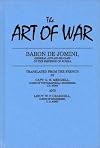
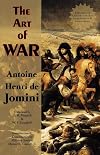
The Art of War
by Antoine Henri De Jomini
On This Page
Description
Antoine-Henri Jomini was the most celebrated writer on the Napoleonic art of war. Jomini was present at most of the most important battles of the Napoleonic Wars. His writing, therefore, is the most authoritative on the subject. "The art of war, as generally considered, consists of five purely military branches,-viz.: Strategy, Grand Tactics, Logistics, Engineering, and Tactics. A sixth and essential branch, hitherto unrecognized, might be termed Diplomacy in its relation to War. Although show more this branch is more naturally and intimately connected with the profession of a statesman than with that of a soldier, it cannot be denied that, if it be useless to a subordinate general, it is indispensable to every general commanding an army." -Antoine-Henri Jomini show lessTags
Recommendations
























Member Reviews
Much underrated today, this Swiss-French military theorist once rivalled & eclipsed Prussia's great Clausewitz. While the latter is infinitely thorough, but antisystematic, Jomini's approach is rationalist, spatial, aiming at economy & elegance. His central ideas:
1) The basic, presumably eternal principle of successful warfare is to concentrate as much force as possible in attacks on key enemy vulnerabilities.
2) Obvious, but easier said than done? The rest of Jomini's work is about precisely how this violent effect may be achieved. But an essential simplifying device is that the enemy will always, in some form or other, present a front line - with its left, right, & centre. The task for the strategist or grand tactician may thus, almost show more invariably, be boiled down to analyses of whether to concentrate attack on the enemy's centre or on either of his 2 extremities.
With this spare, almost skeletal main apparatus, Jomini works wonders at clarifying the complexity of war & strategy. Time & again, he insists that such simplifying principles do not stand alone as determinants of success. They are more necessary than sufficient - a resource for the already accomplished commander & his forces (but may still, on occasion, prove enough on their own to give one side a decisive edge).
Jomini remains a luminous supplement & corrective to modern military theory's fixation on the "chaos" & "unpredictability" of war. Yet this chaos is a reality too. The very flawlessness of Jomini's abstractions are what makes it perilous, even suicidal, to study him in isolation.
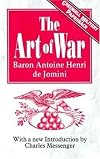
(This paperback edition comprises only Parts I-III of the 1838 original, but features a conscientious modern introduction on the history, reception, & posterior influence of Jomini's work.) show less
1) The basic, presumably eternal principle of successful warfare is to concentrate as much force as possible in attacks on key enemy vulnerabilities.
2) Obvious, but easier said than done? The rest of Jomini's work is about precisely how this violent effect may be achieved. But an essential simplifying device is that the enemy will always, in some form or other, present a front line - with its left, right, & centre. The task for the strategist or grand tactician may thus, almost show more invariably, be boiled down to analyses of whether to concentrate attack on the enemy's centre or on either of his 2 extremities.
With this spare, almost skeletal main apparatus, Jomini works wonders at clarifying the complexity of war & strategy. Time & again, he insists that such simplifying principles do not stand alone as determinants of success. They are more necessary than sufficient - a resource for the already accomplished commander & his forces (but may still, on occasion, prove enough on their own to give one side a decisive edge).
Jomini remains a luminous supplement & corrective to modern military theory's fixation on the "chaos" & "unpredictability" of war. Yet this chaos is a reality too. The very flawlessness of Jomini's abstractions are what makes it perilous, even suicidal, to study him in isolation.
(This paperback edition comprises only Parts I-III of the 1838 original, but features a conscientious modern introduction on the history, reception, & posterior influence of Jomini's work.) show less
Ratings
Members
- Recently Added By
Author Information

31+ Works 495 Members
All Editions
Work Relationships
Is contained in
Common Knowledge
- Canonical title
- The Art of War
- Original publication date
- 1838
- People/Characters
- Napoleon Bonaparte
- First words
- The art of war, as generally considered, consists of five purely military branches, - viz.: Strategy, Grand Tactics, Logistics, Engineering, and Tactics.
- Last words
- (Click to show. Warning: May contain spoilers.)The future will develop the plans of the allies; but the ultimate result of a struggle (if, indeed, one be attempted by the Mexicans) cannot be doubted, when three of the most powerful states of Europe are arrayed against the feeble and tottering republic of Mexico.
- Original language
- French
- Disambiguation notice
- Not to be confused with the ancient book of the same title that originated in Chinese, this book was from a 19th century French writer.
Classifications
Statistics
- Members
- 419
- Popularity
- 73,544
- Reviews
- 1
- Rating
- (3.98)
- Languages
- Chinese, English, French
- Media
- Paper, Ebook
- ISBNs
- 41
- ASINs
- 19