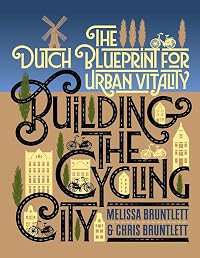
Building the Cycling City: The Dutch Blueprint for Urban Vitality
by Melissa Bruntlett
On This Page
Description
In car-clogged urban areas across the world, the humble bicycle is enjoying a second life as a legitimate form of transportation. City officials are rediscovering it as a multi-pronged (or -spoked) solution to acute, 21st-century problems, including affordability, obesity, congestion, climate change, inequity, and social isolation. As the world’s foremost cycling nation, the Netherlands is the only country where the number of bikes exceeds the number of people, primarily because the Dutch show more have built a cycling culture accessible to everyone, regardless of age, ability, or economic means.Chris and Melissa Bruntlett share the incredible success of the Netherlands through engaging interviews with local experts and stories of their own delightful experiences riding in five Dutch cities. Building the Cycling City examines the triumphs and challenges of the Dutch while also presenting stories of North American cities already implementing lessons from across the Atlantic. Discover how Dutch cities inspired Atlanta to look at its transit-bike connection in a new way and showed Seattle how to teach its residents to realize the freedom of biking, along with other encouraging examples.Tellingly, the Dutch have two words for people who ride bikes: wielrenner (“wheel runner”) and fietser (“cyclist”), the latter making up the vast majority of people pedaling on their streets, and representing a far more accessible, casual, and inclusive style of urban cycling—walking with wheels. Outside of their borders, a significant cultural shift is needed to seamlessly integrate the bicycle into everyday life and create a whole world of fietsers. The Dutch blueprint focuses on how people in a particular place want to move.The relatable success stories will leave readers inspired and ready to adopt and implement approaches to make their own cities better places to live, work, play, and—of course—cycle. show lessTags
Recommendations









Member Reviews
This book discusses success stories of building cycling infrastructure in several Dutch cities (Groningen, Utrecht, Rotterdam, Eindhoven, etc.), the history of urban planning in those cities over the last century, and how lessons learned in those cities can be and are being applied in North American cities to promote cycling and "human-scale design." This isn't a topic that I know much at all about, so I learned a lot from this book and am now really interested in what's going on in my city.
I listened to this audiobook on my bike commute, which was probably the ideal way to listen to this, and I found it really thought-provoking. A few things that I found especially interesting: the authors sing the praises of non-"traditional" bikes show more like electric-assisted bikes, cargo bikes, and upright bikes as a way to encourage biking among people of varied ages/abilities. I hadn't thought much about how useful these could be. The in-depth looks at the different Dutch cities were also really interesting. Most broadly, though, I found one of the main ideas, that the impressive bike infrastructure and system in the Netherlands isn't just a foregone conclusion/how things have always been, really compelling; though people in the Netherlands have ridden bikes for a long time, there have been active decisions within the last century regarding how traffic in cities is conceptualized and how the flow of traffic (of various kinds) is directed. There's a lot of optimism in this view, I think, regarding how these kinds of decisions could also be made elsewhere. show less
I listened to this audiobook on my bike commute, which was probably the ideal way to listen to this, and I found it really thought-provoking. A few things that I found especially interesting: the authors sing the praises of non-"traditional" bikes show more like electric-assisted bikes, cargo bikes, and upright bikes as a way to encourage biking among people of varied ages/abilities. I hadn't thought much about how useful these could be. The in-depth looks at the different Dutch cities were also really interesting. Most broadly, though, I found one of the main ideas, that the impressive bike infrastructure and system in the Netherlands isn't just a foregone conclusion/how things have always been, really compelling; though people in the Netherlands have ridden bikes for a long time, there have been active decisions within the last century regarding how traffic in cities is conceptualized and how the flow of traffic (of various kinds) is directed. There's a lot of optimism in this view, I think, regarding how these kinds of decisions could also be made elsewhere. show less
Although the focus was on cycling, it's message extends to say that we ought to look to the Netherlands to help us better interact and transport around our cities.
Each chapter contained a clear and reasoned argument, supplemented by interviews and historical stories, as to why the Netherlands ended up choose the bike or bike and train as their primary method of transportation and how they are better off for it.
I was accidentally given this book twice for Christmas due to it being the only thing on my wishlist, so now my only decision is who to donate to, my local councillor, or my local library.
Each chapter contained a clear and reasoned argument, supplemented by interviews and historical stories, as to why the Netherlands ended up choose the bike or bike and train as their primary method of transportation and how they are better off for it.
I was accidentally given this book twice for Christmas due to it being the only thing on my wishlist, so now my only decision is who to donate to, my local councillor, or my local library.
Ratings
Members
- Recently Added By
Lists

The War on Cars podcast
108 works; 1 member
Author Information
2 Works 72 Members
Common Knowledge
- Dedication
- To Coralie and Etienne
the best adventurers any parents could ask for.
You are our constant inspiration, and the reason we keep riding along on this crazy journey. - Publisher's editor
- Boyer, Heather
- Blurbers
- Montgomery, Charles; Kluit, Saskia; Toderian, Brent; Keesmaat, Jennifer
Classifications
- Genres
- Nonfiction, Sports and Leisure, General Nonfiction, Art & Design
- DDC/MDS
- 796.6 — Arts & recreation Recreation, sports, and performing arts Athletic and outdoor sports and games Cycling
- LCC
- TA1001 — Technology Engineering Civil engineering (General). Engineering (General). Civil engineering (General) Transportation engineering
- BISAC
Statistics
- Members
- 56
- Popularity
- 548,238
- Reviews
- 2
- Rating
- (4.40)
- Languages
- English
- Media
- Paper, Ebook
- ISBNs
- 4