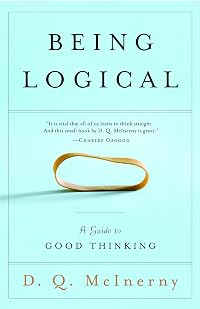
Being Logical: A Guide to Good Thinking
by D. Q. McInerny
On This Page
Description
Logic is synonymous with reason, judgment, sense, wisdom, and sanity. Being logical is the ability to create concise and reasoned arguments-arguments that build from given premises, using evidence, to a genuine conclusion. But mastering logical thinking also requires studying and understanding illogical thinking, both to sharpen one's own skills and to protect against incoherent, or deliberately misleading, reasoning. Elegant, pithy, and precise, Being Logical breaks logic down to its show more essentials through clear analysis, accessible examples, and focused insights. D. Q. McInerny covers the sources of illogical thinking, from naïve optimism to narrow-mindedness, before dissecting the various tactics-red herrings, diversions, and simplistic reasoning-the illogical use in place of effective reasoning. An indispensable guide to using logic to advantage in everyday life, this is a concise, accessible book. Written explicitly for the layperson, McInerny's Being Logical promises to take its place beside Strunk and White's The Elements of Style as a classic of lucid, invaluable advice. show lessTags
Recommendations





Member Reviews
This book would make an excellent textbook for any class on logic or critical thinking. It is very well set up, very informative, and never quite becomes 'boring' as these texts tend to. My reason for a lower rating is primarily due to the context in which I read it (writing a curriculum.) I read the book out of order and never quite gave it the chance it deserved.
This book, however, is excellent at teaching clear thinking, interesting, and perfect for any layperson wishing to glimpse the world of logicians without getting too technically involved.
This book, however, is excellent at teaching clear thinking, interesting, and perfect for any layperson wishing to glimpse the world of logicians without getting too technically involved.
This is a decent refresher on formal (and not so formal) logic, for anyone who took a logic class so many years ago. Or for those who didn't, it's a good introduction. It's modeled more or less on Strunk and White, so it's concise (maybe a bit too much), and it’s not very technical. It doesn't cover all the bases, e.g. there's nothing on truth trees, but it does a good job with the fundamentals, including the more common fallacies. Someone (maybe this author) said something to the effect that logic is the most neglected subject in US schools today and the most in need of being returned to a central place in the curriculum. If that’s not precisely true, it must be pretty close. Just look at what passes for political debate these show more days, and the fact that almost no one cares that candidates don’t actually use premises, don’t bother with valid arguments, don’t make rational connections, and draw conclusions that can’t possibly be supported. Sheesh .... Copies should be handed out with all birth certificates. show less
Enjoyable short discussion with the stated purposes of being The Elements of Style for logic.
Very topical in the time of wokeism and rejection of expertise. As the author implies, we all need to know how to reason.
Very topical in the time of wokeism and rejection of expertise. As the author implies, we all need to know how to reason.
An interesting little book on the subject of logic and clear thinking. An excellent introduction.
McInerny, D. Q.. Being Logical. Random House, New York, 2004. I quickly went into skim mode with this book. Extremely formal and concise -- Asking the Right Questions is a more accessible introduction to logic. I picked up a few formal insights: The real meaning & structure of a definition, and some formal requirements for a sound syllogistic argument. Otherwise, I'd skip this book unless you're taking a logic class or are preparing a detailed argument. Could be a useful reference, though.
A brief introduction to logic, presented without mathematics or formal apparatus. It is basically an exhortation to thinking clearly, based on the classical concept of logic from Aristotle. It had good summaries of logical fallacies.
A good book on improving how you process thoughts... ok, that sounds hokey, but it is a decent read.
Members
- Recently Added By
Author Information
17 Works 931 Members
Common Knowledge
- Original publication date
- 2004
- Dedication
- IN MEMORIAM
AUSTIN CLIFFORD MCINERNY
and
VIVIAN GERTRUDE RUSH MCINERNY
Classifications
Statistics
- Members
- 802
- Popularity
- 34,568
- Reviews
- 10
- Rating
- (3.65)
- Languages
- Chinese, English, French, Polish
- Media
- Paper, Audiobook, Ebook
- ISBNs
- 10
- ASINs
- 6