On This Page
Description
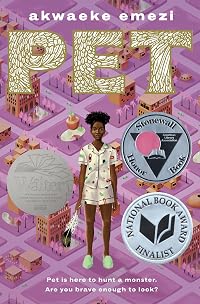
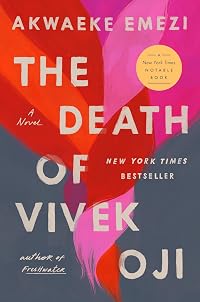
In a near-future society that claims to have gotten rid of all monstrous people, a creature emerges from a painting seventeen-year-old Jam's mother created, a hunter from another world seeking a real-life monster.Tags
Recommendations



Member Reviews
There are no monsters in Lucille, or at least that is what Jam has learned growing up. During the revolution angels removed the monsters in power, and changed Lucille’s laws and structures. Kids learned that angels changed the world and to be like the angels. But “forgetting is how the monsters come back.” Jam inadvertently brings to life her mother’s painting of a feathered goat-like creature, named Pet. Pet tells Jam it is there to hunt a monster, specifically one close to her best friend Redemption. Jam can’t imagine what monster that would be and is reluctant to let Redemption know what she’s learned, wishing the knowledge would just go away. But Pet warns her of the importance of seeing the unseen and Jam knows she must show more save Redemption. An allegory for our troubled times, reflecting our current monsters (ex. Larry Nasser, mass shooters, terrorists, Trump, white supremacists) and angels (ex. Greta Thurnburg, Emma Gonzales, Malala, #timesup, #metoo, #blacklivesmatter, Aly Raisman). Not for every young reader; I myself found Pet's Yoda-like riddle speech rather wearing and circular. show less
I don't usually go for fantasy novels, but this allegorical tale of Jam, a transgender teen girl and the creature, Pet, who pops out of a painting one day to warn Jam about monsters, is fantastic. You could also call this speculative fiction: the town Jam lives in, called Lucille, is supposedly a safe place purged of monsters. The adults all seem kind, loving, helpful. But someone is hiding behind a mask and Pet, who actually looks like a monster, has come to help Jam bring the real monster out in the open.
I would say this short novel is appropriate for grade 7 and above. The deeds of the monster are never actually named, just hinted at.
Jam herself is an unusual character: a transgender girl who is also selectively mute. Her parents show more teach her to sign and she communicates mostly by signing with people who have learned how to sign. One thing I wondered about was why she was mute? She was able to talk, which she calls voicing. But most of the time she doesn't choose to. I would have liked to know more about that. Perhaps it is just the author's way of showing how accepting and kind the town is, that everyone accepts not only Jam's transgender-ness, but the mutism as well.
There is also a polyamorous couple that includes one transgender person. show less
I would say this short novel is appropriate for grade 7 and above. The deeds of the monster are never actually named, just hinted at.
Jam herself is an unusual character: a transgender girl who is also selectively mute. Her parents show more teach her to sign and she communicates mostly by signing with people who have learned how to sign. One thing I wondered about was why she was mute? She was able to talk, which she calls voicing. But most of the time she doesn't choose to. I would have liked to know more about that. Perhaps it is just the author's way of showing how accepting and kind the town is, that everyone accepts not only Jam's transgender-ness, but the mutism as well.
There is also a polyamorous couple that includes one transgender person. show less
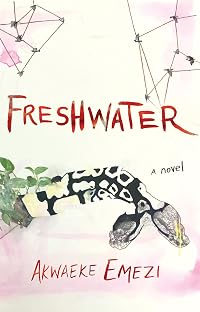
Boy, there’s a lot to like about this book. First of all, the protagonist, Jam, is a selectively mute trans girl who does not suffer for her gender. She’s loved! Her parents love her, her friends love her. That was so refreshing to read. Second, Akwaeke Emezi has a mind like no one else’s. I recently read their adult debut, Freshwater, and it was a wholly unique, memorable book. Pet is, too - you won’t find anything else like it on the YA landscape right now. I’m glad new authors with interesting stories to tell are breaking into this age group, because teens need to read about trans girls making friends with monsters to hunt down child abusers. That’s cool as hell. Pet itself is also very neat, and the way its true nature show more is revealed at the end of the book, tying together themes woven throughout the book... that was my favorite part, personally. It probably helps that I’m a huge sucker both for religious imagery used in unexpected ways and for bonds between kids and frightening fantasy creatures. The social commentary, too, is excellent. It’s something that isn’t often addressed in YA fiction: the importance of weeding out abusers even in “enlightened” circles, the way even good people can accidentally turn a blind eye in favor of peace of mind, the idea that having the right politics does not mean you can’t hurt the people around you.
The one problem I have - and unfortunately it’s a pretty big one - is that in between all this excellent stuff, the great protagonist and the message and the giant feathery beast and the effective ending, is... filler. The actual plot doesn’t amount to much, which isn’t necessarily a problem - I don’t mind a more cerebral, introspective book. It’s just that in the place of moving the plot forward is a lot of explaining and re-explaining. It was as if Emezi was worried that the reader wouldn’t understand why Jam was doing what she was doing or feeling what she was feeling, and often outlined things that just didn’t need to be outlined again: for example, they repeatedly, explicitly explained that other people could not see Pet unless it wanted them to. I did not need reminding of that; it was easy to understand in the first place, context made it easy to remember, and I just wanted to get on with the story. The narrative was also often less intense than it could have been. At one point Jam wonders to herself, “Had the plan worked already--so quickly?” The answer, we find out mere sentences later, is yes, it has. Her plan has gone off without a hitch. No hurdles. She even predicts the eventual blowup long before it happens - “She knew it would come back and blow up and be worse” - effectively ruining any tension the situation could have rendered. Stuff like that made the book less enjoyable than it could have been.
I still think the good makes up for the less-than-good, though, and I think people should read this one. It’s an interesting, unique fantasy read with a truly memorable protagonist, and it has some great things to say.
Thanks to NetGalley and the publisher for the review copy.
ETA Okay so I originally read a digital copy of this book but today I got my hands on a physical galley and um?? It’s the nicest galley I’ve ever seen??? The title is EMBOSSED????? Lord god how much money did y’all spend on these show less
The one problem I have - and unfortunately it’s a pretty big one - is that in between all this excellent stuff, the great protagonist and the message and the giant feathery beast and the effective ending, is... filler. The actual plot doesn’t amount to much, which isn’t necessarily a problem - I don’t mind a more cerebral, introspective book. It’s just that in the place of moving the plot forward is a lot of explaining and re-explaining. It was as if Emezi was worried that the reader wouldn’t understand why Jam was doing what she was doing or feeling what she was feeling, and often outlined things that just didn’t need to be outlined again: for example, they repeatedly, explicitly explained that other people could not see Pet unless it wanted them to. I did not need reminding of that; it was easy to understand in the first place, context made it easy to remember, and I just wanted to get on with the story. The narrative was also often less intense than it could have been. At one point Jam wonders to herself, “Had the plan worked already--so quickly?” The answer, we find out mere sentences later, is yes, it has. Her plan has gone off without a hitch. No hurdles. She even predicts the eventual blowup long before it happens - “She knew it would come back and blow up and be worse” - effectively ruining any tension the situation could have rendered. Stuff like that made the book less enjoyable than it could have been.
I still think the good makes up for the less-than-good, though, and I think people should read this one. It’s an interesting, unique fantasy read with a truly memorable protagonist, and it has some great things to say.
Thanks to NetGalley and the publisher for the review copy.
ETA Okay so I originally read a digital copy of this book but today I got my hands on a physical galley and um?? It’s the nicest galley I’ve ever seen??? The title is EMBOSSED????? Lord god how much money did y’all spend on these show less
I wanted to like this YA novel so much better than I did (especially since it features a trans girl but is not about being trans). It started out pretty wonderful, and I still think the premise and theme are pretty cool. The book is set in Lucille, a near-future city where all the monsters (that is, people who hurt other people, especially those who hurt others based on their race) are gone and the angels (leaders) who led the revolution are revered. But in a world with no monsters, who will recognize any new monsters who come among us?
Jam, the seventeen-year-old girl at the center of the story, lives a happy life with her parents and hanging out with her best friend Redemption. Until one day Pet, a monster (angel?) in one of her show more mother's paintings, steps out of the painting and tells Jam there is a monster (person) in her community who must be dealt with. Jam has to deal with deciding whether to believe Pet, what to tell Redemption (whose family Pet claims is harboring the monster Pet's after), and what to do with the monster she and Redemption find in his home. Okay, good stuff, with some compelling, if not *super* nuanced metaphors going on. But then it falls apart when the monster Pet is hunting is revealed.
It turns out that Redemption's unclehas been sexually abusing Redemption's younger brother. And that is for sure one of the most monstrous things that humans do to other humans. But the thing is, it *isn't* "monstrous," which isn't to say that it isn't horrific and appalling. Sexual abuse is *human*, in that it is a thing that humans do to humans. And the book just doesn't grapple enough with that for me. It calls what the uncle does "evil," and it *is*, but that doesn't make it not also *human.* When you set aside some human behavior as "monstrous," you fail to recognize that that monstrous behavior is part of humanity. This is fundamentally human evil, and I don't think Pet deals enough with the fact that the monsters in the book (all our monsters) are *us.* At least it didn't read as such to me. The uncle is tortured, and there's some talk of rehabilitation (for all the monsters), but *that* is what I really wanted to hear more about. What do you do when you find the monster (us)? How do you reconcile the fact that some people are monstrous, but still people? For a book that is so much about how we must look at what is evil in order to continue to *be able* to see what is evil, I was expecting more about what we do when we realize that what we see when we see evil is not some othered monster but the very humanity we're all a part of.
This won many awards, and I did so love the beginning. So I wonder if I missed something. It brings up such a tough, tough subject, one I think most of us do shy away from looking at because it is *so* awful, but then the treatment of that subject left me feeling unsatisfied with the book's whole treatment of human evil. show less
Jam, the seventeen-year-old girl at the center of the story, lives a happy life with her parents and hanging out with her best friend Redemption. Until one day Pet, a monster (angel?) in one of her show more mother's paintings, steps out of the painting and tells Jam there is a monster (person) in her community who must be dealt with. Jam has to deal with deciding whether to believe Pet, what to tell Redemption (whose family Pet claims is harboring the monster Pet's after), and what to do with the monster she and Redemption find in his home. Okay, good stuff, with some compelling, if not *super* nuanced metaphors going on. But then it falls apart when the monster Pet is hunting is revealed.
It turns out that Redemption's uncle
This won many awards, and I did so love the beginning. So I wonder if I missed something. It brings up such a tough, tough subject, one I think most of us do shy away from looking at because it is *so* awful, but then the treatment of that subject left me feeling unsatisfied with the book's whole treatment of human evil. show less
"Forgetting is how the monsters come back."
"Do not be afraid." Jam lives in Lucille, a town where angels have banished their monsters. Jam lives with her parents, Bitter and Aloe, and is best friends with a boy called Redemption. When Jam cuts herself on a piece of metal embedded in one of her mother's paintings, she brings it to life: a terrifying creature emerges and declares that there is a monster in Lucille after all - and it's in Redemption's house. Jam's parents tell her to send "Pet" back into the painting, and Jam lets them think she has, but in fact she asks Pet to stay and hunt the monster, telling Redemption about the hunt but not about the monster's location.
Quotes
[Bitter had taught Jam] that a lot of things were manageable show more as long as they were honest. (7)
Whenever [Jam] was really scared or freaking out, the same thing always happened: she began to dissociate, reality loosening around her like a hammock deconstructing itself, spilling her out into sands of nothingness. (45)
If she hadn't gone numb, then she might have been frightened, but nothing matters when it's not real. (46)
The first step to seeing is seeing that there are things you do not see. If you do not know there are things you do not see, then you will not see them because you do not expect them to be there. You think you see everything, so you think everything you see is all there is to be seen. (Pet to Jam, 71-72)
The truth does not care about what you want....A thing that is happening happens whether you look at it or not. (Pet to Jam, 95)
...everyone's always braver when they think they're the hero. (110)
How do we know we're going the right thing?
There is no right thing. There is only the thing that needs to be done. (Jam and Pet, 160)
"Your angels are monsters, your world is corrupt, and you want a chance?" (Pet to Jam, 185)
Is an angel not always a hunter, is a hunter not always an angel? As long as the target is a monster. (Pet to Jam, 202) show less
"Do not be afraid." Jam lives in Lucille, a town where angels have banished their monsters. Jam lives with her parents, Bitter and Aloe, and is best friends with a boy called Redemption. When Jam cuts herself on a piece of metal embedded in one of her mother's paintings, she brings it to life: a terrifying creature emerges and declares that there is a monster in Lucille after all - and it's in Redemption's house. Jam's parents tell her to send "Pet" back into the painting, and Jam lets them think she has, but in fact she asks Pet to stay and hunt the monster, telling Redemption about the hunt but not about the monster's location.
Quotes
[Bitter had taught Jam] that a lot of things were manageable show more as long as they were honest. (7)
Whenever [Jam] was really scared or freaking out, the same thing always happened: she began to dissociate, reality loosening around her like a hammock deconstructing itself, spilling her out into sands of nothingness. (45)
If she hadn't gone numb, then she might have been frightened, but nothing matters when it's not real. (46)
The first step to seeing is seeing that there are things you do not see. If you do not know there are things you do not see, then you will not see them because you do not expect them to be there. You think you see everything, so you think everything you see is all there is to be seen. (Pet to Jam, 71-72)
The truth does not care about what you want....A thing that is happening happens whether you look at it or not. (Pet to Jam, 95)
...everyone's always braver when they think they're the hero. (110)
How do we know we're going the right thing?
There is no right thing. There is only the thing that needs to be done. (Jam and Pet, 160)
"Your angels are monsters, your world is corrupt, and you want a chance?" (Pet to Jam, 185)
Is an angel not always a hunter, is a hunter not always an angel? As long as the target is a monster. (Pet to Jam, 202) show less
"There was a monster here---how was anything supposed to even seem safe again? Especially when none of them had any idea who the monster was. They were probably walking around in plain sight, hidden nicely by smiles and...optimism."
After the Sandy Hook shooting, I had a conversation with a neighbor about how I thought it was important to recognize that, while the shooter's actions were heinous, reprehensible, unforgivable, he's still a human being. We can debate how to deal with him, but by dismissing him as evil or somehow "other," we're ignoring the fact that people who do evil things are among us and of us. By disowning them, we risk disavowing our responsibility to prevent the crimes they might perpetrate.
My neighbor completely show more dismissed the idea, referring to the shooter as "an abomination."
In the past year or so, it has come out that at the time of this conversation and over the span of more than a decade, this neighbor perpetrated crimes against children, crimes detailed in part in newspaper articles that I cleared from my browser history so my children wouldn't stumble upon them (my spouse and I are talking to them about the situation, we just don't want them to see these articles without us there with them)
I wonder, does this neighbor apply his "abomination" worldview to himself? Or does he view himself as human but flawed? Moreover, how do I view him? I really don't know yet. I'm still working through the fact that this happened right across the street.
I think that part of the reason this novel resonated with me is that, like the characters in this novel, I'm feeling fearful, second-guessing my judgments about people, especially those who have access to my children. Like these characters, I feel an uncomfortable pull towards revenge even as I recognize that vengeance isn't the same as justice and that by mistaking the two, we risk becoming monstrous ourselves. What is the response that won't just remove one monster from the equation but will prevent others from springing up in their place?
Myth-like and a little reminiscent of Pan's Labyrinth, this novel hit me hard with the reality of how monsters and angels and justice and violence and utopia and dystopia are all jumbled together, how complacency hides monsters, and how we can miss seeing something even when we're looking for it. Emezi's characters are rich and flawed and passionate. As I'm reading, I want to know what happens to them, I'm rooting for them and confused with them and hoping they can sift through the many variations of "right."
How do we know we're doing the right thing? she asked.show less
There is no right thing, Pet replied. There is only the thing that needs to be done."
Jam lives in a city where, a generation ago, the "angels" (members of the community who fought for the greater good) called out and brought to justice all the "monsters" (billionaires who exploited their workers, murderers, rapists, corrupt politicians,...). Lucille is now a city free of monsters and free from the fear of them. Or so everyone thinks. But relaxing into the feeling of safety in such a utopia can be problematic, and Jam, who is just a kid, comes face to face with the reality of seeing what others do not see, and with hidden monsters.
Oooh, this is a good one, folks. A fantasy in which utopia and dystopia are on a sliding scale and you never really feel that you can get your footing, where monsters and angels are difficult show more to discern with your eyes, and it's all told in a beautifully strange way. I also love love love the wonderfully nonchalant way in which multiple characters represent various LGBTQ+ identities; they are intricate parts of the story, but their identities aren't the story itself. Highly recommended. show less
Oooh, this is a good one, folks. A fantasy in which utopia and dystopia are on a sliding scale and you never really feel that you can get your footing, where monsters and angels are difficult show more to discern with your eyes, and it's all told in a beautifully strange way. I also love love love the wonderfully nonchalant way in which multiple characters represent various LGBTQ+ identities; they are intricate parts of the story, but their identities aren't the story itself. Highly recommended. show less
Members
- Recently Added By
Lists

Trans Books by Trans Authors
134 works; 10 members

The 100 Best Fantasy Books of All Time
100 works; 15 members

LGBTQIA Horror
172 works; 7 members

Read This Twice's Best Horror Books
94 works; 2 members

Recommended Speculative Fiction by Women and People of Color
298 works; 45 members

Good LGBT fiction for LGBT folk and friends
551 works; 55 members

Black Authors
384 works; 32 members

School library books removed after TX state legislator inquiry
429 works; 6 members

SFF standalone novellas with female protagonists
101 works; 4 members

LGBTQ+ SFF standalone novellas
42 works; 2 members

2020 Ignyte Awards
15 works; 1 member

Books Read in 2020
4,379 works; 124 members

Books recommended by Calgary Public Library staff
1,588 works; 4 members
Author Information

13+ Works 6,535 Members
Some Editions
Awards and Honors
Awards
Distinctions
Notable Lists
Series

Common Knowledge
- Original publication date
- 2019-09-10
- People/Characters
- Jam; Bitter; Aloe; Pet; Redemption
- Important places
- Lucille (fictional place)
- Dedication
- To the magician,
the spells our stories make,
the ways we shape the world.
For Toyin Salau,
(August 17, 2000-June 2020)
You deserved a better world. - First words
- There shouldn't be any monsters left in Lucille.
- Last words
- (Click to show. Warning: May contain spoilers.)Good, Pet whispered, and this it was gone and Jam was alone with the house, with the whispers in the floorboards and her parents asleep in their room, one last tendril of smoke fading before her eyes.
- Publisher's editor
- Myers, Christopher
- Original language
- English
Classifications
- Genres
- LGBTQ+, Tween, Fiction and Literature, Teen, Fantasy
- DDC/MDS
- 823.92 — Literature & rhetoric English & Old English literatures English fiction 1900- 2000-
- LCC
- PZ7.1 .E474 .P — Language and Literature Fiction and juvenile belles lettres Fiction and juvenile belles lettres Juvenile belles lettres
- BISAC
Statistics
- Members
- 1,514
- Popularity
- 15,259
- Reviews
- 53
- Rating
- (4.06)
- Languages
- English, Portuguese, Swedish
- Media
- Paper, Audiobook, Ebook
- ISBNs
- 26
- ASINs
- 5